- Proven Programs in Literacy
- Proven Programs in STEM
- Proven Programs in Social Emotional Development
- Proven Programs in Classroom Management and Assessment
eBook - ePub
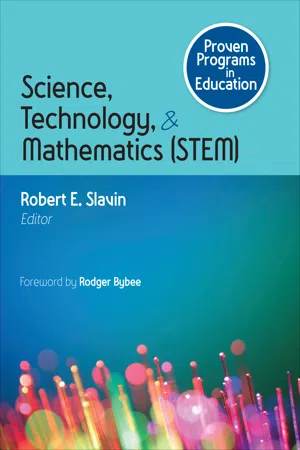
Proven Programs in Education: Science, Technology, and Mathematics (STEM)
- 136 pages
- English
- ePUB (mobile friendly)
- Available on iOS & Android
eBook - ePub
Proven Programs in Education: Science, Technology, and Mathematics (STEM)
About this book
Proven Programs in Education is a series of books that draws on the best of Better: Evidence-Based Education, a unique magazine that provides leadership teams in education with the information they need. The series includes four titles:
Information
1 What Works in Teaching Math
For better outcomes, focus on the classroom, not just the curriculum, writes Robert Slavin.
If students are to reach their full potential, they must be able to confidently compute and solve complex math problems. To ensure success in math for all children, educators need to know which programs and practices are effective. Which textbooks, computer programs, and professional development strategies increase math achievement?
We carried out a review of research on math programs in both elementary and middle/high schools. The aim was to place all types of programs on a common scale. In this way, we hoped to provide educators with meaningful, unbiased information that they can use to choose programs and practices. We examined the quantitative evidence on math programs to discover how much of a scientific basis there is for competing claims about their effects.
Our review threw some interesting light on the kinds of math reforms that are likely to improve the achievement of children in math.
Studies We Included
In order to be included in our review, studies had to meet a number of commonsense criteria:
- Students participating in a program had to be compared to children using ordinary methods.
- Students participating in a program had to be well matched to those using ordinary methods.
- Measures had to be fair to all groups (and not, for example, be a test inherent to the program).
- Programs had to be evaluated for at least twelve weeks—and preferably a year or more.
We considered studies carried out in all countries, but the results had to be available in English. The majority of studies were done in the United States. In total, nearly 200 studies met the inclusion criteria for the two reviews. They broke down into three broad areas—math curricula, computer-assisted instruction (CAI) approaches, and teaching strategies.
Math Curricula
A number of studies measured impact on achievement for various textbooks and curricular innovations. These fell into three categories:
- Innovative strategies that focus on problem solving, alternative solutions, and conceptual understanding
- Traditional commercial textbooks
- A back-to-basics textbook that emphasizes a step-by-step approach
There were thirteen studies of elementary curricula and forty of middle/high school curricula. There was very little evidence that it mattered which curriculum was used. None of them showed any strong evidence of effectiveness in comparison to the others. Although it might be suggested that the standardized tests used to measure performance would not detect some of the more sophisticated skills taught by some innovative curricula, there didn’t seem to be any evidence of this in the studies we looked at.
Computer-Assisted Instruction Approaches
In elementary schools, technology has typically been used as a supplement to classroom teaching—often used only a few times a week. These programs can help to identify children’s strengths and weaknesses and then give them self-instructional exercises designed to fill in gaps.
Across the thirty-eight elementary school studies that qualified for our review, we found that most studies found positive effects, and none significantly favored a control group. However, there was not enough high-quality evidence to recommend one program over another. We also found that the outcomes were stronger for computations than for concepts or problem solving. This is not surprising, as CAI particularly helps children with their computation skills. In middle/high schools, technology is used in three ways in the teaching of math:
- Supplemental programs, used to fill gaps in children’s knowledge
- Core programs, where the computer largely replaces the teacher
- Computer-managed learning systems that use a computer to assess students and provide teachers with feedback for use in lessons. In the forty qualifying studies that looked at these various programs, there was little evidence of effectiveness. No program stood out as having large and replicated effects.
Teaching Strategies
A number of studies have looked at the impact of using extensive professional development to help teachers use effective teaching strategies. These studies usually keep the textbooks, content, and objectives the same but change the teaching methods.
There were thirty-six qualifying studies of professional development strategies in elementary schools and twenty-two in middle/ high schools. Professional development programs had the strongest evidence of effectiveness. Cooperative learning was particularly strong. In cooperative learning, students work in pairs or small groups to help each other. This strategy increases learning if the groups have a common goal that they can only achieve if all group members do well on independent learning. In other words, students have to teach each other, because their own success depends on it.
In elementary schools, programs that focused on classroom management and motivation also had strong evidence of effectiveness.
Conclusion
There are a number of important conclusions to be taken from our reviews:
- There is no evidence that different curricula give different achievement outcomes. Clearly this has enormous implications for teaching and policy.
- There is also limited evidence that ordinary CAI improves math learning.
- Finally, there is strong evidence that using effective teaching strategies can make a real difference. Changing the way that children work together, and classroom management and motivation, can improve the math outcomes for all students.
The full reviews, together with educator’s summaries, can be found on the Best Evidence Encyclopedia (BEE) website: www.bestevidence.org.
About the Author
Robert Slavin is director of the Center for Research and Reform in Education at Johns Hopkins University and a professor in the Institute for Effective Education at the University of York in the United Kingdom. He is also chairman of the Success for All Foundation, a restructuring program that helps schools to identify and implement strategies to meet the needs of all learners.
References and Further Reading
, & (2008). Effective programs for elementary mathematics: A best evidence synthesis. Review of Educational Research, 78(3), 427–515.
, , & (2009). Effective programs in middle and high school mathematics: A best evidence synthesis. Review of Educational Research, 79(2), 839–911.
2 The Importance of the Early Years
Research provides findings—some surprising—about the importance of math for young children. Douglas Clements and Julie Sarama explore these and suggest ways to build up children’s mathematical concepts and skills.
Nearly a century ago two giants of psychology gave quite different impressions of the role of math in the lives and education of young children.
It seems probable that little is gained by using any of the child’s time for arithmetic before grade 2, though there are many arithmetic facts that he [sic] can learn in grade 1.—Edward L Thorndike, 1922
Children have their own preschool arithmetic, which only myopic psychologists could ignore.—Lev Vygotsky, 1935
Throughout history, views of the role mathematics should play in young children’s lives have differed widely. However, recent research has revealed striking findings of its importance and role in education.
Young Children Need to Learn Math
The early years are an especially important period for learning math. Children’s knowledge of math in the preschool and early elementary years predicts their mathematics achievement for years later—throughout their school career. Moreover, what they know in math also predicts their reading achievement later. Their early knowledge of literacy also predicts their later reading ability—but only reading ability. Given that early math predicts later math and reading, it appears that math is a core component of cognition. Learning math is therefore important. This is especially true for children from deprived communities, who often have not been provided with rich opportunities to build math ideas and skills.
Young Children Can Learn Challenging Math
Even infants can discriminate between groups of two objects and only one object. There is no age too young for mathematical thought. Older children often know more than curriculum developers or teachers believe. Even among those w...
Table of contents
- Cover
- Half Title
- Title Page
- Title Page
- Copyright Page
- Contents
- Foreword
- Introduction
- Preface
- About the Editor
- 1 What Works in Teaching Math
- 2 The Importance of the Early Years
- 3 Building Mathematics Skills
- 4 Which Instructional Methods Are Most Effective for Mathematics?
- 5 Understanding Mathematics Learning
- 6 Depth of Knowledge for Mathematics
- 7 Supporting Sensemaking Thinking Mathematically
- 8 Effectively Using Technology in Education
- 9 Embedded Multimedia: Trailing Edge Technology Cuts a New Path
- 10 Interactive Whiteboards and Classroom Interactions
- 11 Whiteboards Are for Learning
- 12 The Role of Technology in Science Assessments
- 13 Digital Storytelling: Reinventing How Learners Communicate
- 14 Blended Education for Elementary and Secondary Students
- 15 Online Social Networking for Learning
- 16 Transforming Education, One-to-One
- 17 Using Technology for Active Differentiation
- 18 Professional Development The Key to Integrating Technology
- 19 Using Cooperative Learning to Engage Students in Science
- 20 Teaching Practices That Matter in Middle School Science
- 21 How Science Teachers Use Research Evidence
- 22 Linking Textbooks to Science Learning
- 23 Diversity and Equity in Science Education
- 24 Learning to See Scientifically
- 25 Ideas About Designing Science Programs
- 26 Evidence-Based Policy Making Theory Into Practice
- Index
- Advertisement
Trusted by 375,005 students
Access to over 1.5 million titles for a fair monthly price.
Study more efficiently using our study tools.
Frequently asked questions
Yes, you can cancel anytime from the Subscription tab in your account settings on the Perlego website. Your subscription will stay active until the end of your current billing period. Learn how to cancel your subscription
No, books cannot be downloaded as external files, such as PDFs, for use outside of Perlego. However, you can download books within the Perlego app for offline reading on mobile or tablet. Learn how to download books offline
Perlego offers two plans: Essential and Complete
- Essential is ideal for learners and professionals who enjoy exploring a wide range of subjects. Access the Essential Library with 800,000+ trusted titles and best-sellers across business, personal growth, and the humanities. Includes unlimited reading time and Standard Read Aloud voice.
- Complete: Perfect for advanced learners and researchers needing full, unrestricted access. Unlock 1.5M+ books across hundreds of subjects, including academic and specialized titles. The Complete Plan also includes advanced features like Premium Read Aloud and Research Assistant.
We are an online textbook subscription service, where you can get access to an entire online library for less than the price of a single book per month. With over 1.5 million books across 990+ topics, we’ve got you covered! Learn about our mission
Look out for the read-aloud symbol on your next book to see if you can listen to it. The read-aloud tool reads text aloud for you, highlighting the text as it is being read. You can pause it, speed it up and slow it down. Learn more about Read Aloud
Yes! You can use the Perlego app on both iOS and Android devices to read anytime, anywhere — even offline. Perfect for commutes or when you’re on the go.
Please note we cannot support devices running on iOS 13 and Android 7 or earlier. Learn more about using the app
Please note we cannot support devices running on iOS 13 and Android 7 or earlier. Learn more about using the app
Yes, you can access Proven Programs in Education: Science, Technology, and Mathematics (STEM) by Robert E. Slavin, Robert Slavin in PDF and/or ePUB format, as well as other popular books in Education & Education Technology. We have over 1.5 million books available in our catalogue for you to explore.