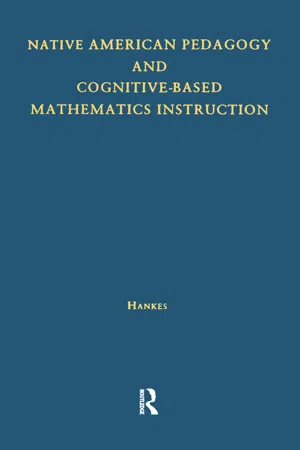
Native American Pedagogydetails a study that investigated the teaching of mathematics to Oneida Indian kindergartners. This study proves that Native American children who are taught with culturally sensitive methods will perform more successfully on mathematical problem solving tasks, and that Cognitively Guided Instruction, an approach that provides teachers with research-based knowledge of how children learn mathematics, enables such culturally sensitive teaching methods.
- 168 pages
- English
- ePUB (mobile friendly)
- Available on iOS & Android
eBook - ePub
Native American Pedagogy and Cognitive-Based Mathematics Instruction
Chapter 1
Statement of the Problem
Foreshadowing of Culture’s Impact
I never was the greatest mathematician… . I never expected to be rich so that I would have to worry about how much money I might get… . The father works enough to keep bread on the table, we’re fed, we’re warm, all of that, but there’s no looking down the road to say, “I’m going to have a bicycle by that time.” … We are never going to be rich because we don’t know how to, you know, how to hoard it. When someone needs something and we have it, we’ll help. That’s the way I am, but I really can’t say me, because I’m not me. I am a part of a whole family (Student Advocate 1/1 11-17-73, 275–77, 381–406).—A 61 year old Oneida teacher
This comment, given in response to the question, “How do you feel about mathematics?” was freely shared by a sixty-one year Oneida school teacher while being interviewed in her home. The home attested to the sincerity of her comment. Though made comfortable with family photos, colorful throws and pillows, and artificial flowers, it spoke boldly against materialism and conspicuous consumption.
I was not surprised with her comment; for most of my life I shared identical feelings. What surprised me was the disregard registered by several mathematics educators after I shared the interview transcription. One comment was, “That’s a pretty narrow view of mathematics.” I did not disagree with this observation, but I was surprised with the disengagement. More than surprised, I was dismayed that the teacher’s comments had not provoked curiosity as to why a sixty-one year old Native American teacher would have held such a narrow mathematics perspective.
My belief is that insight to understanding the mathematical underachievement of many Native American people is sequestered within this teacher’s response.
Documentation of the Indian Mathematics Problem
Poor performance and limited participation in mathematics by Native Americans has been well documented throughout the nation (Cajete 1988; Preston 1991; Hadfield 1992). In a paper prepared for a mathematics equity conference, Johnson (1982) reported that while 30.3% of all white students nationally take six or more semesters of math in grades ten through twelve, only 10.9% of all Indians did so. This compares to 17.3 of all Hispanic students and 19.4% of all black students. A comprehensive study completed in 1983 indicated that American Indians were 1.7 years behind the national norm in grade six mathematics achievement and three years behind the norm at grade twelve, and the proportion of Indian students with special needs increased from 32% in grade two to 41% in grade four and 46% in grade six (Fletcher 1983).
Another study with Ute students in northeastern Utah (Leap 1988) helps illuminate how limited mathematics proficiency among primary and secondary Indian students impacts on Indian people in general. Leap concluded that poor mathematics performance extends beyond ineffective problem solving to affective domains as well. He found that Indian children who remain in school (as many as 80% of students on Indian reservations do not complete high school (Fries 1987)) tended to avoid enrolling in mathematics courses or in other courses where mathematics held a significant role in course content. Career choices were also made along similar lines with Ute students rejecting careers that emphasized the need for quantitative skills and favoring career options where qualitative skills were stressed. Consequently, virtually no member of the Northern Ute tribe had been educated in mathematics related sciences, in engineering, in energy-related science, or in business management. It is important to note that this situation is common among tribes across the nation and has serious implications for economic self-determination as well as political self-sufficiency for all American Indians (Lane 1988). Leap concluded his report with the following comment:
Perhaps it is now clear why the “Indian mathematics problem” continues to be a source of major concern for all Indian educators, and even when the “problem” is recognized; truly effective remediation strategies have yet to emerge (Leap 1982, 185).
As indicated above, a considerable amount of research has documented the Indian mathematics problem and its consequences; however, few studies have focused on the cause and resolution of the problem (Cheek, Scott, and Fletcher 1983). Among the limited studies contributing to this critical discourse are investigations into the influence of low expectations for Indian students held by teachers, counselors, principals (Nash 1973; Green et al. 1978), and parents (Ortiz-Franco 1981); investigations into the impact of equity and opportunity and the influence of low socio-economic status on performance (Witthun 1984); investigations into cognition and learning style aspects (Lombardi 1970; Jordan and Tharp 1979; Rhodes 1989; Tharp 1994) and investigations into social-cultural influences (Guilmet 1979; Philips 1983; Greenbaum 1983; Ericksen and Mohatt , Leap, Spanos 1988).
The present study contributes to this critical discourse by investigating, like Leap, the impact of culture. However, the present study does not implicate culture or call for truly effective remediation strategies as did Leap. Instead, it ethnographically investigates the interactive relationship of one teacher’s personal culture-based values and how those values influenced her production of culturally responsive pedagogy. Simply put, the purpose of this investigation was to identify methods of teaching that, because of their cultural congruence, enhance the way Native American children learn mathematics.
Educational researchers, until recently, minimized the importance of investigating the influence of culture on teaching and learning; however, for more than a decade anthropologists have examined ways that teaching can better match the home and community cultures of students of color (Ladson-Billings 1994). Au and Jordon (1981) investigated what came to be termed “culturally appropriate” pedagogy in Hawaiian schools; Cazden and Leggett (1981) and Ericksen and Mohatt (1981) used the term “culturally congruent” to describe interactions of teachers with Native American students; Jordon (1985) and Vogt et al. (1987) used the term “culturally compatible” to explain successful teaching practice of classroom teachers with Native Hawaiian children; later, Erickson and Mohatt (1985) introduced the concept of “culturally responsive” pedagogy. Ladson-Billings (1994), in her article, Toward a Theory of Culturally Relevant Pedagogy, stressed that the terms culturally appropriate, culturally congruent, and culturally compatible connote accommodation of student culture to mainstream culture and that only the term “culturally responsive” refers to the dynamic and synergistic relationship between home/community culture and school culture. The present study attempts to advance the investigation of culturally responsive pedagogy.
The Impact of Culture: An Indian Perspective
When people experience what is called “culture shock” on going from one society to another, it’s probably not the obvious differences, which cause the greatest sense of personal disorganization. In other words, it is probably not the differences in physical landscape, climate, religion, dress, or even food, which bring about the strongest sense of confusion. More often, it is in the assumptions of everyday life, shared by members of a society by virtue of constant interaction from birth, assumptions which are so much a part of the culture that they are not even consciously held (Watson 1974, 29).
In every society, children engage in experiences and interactions, which transmit the values, beliefs, and attitudes of that society. Social interactions, which impact directly on math-related attitudes, might be as subtle as whether a child’s efforts are rewarded with an appreciative smile or with a monetary allowance. They might be obvious but informal as when a grandfather helps a young gardener estimate distance between rows of beans, or they might be obvious and formal as when a classroom teacher administers a standardized test. It is through such interactions that both spoken and unspoken cultural beliefs and values are communicated and children become enculturated. Understanding this process is intuitively and logically sensible, yet too often the implications of the process are ignored, and too often in mainstream school settings where ethnicities merge, culturally based beliefs and behaviors create misunderstanding and conflict.
Within the past twenty years Indian and non-Indian educators, responding to conflict by recognizing the importance of providing culturally sensitive curriculum, have produced units of study, rewritten textbooks, and infused Indian arts and crafts into lessons. However, large numbers of Indian children continue to underachieve, fail, and drop out of school. Apparently, it is not enough to depict history with an alternative perspective of manifest destiny or to study the geometry involved in basket weaving. It is not that curriculum adaptation is inappropriate. It is simply inadequate. The simple revision of a story or the inclusion of Plains Indian geometric designs will not alter subtle enculturated beliefs. This line of reasoning leads one to wonder whether there are, among American Indians, “assumptions of everyday life” related specifically to mathematics avoidance “which are so much a part of the culture that they are not even consciously held” as Watson suggested? If so, what are they?
One example of a conscious assumption related to mathematics avoidance among Indians was documented by Cocking, Chipman (1992) and Green (1978). These studies report that among Native Americans there is a negative image of mathematics, whereby mathematicians are perceived as remote, competitive, self-serving, obsessive, and calculating. Opposed to this view of mathematicians are fundamental Indian beliefs and values, which are presently shared and have been shared by tribes across the nation for hundreds of years. These values underlie the teacher’s comments presented at the beginning of this chapter and include valuing cooperation rather than competition and believing in close family solidarity with mutual support among kinfolk rather than materialism (Butterfield 1985; Phillips 1983; Erickson and Mohatt 1982; Fuchs and Havighurst 1973). Recognition of these fundamental values and acknowledgment of the often competitive and individualistic achievement demands common in dominant American society and reflected often in mainstream mathematics classrooms (Allison and Spence 1993; Romberg 1992), helps one better understand why an Indian student might find it difficult to become excited about planning a mathematics career or even participating in the discourse of a norm-based and competition-driven mathematics classroom. Careful consideration of the mathematics avoidance of Indian people helps illuminate why general instructional efforts of Indian children by non-Indians have failed; the cultural values on which such efforts have been and are based may be in stark contrast to Native American values.
Chapter 2
A Literature Review of Native American Pedagogy and Cognitively Guided Instruction
The Native American Way of Teaching
Surprisingly little attention has been given to the teaching methods used in teaching ethnic minority students in this country, particularly when the notion of culturally relevant curriculum materials has been around as long as it has. It is as if we have been able to recognize that there are cultural differences in what people learn, but not in how they learn. (Philips 1982)
The preceding quote will serve as a lens through which this chapter is focused. Here, Philips succinctly identifies the critical issue addressed within this study—the importance of culturally compatible teaching methods.
It is this issue that underlies the initial research question: What cultural values influence Oneida instruction? And it is this issue that grounds the investigation of pedagogical compatibility between a Native American way of teaching and Cognitively Guided Instruction (CGI). Within this chapter both Native American pedagogy and Cognitively Guided Instruction will be described and the commonalties between the two will be identified.
However, before one is able to gain an understanding of traditional Indian teaching, it is important to discuss the Native American perspective of the learner’s role. Tafoya (1982) helps illuminate this perspective by relating the incident of a Navajo elder responding to a young boy’s query as to why it snows in Montezuma Canyon. The elder responded by telling him a story about a boy who discovered a strange flaming object:
They (the Holy People) would not allow him to keep even a part of it, but instead put him to a series of tests. When he was successful at these tests, they promised they would throw all of the ashes from their fireplace into Montezuma Canyon each year. “Sometimes they fail to keep their word, and sometimes, they throw down too much; but in all, they turn their attention toward us regularly, here in Montezuma Canyon” (27).
When the boy heard the story, he accepted the explanation of why it snowed in Montezuma Canyon but then wanted to know why it snowed in Blanding, another Navajo area.
The old man quickly replied, “I don’t know. You’ll have to make up your own story for that.” To the anthropologist (Toelken) who had witnessed this exchange, the old man later commented that, “It was too bad the boy did not understand stories,” and he explained that this was not really about the historical origin of snow in Montezuma Canyon or any other place, but a story about the proper reciprocal relationship between man and other beings. He attributed the boy’s failure to grasp the meaning of the story to the influence of white schooling (28).
Tafoya’s explanation of this interchange situates the learner as an active participant, not merely a passive recipient of knowledge:
This is very much a part of Native American teaching: that one’s knowledge must be obtained by the individual… gaining of that knowledge does not come from only listening to elders, or seeing what others have done… . The seeker must open up himself to himself… . The insights and comprehensions must be achieved internally (28).
Others (Leavitt 1983; Smith 1987; Scollon and Scollon 1981) have investigated both the social and cognitive aspects of storytelling as well as other traditional Native American teaching practices, and, like Tafoya, have concluded that abstracting basic rules and principles is left to participants according to their experience levels and perspectives. This conclusion situates the learner not as a dependent student but as an autonomous learner. Understanding this perspective becomes vitally important when analyzing principles of Native American pedagogy; learner autonomy is covertly embedded in indirect, cooperative, sense-making, culturally situated, and time-generous instruction. In the following section, four research studies detailing instruction of Indian children by Indian teachers will be reviewed. Though the studies share attributes common to traditional Native American instruction, such as the autonomous role of the learner, each study was selected to exemplify a particular component or principle of such pedagogy, and each study is identified by the principle it exemplifies:
1. Teacher as facilitator—indirect rather than direct instruction
2. Sense-making instruction
3. Problem-based instruction with problems situated in the culture and lived experiences of the learner
4. Cooperative rather than competitive instruction
5. Time-generous rather than time-driven instr...
Table of contents
- Cover
- Half Title
- Title Page
- Copyright Page
- Table of Contents
- Introduction
- Acknowledgments
- Chapter 1: Statement of the Problem
- Chapter 2: A Literature Review of Native American Pedagogy and Cognitively Guided Instruction
- Chapter 3: Design of the Study
- Chapter 4: Findings
- Chapter 5: Discussion
- Appenndices
- Bibliography
Trusted by 375,005 students
Access to over 1.5 million titles for a fair monthly price.
Study more efficiently using our study tools.
Frequently asked questions
Yes, you can cancel anytime from the Subscription tab in your account settings on the Perlego website. Your subscription will stay active until the end of your current billing period. Learn how to cancel your subscription
No, books cannot be downloaded as external files, such as PDFs, for use outside of Perlego. However, you can download books within the Perlego app for offline reading on mobile or tablet. Learn how to download books offline
We are an online textbook subscription service, where you can get access to an entire online library for less than the price of a single book per month. With over 1.5 million books across 990+ topics, we’ve got you covered! Learn about our mission
Look out for the read-aloud symbol on your next book to see if you can listen to it. The read-aloud tool reads text aloud for you, highlighting the text as it is being read. You can pause it, speed it up and slow it down. Learn more about Read Aloud
Yes! You can use the Perlego app on both iOS and Android devices to read anytime, anywhere — even offline. Perfect for commutes or when you’re on the go.
Please note we cannot support devices running on iOS 13 and Android 7 or earlier. Learn more about using the app
Please note we cannot support devices running on iOS 13 and Android 7 or earlier. Learn more about using the app
Yes, you can access Native American Pedagogy and Cognitive-Based Mathematics Instruction by Judith T. Hankes in PDF and/or ePUB format, as well as other popular books in History & World History. We have over 1.5 million books available in our catalogue for you to explore.