Although its beginnings can be traced back to the late 19th century, the interfaith movement has only recently begun to attract mainstream attention, with governments, religious leaders and grassroots activists around the world increasingly turning to interfaith dialogue and collective action to address the challenges posed and explore the opportunities presented by religious diversity in a globalising world. This volume explores the history and development of the interfaith movement by engaging with new theoretical perspectives and a diverse range of case studies from around the world. The first book to bring together experts in the fields of religion, politics and social movement theory to offer an in-depth social analysis of the interfaith movement, it not only sheds new light on the movement itself, but challenges the longstanding academic division of labour that confines 'religious' and 'social' movements to separate spheres of inquiry.
eBook - ePub
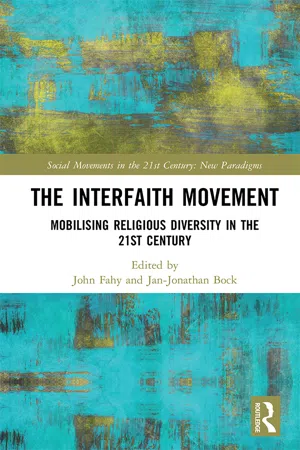
The Interfaith Movement
Mobilising Religious Diversity in the 21st Century
- 240 pages
- English
- ePUB (mobile friendly)
- Available on iOS & Android
eBook - ePub
The Interfaith Movement
Mobilising Religious Diversity in the 21st Century
About this book
Information
1 Introduction
Interfaith and social movement theory
Introduction
On 11 September 2015, Pope Francis led an interfaith remembrance service in the Foundation Hall of the National September 11 Memorial and Museum in New York City. 1 He was joined on stage by over a dozen representatives from a range of religious traditions, whose colourful regalia made for a stark contrast with the cavernous space where the Twin Towers once stood. The service was conceived not only as an opportunity to mourn the victims of 9/11, but also to celebrate what Archbishop of New York, Timothy Dolan, called the ‘sincere and fruitful interreligious friendship’ amongst the city’s diverse communities. New York-based imam Khalid Latif echoed this sentiment: ‘the courage of today’s gathering distinguishes us from the opponents of religious freedom as we stand together as brothers and sisters to condemn their horrific acts of violence’. Latif went on to cite a popular passage from the Qur’an (5:32): ‘one man lost is like all mankind, and one man saved is like all mankind’. Rabbi Elliott Cosgrove, also based in New York, in turn quoted the Book of Psalms (34:14): ‘we should love peace, and we should pursue peace’. He continued, ‘let us celebrate, affirm, and build on our shared commitment to interreligious dialogue’. Over the course of the ceremony, representatives of Buddhism, Sikhism and Hinduism shared similar reflections and scriptural references in an effort to reassert the centrality of peace in their respective religions, and highlighted the important role of interreligious dialogue in the pursuit of that peace. Pope Francis ended with some words of hope and reconciliation:
It is a source of great hope that in this place of sorrow and remembrance I can join with leaders representing the many religious traditions which enrich the life of this great city. I trust that our presence together will be a powerful sign of our shared desire to be a force for reconciliation, peace and justice in this community and throughout the world.
While 9/11 continues to stand as a brutal reminder of the threat of religious extremism, it has at the same time become a focal point for those advocating for the urgency of interfaith engagement. Just days after the 9/11 attacks in 2001, President George W. Bush led a similar interfaith service at the National Cathedral in Washington DC, although on that occasion he was joined only by a rabbi and an imam. The service came on the same day that an interfaith statement of solidarity, signed by 4,000 religious leaders, was published in response to the terrorist attacks. In that same week, President Bush also made a historic visit to the Islamic Center of Washington, and subsequently held private interfaith meetings at the White House. In the years following 9/11, under President Bush, and even more so under President Obama, interfaith initiatives proliferated throughout the US. In 1980, there had been only 24 interfaith councils, compared with 500 in 2006 (Halafoff 2013, 72). Today, one can search a directory of more than one thousand initiatives across the country on the Pluralism Project’s website. 2 In Boston alone, there are 60 interfaith organisations listed.
Interfaith advocates have undoubtedly found fertile ground in post-9/11 America, but interfaith initiatives have also become increasingly common elsewhere. In the wake of the London Bridge terrorist attack in June 2017, dozens of interfaith organisations across the UK – including Faiths Forum for London, Religions for Peace UK, and the Interfaith Network – released statements, hosted community reassurance events and held vigils and minutes of silence. Similar efforts characterised the interfaith response to the Manchester Arena bombing (in May 2017) and the Finsbury Park attack (in June 2017). In fact, it has become a public ritual of sorts for religious leaders to come together in the wake of terrorist attacks, to issue joint-statements condemning violence and bigotry while at the same time championing the values of diversity, peace and coexistence. While such highly visible interfaith efforts make for striking headlines – and, in many cases, even more striking optics – they are just the tip of the interfaith iceberg.
Wide-ranging efforts to bring together institutions and individuals representing different religious traditions have often been grouped under the banner of the ‘interfaith movement’. From its beginnings in the West in the 19th century, sporadic gatherings evolved into a sustained but splintered transnational movement over the course of the 20th century. Historically rooted in theological (and often ecumenical) concerns, the interfaith movement has found itself, not unwittingly, on the forefront of a range of social and political issues as varied as human rights, climate change, conflict resolution, poverty alleviation, social justice and nuclear disarmament, to name but a few. The movement has been spurred on by major global developments, and often moments of acute crisis or periods of social and moral breakdown, such as World War II, the Holocaust and the Cold War. In the wake of 9/11 and other terrorist attacks carried out by religious fundamentalists, the interfaith movement achieved unprecedented visibility, particularly in Western multicultural democracies, where interfaith dialogue and collective action have been championed as both conduits for social cohesion and antidotes to religious intolerance and violent extremism (Fahy and Bock 2018). Beyond the West, interfaith initiatives have become a popular mode of engagement in increasingly religiously diverse contexts, from Israel to Ethiopia and Singapore to South Africa. From high-profile United Nations resolutions to state-sponsored initiatives and grassroots efforts in local neighbourhoods all over the world, the interfaith movement seems to be moving into the mainstream (Brodeur 2005, McCarthy 2007).
Much has been written on the theme of interfaith, from overviews of the interfaith landscape (Bharat and Bharat 2007, Marshall 2017) to historical accounts that outline its development (Braybrooke 1992, Kirkwood 2007), and case studies that focus on particular geographical contexts (see e.g., McCarthy 2007, Niebuhr 2008, Halafoff 2013, Knutson 2013, Chia 2016, Swamy 2016). While there is a growing body of literature that addresses what is often simply described as the ‘interfaith movement’, however, relatively little attention has been paid to what exactly it means to describe such a wide range of disparate efforts as constituting a ‘movement’. That is to say there has yet to develop a sustained analysis that focuses on the social dimensions of the actors, institutions and initiatives that comprise the global patchwork of interfaith activity. Despite the substantial body of literature that brings together religion, civil society and faith-based organisations, the interfaith movement – comprising what we might call ‘faiths-based’ organisations and initiatives – has received remarkably little attention in the social sciences. Furthermore, there has to date been very little explicit engagement with social movement theory (cf. Snarr 2011, Halafoff 2013). This is largely attributable to the centrality of theological concerns in the field, on the one hand, and the academic boundary that delineates ‘religious’ and ‘social’ movements, on the other.
Unlike other similarly fragmented social movements that centre on, for example, civil rights, economic inequality or the environment, the interfaith movement is often understood to be a ‘religious’ rather than a social or political phenomenon. This is unsurprising, given both the predominance of religious actors in, and the centrality of comparative theology to, the interfaith enterprise. The emphasis in the field on theologies of dialogue and pluralism (see e.g., Buber 1970, Hick 1985, Panikkar 1999), nevertheless, has served to obscure the myriad ways interfaith initiatives have been shaped by, and have responded to, different historical, social and political contexts. Theological perspectives, while not unimportant, have tended to pay little attention to the broader socio-historical processes that have created the conditions for the emergence of the interfaith movement in different parts of the world. However, the lack of engagement with the social and political dimensions of the movement can also be ascribed to the unease with which social movement theorists have tended to treat religion in general, and ‘religious’ movements in particular.
Despite widespread criticism of the secular paradigm in the late 20th century (Casanova 1994, Berger 2014), there remains a tacit assumption that ‘religious’ and ‘social’ movements represent distinct modes of collective behaviour. Whereas religious movements have often been distinguished by their ‘other-worldly’ orientation, social movements have been understood to be concerned with distinctly ‘this-worldly’ grievances. Religious movements have not been entirely absent from social movement theory debates, but they have for the most part been confined to resource mobilisation (RM) frameworks – that have been disproportionately interested in new religious movements (NRMs) – rather than broader theories of collective behaviour. There have long since been calls to end the estrangement between the sociology of religion and the sociology of social movements (Zald 1982, Hannigan 1991, Lindekilde and Kühle 2015). Some have sought to overcome the rigid disciplinary boundary (Beckford 2003, Smith 1996, Rozell and Wilcox 1997), while others have highlighted the distinctly religious origins of contemporary social movements (Morris 1984, Young 2002, 2007). A theoretical synthesis, however, remains elusive.
In the case of the interfaith movement, it is particularly important to challenge this disciplinary boundary. However often interfaith advocates may rely on theological or broadly speaking religious resources to frame their agenda, and however integral religious actors and institutions may be to the movement itself, it would be a mistake to conceive of the interfaith movement in exclusively religious terms. Its value-oriented goals of mutual understanding, tolerance and coexistence – not to mention the variety of agendas interfaith advocates have invested in, such as human rights, poverty alleviation and climate change – represent inherently moral, as indeed they do social and political concerns. Furthermore, insofar as it occupies a range of discursive spaces at the intersection of theology, morality and politics, and espouses initiatives that engage with issues that belong not only to the ‘religious’, but also the social and political spheres, the interfaith movement presents a particularly interesting challenge to theorists of religion and social movements alike. As this volume sets out to demonstrate, it also presents an important opportunity to overcome the longstanding estrangement between the two.
Often conceived simply as a network of religious or theological initiatives, a central claim of this volume is that the interfaith movement is best understood as a socio-political phenomenon, within which religious actors and institutions occupy a privileged place. Unlike much of the literature on interfaith that focuses on theological questions of dialogue or pluralism, this volume brings together experts in the fields of religion, sociology, anthropology, political science and social movement theory to offer an in-depth social analysis of the field of interfaith through a range of case studies from around the world. In doing so, it both sheds new light on the movement itself and challenges the longstanding academic division of labour that confines ‘religious’ and ‘social’ movements to separate spheres of inquiry. Before returning to these themes in more detail, we first sketch a historical overview of the emergence and development of the so-called ‘interfaith movement’.
The emergence of the interfaith movement
All of the major world religions can point to historical examples of ‘interfaith’ in their respective traditions. Muslims often present the Convivencia (in the medieval Iberian Peninsula) as a shining example of interreligious coexistence, and as evidence of the inherent tolerance of the Islamic faith. In India, Buddhist Emperor Ashoka (304–232 BC) and Mughal Emperor Akbar (1542–1605 AD) are venerated as champions of interfaith ahead of their time. Indeed, Indians in general and Hindus in particular are deeply proud of what they consider a unique capacity for interreligious coexistence (see Adcock 2014). While the challenge of managing religious diversity and the idea of gathering representatives from different religious traditions for dialogue are not particularly novel, the interfaith movement, as we know it today, is a distinctly modern phenomenon that represents a new departure from earlier sporadic attempts to improve relations between people of different religious backgrounds. Emerging in the late 19th century in the West, the interfaith movement is both a product of, and a concerted if not always coherent response to, new patterns of transnational migration, increasing religious diversity and religion’s shifting place in a secularising public sphere. These same aspects of modernity that catalysed the interfaith imperative in the late 19th century in turn informed the development of what has slowly emerged as a transnational movement over the course of the 20th century. At times couched in orientalist curiosity, and typically pervaded by (predominantly Christian) theological concerns, early interfaith efforts spawned wide-ranging discourses and developments as the movement slowly gained momentum. In response to a series of crisis events in the 20th and 21st centuries, the interfaith movement began to transcend its theological roots, and today finds itself on the forefront of a wide range of social and political challenges around the world.
The beginnings of the modern interfaith movement are often traced back to the 1893 World’s Parliament of Religions in Chicago. Organised to coincide with the World’s Fair, the Parliament was conceived as a response to both increasing diversity and growing xenophobia in North America in the late 19th century. Geared towards improving interfaith relations, the Parliament brought together representatives from several of the world’s major religious traditions, including a range of Christian denominations, Hindus, Jains, Buddhists and some smaller new religious movements. Muslims, however, were noticeably absent; the only Muslim speaker was Mohammed Alexander Russell Webb, an American convert, whose talk was received with jeers from the predominantly Christian audience. While the Parliament was a watershed moment in the history of the interfaith movement, it was not an egalitarian platform as much as a ‘Christian assembly to which guests of other faiths were invited’ (Braybrooke 1992, 35). Participants of all faiths were asked to join in reciting the Lord’s Prayer, and 78 per cent of the almost 200 talks were delivered by Christians (Braybrooke 1992, 27). Reflecting on the gathering, Chairman John Henry Barrows noted that:
The Parliament has shown that Christianity is still the great quickener of humanity, and thus it is now educating those who do not accept its doctrines, that there is no teacher to be compared with Christ, and no Saviour expecting Christ … (cited in Braybrooke 1992, 15).
While the Parliament was for some a thinly veiled platform for proselytisation, there were many within the Christian fold that were firmly against it. The Archbishop of Canterbury, for example, opposed the gathering, and Pope Leo VIII warned Catholics to avoid any ‘further promiscuous conventions’ (Braybrooke 1992, 29). Although amicable relations between the world’s major religious institutions are commonplace today, informed as they are by an increasingly ‘pluralist’ approach to the religious other (more on which below), gatherings like the Parliament were relatively rare exceptions in the late 19th century, during which ‘exclusivist’ attitudes predominated, as indeed they still do in many quarters today. 3
The Parliament in Chicago was a once-off, but would inspire interfaith efforts for generations to come. Similar but significantly smaller-scale events were sporadically organised in the e...
Table of contents
- Cover
- Half Title
- Series Page
- Title Page
- Copyright Page
- Table of Contents
- List of illustrations
- Acknowledgements
- List of contributors
- 1. Introduction: Interfaith and social movement theory
- 2. Interfaith political activism in the United States: Understanding variation in the cultural challenges of being and doing interfaith
- 3. Faith embedded and embodied: Interfaith collaboration to address Islamophobia in the United States
- 4. InterAction Australia: Countering the politics of fear with netpeace
- 5. Making space for faith: Interfaith initiatives in Denmark
- 6. Empowerment or oligarchisation?: Interfaith governance of religious diversity in two German cities
- 7. Local governance of religious diversity in Southern Europe: The role of interreligious actors
- 8. Singapore’s interfaith movement: Embedded autonomy and precarious toleration
- 9. Beyond normative secularity: Politics of interfaith dialogue in Lebanon
- 10. Religious discourse and interreligious impact in Egypt’s ‘Spring’
- 11. Transnational interfaith diplomacy: The interfaith G8/G20 shadow summits
- Epilogue: Understanding a decentralised social movement
- Index
Trusted by 375,005 students
Access to over 1.5 million titles for a fair monthly price.
Study more efficiently using our study tools.
Frequently asked questions
Yes, you can cancel anytime from the Subscription tab in your account settings on the Perlego website. Your subscription will stay active until the end of your current billing period. Learn how to cancel your subscription
No, books cannot be downloaded as external files, such as PDFs, for use outside of Perlego. However, you can download books within the Perlego app for offline reading on mobile or tablet. Learn how to download books offline
Perlego offers two plans: Essential and Complete
- Essential is ideal for learners and professionals who enjoy exploring a wide range of subjects. Access the Essential Library with 800,000+ trusted titles and best-sellers across business, personal growth, and the humanities. Includes unlimited reading time and Standard Read Aloud voice.
- Complete: Perfect for advanced learners and researchers needing full, unrestricted access. Unlock 1.5M+ books across hundreds of subjects, including academic and specialized titles. The Complete Plan also includes advanced features like Premium Read Aloud and Research Assistant.
We are an online textbook subscription service, where you can get access to an entire online library for less than the price of a single book per month. With over 1.5 million books across 990+ topics, we’ve got you covered! Learn about our mission
Look out for the read-aloud symbol on your next book to see if you can listen to it. The read-aloud tool reads text aloud for you, highlighting the text as it is being read. You can pause it, speed it up and slow it down. Learn more about Read Aloud
Yes! You can use the Perlego app on both iOS and Android devices to read anytime, anywhere — even offline. Perfect for commutes or when you’re on the go.
Please note we cannot support devices running on iOS 13 and Android 7 or earlier. Learn more about using the app
Please note we cannot support devices running on iOS 13 and Android 7 or earlier. Learn more about using the app
Yes, you can access The Interfaith Movement by John Fahy, Jan-Jonathan Bock, John Fahy,Jan-Jonathan Bock in PDF and/or ePUB format, as well as other popular books in Social Sciences & Sociology. We have over 1.5 million books available in our catalogue for you to explore.