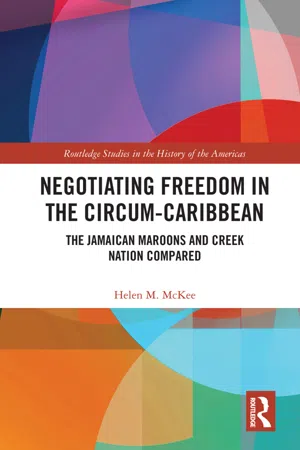
Bringing together Jamaican Maroons and indigenous communities into one framework – for the first time – McKee compares and contrasts how these non-white, semi-autonomous communities were ultimately reduced by Anglophone colonists. In particular, questions are asked about Maroon and Creek interaction with Anglophone communities, slave-catching, slave ownership, land conflict and dispute resolution to conclude that, while important divergences occurred, commonalities can be drawn between Maroon history and Native American history and that, therefore, we should do more to draw Maroon communities into debates of indigenous issues.
eBook - ePub
Negotiating Freedom in the Circum-Caribbean
The Jamaican Maroons and Creek Nation Compared
- 224 pages
- English
- ePUB (mobile friendly)
- Available on iOS & Android
eBook - ePub
Negotiating Freedom in the Circum-Caribbean
The Jamaican Maroons and Creek Nation Compared
About this book
1 The Relationship Develops
Maroons and Creeks in the Early Post-Treaty Years
In early 1739, after the colonial government had decided that negotiation, rather than war, was the only way to defeat the Maroons, a detachment of soldiers was sent to parlay with Cudjoe and his followers. Once the Leeward Maroons in the west of the island were located, a series of shouted exchanges led to a short conference between the Maroon leaders and the colonists. On 1st March 1739, negotiations concluded and the Leeward treaty was signed by Captain Cudjoe and Colonel John Guthrie.1 Buoyed by this success, the British set out to treat with the Windward Maroons in the east. The British hailed them with a trumpet and told them they had “come to agree, not to fight.” Philip Thicknesse, one of the British soldiers present, declared that the Governor had “given Cudjoes people freedom, and that the same terms were upon to them.”2 Once again, negotiations were held, which resulted in Quao’s treaty, named after the Windward leader, being signed on 23rd June 1739. These two treaties brought to an end the decades of fighting between colonists and Maroons. Many of the clauses, and their effects, are discussed in subsequent chapters; I will begin here with those directly relevant to the new alliance to be formed with the colonial government.
The most important clauses of the treaties attempted to secure the alliance of Maroons in returning runaways and/or rebellious slaves. In Cudjoe’s treaty, Clause Six required the Leewards to “use their best endeavors to take, kill, suppress, or destroy” all of the “rebels wheresoever they be throughout the island”3 This clause rather vaguely refers to “rebels” without explicitly stating that the “rebels” were, most frequently, runaway slaves. In Quao’s treaty, it became more precise. Clause Four stated, “that the said captain Quao, and his people shall be ready” on the command of the Governor “to suppress and destroy all other party or parties of rebellious negroes” that may gather or settle in any part of the island and “shall bring in such other negroes as shall from time to time runaway from their respective owners.”4 Quao’s treaty, therefore, not only stated that the “rebels” are runaway slaves but also required the Windwards to treat them as “rebels” as soon as they ran away from their masters.
A further requirement of both treaties was to provide aid when the island was under external threat. Clause Seven of the Leeward treaty stated, “that in case this island is invaded by any foreign enemy,” Captain Cudjoe and his successors should “immediately repair to any place the governor … shall appoint” in order to “repel the said invaders with his or their utmost force.” During these skirmishes, the Leewards were to be under the orders of the commander-in-chief.5 Similarly, Quao’s men were required, in their Clause Five, to be ready to assist the Governor “in case of any invasion” and to put themselves “under the command of the general or commander of such forces, appointed by his excellency to defend the island from the said invasion.”6
Subordinance to the Governor was also demanded in yearly meetings. Cudjoe’s Clause Eleven stated that, “captain Cudjoe, and his successors, shall wait on his excellency, or the commander in chief for the time being, once every year if thereunto required.”7 Likewise, Clause Six of Quao’s treaty required him “and all his people” to be in “subjection to his excellency the Governor for the time being; and the said captain Quao shall, once every year, or oftener, appear before the Governor, if thereunto required.”8 Details of these meetings, and their consequences, will be discussed later in this chapter.
Finally, both treaties also laid out the line of succession of both the Leewards and the Windwards. Clause Fifteen of Cudjoe’s treaty stated “that captain Cudjoe shall, during his life, be chief commander in Trelawny-Town” and, after his death, the command was to be passed to Accompong, then Johnny, Cuffee and finally Quaco. After all of their demises, it was decreed that the “governor, or commander in chief for the time being shall appoint, from time to time, whom he thinks fit for that command.”9 The line of succession in Quao’s treaty was to be Quao, then captain Thomboy, Apong, Blackwell and, finally, Clash, after which the Governor or commander-in-chief was to appoint “whom he thinks proper.”10 Therefore, the Maroon-determined line of succession was, at best, to last a little over a generation. After that, it was to be the preserve of the colonists to decide on a leader. Quite how they expected to do this is unclear.
Kathleen Wilson argues that these treaties constituted a pivotal moment in British-Maroon relations, the differing interpretations of which had lasting repercussions for both sides.11 Carey Robinson agrees, stating that the treaties changed “the entire character of the Maroons and reverse their way of life.”12 There is no doubt that, on paper, the British gained more: peace, an internal police force and a psychological blow to the enslaved people left on the plantations. But Maroons also gained much: recognition of some of their territories, the ending of hostilities and an acceptance by the colonial government that they would not return to slavery. The treaties, however, also left both Maroons and the colonial population in a precarious position. Maroons lived in close proximity to a slave society, where their brethren were still in chains, and were now allied to their former enemies. The plantocracy also found itself in a difficult situation after the peace treaties. Its fear that Maroons might use peace to regroup and then join with the slaves in one great alliance to overthrow the slave system was not unreasonable. The colonists’ horror of such an alliance would later be realised in neighbouring Saint Domingue.13 However, the fear in Jamaica was soon dissipated, although never disappeared, when Maroons stuck faithfully to the clauses of treaties which obliged them to hunt and return runaway slaves. In fact, fourteen years after the signing of the treaties, Governor Charles Knowles of Jamaica said, “I verily believe the Maroons will prove of more service to the country, than they ever were of prejudice.”14 Despite this, Michael Mullin asserts that Maroon support was never taken for granted by the colonial government.15 The Governor offered three explanations for this: the Maroons’ “manner of life,” their strategic location “in the heart of the country” and the “very high idea the slaves entertain of them.”16 In addition, it is doubtful that the terms of the treaties were acceptable to all Maroons. Alvin O. Thompson argues that some Maroons were hardliners who would have preferred to fight the colonists to the last man for both ideological and pragmatic reasons.17 But how true were these statements? Had Governor Knowles interpreted the situation correctly, or had the colonial government made a grave error in treating with the Maroons? As a cautionary measure, the colonial government decided to search for an alternative defence force, as “they would likewise form a proper counter balance to the Maron [Maroon] negroes.”18 The colonial government, at this conjuncture, had no idea how Maroons would act following the signing of the treaties. Was it a trick? Was it a chance to regroup before attacking with renewed vigour? The colonial government could do little but wait, see and hope.
Despite this search for alternative forces, the immediate post-treaty relationship could not have started out any better for the colonial government. Upon hearing of the declaration of war against Spain in March 1740, Cudjoe sent one of his principal men to offer assistance to the British. Cudjoe’s man enquired how best to “Dispose of his People for the Defense of the Island” and whether he “could otherwise be of Service.”19 Several of his men even sailed as volunteers on the British ship Louisa.20 This first test of the alliance had proved successful.
The colonial government was quick to further trial the resolve of the Maroons. In April 1741, just a few months after it became generally known that the Maroon treaties had been ratified, the members of the Assembly heard that a considerable number of slaves had deserted from several plantations in the parishes of Clarendon and St. Elizabeth and formed themselves into groups to settle in the mountains of Clarendon and St. George. Advising the Governor, the Legislature requested him to “give proper direction to Captain Cudjoe and Captain Accompong to pursue, take and destroy those in Clarendon and St. Elizabeth and the commanding officer in Crawford Town to do the like in St. George.”21 A few days later, on 2nd May, the Assemblymen drew up a bill, which became Act Number Seven of 1741 to
encourage Colonel Cudjoe and Captain Quao and the several negroes under them in Trelawny and Crawford Town and all other towns of the rebellious negroes who submitted to terms to pursue and take up runaway slaves and such negroes as continue in rebellion; and for remedying some inconveniences in the laws already made for that purpose.22
The bill was passed in one day and received the assent of the Governor within six days, on 8th May. Its success was almost immediate. Cudjoe instructed a group of Maroons to assist colonial troops, and the threat was quickly quelled.23
Cudjoe’s response to the rumoured rebellion occasioned rapturous applause from the Assembly. Colonial officials poured gratitude on him and his actions, stating, “the use such an example must be of in preventing other negroes, for the future, from running away in bodies in hopes of being protected by them.”24 The Assembly followed up their lavish words with generous rewards. Reckoning that money was soon spent, and therefore forgotten, the colonists searched for a more long-lasting token of their appreciation. Learning that the Maroons were “desirous” of a few cattle, the committee recommended a reward of two cows each for the two Leeward leaders, Accompong and Cudjoe, and one each for each of the captains of the Leeward towns. They further awarded a clothing allowance of ten yards of cloth per annum for each officer and five yards per annum for every other Maroon—to a sum of £300 annually—and agreed to the cutting of roads from Sandler’s estate to Trelawny Town, for which the government would pay. Finally, they agreed to the manumission of Molly, the daughter-in-law of a prominent Maroon called Captain Cranky.25
Despite these rather encouraging acts, at least in the eyes of the colonists, the government saw fit to propose a resolution in 1744 to recommend that the House appoint a committee to revise the laws relating to “the negroes in Trelawny Town, Crawford Town, Nanny Town and Accompong Town” and to consider the most proper methods to render “those negroes” useful and governable by encouraging them to engage in services to the public.26 This resulted in the following:
- An Act for raising companies in the several negro towns and encouraging them to r...
Table of contents
- Cover
- Half Title
- Series
- Title
- Copyright
- Dedication
- Contents
- List of Figures
- Acknowledgements
- Introduction
- 1 The Relationship Develops: Maroons and Creeks in the Early Post-Treaty Years
- 2 The Relationship Deteriorates: On the Road to War
- 3 Runaways and Rebellions: Maroons and Creeks as Hunters and Harbourers
- 4 African Americans in Maroon and Creek Country
- 5 Desirable Lands? Land Disputes on the Maroon and Creek Borders
- 6 Contact Across the Borders: Maroon and Creek Interaction With White Settlers
- Epilogue
- Index
Frequently asked questions
Yes, you can cancel anytime from the Subscription tab in your account settings on the Perlego website. Your subscription will stay active until the end of your current billing period. Learn how to cancel your subscription
No, books cannot be downloaded as external files, such as PDFs, for use outside of Perlego. However, you can download books within the Perlego app for offline reading on mobile or tablet. Learn how to download books offline
We are an online textbook subscription service, where you can get access to an entire online library for less than the price of a single book per month. With over 1.5 million books across 990+ topics, we’ve got you covered! Learn about our mission
Look out for the read-aloud symbol on your next book to see if you can listen to it. The read-aloud tool reads text aloud for you, highlighting the text as it is being read. You can pause it, speed it up and slow it down. Learn more about Read Aloud
Yes! You can use the Perlego app on both iOS and Android devices to read anytime, anywhere — even offline. Perfect for commutes or when you’re on the go.
Please note we cannot support devices running on iOS 13 and Android 7 or earlier. Learn more about using the app
Please note we cannot support devices running on iOS 13 and Android 7 or earlier. Learn more about using the app
Yes, you can access Negotiating Freedom in the Circum-Caribbean by Helen M. McKee in PDF and/or ePUB format, as well as other popular books in History & American Civil War History. We have over 1.5 million books available in our catalogue for you to explore.