Democratic Transition in Bhutan
eBook - ePub

Democratic Transition in Bhutan

Political Contests as Moral Battles

  1. 292 pages
  2. English
  3. ePUB (mobile friendly)
  4. Available on iOS & Android
eBook - ePub

Democratic Transition in Bhutan

Political Contests as Moral Battles

About this book

This book studies how a modern monarchy transformed Bhutan into a parliamentary democracy. A political ethnography, it focuses on the historic elections of 2007–2008, and studies democracy and its transformational processes from the ground up. It draws on historical as well as contemporary theories about kingship and regime change to analyse Bhutan's nascent democratic process and reflect on the direction of political change, both at the state and local levels in the aftermath of the elections. It also presents insights into the electoral and political process by giving a first-hand account of the author's own participation in the elections and ponders on the larger political implications of this election for the region.

A strong theoretical discussion situated in robust fieldwork and personal experience, this book will be an essential read for scholars and researchers of politics, especially comparative politics and political institutions, South Asian and Himalayan Studies, political sociology and social anthropology.

Frequently asked questions

Yes, you can cancel anytime from the Subscription tab in your account settings on the Perlego website. Your subscription will stay active until the end of your current billing period. Learn how to cancel your subscription.
No, books cannot be downloaded as external files, such as PDFs, for use outside of Perlego. However, you can download books within the Perlego app for offline reading on mobile or tablet. Learn more here.
Perlego offers two plans: Essential and Complete
  • Essential is ideal for learners and professionals who enjoy exploring a wide range of subjects. Access the Essential Library with 800,000+ trusted titles and best-sellers across business, personal growth, and the humanities. Includes unlimited reading time and Standard Read Aloud voice.
  • Complete: Perfect for advanced learners and researchers needing full, unrestricted access. Unlock 1.4M+ books across hundreds of subjects, including academic and specialized titles. The Complete Plan also includes advanced features like Premium Read Aloud and Research Assistant.
Both plans are available with monthly, semester, or annual billing cycles.
We are an online textbook subscription service, where you can get access to an entire online library for less than the price of a single book per month. With over 1 million books across 1000+ topics, we’ve got you covered! Learn more here.
Look out for the read-aloud symbol on your next book to see if you can listen to it. The read-aloud tool reads text aloud for you, highlighting the text as it is being read. You can pause it, speed it up and slow it down. Learn more here.
Yes! You can use the Perlego app on both iOS or Android devices to read anytime, anywhere — even offline. Perfect for commutes or when you’re on the go.
Please note we cannot support devices running on iOS 13 and Android 7 or earlier. Learn more about using the app.
Yes, you can access Democratic Transition in Bhutan by Sonam Kinga in PDF and/or ePUB format, as well as other popular books in Politics & International Relations & Democracy. We have over one million books available in our catalogue for you to explore.

1

The Constitution

Royal gift or public responsibility? Setting the discourse for democracy1

To question or not to question, that was the question

When the parliament convened for its inaugural session on 8 May 2008, the first debate centred on the question of either endorsing the draft Constitution as it was or discussing the contents before its promulgation. Many parliamentarians pointed out that the Constitution was a gift, soelra (gsol ra) from the Fourth King of Bhutan, and hence, the question of questioning a gift by discussing its provisions should not arise. There was, however, another group of parliamentarians, who argued that discussing the Constitution does not run contrary to their faith in the King or the Constitution. It would be better, they argued, to seek clarifications from the chief justice, who was the chairman of the drafting committee, on important provisions and take the opportunity to improve it so that the Constitution need not be amended frequently in future. To suggest that the draft Constitution should be promulgated intact without making any amendment, the copies circulated to the parliamentarians that day were printed in gold letters. It was symbolic of the fact that a gift precious as gold should not be tainted by debates and amendments.
The Constitution had, anyway, undergone a thorough and inclusive process of national consultations. First, all the households of the country’s 20 districts were provided a copy each. Second, the King and Crown Prince travelled throughout the country to meet the people and hold public consultations on the draft Constitution. Their responses, comments and feedback were noted. Third, the draft Constitution was up on a website since 26 March 2005 for feedback and comments from readers, which were subsequently considered. Fourth, the Constitution was drafted drawing on the best of provisions of constitutions of many other nations. While 100 constitutions were studied, the drafting committee focused on 50, which were scaled down to 22 for deeper analysis (Ugyen Penjore, 2008a, p. 5). Finally, most members of the drafting committee were elected representatives of different districts.
Parliamentarians who wanted to discuss the Constitution with the possibility of amendments considered seeking clarifications from the chairman of the drafting committee on important provisions. It would ensure there are no conflicting interpretations in future. Moreover, the parliamentary session was to be broadcast live.2 So the people who watched the proceedings would also benefit by understanding the provisions. As debates began, I said that there were important lessons to be learnt from the experiences of the last elections. For example, I said the Constitution has provisions for two rounds of elections to the Assembly. In the primary round, all registered political parties would contest. In the general round, the two parties that win the maximum number of votes in the primary round would contest. However, there were only two registered political parties for the last election. As such the primary round was not held. The Constitution did not specify if the primary round should be foregone if there were only two political parties. It certainly states that two rounds of elections should be conducted. There was thus a need, I argued, to rethink those issues. Initially, the chairman of the drafting committee, who presented the draft Constitution to the parliament, expected discussions to take place for about two or three days. It was mainly to provide clarifications and details on certain articles and clauses. Discussions, nevertheless, continued for three weeks as every article of the draft Constitution was up for discussions. Before discussing whether any amendments were made to the Constitution, the idea of the Constitution as a gift needs to be examined further.

Source of legitimacy: King and people

The popular thinking that the Constitution is a gift from the throne locates and acknowledges the throne, particularly the Fourth King as the source of legitimacy as well as agency for Bhutan’s historic democratic transition. However, he had said: “[t]he Constitution should not be considered as a gift from the King to the people: it is my duty to initiate the constitutional process so that our people can become fully involved in shaping and looking after the future destiny of our country.”3 Hence, from the very beginning, the King conveyed the idea that while he would initiate the constitutional process, it is the people and their representatives who would draft the Constitution. The King intended to locate the legitimacy of the Constitution in the people.
There was thus two ways to think about assigning the source of legitimacy for Bhutan’s first written Constitution. The King placed it in the people, and the people in the King. How did the King embed the legitimacy for the Constitution in the people and the people conceptualised the Constitution as the King’s gift? He had commanded the drafting of the Constitution on 4 September 2001 by issuing a decree to the government:
While His Majesty gave a broad directive, enunciating the basic and progressive democratic principles, Lyonpo Sonam Tobgye4 said that His Majesty was cognizant of the fact that the members of the drafting committee must be broad-based and that they must be elected so that there will be a voice of the people. Consequently, His Majesty commanded the Prime Minister to issue a directive to the 20 dzongkhags to elect one member each from every dzongkhag primarily or wholly for the purpose of drafting the constitution.
(Ugyen Penjore, 2008a, p. 5; emphasis mine)
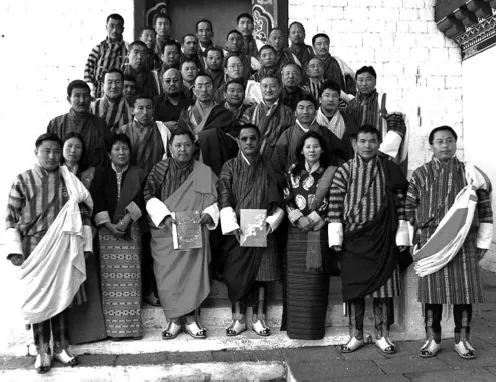
When the drafting of the Constitution was initiated on 20 November 2001 in Tashichho Dzong, the seat of the Bhutanese state, there were 39 members. Among them, there were 13 representatives from the government, three from the judiciary, two from the monastic community and 27 from the people. Among the representatives of the people were a member each from the 20 districts, who were elected by the respective DYTs. In addition, there were six councillors, who were elected members of RAC. Each councillor represented a group of districts. The councillors were also members of the former Assembly.
Figure 1.1
Figure 1.1 Members of the Constitution Drafting Committee
Source: Provided by the Chairman of Constitution Drafting Committee
The composition of the drafting committee was, therefore, intended to constitute a popular body. With representations from the government and the monastic community, it became broad-based. Such representations have been the hallmark of popular institutions like the RAC and the earlier Assembly. However, it is important to note that the drafting committee was not a legislative body and, therefore, had no authority to promulgate the Constitution. Its broad-based composition nevertheless suggested that the Constitution was drafted by the representatives of the people.
The second important element in reinforcing the idea of the people as the source of legitimacy for the Constitution was the distribution of its copies on 26 March 2005 to members of GYTs and DYTs, civil servants, members of the judiciary, educational institutions, municipal corporations and the business community. Basically, every household in the country was provided a copy each. This was to set the stage for kingdom-wide public consultations later. King Jigme Singye Wangchuck began the nation-wide consultation process in Thimphu on 29 October 2005.
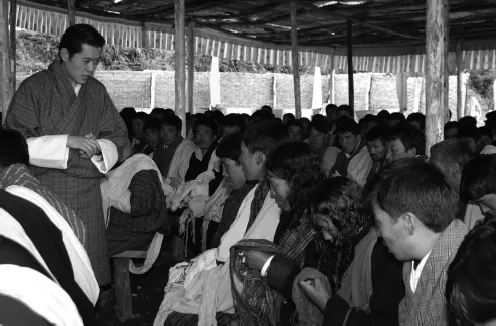
Later, the Crown Prince (the present King) continued the consultations, which ended on 4 May 2006 in Trongsa. In every public consultation, the people echoed concern over the introduction of parliamentary democracy. In his National Day address on 17 December 2005, the Fourth King said, “During my consultations on the Constitution in different districts, the main concern of the people is that it is too early to introduce parliamentary democracy in Bhutan” (His Majesty’s National Day Address a, 2005, p. 3). The King and Crown Prince conveyed to the people during the consultations that it was not at all early. Rather, they said the time was right to venture on historic political reforms. Although the people expressed concerns on the political transition that was being initiated, they made suggestions or raised objections on different clauses of the draft Constitution as discussions on its provisions proceeded during these public consultations.
The other important means of legitimising the Constitution through popular participation was the idea of holding a national referendum.
His Majesty pointed out that the draft Constitution was not submitted to the National Assembly first because the people might not accept the decision of the Assembly as there would be only 100 chimis representing the dzongkhags. The Constitution of Bhutan would, therefore, be adopted by referendum, as has been the practice in Bhutan for all important issues, and then enacted in the National Assembly.
(Kinley Dorji, 2005. pp. 1, 12; emphasis mine)
The referendum, however, was not held. Nor was the Constitution enacted in the Assembly. Rather, the public consultations came to be regarded later as a kind of national referendum. The concern was that the people may not endorse the Constitution and hence, parliamentary democracy, if a national referendum were held. Lyonpo Sonam Tobgye shared with me that the possibility of people rejecting the draft Constitution in a national referendum looked very real that it was later decided the process be foregone. Similarly, it was felt that the former Assembly would turn down the Constitution. Both these would be a major setback for the King’s initiative to democratise Bhutan. Some members asked that the draft Constitution and Election Bill be tabled for discussions in its final session of June 2007. The Chief Election Commissioner (CEC), however, refused to do so arguing that in the absence of the two houses of parliament, which would be elected in 2008, only the King was the legitimate authority at that point of time to endorse or reject the provisions of the Constitution and the Election and National Referendum Bills.
Figure 1.2
Figure 1.2 HRH The Trongsa Penlop consulting the people on the draft Constitution
Source: Kuensel
The idea that the Constitution has popular legitimacy was reasserted when it was finally signed and promulgated on 18 July 2008. The King said that the Constitution had been placed before the people of the 20 districts. “Each word has earned its place with the blessings of every citizen in our nation. This is the People’s Constitution” (His Majesty’s Address at the Signing of the Constitution, 2008).
The popular view, nevertheless, continues to present the Constitution and parliamentary democracy as gift from the King. When the draft Constitution was distributed to the people on 26 March 2005, representatives of various institutions and organisations received copies of the draft Constitution from the chairman of the drafting committee. Wrapped in colourful silken cloth, the ceremony of distributing it was like that of granting a gift.
The chairman said:
This constitution was given by the head of the state, the King of Bhutan, who enjoyed the absolute confidence of the people. This is truly unique in the sense of the Buddhist principle of detachment … The people of Bhutan did not want the Constitution, but His Majesty in his wisdom felt that it was necessary to have one for the benefit of our posterity.
(Ugyen Penjore, 2008a, p. 5)
The chairman shared his thoughts that parliamentarians should not think of amending the Constitution in the near future.5 Once someone starts the amendment process, he was concerned that others would follow suit, and this may open doors for any ruling party in future to amend the Constitution as it deems fit to realise narrow short-term political goals. He shared his view that this Constitution must be in force without amendment for at least 50 years from now and that its letter and spirit must be given time and space for expression.
Lyonpo Khandu Wangchuk, the outgoing prime minister6 had also said that democracy was a gift from the golden throne to the people (Ugyen Penjore, 2007a, p. 13). Similarly, the then opposition leader, who served as the prime minister after the second parliamentary elections, had always maintained that the Constitution should not be discussed but promulgated intact. “Like most Bhutanese I see the Constitution as a precious gift from a monarch to his people, unparalleled and unprecedented in the world” (Tashi Wangmo, 2008b, p. 16). The idea of Constitution and democracy as gift was also articulated by the first prime minister, when he was on his familiarisation tours in different constituencies before formal campaigning for the last election began:
Beware of those that come to buy your vote. Your vote is a “Norbu Rinpoche,” a precious gem, a once in a lifetime gift. His Majesty the fourth King has given you each a precious gift, with the hope that you will use it wisely.
(Kencho Wangdi, 2007, p. 1; emphasis mine)
The discourse on Constitution and democracy as gift of the King did not take birth within the immediate context of introducing parliamentary democracy. Parliamentary elections of 2008 were preceded by 55 years of democratisation process, of which 34 years were largely characterised by decentralisation. Hence the people’s idea of Constitution as their King’s gift is in fact, a re-articulation of similar discourse surrounding political reforms he initiated during his reign.
Changing with times—the rationale for democratisation

When the Fourth King first commanded the drafting of the Constitution, many people were taken by surprise. The general response that continued to echo over the next few years was initially captured in a Kuensel story. “We have this unique system which works. Why do we need to change it? … Today we enjoy peace and harmony, stability and prosperity. Are you going to change it for better or worse?” (Kinley Dorji, 2002, p. 1).
The reactions were undoubtedly genuine. The King persuaded the people to accept parliamentary democracy. It is important to identify the basic arguments he gave time and again for introducing democracy. The first and perhaps the most important argument is that the Kingdom must change with time.
It is important for all of us today to look into the future and to take the necessary steps to shape the destiny of our country … Bhutan must move with times to ensure that the nation not only overcomes all internal and external threats, but continues to prosper in an atmosphere of peace and stability.
(Kinley Dorji, 2001, p. 1)
Obviously, the question was why change. He said that Bhutan needs institutions and a political system that rest on the wisdom of all people. That political system was to be parliamentary democracy expressed in a written Constitution. He argued that democracy was a viable political institution that could fulfil the aspirations of Bhutanese people. If democracy had not worked elsewhere, it was not because of its inherent weaknesses but due to abuses of it by those in power.
The principles and goals of democracy are inherently good, and a democratic system is desirable for Bhutan. If the lessons of some democracies are not encouraging, it is not because the concept of democracy is flawed: it is because of mismanagement or susceptibility to corruption by those who participate in the democratic political systems in some of the countries.
(Kinley Dorji, 2002, pp. 1, 20)
The essential argument was, therefore, that Bhutan should not be deterred by the fact that democracy did not work in some countries. A key theme in the King’s repeated public declaration was that the future of the country lies in the hands of the people, who must shoulder the responsibility of shaping the country’s destiny. Moreover, those in power must trust the people to undertak...

Table of contents

  1. Cover
  2. Half Title
  3. Title
  4. Copyright
  5. Contents
  6. List of figures
  7. List of tables
  8. Preface
  9. Acknowledgements
  10. Introduction: revisiting theories of kingship and democratic transition
  11. 1 The Constitution: royal gift or public responsibility? Setting the discourse for democracy
  12. 2 Election Commission and electoral laws: oscillating between “rational” and “magical” modes
  13. 3 Mock elections: the practice of an idea
  14. 4 National Council elections: a national idiom for conducting local arguments
  15. 5 Assembly elections as moral battle: moralizing of politics
  16. 6 Electoral costs and losses: miscalculation, misinformation and misunderstanding
  17. 7 Powerless government? Contesting royal prerogatives and projects
  18. 8 Convention of 19 July 2013: manifesting affective polarization
  19. 9 The monarch above politics: kingship and democratic consolidation
  20. Conclusion: disjunction, continuity and transformation
  21. Bibliography
  22. Index