The mental lexicon is a system in our long term memory (LTM), where all our knowledge about the words of our language(s) is stored.
(Schwarz, 1995, p. 63)
One of the few definitions of lexical competence, which can be found in the literature has been offered by the Common European Framework of Reference. The document specifies lexical competence as the “knowledge of, and ability to use, the vocabulary of a language” (Council of Europe, 2001, p. 110). This delineation may seem simplistic at first glance, but it emphasises two important aspects of vocabulary—knowledge and ability, as well as observable behaviour through which they are manifested—vocabulary use. It implies that the lexical competence does not only consist of a body of information but it also includes a capability of applying this information to perform a communicative act. In this way the authors of CERF relate the concept of lexical competence to larger models of language and frameworks of communicative competence, which were developed in the 1980s and 1990s.
1.2.1 Communicative Competence, Language Ability and Language Proficiency
For a long time preparing learners for the demands of communication in L2 was conceptualised as developing their knowledge of and about the second language, which was perceived as the only factor enabling learners to use language. This was a reflection of formal approaches to language dominant in linguistics for the first seven decades of the 20th century. Structuralism introduced the distinction between langue, an abstract and complex system of linguistic structures which existed independent of its users, and parole, concrete instances of the use of langue (de Saussure, Bally, Sechehaye, & Riedlinger, 1916). It was langue which constituted the focus of linguistic inquiries. A revolution in linguistics brought about Noam Chomsky (1957, 1965) and transformational-generative linguistics shifted the perspective by focusing on linguistic competence, i.e. “the speaker-hearer’s knowledge of his language” (1965, p. 4), but also discarded linguistic performance—defined as “the actual use of language in concrete situations” (p. 4)—as not worthy of scientific scrutiny. Although these major schools of thought were not directly concerned with second language acquisition and use, they exerted their influence on the SLA discipline. Thus, L2 knowledge was placed at the heart of L2 research, teaching and assessment and it was believed to be the driving force of L2 performance. It was not until Dell Hymes’s (1972) seminal paper that the direct link between knowledge and performance was challenged. Working in the context of sociolinguistics, Hymes introduced the concept of communicative competence which encompassed two separate components: knowledge of language and ability for use. He claimed that the actual language performance is a result of a complex interaction between underlying linguistic knowledge as well as more general cognitive and psychological mechanisms constituting ability for use.
Hymes’s model of communicative competence caught the attention of researchers in second language acquisition, teaching and testing, and in the ’80s and ’90s its several adaptations and elaborations were proposed by Widdowson (1979), Canale and Swain (1980), Bialystok and Sherwood-Smith (1985), Taylor (1988), Davies (1989), Bachman (1990) and most recently by Bachman and Palmer (1996). Each of these paradigms recognises the basic distinction introduced by Hymes, but differs in the way of conceptualising these two components and their constituents (see McNamara, 1996 for a detailed review).
One of the most influential accounts of these components and the patterns of interaction between them were proposed by Bachman (1990) and later modified by Bachman and Palmer (1996). In the more recent version, the authors introduce the term language ability which consists of language knowledge and strategic competence and which interacts with topical knowledge, personal characteristics and affective states and further with contextual factors in generating language use.
Bachman and Palmer (1996) describe their model in the following words:
Language use involves complex and multiple interactions among the various individual characteristics of language user, on the one hand, and between these characteristics and the characteristics of the language use or testing situation, on the other. Because of the complexity of these interactions, we believe that language ability must be considered within the interactional framework of language use. The view of language use we present here thus focuses on the interactions among areas of language ability (language knowledge and strategic competence, or metacognitive strategies), topical knowledge, and affective schemata, on the one hand, and how these interact with the characteristics of the language use situation, or the task, on the other.
(Bachman & Palmer, 1996, p. 62)
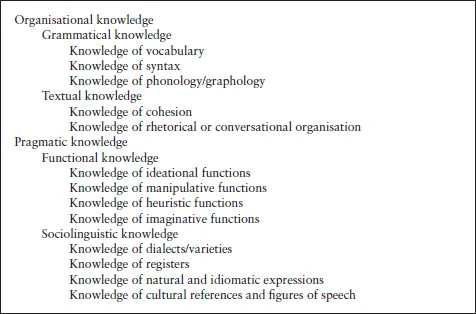
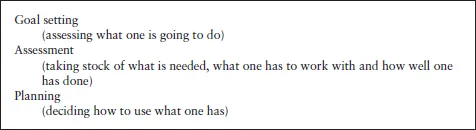
Bachman and Palmer further list the constitutes of the two components of language ability, which are presented in Figure 1.1 and Figure 1.2.
Figure 1.1 Areas of Language Knowledge
Figure 1.2 Areas of Metacognitive Strategy Use
The strategic competence is placed at the heart of the whole process of language use in Bachman and Palmer’s model. They define it as a set of metacognitive strategies which are executive processes regulating language use by managing the interaction of various components of the process, language knowledge being only one of them.
The interesting new development in this model of language use and language test performance consisted in including both topical knowledge and affective schemata, the latter defined as “affective and emotional correlates of topical knowledge” (p. 65) which determine the language user’s affective response to the language use situation and which can influence his or her linguistic reaction to it. Emotional response can have a facilitating or debilitating effect on the user. Yet, as pointed by McNamara (1996, p. 74) the understanding of the precise functioning of the affective schemata in relation to performance is still very crude.
The language ability, as conceptualised by Bachman and Palmer has also been referred to by other researchers as language proficiency. For example, Thomas (1994, p. 330, footnote 1) defines language proficiency “a person’s overall competence and ability to perform in L2”. A more in-depth elaboration of the concept of language proficiency was provided by Hulstijn (2011):
Language proficiency (LP) is the extent to which an individual possesses the linguistic cognition necessary to function in a given communicative situation, in a given modality (listening, speaking, reading, or writing). Linguistic cognition is the combination of the representation of linguistic information … and the ease with which linguistic information can be processed (skill)… . Linguistic cognition in the phonetic-phonological, morphonological, morphosyntactic, and lexical domains forms the center of LP (core components). LP may comprise peripheral components of a less-linguistic or non-linguistic nature, such as strategic or metacognitive abilities related to performing listening, speaking, reading or writing tasks.
(Hulstijn, 2011, p. 242; emphasis in original)
Clearly, all the notions already discussed: Hymes’s (1972) communicative competence, Bachman and Palmer’s (1996) language ability and Hulstijn’s (2011) language proficiency relate to the same construct which—according to the researchers—consists of two main components termed by the authors as: knowledge of language, language knowledge or linguistic cognition; and, on the other hand, ability for use, strategic competence, or strategic or metacognitive abilities. Yet, while for Hymes the two components seem equally important, Bachman and Palmer place the strategic competence in the centre of their model, and Hulstijn treats strategic or metacognitive abilities as peripheral constituents of the construct. Nevertheless, the researchers agree that this latter element of the construct is not a purely linguistic faculty and includes broader cognitive and affective factors. Its exact nature is not well understood, which was best commented on by McNamara (1996):
Language know...