- 288 pages
- English
- ePUB (mobile friendly)
- Available on iOS & Android
eBook - ePub
About this book
The Alpha Enterprise explores the development, growth and impact of the most widely used evangelising programme of recent decades. The Alpha course is run in over seven thousand churches in the UK and over five thousand in the USA. Across the world some four million people have graduated through the course in over 80 countries. Alpha is truly the fastest growing evangelising initiative, creating widespread support as well as stirring strong criticism. Stephen Hunt critically examines the content and working philosophy of the Alpha course through the experiences of the churches that have run it, as well as the individuals who have experienced it first hand. Hunt charts the history of the programme, its use of group dynamics and media, how it links with the charismatic movement, how it deals with issues such as homosexuality, how it is run not only in churches but in prisons and universities too, and concludes by measuring Alpha's impact and success. Engaging with debates regarding postmodernity, globalisation, McDonaldisation, consumerism, and secularisation, and based on real-life surveys, The Alpha Enterprise sheds new light not only on evangelism but on contemporary Christianity in general and how it engages with a post-Christian culture.
Information
Chapter 1
Alpha: Developments So Far
The Reach of Alpha
Alpha has to be put in historical perspective. As an evangelizing enterprise it proved to be a rather late contribution to the so-called ‘Decade of Evangelism’ of the 1990s. As the century closed, Alpha was regarded by many church leaders in the UK as the most important initiative of its time. The Decade of Evangelism initially amounted to a large-scale evangelizing effort by UK churches and was perhaps most noteworthy because of its monumental failure to win the converts that it sought and hence to reverse the decline of the churches and restore their fortunes lost in the post-war years. Yet the UK initiative was spurred not only by declining church attendance, but also by an appeal for a global mission from wider quarters. The call for world-wide ‘evangelization’ had first been ventured by Pope John Paul as part of a dedication to the Christian mission and commitment leading up to the second millennial celebration of Christ’s birth. The Decade of Evangelism was the Christian response in the UK. Tentatively supported by the Archbishop of Canterbury and enthusiastically validated by Protestant evangelicals (perhaps wishing to match the efforts of the Catholic church), the Decade of Evangelism attempted to combat but also constructively engage with the secular forces of the contemporary world.
Most of the previous outreach programmes (largely based on leafleting and poster campaigns) put together during the 1990s as part of the Decade of Evangelism, were ill-conceived and ineffectual. They often embraced only one method of evangelism, and conspicuously failed to understand the nature of society today — its level of disbelief, secularity, plurality, and prevailing cultural trajectories. Alpha followed a number of these other rather unsuccessful evangelizing initiatives that surfaced in the early/mid-1990s. Probably the two most noteworthy endeavours were Minus to Plus, whose title clearly recognized church attendance decline, and Jesus in Me (JIM) instigated by the Pentecostal denominations Elim and the Assemblies of God. Despite the effort and finances poured into them, such evangelistic forays into the disbelieving world appeared marginal and inept.
Rather ironically, it was two leading personalities of the Pentecostal churches who instigated these initiatives by departing from the narcissistic preoccupation with the pentecostal experience and all things related to the charisma that had dominated evangelical life since the 1980s. In doing so, they also turned their backs on the much-vaunted evangelizing formula of the soul-winning crusade. Wyn Lewis of the Elim denomination headed up JIM. It cost several million pounds to initiate and underscored the fact that large-scale evangelizing outreaches require money and plenty of it, but its posters and pictures proved too enigmatic and the language too archaic to impact upon the secular world.
The second initiative, Minus to Plus, was the brain-child of the South African evangelist, Reinhard Bonnke. Minus to Plus involved the distribution of a booklet which was posted through the letterboxes of millions of householders in the UK and subsequently to other countries in Western Europe. It was Christian tract, but clearly contemporary Christian tract. However, without ‘the human touch’ of contact through a church, it largely proved to be a failure – certainly in terms of winning converts. It is noteworthy, nonetheless, that Minus to Plus, with its designated aim of increasing church attendance, was also locked in several prophecies emerging from a number of leading neo-Pentecostal churches, at least from their leaders or self-designated prophets. These prophecies spoke of an impending world revival, which would commence in the UK and then spread to all other nations. Bonnke had uttered such prophecies himself and they were made known as he led a number of crusading conventions in Western Europe to launch Minus to Plus. In the UK he shared a platform in the autumn of 1994 at the Central Methodist Hall, London, with key figures in the charismatic churches – both from the mainline denominations and the so-called ‘New Churches’. There was much talk of revival, of possibly the last revival before the Second Coming of Christ. This hope born in Christian eschatology might seem very remote from the more realistic and sober language of much of the Alpha programme but there is a certain continuity, as we shall explore below.
Minus to Plus aimed at winning 250,000 converts. In the event only some 20,000 souls were won over, many of whom were believed to be those returning to the faith rather than discovering it for the first time. It goes without saying that this failure scotched the erroneous prediction of a coming revival, but this was not the end of the efforts of the evangelical constituency. Enter Alpha, fully endorsed by the Evangelical Alliance – the umbrella organization for the majority of evangelical (mostly charismatic) churches in the UK. It promised much towards the end of the 1990s with its fresh approach and simple design and was prepared to learn from the mistakes of the earlier evangelizing initiative. It also had a fair amount of financial support and that other vital ingredient for the evangelizing effort, an abundance of soul-winning enthusiasm.
In September 1998, over 4,000 churches came together to launch the first £1 million so-called national Alpha initiative. This was some three years after the churches were first encouraged to adopt the Alpha programme by its founders at Holy Trinity, Brompton. Towards the end of 1998 nearly 2,000 billboards were posted in towns and cities nationwide, while advertising space was taken out in hundreds of national and local newspapers. As far as publicity was concerned, this was the turning point for Alpha. Given the high profile, it was undoubtedly a success in that the non-churched increasingly became aware of Alpha’s existence even if they had not signed up in any great number.
Alpha’s Appeal
Alpha’s appeal has also proved to be universal. Over 7,000 churches in the UK now sponsor the programme. In addition, there are allegedly nearly 20,000 courses running world-wide in approximately 130 countries. On a global scale Alpha is believed to have attracted almost 3 million people to its programme, the figure provided by Alpha News.1 The same edition stated that 4 million people in the UK ‘have either done the course or know someone who has’. These are estimates and rounding off statistics in an upward` direction obviously forges good impressions.
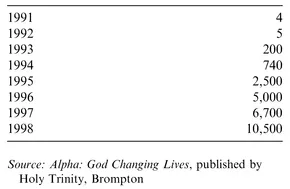
Despite such tendencies of self-aggrandisement, the growth of Alpha since 1998 has undoubtedly been phenomenal. If Christ had given the command for the gospel to be preached all over the world, then Alpha was seen as a major vehicle for doing so – a unique package of evangelism exported on a global basis. Hence, Alpha courses steadily proliferated from the mere four ran at Holy Trinity in 1991, to 200 in 1993, rising to 2,500 in 1995, and advancing to 10,500 as a result of the national initiative in 1998.2 Interestingly, however, in November 2001 Alpha News stated that 7,300 courses were running in the UK. This might suggest that the 1998 national initiative marked the height of Alpha’s impact in the churches.
Table 1.1 Number of Alpha courses in the UK
Alpha has unquestionably developed rapidly over the last few years. The first national initiative of 1998 was aimed at bringing the programme to saturation point in order to enhance a greater public awareness of what it had to offer. Those who put Alpha together were well aware that people outside of social networks which fed into the churches through friends, relatives, neighbours and work associates, were not being contacted. This meant that a fair proportion of the population were failing to be reached with the gospel message and that those who knew of Alpha did so mostly through association with people already in the church. The national initiative of Alpha therefore marked an attempt to supplement personal contacts, as valued as they were, with saturation advertising in order to reach those previously untouched. The newly-established aim was to develop large-scale advertising through high-street posters and the comprehensive leafleting of homes and, in doing so, it was hoped to reach a wider section of the population. By supporting the rather vague messages that the posters carried, every house in the UK was meant to be leafleted in order to provide more details about Alpha and stipulate points of contact. The latter did not quite come to fruition. Nonetheless, many national initiatives since 1998 have carried the same strategy of media saturation.
UK churches have certainly tried hard to promote Alpha and sustain its high profile. In September 1998, over 4,000 churches (all supposedly contributing £100 to the campaign) of the major denominations came together at London’s Docklands Arena to launch the first £1 million national initiative. In the weeks which followed more than 1,700 large posters were displayed nationwide, while smaller posters were placed on church notice-boards. Approximately 5,500 poster sites in total were set up. At the same time, 4.5 million invitations to attend Alpha courses were distributed in the form of leaflets through letter boxes, supplemented by advertisements in 850 local newspapers across the country in addition to those in several national newspapers. Free nationwide publicity was also given to the campaign by television and radio stations in the UK. ITV’s flagship news programme ‘News at Ten’ carried the Alpha national initiative as a major news item, and BBC1 devoted an entire edition of ‘Songs of Praise’ to its launch.
Although the campaigns associated with the Decade of Evangelism had failed spectacularly to return people to the churches, Alpha at least offered the promise of human contact and gave them something to ‘jump off onto’ rather than mere media advertising. The problem was that there was no contact address displayed on the large billboards: ‘The Alpha course. Starting at a church near you’ was (and remains) as close as things got to specifics. The initiative then appeared to lay with the ‘customer’ – or what Alpha refers to as the ‘guest’. Yet the poster campaign epitomized a fresh strategy since it marked a new way of thinking about communicating with the public. Posters did not include quotations of biblical text. There was no call to repentance. Rather they were deliberately designed to be eye-catching, challenging and tended to be rather zany. Local and national newspapers also carried other provocative inducements to discover the Christian faith:
Job, Flat, Car, Girlfriend, Season ticket to United. Still not Satisfied?
You’re born. You live. You die. End of story?
An Opportunity to Explore the Meaning to Life.
Christianity: Boring, Untrue and Irrelevant?
Alpha into the Twenty-first Century
In September 2001 the fourth annual ‘Alpha Initiative’ was launched. It was the first in which no voluntary contribution was requested from the 7,000 or so churches that subscribed to Alpha in the UK. Instead, the money had been raised from the ‘Alpha Partners’, a group of private donors, churches and trusts. Holy Trinity, Brompton, itself contributed £2 million towards the running costs. As part of the new national campaign hundreds of churches also took part in the nationwide so-called Alpha Supper Prayer Initiative, when over 300 meetings were organized.
The 2001 national Alpha Initiative amounted to the largest ever poster campaign. The face of black Alpha course leader Ade Adebajo was chosen as the main image this time. Pictured with his head thrown back and laughing, Adebajo appeared on 1,500 major billboard sites in the UK, 75 London underground stations, 3,000 buses, hundreds of thousands of leaflets and brochures. Other images showed a happy group of people of various ages and this undoubtedly was meant to indicate that all were welcomed and that Alpha had a broad appeal to every section of society, the old and young, all ethnic groups, men and women, people in different occupations, and the less well off alongside the more affluent.
The 2001 initiative was also expected to be boosted by the 10-week national television documentary on the independent channel which began in July of that year – ‘Alpha: Will it Change Their Lives?’ – hosted by the well-known and respected personality Sir David Frost. It proved to be a non-critical, mostly highly favourable approach that was programmed extremely late on Sunday evenings and therefore had relatively low viewing figures. Around 2.3 million people switched on to the first programme which was succinctly described by Frost as ‘Big Brother meets the New Testament’. Viewing figures settled down at under one million – allegedly, according to Alpha News, because of the late scheduling.3 Undoubtedly its late coverage ultimately said something, perhaps most obviously that the television company anticipated Alpha would have a very limited appeal. This did not prevent Alpha News from claiming that the ten young people who had taken the televised course were so inspired by Alpha as to either become committed Christians, embarked on a spiritual journey, or simply that participation ‘changed their attitude to life’.4
The impact of Alpha is by no means restricted to churches in the UK. Even before the launch of the 1998 national campaign, the programme had taken on global dimensions and was soon running in 75 countries by the end of that year. In mid-1999, its organizers claimed that there were 11,430 Alpha courses established internationally; in total over one million people across the world had passed through the programme since 1995, a further half a million by 1999, doubling to 3 million by 2002.5 By the end of 2003 the figure of those graduating through Alpha may well have been nearer 4 million.
Outside of the UK, Alpha courses have been set up in Eastern Europe including Albania, Romania, and other former Soviet bloc nations which were starved of religious expression under decades of communist rule. Farflung places such as Australia, Latin America, the Far East, and sometimes more remote regions of the world, have also embraced Alpha. Where it has performed especially well however is, perhaps predictably, in the USA. Thousands of Alpha courses have been set up, thus establishing North America as the major growth area for the programme in recent years. At first its spread was largely through the highly successful global network of USA churches, the Association of Vineyard Churches with which Holy Trinity, Brompton, and other major evangelical churches in the UK had developed a close contact since the early 1980s. Indeed, Vineyard as a ‘movement’ had in its own right impacted powerfully on the charismatic ‘scene’ for nearly two decades. Its closeness to charismatic Anglican circles in particular had further developed with the renowned evangelical, the late David Watson, who was befriended by Vineyard’s then leader John Wimber. The dissemination of Vineyard’s teachings and practice followed the influential Third Wave conference at Methodist Central in 1983 – an event which attracted national denominational representation.
More recently Alpha, through the active work of Holy Trinity and its associates, has expanded to thousands of other churches in the USA. Over 3,500 American churches were registered in early 2002 as running Alpha courses compared to 2,300 in September 2001. According to the Alpha website this had risen to 5,000 churches by the end of 2003, with over a million people having graduated through the programme. Something of an Alpha craze has struck America and, as with most else in the country, Alpha is on a bigger scale. The largest-ever Alpha conference with 1,500 church leaders gathered in Boston. It was just one of the 40 Alpha conferences taking place throughout America during 2001.6 These are early days for the USA as far as Alpha is concerned and despite its apparent ready acceptance the course remains fairly limited to the Vineyard churches and their fellow passengers, as well as mainline churches of a typically charismatic orientation. Many other churches, however, including those of a more traditional fundamentalist persuasion, remain largely outside of its influence. Nevertheless, according to the Alpha website, leaders of some of the largest churches and ministries in the USA, along with respected theologians, are increasingly endorsing Alpha and the site boasts complimentary quotes from a variety of Christian celebrities including Bill Hybels, J.I. Packer, Luis Palau and Jack Hayford.
Indicative of Alpha’s international appeal is its sale of books and other material supporting the course. Most have been written by Nicky Gumbel who heads the Alpha initiative and has largely devised it. Questions of Life (Kingsway Publications), Gumbel’s first and best-selling book on the Alpha course, has been on sale since July 2001 in high-street mainstream bookshops as well as the usual Christian outlets. The book has sold more than 500,000 copies (150,000 in the USA) around the ...
Table of contents
- Cover
- Half Title
- Title
- Copyright
- Contents
- List of figures and tables
- Foreword
- Introduction
- 1 Alpha: Developments So Far
- 2 Alpha: Towards a Sociological Framework
- 3 The Charismatic Movement and its Significance for Alpha
- 4 The Alpha Programme
- 5 Critical Views of Alpha
- 6 The Survey in the Churches
- 7 The Group Dynamics of Alpha
- 8 Searching Issues
- 9 The Supply-side of Alpha
- 10 Who Joins Alpha?
- 11 Is Alpha Working?
- 12 Alpha in the 'Hard Places'
- 13 Is Alpha Homophobic?
- 14 Holy Spirit Weekend
- Conclusion
- Appendix
- References
- Index
Trusted by 375,005 students
Access to over 1.5 million titles for a fair monthly price.
Study more efficiently using our study tools.
Frequently asked questions
Yes, you can cancel anytime from the Subscription tab in your account settings on the Perlego website. Your subscription will stay active until the end of your current billing period. Learn how to cancel your subscription
No, books cannot be downloaded as external files, such as PDFs, for use outside of Perlego. However, you can download books within the Perlego app for offline reading on mobile or tablet. Learn how to download books offline
Perlego offers two plans: Essential and Complete
- Essential is ideal for learners and professionals who enjoy exploring a wide range of subjects. Access the Essential Library with 800,000+ trusted titles and best-sellers across business, personal growth, and the humanities. Includes unlimited reading time and Standard Read Aloud voice.
- Complete: Perfect for advanced learners and researchers needing full, unrestricted access. Unlock 1.5M+ books across hundreds of subjects, including academic and specialized titles. The Complete Plan also includes advanced features like Premium Read Aloud and Research Assistant.
We are an online textbook subscription service, where you can get access to an entire online library for less than the price of a single book per month. With over 1.5 million books across 990+ topics, we’ve got you covered! Learn about our mission
Look out for the read-aloud symbol on your next book to see if you can listen to it. The read-aloud tool reads text aloud for you, highlighting the text as it is being read. You can pause it, speed it up and slow it down. Learn more about Read Aloud
Yes! You can use the Perlego app on both iOS and Android devices to read anytime, anywhere — even offline. Perfect for commutes or when you’re on the go.
Please note we cannot support devices running on iOS 13 and Android 7 or earlier. Learn more about using the app
Please note we cannot support devices running on iOS 13 and Android 7 or earlier. Learn more about using the app
Yes, you can access The Alpha Enterprise by Stephen Hunt in PDF and/or ePUB format, as well as other popular books in Theology & Religion & Religion. We have over 1.5 million books available in our catalogue for you to explore.