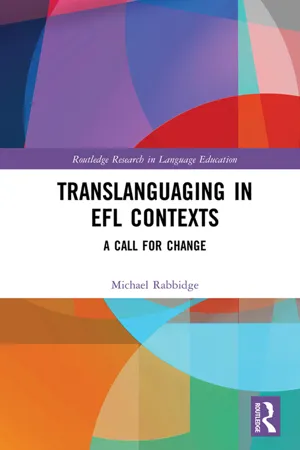
The purpose of this book is to promote the value of translanguaging in EFL teaching contexts. To date, translanguaging has been discussed mostly in regards to US and European contexts. This book will examine the teaching beliefs and practices of teachers within a South Korean elementary school context to evaluate the practices of current teachers who use translanguaging strategies when teaching. This examination utilizes sociological theories of pedagogic discourse to discuss the consequences of language exclusion policies on the peninsula. Using these theories, it presents an argument for why EFL contexts like South Korea need to reevaluate their current policies and understandings of language learning and teaching. By embracing translanguaging as an approach, the author argues, they will transform their traditional notions of language learning and teaching in order to view teachers as bilinguals, and learners as emerging bilinguals, rather than use terms of deficiency that have traditionally been in place for such contexts. This book's unique use of sociological theories of pedagogic discourse supports a need to promote the translanguaging ideology of language teaching and learning.
- 194 pages
- English
- ePUB (mobile friendly)
- Available on iOS & Android
eBook - ePub
About this book
Information
1
Evolving understandings of language in the language classroom
Introduction to the chapter
This chapter provides an overview of the traditional scholarship of different language use in language learning settings. The way languages are described during this review reflects traditional understandings of languages, namely, separate entities that exist within the user. These descriptions are seen in the use of terminology such as first language, or L1, and target language, or TL. These terms are initially used as acknowledgements of theories that have dominated language learning over the last century. By the end of the chapter, I will explain why such terminology needs to be replaced with theories of language that promote inclusiveness rather than division.
English learning contexts
English as foreign language teaching (EFL) contexts are typically characterized as those in which English language learners study English almost exclusively in the classroom. They differ from English as second language (ESL) contexts in that learners in ESL contexts also have considerable interaction in English within the community. English learners in EFL contexts have significantly less exposure to, and interaction in, English, and therefore are said to need language lessons which optimize exposure to English. These generalizations of EFL and ESL contexts do nothing to account for the variations found in different cities and different countries around the world where English is learned or used. Different contexts vary in terms of teacher/student ratios, hours of class time per week, physical settings including available resources such as technology and teaching materials, not to mention the adopted teaching philosophies and practices that influence the actions of teachers in these contexts (Block, 2003). The overreliance on generalizations is a key failing of many policy makers. This failing is evident in the way many policy makers in countries where English is a foreign language have adopted second language acquisition theories that originated in ESL contexts. Policy decisions on the role a first language (L1) can play in second language learning are just one example of this failure to critically evaluate the appropriateness of a given teaching theory. Over the last decade or so, EFL countries, including but not limited to South Korea, have established government-initiated policies that seek to ban or minimize the role of the L1 in the class in order to maximize exposure to English. These policies are reactions to trends in second language acquisition and learning theories established predominantly in English-speaking countries, or ESL contexts (Hall & Cook, 2012; Mahboob & Lin, 2016; McKay, 2009). The negative value given to the L1 within ESL contexts was assumed to apply to EFL contexts, and little consideration was put into examining the uniqueness of EFL contexts and how second languages might be learned effectively in these contexts.
Theories of influence
What are these theories that are so influential in EFL contexts such as South Korea? The principal idea is that the exclusive use of the TL, primarily English, is necessary in order to provide a context for learners to communicate in a more meaningful and authentic manner in EFL environments. The more TL input available, the better. Conducting classroom management and organization in the TL is considered a must as it adds to the overall input of the TL (R. Ellis, 1988).
The belief is centred on the idea that competence in the foreign language is best realized by creating a rich TL environment that uses the TL not only for instruction, but also for discipline and management (Chaudron, 1988). It is claimed that in ESL classrooms, TL used for these functions is inevitable (R. Ellis, 1988); however, in EFL environments, this does not always occur due to teacher beliefs about how the L1 facilitates language-related learning goals within lessons. Other claims focus on how L1 use devalues the input of the TL. Support for monolingual teaching methodologies suggest that a TL-only methodology allows for more interaction and negotiation of meaning in the TL (Long, 2000; Pica, 2002), which can allow learners to adopt the language for their own communicative and sociocultural needs (Lin, 2000).
Central to most discussions on language teaching methods since the inception of the direct method has been the place of the L1 in the communicative classroom, and whether or not it should be included. This question of L1 use was one of the tensions central to the teaching approach known as communicative language teaching, or CLT. Although there is no theoretical support to exclude the L1 from a communicative classroom (Widdowson, 2003), the use of the L1 is seen to undermine one of CLT’s fundamental principles: that language can be learned and skills acquired via communicating in the TL (Macdonald, 1993).
Psycholinguistics theories
Second language acquisition theories cited as support for L1 exclusion language teaching methods and policies include Krashen’s Input Hypothesis (Krashen, 1985), Long’s Interaction Hypothesis (Long, 1983, 1996) and Swain’s Comprehensible Output Hypothesis (Swain, 1985, 1995). Krashen’s Input Hypothesis distinguished between acquisition and learning, with the former being an implicit and unconscious act, and the latter an explicit and conscious act. It claimed that TL learning occurred via a natural order of acquisition based on understanding linguistic items a little bit beyond their current competence (i + 1). It also required learners to be affectively disposed to accepting the input they comprehend. The input was made comprehensible via simplification of language as well as contextual and extra linguistic clues. Additionally, it made the claim that learner speaking, or output, does not contribute directly to acquisition. The theory received a number of criticisms involving the nature of comprehension (Faerch & Kasper, 1986; Gass, 1988; Smith, 1986) and its necessity for acquisition (White, 1987). Krashen failed to define what type of comprehension processes were required for acquisition, something that Carroll (1999) pointed out as being necessary for any account of the role of input in acquisition. Long’s Interaction Hypothesis, influenced partly by Krashen’s hypothesis, claimed that incidental language acquisition was facilitated by engaging in interpersonal oral interactions, where communication problems arise and are then negotiated. Like Krashen, Long acknowledged that when simplified, input and context can facilitate language acquisition. Both theories have been used to explain the need to avoid L1 use in the classroom based on the idea that students require opportunities to interact and negotiate in the TL in order to facilitate TL acquisition.
But are they applicable?
Rarely mentioned, however, is the fact that a lot of the research done on these theories took place in laboratory conditions, away from natural classroom contexts, let alone EFL contexts (Krashen, 1985; Long, 1981, 1983). Classroom contexts involve complex sociocultural influences that are not realized in laboratory-like research. In addition to this, most of the observed interactions were between adult native speakers and non-native speakers of English. Classroom interactions often involve a large variety of interactions that have not been accounted for in these studies, including but not limited to: interactions between students who share a common L1, students of differing second language aptitude, and the different age groups present in different classroom contexts. These are important considerations when attempting to explain how theories of language acquisition can be used in differing contexts.
If not input, then output?
A third strand of research used to support L1 exclusion is derived from Swain’s Comprehensible Output Hypothesis (COH) (1985, 1995). Swain agreed that input was important during acquisition, and if the input was comprehensible, then more attention could be on linguistic forms. However, in contrast to Krashen’s earlier hypothesis, Swain placed a great deal of emphasis on the role of output in interaction. Swain’s study of French immersion students (1985) suggested that students did not demonstrate native-like productive competence because of limited comprehensible output. In essence, students who were not given adequate time in class to use the target language did not learn to speak the language. Additionally, students needed to be ‘pushed’ (p. 249) to produce language that more accurately reflected their intended meaning. The being ‘pushed’ concept was considered the equivalent of the i + 1 concept of the comprehensible input. Output forces learners to pay attention to the bottom-up syntactic processing, as opposed to the more semantic top-down processing, of language. Output also allows learners to practice what they already know, helping to automatize discourse and linguistic knowledge (Skehan, 1998). However, criticisms of COH focused on how, or if, output or modified output actually plays a role in TL acquisition (R. Ellis, 2012).
Hegemonic ideologies
The use of these theories to restrict or ban L1 use is prevalent in EFL contexts throughout Asia, even though the studies themselves were largely based in ESL contexts or in contexts where the target language was not English. The application of these theories was a result of a fundamental lack of comprehension of the variances existing within EFL contexts and was part of a larger understanding of how to best teach a second language. Unfortunately, underpinning this push were ‘hegemonic ideologies’ (Mahboob & Lin, 2016, p. 6) based on fallacies in English language teaching, of which monolingualism was a major component (Phillipson, 1992). Minimal efforts have been made to utilize knowledge gathered from bilingual/multilingual contexts (García & Wei, 2014; Kachru, 1994), and there has been an overreliance on research framed within ‘monolingual speaker norms’ (May, 2011, p. 1). This has led to descriptions of learners in terms of deficit, and a tendency to ignore sociolinguistic and cultural influences within EFL contexts (Kachru, 1994; May, 2011). These theories of second language learning and acquisition were imposed upon EFL contexts via the establishment of teacher training colleges which espoused these methodologies and theories as part of the modern aesthetic of the times (Belz, 2003). The psycholinguistic perspective of how SLA occurs dominated discussions on how to best teach in EFL contexts and reflected attitudes to SLA which held the power and control at the time (Kachru, 1994).
The influence of the predominantly psycholinguistic perspectives on SLA have had profound influences on government policies in EFL contexts such as China, Japan, and South Korea. The rise of globalization and emerging ideological, sociocultural, and educational trends have impacted the decision-making processes in these countries (Hu & McKay, 2012), leading to an influx of native English speakers to teach English in both formal and informal teaching situations. This influx has coincided with policies which restrict or outright ban the first language in English classrooms. This situation still persists today in many countries despite the growing interest in sociolinguistic theories of SLA. The limited progress made by sociolinguistics in these countries is due in part to the disciplines of SLA that ‘construct, validate, contain and exclude particular forms of knowledge’ (May, 2011, p. 236) into academic and disciplinary hierarchies which inherently favoured some forms of knowledge over others.
The L1 prevails
Despite the dominance of psycholinguistics in SLA, and the agreed-upon preference for monolingual approaches to language teaching from SLA textbooks (Jenkins, 2006) and English teaching textbook publishers, the use of the L1 in EFL environments prevails (Cook, 2008). Research into L1 use draws upon a range of different perspectives. This research includes theories of cognition and learning, concepts of power and classroom management, and the search for an optimal own language use, as well as the roles of teacher and student beliefs about L1 use in TL learning.
In the last decade, re-conceptualizations of bilingual and multilingual competencies and cognitions have led to an increased belief of the positive role that the L1 can have in the second language classroom. While still acknowledging that learners require a significant amount of exposure to and practice of the TL, psycholinguistic and sociocultural theories brought together by a sociolinguistic view of a bilingual classroom began to acknowledge the value of a more principled approach to L1 inclusion (V. Cook, 2002; Edstrom, 2006; Turnbull & Dailey-O’Cain, 2009).
The social turn
A social turn (Block, 2003; Hall & Cook, 2012) withi...
Table of contents
- Cover
- Half Title
- Series Page
- Title
- Copyright
- Dedication
- Contents
- Introduction: from the beginning
- 1 Evolving understandings of language in the language classroom
- 2 The framework
- 3 Beliefs, identity, and investment
- 4 Profiling the teachers
- 5 Translanguaging strategies of inclusion
- 6 Translanguaging practices of exclusion
- 7 Linguistic repertoires: their origins and impact on pedagogic discourse
- 8 Translanguaging’s call for change
- Index
Trusted by 375,005 students
Access to over 1.5 million titles for a fair monthly price.
Study more efficiently using our study tools.
Frequently asked questions
Yes, you can cancel anytime from the Subscription tab in your account settings on the Perlego website. Your subscription will stay active until the end of your current billing period. Learn how to cancel your subscription
No, books cannot be downloaded as external files, such as PDFs, for use outside of Perlego. However, you can download books within the Perlego app for offline reading on mobile or tablet. Learn how to download books offline
Perlego offers two plans: Essential and Complete
- Essential is ideal for learners and professionals who enjoy exploring a wide range of subjects. Access the Essential Library with 800,000+ trusted titles and best-sellers across business, personal growth, and the humanities. Includes unlimited reading time and Standard Read Aloud voice.
- Complete: Perfect for advanced learners and researchers needing full, unrestricted access. Unlock 1.5M+ books across hundreds of subjects, including academic and specialized titles. The Complete Plan also includes advanced features like Premium Read Aloud and Research Assistant.
We are an online textbook subscription service, where you can get access to an entire online library for less than the price of a single book per month. With over 1.5 million books across 990+ topics, we’ve got you covered! Learn about our mission
Look out for the read-aloud symbol on your next book to see if you can listen to it. The read-aloud tool reads text aloud for you, highlighting the text as it is being read. You can pause it, speed it up and slow it down. Learn more about Read Aloud
Yes! You can use the Perlego app on both iOS and Android devices to read anytime, anywhere — even offline. Perfect for commutes or when you’re on the go.
Please note we cannot support devices running on iOS 13 and Android 7 or earlier. Learn more about using the app
Please note we cannot support devices running on iOS 13 and Android 7 or earlier. Learn more about using the app
Yes, you can access Translanguaging in EFL Contexts by Michael Rabbidge in PDF and/or ePUB format, as well as other popular books in Education & Education General. We have over 1.5 million books available in our catalogue for you to explore.