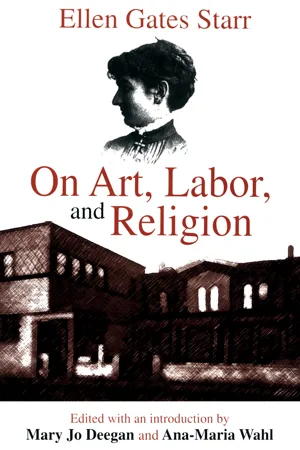
Chicago was a tumultuous and exciting city in 1889. Immigration, industrialization, urbanization, and politics created a vortex of social change. This lively chaos called out for both celebration and reform, and two women, Ellen Gates Starr and Jane Addams, responded to this challenge by founding the social settlement Hull House. Although Addams is one of the most famous women in American history and a major figure in sociology, Starr remains virtually unknown. On Art, Labor, and Religion is the first anthology of Starr's writings and biography and makes evident her contributions to national and international sociological thought and practice.
- 342 pages
- English
- ePUB (mobile friendly)
- Available on iOS & Android
eBook - ePub
On Art, Labor, and Religion
Part 1
Art and Labor
1
Art and Public Schools1
"For all modern communities the decision as to whether art shall be used in education is of much importance. It is, in fact, a decision as to whether the people shall be barbarian or civilized."
—T. C. Horsfall
"The only recovery of our art power possible—nay, when we know the full meaning of it, the only one desirable—must result from the purification of the nation's heart and the chastisement of its life; utterly hopeless now, for our adult population, or in our large cities and their neighborhoods. But so far as any of the sacred influences of former design can be brought to bear on the minds of the young .... the foundation of a new dynasty of thought may be slowly laid.
—John Ruskm
"I was strangely impressed by the effect produced in a provincial seaport school for children .... by the gift of a little colored drawing of a single figure from the Paradise of Angelico. The drawing was wretched enough, seen beside the original, .... but to the children it was like an actual glimpse of heaven; they rejoiced in it with pure joy, and their mistress thanked me for it more than if I had sent her a whole library of good books."
—John Ruskin
With this short gospel of art according to Ruskin,2 I should be content to leave the subject, could I get it universally understood, believed and acted upon, for, to my mind, it contains, in brief, almost the whole "body of truth" concerning the necessity for good pictures in schools. But in order that it may be understood, believed and practiced by practical people it must needs be not only definitely preached but demonstrated by those already convinced of its truth and importance.
Feeling deeply that children, and especially the children of large towns, who are debarred the enjoyment and developing power of daily association with nature and beautiful buildings, ought not to be deprived of what good pictures can do, not by supplying their places, but by creating an image of them in the mind, I began, last year, to make a collection of such pictures within my reach as seemed to me valuable for schools. The first of these, mostly photographs of buildings of architectural and historic value, I gave to the public school [Jones] nearest Hull-House. After that it seemed better to form sets of pictures to be lent to schools and periodically exchanged, and I began getting together pictures on this plan.
It was my privilege, last May [1892], to be the guest of Mr. T.C. Horsfall, of Swanscoe Park, near Manchester, England, who has been so active in the cause of supplying the schools of Manchester with circulating collections of pictures. He has taken infinite care that these collections shall have their full educational value by means of an admirable and elaborate system of arranging and labeling them, and by constant reference, in these labels, to pictures in the [Manchester] Art Museum and to those natural beauties which still remain within such distance from Manchester as may be reached on a holiday.
From Mr. Horsfall I received many most valuable suggestions, not a few of which might be carried out in our schools.
Great self-control should be exercised in the selection of pictures for schools. The temptation is strong toward deciding unadvisedly that a thing "will do," or is "better than nothing." It was certainly better than nothing for the children in the seaport school, who could not see Angelico's Paradise, to see a colored drawing of it; the more faithful the drawing the better for the children. It was better than nothing because the original of the drawing was entirely good for them, and because the drawing retained some of the qualities which made it so. To decide when the reverse is the case—that is, when the obtainable copy is either a worthless one, or of a worthless original, requires a considerable knowledge of pictures. Pictures for school should certainly not be selected by incompetent judges. It should be remembered that, though a given picture may do something for a child's mind, a better would do more; and that, though the first object is, indeed, to secure the child's attention and interest; the second is to direct them somewhither for profit. It is a legitimate object to entertain and recreate the mind, but care must be taken to recreate it, indeed, into a more faithful image of its Source.
There is great difficulty in getting good color. Colored prints are sometimes "better than nothing." They give some kinds of information about the represented thing but they rarely convey its spirit, and do little or nothing for the art instinct of the child. As soon as a machine intervenes between the mind and its product, a hard, impersonal barrier—a nonconductor of thought and emotion—is raised between the speaking and the listening mind. It is not impossible, however, to get good water color drawings of flowers, and other natural objects. Several have been given me for the school collections, and I have good hope that, when once the attention of artists is called to the necessity for good pictures in the education of children, they will often be willing to contribute them for the purpose.
Necessity may seem too strong a word, unless one reflects how barren would be all literature to one who had no acquaintance with nature. Mr. Horsfall, in his paper entitled "The Use of Pictures in Schools,' read to the Manchester branch of the Teachers' Guild, says:
The finest literature of all countries is so saturated with the influence of the knowledge of nature that a very large part of its meaning—nearly all that part of its meaning apprehension of which is perception of its beauty—exists only for those who have the knowledge. If literature is to be the means of evoking admiration and love in those who read it, they must know the fields and woods, the flowers and trees of which so many of the words of prose and poetry are but symbols. Till a considerable degree of education has been reached, words by themselves cannot convey ideas, or touch powers of thought or feeling [italics in original].
This much to be desired knowledge and love of nature is not to be acquired through pictures alone. The chief motive in supplying schools with pictures of natural objects, is that a sufficient amount of pleasant curiosity about them may be excited in the minds of children to induce them to notice and admire such as do come into their experience; which, again, will give increased pleasure in the pictures.
Following love of nature it is desirable that it be made possible to young people reasonably to admire the work of man. To those who rarely or never see a beautiful building, pictures of noble architecture and lovely streets, such as the streets of Venice or Verona, the cathedrals of Canterbury, Lincoln, Rheims or Amiens [seeRuskin 1895/c. 1858,I and II], may speak a new truth; indeed many new truths. It is my wish to combine as much teaching, and of as many different kinds as possible in these school pictures. For example: I have had framed many photographs and other reproductions of the buildings and streets of Venice. There have also been given and lent me, paintings in oil and water color which add color to the otherwise sadly defective idea which a child could form of Venice. In order that the group may have its full possible value to the children, their teachers should be able to tell them something of the history of the city, and the men who made it great. Something of this may be accomplished by the descriptive labels.
A third most important function of pictures is that of arousing in the mind of the child and youth, love and admiration for truly great men and women, and making them real to him. I wish a really good picture of Abraham Lincoln might be in every schoolroom in the land. I know of no really good portrait of him which is not too expensive. If some photographer would take a large and fine photograph of Mr. [Augustus] St. Gauden's statue,3 every school might have it.
If the public were aroused to the importance of making the school room a beautiful place instead of the desert spot it now is, I believe that the board of education would co-operate. The first essential for this is the tinting of the walls with some color in itself agreeable to the eye and pleasant as a background for pictures. The second is a somewhat different management of blackboards. All these changes could be brought about if it came to be generally regarded as a matter of consequence whether the rooms in which the children of the land pass their most susceptible days be beautiful and suggestive or ugly and barren.
Notes
1. [Untitled published pamphlet on art in public schools, October 29th, 1892, Reel 52, Hull-House Association Records; UI, Jane Addams Microfilm, hereafter referred to as JAM. There is another published but unsigned circular from 1892 that was distributed about the Public School Art Society that extends the points made here. It also states that the Manchester and Boston models were adopted in Chicago and it was probably written by Starr.]
2. [We did not locate this citation but Ruskin discusses the importance of color, shade, and archi tecture in Stones of Venice, II & III (1895/1851; 1853).]
3. [This statue was located in Lincoln Park and was a comfort to Addams (1910, 32) during the Pullman Strike in Chicago.]
2
Outline Sketch Descriptive of Hull-House1
Hull-House: A Social Settlement
The two original residents of Hull-House are entering upon their sixth year of settlement in the nineteenth ward. They publish this outline2 that the questions daily asked by neighbors and visitors may be succinctly answered. It necessarily takes somewhat the character of a report, but is much less formal. It aims not so much to give an account of what has been accomplished, as to suggest what may be done by and through a neighborhood of working-people, when they are touched by a common stimulus, and possess an intellectual and social centre3 about which they may group their various organizations and enterprises. This centre or "settlement," to be effective, must contain an element of permanency, so that the neighborhood may feel that the interest and fortunes of the residents are identical with their own. The settlement must have an enthusiasm for the possibilities of its locality, and an ability to bring into it and develop from it those lines of thought and action which make for the "higher life."
The original residents came to Hull-House with a conviction that social intercourse could best express the growing sense of the economic unity of society. They wished the social spirit to be the undercurrent of the life of Hull-House, whatever direction the stream might take. All the details were left for the demands of the neighborhood to determine, and each department has grown from a discovery made through natural and reciprocal social relations.
The College Extension Courses
[The College Extension Courses] grew thus from an informal origin. The first class met as guests of the residents. As the classes became larger and more numerous, and the object of the newcomers more definitely that of acquisition of some special knowledge, the informality of the social relation was necessarily less; but the prevailing attitude toward the house of the two hundred and fifty students now enrolled is that of guests as well as students. Many new students, attracted and refreshed by the social atmosphere, come into the classes who would not be likely to undertake any course of study at an evening high school, or any school within their reach. These students, the larger proportion of whom are young women, represent a great variety of occupations. Among them are teachers in the public schools, employees of factories and shops, typewriters and cashiers. The College Extension Course aims not to duplicate, but to supplement, the advantages offered by evening high schools and business colleges. Hence in these classes the emphasis is laid upon the humanities, and no attempt is made to supply means for earning a livelihood. The most popular and continuous courses have been in literature, languages, music, art, history, mathematics, and drawing. The saving grace of all good things, and the developing power of the love of them, have been proved to the satisfaction of the residents of Hull-House. A prospectus of the College Extension classes is published at the beginning of each term for ten weeks.
The College Extension classes are so called because the instructors are mostly college men and women. These classes were established at Hull-House before the University Extension movement began in Chicago, and are not connected with it. The faculty numbers thirty-five, mostly college men and women, some of whom have taught continuously for three years. No charge is made for the teaching, which is gratuitous on the part of the faculty; but the students pay fifty cents a course, which covers the printing of the prospectuses and other incidental expenses. Any surplus is expended upon lectures and reference books. Three University Extension Courses have been given at the centre formed at Hull-House—two in the drawing-room and one in a neighboring church. The lecturers were from the University Extension Department of the University of Chicago.
Summer School
A helpful supplement of the College Extension Courses has been the summer school held for three years in the buildings of Rockford College, at Rockford, III. Half the students were able to attend. The sum of three dollars a week paid by each student for board, covered the entire expenses of the school—the use of the buildings, including gymnasium and laboratories, having been given free of rent. Much time was devoted to out-door work in botany and the study of birds, and the month proved a successful combination of a summer vacation and a continuation of the year's study. The esprit de corps, fostered by the intimacy of the month's sojourn in college quarters, bore its first fruits in a students' association formed at the close of the summer's term.
The Students' Association
The Students' Association, now including a good proportion of the attendants of the class, is divided into the literary, the dramatic, and the musical sections. The society meets once a month, and each section in turn is responsible for an evening's entertainment. The programme is followed by an informal dance in the gymnasium. Each term's course is opened by a students' reception given by the residents.
Reading-Room
A reading-room in the lower floor of the Hull-House Art Gallery was maintained by the Chicago Public Library Board for three years, with two city librarians in charge. The room was supplied with English and foreign magazines and papers, as well as several hundred books. All the books of the Public Library are accessible to the neighborhood through the excellent system of sub-station delivery. This library has now been moved to a neighboring block.
Exhibitions of Pictures
Owing partly to the limited space available for the purpose, the picture exhibits have been necessarily small. An effort has been made to show only pictures which combine, to a considerable degree, an elevated tone with technical excellence; and at no time can a very large assortment of such pictures be obtained. There is an advantage on the side of a small exhibition carefully selected, especially to an untrained public. The confusion and fatigue of mind which a person of no trained powers of selection suffers in passing his eyes wearily over the assortment of good, bad, and indifferent which the average picture exhibit presents, leave him nothing with which to assimilate the good when he finds it, and his chances of finding it are small. Frequently recurring exhibitions of a few very choice pictures might do more toward educating the public taste of the locality in which they occur than many times the number less severely chosen and less often seen. Hull-House has had two exhibits every year since the gallery was built, which were well attended. They were omitted during the World's Fair, and an effort was made to supply their place by assisting as many people as possible to see the pictures of the fair intelligently. Parties formed for the purpose were conducted regularly by a resident.
The first residents of Hull-House held strongly to the belief that any compromise in the matter of excellence in art was a mistake. They hung their own walls only with such pictures as they felt were helpful to the life of mind and soul. Very much of the influence of the House they believed to be due to the harmony and reasonableness of the message of its walls. One of the residents has been much interested in pictures in the public schools, and has aroused sufficient interest in the subject to result in providing good sets of pictures and casts for several schools in the poorest localities. With the means at her disposal she has been able to put a number of good pictures into each room of th...
Table of contents
- Cover
- Half Title
- Title
- Copyright
- Contents
- Preface
- Introduction: Ellen Gates Starr and Her Journey toward Social Justice and Beauty
- Part 1: Art and Labor
- Part 2: Labor Intensified: The Angel of the Strikers
- Part 3: Religion
- Appendix A: A Chronology of Ellen Gates Starr's Life
- Appendix B: Syllabus of the Tragedy of King Lear by Ellen Gates Starr, College Extension Course
- Bibliography
- Subject Index
- Name Index
Trusted by 375,005 students
Access to over 1.5 million titles for a fair monthly price.
Study more efficiently using our study tools.
Frequently asked questions
Yes, you can cancel anytime from the Subscription tab in your account settings on the Perlego website. Your subscription will stay active until the end of your current billing period. Learn how to cancel your subscription
No, books cannot be downloaded as external files, such as PDFs, for use outside of Perlego. However, you can download books within the Perlego app for offline reading on mobile or tablet. Learn how to download books offline
Perlego offers two plans: Essential and Complete
- Essential is ideal for learners and professionals who enjoy exploring a wide range of subjects. Access the Essential Library with 800,000+ trusted titles and best-sellers across business, personal growth, and the humanities. Includes unlimited reading time and Standard Read Aloud voice.
- Complete: Perfect for advanced learners and researchers needing full, unrestricted access. Unlock 1.5M+ books across hundreds of subjects, including academic and specialized titles. The Complete Plan also includes advanced features like Premium Read Aloud and Research Assistant.
We are an online textbook subscription service, where you can get access to an entire online library for less than the price of a single book per month. With over 1.5 million books across 990+ topics, we’ve got you covered! Learn about our mission
Look out for the read-aloud symbol on your next book to see if you can listen to it. The read-aloud tool reads text aloud for you, highlighting the text as it is being read. You can pause it, speed it up and slow it down. Learn more about Read Aloud
Yes! You can use the Perlego app on both iOS and Android devices to read anytime, anywhere — even offline. Perfect for commutes or when you’re on the go.
Please note we cannot support devices running on iOS 13 and Android 7 or earlier. Learn more about using the app
Please note we cannot support devices running on iOS 13 and Android 7 or earlier. Learn more about using the app
Yes, you can access On Art, Labor, and Religion by Ellen Starr in PDF and/or ePUB format, as well as other popular books in Economics & Labour Economics. We have over 1.5 million books available in our catalogue for you to explore.