Shaolin Monastery at Mount Song is considered the epicentre of the Chan school of Buddhism. It is also well known for its martial arts tradition and has long been regarded as a special cultural heritage site and an important symbol of the Chinese nation. This book is the first scholarly work in English to comprehensively examine the full history of Shaolin Monastery from 496 to 2016. More importantly, it offers a clear grasp of the origins and development of Chan Buddhism through an examination of Shaolin, and highlights the role of Shaolin and Shaolin kung fu in the construction of a national identity among the Chinese people in the past two centuries.
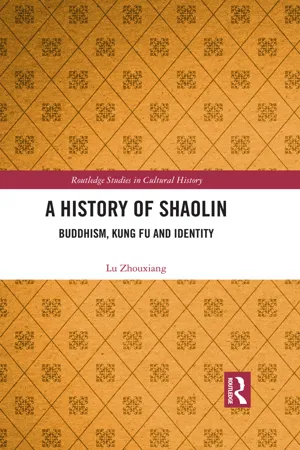
- 294 pages
- English
- ePUB (mobile friendly)
- Available on iOS & Android
eBook - ePub
About this book
1
Introduction
Buddhism was brought to China during the Han dynasty (206 BC–220 AD) by monks from India, via the Silk Road.1 Over the past 2,000 years, Buddhism has been successfully integrated with Confucianism, Daoism and other traditional Chinese religions, and has grown into one of the most popular and influential religions in China.2 According to the Buddhist Association of China, by 2012 there were approximately 33,000 Buddhist monasteries and temples in China, accommodating more than 240,000 monks and nuns.3 A 2011 report by the Chinese Academy of Social Sciences points out that over 18 percent of the Chinese population claims a Buddhist affiliation.4
Today, Buddhism is widely regarded as an important indigenous Chinese tradition.5 Together with the rise and fall of Chinese dynasties, and influenced by the transformation of Chinese society, various schools of Buddhism developed in China over the course of time, with Chan, Huayan, Pure Land, Tiantai and Vajrayana the most popular forms.6 The development of Buddhism in China led to the building of renowned statues, monasteries and historical sites, including White Horse Monastery in Luoyang, Donglin Monastery on Mount Lu, Huayan Monastery in Datong, Guoqing Monastery on Mount Tiantai, the Longmen Grottoes in Henan, the Mogao Caves near Dunhuang and Fayuan Monastery in Beijing.
Shaolin Monastery in Dengfeng is considered the epicentre of the Chan school of Buddhism. This ancient monastery is also well known for its martial arts tradition and has long been recognised as a unique Chinese cultural heritage site and an important symbol of the Chinese nation. Shaolin was born during the first golden age of Buddhism in China. It was built around 496 by Emperor Xiaowen (467–499) for the Indian monk Batuo, who had travelled to China to spread Buddhist teachings. Based on the legends of Bodhidharma (?–mid-530s), the first patriarch of the Chinese Chan lineage, and thanks to royal patronage, Shaolin earned great fame as the cradle of Chan and a centre of Buddhist studies.
The perfect combination of Chan Buddhism, martial arts and traditional Chinese culture has made Shaolin unique and noteworthy. Today, Shaolin is widely recognised as a leading religious institution in China and Shaolin kung fu has become a supporting pillar of Chinese martial arts and a well-recognised brand of Chinese culture.7 In 1983, Shaolin was named a National Key Buddhist Monastery by the State Council. In 2010, the Monastery was designated a World Cultural Heritage Site by UNESCO. In June 2013, Shaolin was listed by the State Council as a Major Historical and Cultural Site Protected at the National Level.8 On 17 February 2018, the China International Publishing Group (CIPG) released a report on the 100 most recognised Chinese words in foreign countries—Shaolin tops the list.9
Studying Shaolin in the context of the history of Chan Buddhism and Chinese martial arts is of vital importance in understanding the formation of Chinese culture and identity. From the late 1920s, Chinese scholars began to examine the history and theories of Shaolin kung fu, due to its overwhelming popularity. Book chapters, journal articles and monographs were published to this end.10 Between the 1980s and 2010s, in the context of the revival of Buddhism and the rapid development of Shaolin and Shaolin kung fu, several major historical works on Shaolin were published in China.11
In the past two decades, in response to the growing interest in Shaolin kung fu among the general public, an increasing number of books on the topic of Shaolin have also been published in the West, most of which focus on introducing the theory, philosophy and practice of Shaolin kung fu.12 In 2007, American Shaolin by travel writer Matthew Polly, the story of the author’s Shaolin kung fu study in China, became a bestseller in the United States.13
Meir Shahar’s book The Shaolin Monastery: History, Religion, and the Chinese Martial Arts was the first scholarly work in English to examine the history of Shaolin and Shaolin kung fu.14 The book has been widely reviewed in leading academic journals, and very well received by Chinese martial arts enthusiasts and scholars in the West. However, Shahar’s work mainly focuses on the evolution of the Shaolin martial arts tradition in dynastic China, notably the development of Shaolin kung fu in the Ming (1368–1644) and Qing (1644–1911) dynasties, and therefore does not offer a full picture of the history of Shaolin.
This book explores the history of Shaolin Monastery from 496 to 2016. More importantly, it offers a clear grasp of the development of Chan Buddhism through an examination of Shaolin, and explains the role of Shaolin and Shaolin kung fu in the construction of a national identity among the Chinese people.
Beginning with a discussion of the early days of Shaolin Monastery, the book investigates the beginning of the martial tradition in Shaolin and how it helped the monastery win favourable treatment from Tang dynasty (618–907) rulers.
The following section, on the Song (960–1279), Jin (1115–1234) and Yuan (1271–1368) dynasties, studies Shaolin’s emergence as the nucleus of the Caodong Chan orthodoxy amidst the rise of Chan as the dominant form of Buddhism in China.
The sections on the Ming and Qing dynasties explain how Shaolin was transformed from a centre of Buddhist studies into a major player in the martial arts community, and how Shaolin turned into a source of ethno-national identity and came to be associated with the nationalist revolution.
The book then discusses the decline of Buddhism and Shaolin in the Republic of China era (1912–1949) and explores the interactions between Shaolin, Shaolin kung fu and the construction of a national consciousness, illustrating how martial arts, wuxia (martial arts hero) novels and movies helped Shaolin become a symbol of indigenous virtue and strength.
Moving on to the People’s Republic of China era (1949–present), the obsolescence of Shaolin in the 1950s, 1960s and 1970s is examined in the context of radical Socialist reforms. Finally, the book analyses the revival of Shaolin since the reform and opening up of the late 1970s, explaining how Shaolin monks have played their part in the development of Chan Buddhism and Shaolin kung fu in an era of commercialisation, modernisation and globalisation.
Today, stemming from Chan doctrines and infused with political significance, Shaolin has developed into one of the best-known Chinese martial arts schools and is a source of strength and pride for the nation. As an important religious institution with more than 1,500 years of history, Shaolin has created a legacy of remembrance which serves the formation of the Chinese nation’s soul and spiritual principles. In the twenty-first century, facilitated by globalisation, Shaolin is now attracting a worldwide audience.
Notes
1. Jingbao Zhou and Ling Qiu, Sichou zhi lu zongjiao wenhua (The silk road and religious culture) (Urumqi: Xinjiang renmin chuban she, 1998), 176–177; Litian Fang, Zhongguo fojiao yu chuantong wenhua (Chinese Buddhism and traditional culture) (Beijing: China Renmin University Press, 2010), 26–27.
2. Fang, Zhongguo fojiao yu chuantong wenhua, 2.
3. The Buddhist Association of China, ‘Introduction to the Buddhist Association of China’, The Buddhist Association of China, 24 July 2017, http://51voiphone.com/bhjs1.html (accessed 19 February 2018).
4. Zhiyuan Wang, ‘Jiji wenjian de 2010 nian Zhongguo fojiao daojiao baogao’ (2010 report on Buddhism and Daoism in China), in Zongjiao lanpi shu: Zhongguo zongjiao baogao 2011 (Blue book of religions: Report on religions in China 2011), ed. Ze Jin and Yonghui Qiu (Beijing: Social Sciences Academic Press, 2011), 19.
5. Xuesong Zhang, ‘2014 nian fojiao yingxiangli fazhihua guanli baogao’ (2014 report on the influence of Buddhism and management and legal development), in Zongjiao lanpi shu: Zhongguo zongjiao baogao 2015 (Blue book of religions: Report on religions in China 2015), ed. Yonghui Qiu (Beijing: Social Sciences Academic Press, 2016), 25.
6. Yuan Fo and Xiang Ming, eds., Dacheng fojiao yu dangdai shehui (Mahāyāna’ Buddhism and contemporary society) (Beijing: Dongfang chuban she, 2003), 55.
7. Kam Hung, Xiaotao Yang, Philipp Wassler, Dan Wang, Pearl Lin and Zhaoping Liu, ‘Contesting the Commercialization and Sanctity of Religious Tourism in Shaolin Monastery, China’, International Journal of Tourism Research 19, no. 2 (2016): 145.
8. Lei Pei, ‘Henan Shaolin si, Cao Cao mu guji ruxuan zhongdian wenwu baohu danwei’ (Henan’s Shaolin monastery and Cao Cao’s tomb named as major historical and cultural sites), Zhengzhou Wanbao, 6 May 2013.
9. ‘Which Chinese words do foreigners recognize the most?’ ChinaDaily.com.cn, 18 February 2018, http://usa.chinadaily.com.cn/a/201802/18/WS5a88e8eda3106e7dcc13cf91.html (accessed 18 February 2018).
10. Major works include: Zhedong Xu, Guoji lun lue (A study of national skills) (Shanghai: Shangwu yinshu guan, 1928); Hao Tang, Shaolin wudang kao (A study of Shaolin and Wudang) (Nanjing: Zhongyang guoshu guan, 1930); Chengzhou Gu, ‘Shaolin si ji qi sengtu zhilue’ (The history of Shaolin and Shaolin monks), Tiyu 3, no. 1–11 (1935) in Minguo guoshu qikan wenxian jicheng (Collection of national skills journals published in the Republic of China era), vols. 16, 87; 117; 145; 173; 236; 300; 354; 406; 425, ed. Yongxin Shi (Beijing: Zhonghua Book Company, 2008); Zirong Shen, ‘Shaolin di pai lian quan de shi tiao jie yue’ (Ten rules of the direct line of descent of the Shaolin School), Guoshu zhoukan, no. 150–151 (1936); Hao Tang, Xingjian zhai sui bi (Xingjian Pavilion) (Shanghai: Shanghai Zhongguo wushu xiehui, 1937); Hao Tang, Shaolin quanshu mijue kaozheng (A study of the key principles of Shaolin kung fu) (Shanghai: Shanghai shi guoshu xiejin hui, 1941).
11. Major works include: Baojun Zhao, Shaolin si (Shaolin Monastery) (Shanghai: Shanghai renmin chuban she, 1982); Changqing Xu, Shaolin si yu Zhongguo wenhua (Shaolin Monastery and Chinese culture) (Zhengzhou: Zhongzhou Guji Chubanshe, 1993); Yucheng Wen, Shaolin fang gu (Explore the history of Shaolin) (Tianjin: Baihua Literature and Art Publishing House, 1999); Hongjun Lu, Songshan Shaolin si (Shaolin Monastery at Mount Song) (Zhengzhou: Henan renmin chuban she, 2001); Yongxin Shi and Yucheng Wen, eds., Shaolin wenhua yanjiu lunwen ji (Shaolin culture studies essay collection) (Beijing: Religious Culture Publisher, 2001); Hongjun Lu and Lei Teng, Shaolin gongfu (Shaolin kung fu) (Zhejiang renmin chuban she, 2005); Yucheng Wen, Shaolin shihua (Book on history of Shaolin Temple with illustrations) (Beijing: Gold Wall Press, 2009); Derong Ye, Zon...
Table of contents
- Cover
- Half Title
- Series Page
- Title
- Copyright
- Contents
- List of Figures
- List of Tables
- List of Abbreviations
- Acknowledgements
- 1 Introduction
- 2 The Early Days of Shaolin
- 3 The Song, Jin and Yuan Dynasties
- 4 The Transformation of Shaolin in the Ming Dynasty
- 5 The Development of Shaolin in the Qing Dynasty
- 6 The Republic of China Era: Warlords, Militarism and Nationalism
- 7 Surviving Socialist Reforms
- 8 The Revival of Shaolin in the Era of Reform and Opening Up
- 9 Conclusion
- Appendix: Chronology of Major Events in the History of Shaolin
- Glossary
- Index
Frequently asked questions
Yes, you can cancel anytime from the Subscription tab in your account settings on the Perlego website. Your subscription will stay active until the end of your current billing period. Learn how to cancel your subscription
No, books cannot be downloaded as external files, such as PDFs, for use outside of Perlego. However, you can download books within the Perlego app for offline reading on mobile or tablet. Learn how to download books offline
Perlego offers two plans: Essential and Complete
- Essential is ideal for learners and professionals who enjoy exploring a wide range of subjects. Access the Essential Library with 800,000+ trusted titles and best-sellers across business, personal growth, and the humanities. Includes unlimited reading time and Standard Read Aloud voice.
- Complete: Perfect for advanced learners and researchers needing full, unrestricted access. Unlock 1.5M+ books across hundreds of subjects, including academic and specialized titles. The Complete Plan also includes advanced features like Premium Read Aloud and Research Assistant.
We are an online textbook subscription service, where you can get access to an entire online library for less than the price of a single book per month. With over 1.5 million books across 990+ topics, we’ve got you covered! Learn about our mission
Look out for the read-aloud symbol on your next book to see if you can listen to it. The read-aloud tool reads text aloud for you, highlighting the text as it is being read. You can pause it, speed it up and slow it down. Learn more about Read Aloud
Yes! You can use the Perlego app on both iOS and Android devices to read anytime, anywhere — even offline. Perfect for commutes or when you’re on the go.
Please note we cannot support devices running on iOS 13 and Android 7 or earlier. Learn more about using the app
Please note we cannot support devices running on iOS 13 and Android 7 or earlier. Learn more about using the app
Yes, you can access A History of Shaolin by Lu Zhouxiang in PDF and/or ePUB format, as well as other popular books in History & Chinese History. We have over 1.5 million books available in our catalogue for you to explore.