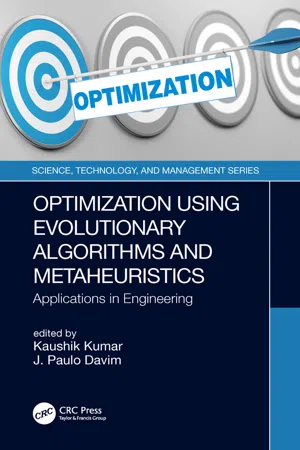
Optimization Using Evolutionary Algorithms and Metaheuristics
eBook - ePub

Optimization Using Evolutionary Algorithms and Metaheuristics

Applications in Engineering

  1. 136 pages
  2. English
  3. ePUB (mobile friendly)
  4. Available on iOS & Android
eBook - ePub

Optimization Using Evolutionary Algorithms and Metaheuristics

Applications in Engineering

About this book

Recognized as a "Recommended" title by Choice for their April 2021 issue.

Choice is a publishing unit at the Association of College & Research Libraries (ACR&L), a division of the American Library Association. Choice has been the acknowledged leader in the provision of objective, high-quality evaluations of nonfiction academic writing.

Metaheuristic optimization is a higher-level procedure or heuristic designed to find, generate, or select a heuristic (partial search algorithm) that may provide a sufficiently good solution to an optimization problem, especially with incomplete or imperfect information or limited computation capacity. This is usually applied when two or more objectives are to be optimized simultaneously.

This book is presented with two major objectives. Firstly, it features chapters by eminent researchers in the field providing the readers about the current status of the subject. Secondly, algorithm-based optimization or advanced optimization techniques, which are applied to mostly non-engineering problems, are applied to engineering problems. This book will also serve as an aid to both research and industry. Usage of these methodologies would enable the improvement in engineering and manufacturing technology and support an organization in this era of low product life cycle.

Features:


  • Covers the application of recent and new algorithms


  • Focuses on the development aspects such as including surrogate modeling, parallelization, game theory, and hybridization


  • Presents the advances of engineering applications for both single-objective and multi-objective optimization problems


  • Offers recent developments from a variety of engineering fields


  • Discusses Optimization using Evolutionary Algorithms and Metaheuristics applications in engineering

Frequently asked questions

Yes, you can cancel anytime from the Subscription tab in your account settings on the Perlego website. Your subscription will stay active until the end of your current billing period. Learn how to cancel your subscription.
No, books cannot be downloaded as external files, such as PDFs, for use outside of Perlego. However, you can download books within the Perlego app for offline reading on mobile or tablet. Learn more here.
Perlego offers two plans: Essential and Complete
  • Essential is ideal for learners and professionals who enjoy exploring a wide range of subjects. Access the Essential Library with 800,000+ trusted titles and best-sellers across business, personal growth, and the humanities. Includes unlimited reading time and Standard Read Aloud voice.
  • Complete: Perfect for advanced learners and researchers needing full, unrestricted access. Unlock 1.4M+ books across hundreds of subjects, including academic and specialized titles. The Complete Plan also includes advanced features like Premium Read Aloud and Research Assistant.
Both plans are available with monthly, semester, or annual billing cycles.
We are an online textbook subscription service, where you can get access to an entire online library for less than the price of a single book per month. With over 1 million books across 1000+ topics, we’ve got you covered! Learn more here.
Look out for the read-aloud symbol on your next book to see if you can listen to it. The read-aloud tool reads text aloud for you, highlighting the text as it is being read. You can pause it, speed it up and slow it down. Learn more here.
Yes! You can use the Perlego app on both iOS or Android devices to read anytime, anywhere — even offline. Perfect for commutes or when you’re on the go.
Please note we cannot support devices running on iOS 13 and Android 7 or earlier. Learn more about using the app.
Yes, you can access Optimization Using Evolutionary Algorithms and Metaheuristics by Kaushik Kumar,J. Paulo Davim in PDF and/or ePUB format, as well as other popular books in Mathematics & Applied Mathematics. We have over one million books available in our catalogue for you to explore.

Information

Publisher
CRC Press
Year
2019
Print ISBN
9780367260446
eBook ISBN
9781000546804

Section II

Application to Design and Manufacturing

2

AGV Routing via Ant Colony Optimization Using C#

Şahin InanƧ
Bursa Uludag University, Lecturer, [email protected]
Arzu Eren Şenaras
Bursa Uludag University, Research Assistant Dr, [email protected]
CONTENTS
2.1 Introduction
2.2 A Short Literature Review
2.3 Ant Colony Optimization (ACO)
2.4 ACO Application via C#
2.5 Conclusion
References

2.1 Introduction

An AGV (automated guided vehicle) consists of a mobile robot used for transportation and automatic material handling, for example for finished goods, raw materials, and products in process. The design and operation of AGV systems are highly complex due to high levels of randomness and the large number of variables involved. This complexity makes simulation an extremely useful technique in modelling these systems (Negahban and Smith 2014). The AGV has the function to ensure efficient flow of materials within the production system. Production systems must be flexible and must allow the dynamic reconfiguration of the system. The AGV is a key component to achieve the objectives of an FMS. This means that the AGV should provide the required materials to the appropriate workstation, at the right time and in the right amount, otherwise the production system will not perform well, making it less efficient, generating less profit or increasing the operating costs. In an FMS system, the AGV has the following advantages (Leite et al. 2015):
  • Driverless operation
  • More efficient control of the production
  • Diminishing of the damages caused by manual material handling.
An AGV is a driverless material handling system used for horizontal movement of materials. AGVs were introduced in 1955. The use of AGVs has grown enormously since their introduction. The number of areas of application and variation in types has increased significantly. AGVs can be used in inside and outside environments, such as manufacturing, distribution, transshipment and (external) transportation areas. At manufacturing areas, AGVs are used to transport all types of materials related to the manufacturing process (Fazlollahtabar and Saidi-Mehrabad 2015).
An AGV consists of a mobile robot used for transportation and automatic material handling, for example for finished goods, raw materials, and products in process. The design and operation of AGV systems are highly complex due to high levels of randomness and the large number of variables involved. This complexity makes simulation an extremely useful technique in modelling these systems (Negahban and Smith 2014).

2.2 A Short Literature Review

Kulatunga et al. (2006) studied a metaheuristic-based ant colony optimization (ACO) technique for simultaneous task allocation and path planning of AGV in material handling. They found that ACO solutions have slightly better performance than that of simulated annealing algorithm.
Udhayakumar and Kumanan (2010) studied to find the near optimum schedule for two AGVs based on the balanced workload and the minimum traveling time for maximum utilization.
Leite et al. (2015) investigated the utilization rate of an AGV system in an industrial environment and evaluated the advantages and disadvantages of the project. They used the simulation software Promodel 7.0 to develop a model. Their model aims to analyze and optimize the use of AGVs. Problems were identified and solutions were adopted by the authors according to the results obtained from the simulations.
Fazlollahtabar and Saidi-Mehrabad (2015) categorized the methodologies into mathematical methods (exact and heuristics), simulation studies, metaheuristic techniques and artificial intelligence–based approaches.
Wang et al. (2016) studied a scheduling problem in the FMS in which orders require the completion of different parts in various quantities. The orders arrive randomly and continuously, and they all have predetermined due dates. Two scheduling decisions were considered in this study: launching parts into the system for production and determining the order sequence for collecting the completed parts.
Hana and Gabriel (2016) aimed to present the possibilities of computer simulation methods for obtaining data for a full-scale economic analysis implementation.
Vavrika et al. (2017) studied methods for the determination of the number of automated guided vehicles and choosing the optimal internal company logistics track. The simulation results of the logistics system were various in terms of increasing the use of operation areas, optimized material supply, and a created layout that would be able to flexibly respond to future company requirements.
Demesure et al. (2017) proposed motion planning and the scheduling of AGVs in an FMS. Numerical and experimental results are provided to show the pertinence and the feasibility of the proposed strategy.

2.3 Ant Colony Optimization (ACO)

In the early 1990s, ant colony optimization (ACO) was introduced by M. Dorigo and colleagues as a novel, nature-inspired metaheuristic for the solution of hard combinatorial optimization (CO) problems. ACO belongs to the class of metaheuristics, which are approximate algorithms used to obtain good-enough solutions to hard CO problems in a reasonable amount of computation time. Other examples of metaheuristics are tabu search, simulated annealing, and evolutionary computation. The inspiring source of ACO is the foraging behaviour of real ants. When searching for food, ants initially explore the area surrounding their nest in a random manner. As soon as an ant finds a food source, it evaluates the quantity and the quality of the food and carries some of it back to the nest. During the return trip, the ant deposits a chemical pheromone trail on the ground. The quantity of pheromone deposited, which may depend on the quantity and quality of the food, will guide other ants to the food source. As it has been shown in, indirect communication between the ants via pheromone trails enables them to find the shortest paths between their nest and food sources. This characteristic of real ant colonies is exploited in artificial ant colonies in order to solve CO problems (Dorigo and Blum 2005).
Ant colony algorithms were first proposed by Dorigo and colleagues as a multi-agent approach to difficult combinatorial optimization problems such as the traveling salesman problem and the quadratic assignment problem. There is currently much ongoing activity in the scientific community to extend and apply ant-based algorithms to many different discrete optimiz...

Table of contents

  1. Cover
  2. Half Title
  3. Series
  4. Title
  5. Copyright
  6. Contents
  7. Preface
  8. Editor Biography
  9. Section I State of the Art
  10. Section II Application to Design and Manufacturing
  11. Section III Application to Energy Systems
  12. Index