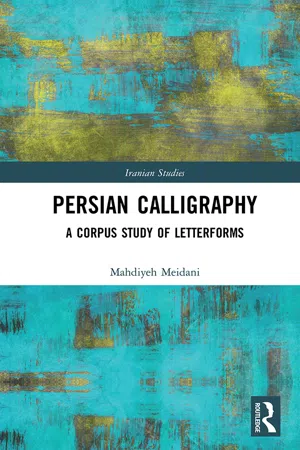
This book is an exploratory adventure to defamiliarize calligraphy, especially Persian Nastaliq calligraphic letterforms, and to look beyond the tradition that has always considered calligraphy as pursuant to and subordinate to linguistic practices.
Calligraphy can be considered a visual communicative system with different means of meaning-making or as a medium through which meaning is made and expression is conveyed via a complex grammar. This study looks at calligraphy as a systematic means in the field of visual communication, rather than as a one-dimensional and ad hoc means of providing visual beauty and aesthetic enjoyment. Revolving around different insights of multimodal social semiotics, the volume relies on the findings of a corpus study of Persian Nastaliq calligraphy. The research emphasizes the way in which letterforms, regardless of conventions in language, are applied as graphically meaningful forms that convey individual distinct meanings.
This volume on Persian Nastaliq calligraphy will be inspirational to visual artists, designers, calligraphers, writers, linguists, and visual communicators. With an introduction to social semiotics, this work will be of interest to students and scholars interested in visual arts, media and communication, and semiotics.
- 330 pages
- English
- ePUB (mobile friendly)
- Available on iOS & Android
eBook - ePub
About this book
Information
1 Introduction
Today, in the age of communication, people are surrounded by new media: “screen media such as the internet have become more and more oriented toward the written word and page media such as books and magazines have become increasingly visual” (Van Leeuwen, 2006, p. 142). Indeed, there is a move toward a new look at, and new roles for, visual images in general, a movement associated with the notion that “Gestaltung ist auch Information [design is also information]” (Hans-Rudolf Lutz, 1987, p. 81 in Van Leeuwen, 2006, p. 142). Given this, among different visual phenomena in the area of visual art, calligraphy in general, and Persian Nastaliq calligraphy in particular (which is the main subject of this study), can no longer be seen as an abstract art; it influences not only visual artists, designers, and calligraphers, but also writers, linguists, and visual communicators. Today, although every field of art or science is becoming more specialized and independent in its own right, the borders between different fields are becoming blurred, and everything is changing. Nastaliq calligraphy, as a tradition that has been ongoing from ancient times to the present, has faced different challenges in terms of historical, social, and cultural issues.
Nastaliq calligraphy has been used in many different areas and formats, including religious inscriptions on the facade of temples and mosques, scribing the Quran and verses of holy books, poetry and fictional literature, stereoplates or print clichés, and in the lithography, lineament, and layout of books and magazines. Furthermore, it has appeared in the calligrammes and three-dimensional artifacts of the graphic urban environment of the contemporary art era, in graphic works such as logos and posters, and in today’s technological era in screen media such as the internet. Thus, Nastaliq has been challenged in many ways over time. Although it has retained its traditional principles, it handsomely embraced all changes caused by time and place. These changes expand the scope of Nastaliq’s potential for use as a systematic means in the field of visual communication, rather than as a one-dimensional and ad hoc means of providing visual beauty and aesthetic enjoyment. Therefore, it cannot be considered only a submissive abstract art assigned to serve writing and linguistic practices. Instead, hypothetically, calligraphy can be considered a visual communicative system with different means of meaning-making or as a medium through which meaning is made and expression is conveyed via a complex grammar.
The various aspects of this expressive phenomenon present a range of potential approaches, whether in the area of fine arts or media and visual communications. The multi-dimensional character of this calligraphy type, from its creation to its heyday, presents unprecedented complexity for analysis. The similarities and differences between Nastaliq and other types of visual arts and communication systems offer a multitude of factors and resources of this calligraphy in the construction of meaning. The stable yet dynamic principles of Nastaliq imbue it with the potential for a variety of applications in different communicative situations. It is characterized by flexibility, softness, and at the same time systematic and regular motions, as well as a stable and dignified composition, which taken together function as an elegant synchronic whole. These concurrent characteristics expand the scope of Nastaliq’s potential for use as a systematic means in the visual communication field, rather than as a one-dimensional and ad hoc means of providing visual beauty and aesthetic enjoyment.
However, historically, Nastaliq calligraphy has been viewed through a one-dimensional lens and considered an abstract art that has been ceaselessly tied to language and literature, a means which serves to transmit information, not distinctly as information in its own right. It has never been examined beyond visual art and aesthetic practices, never been seen as a self-determining system which itself is considered to be information in its own visual appearance, independent of meanings embedded in linguistic practices. It has always been examined and characterized based on linguistic meaning or the given information transmitted through letters. In other words, its personality has always been defined as subordinate to language and its conventional meanings.
This study approaches Nastaliq calligraphic letterforms in a different way. It emphasizes the way in which letterforms, regardless of conventions in language, are applied as graphically meaningful forms that convey individual distinct meanings. In other words, the study investigates Nastaliq letterforms as independent graphic phenomena that visually communicate messages independent of linguistic meanings. It attempts to defamiliarize calligraphy, especially Nastaliq calligraphic letterforms, and to look beyond the tradition that has always considered calligraphy as pursuant to and subordinate to linguistic practices.
Background
As a prerequisite for entering the main discussions of the study, here I present background on current research related to the subject matter of this study – though not directly addressing calligraphy – as well as previous research on Islamic calligraphy in general and Nastaliq in particular; I also provide concise historical background of calligraphy, especially Nastaliq in Iran, from its emergence to its heyday.
Current state of research
Works on Western typography have regarded typography in general in different ways, such as the works by Stöckl (2005), Van Leeuwen (2006), Nørgaard (2009), Serafini et al. (2012) and before them, the works of linguistics such as Myers (1994), Goodman and Graddol (1996), Walker (2000), and Cook (2001). Studies have also mentioned attempts by some designers to distinguish typography from linguistic practices; for instance, Bellantoni and Woolman (2000), as quoted in Van Leeuwen (2006), particularly say that a printed word conveys meaning on the two levels of “word image” and “typographic image” which, respectively, suggest “the idea of represented by the word itself” and “the holistic visual impression” of the given word. McLean (2000) also mentions typography and lettering that “to a very limited extent, … may help to express a feeling or a mood that is in harmony with the meaning of the words,” although he mentions that it is still an abstract art for the most part (McLean, 2000, pp. 54–56). German designer Neuenschwander (1993) considers typography to be “a fully developed medium of expression” that has “a complex grammar by which communication is possible” (Neuenschwander, 1993, p. 13, 31, in Van Leeuwen, p. 142). Reza Abedini, an Iranian designer, has also attempted to demonstrate this idea in his artworks to defamiliarize calligraphy and typography and present them apart from linguistic practices and literal meanings; in explaining his exhibitions entitled “callidrawing” in 2015, for instance, he writes: “do not try to read these words, these are the words to be unread” (Abedini, 2015).
Some researchers have examined the relationship between image and text. For instance, Martinec and Salway (2005) suggest a semantic functional system that classifies the relationship between image and text in terms of “the dependency relations between image and word” (Martinec & Salway, 2005, in Jewitt, 2009, p. 18). They theorize that inter-semiotic resources explain how different semiotic resources are integrated into image, texts, and letterforms. Despite these attempts, this move in general is still at the beginning and no principled grammar or systematic framework exists through which to analyze typographic works. Regarding Islamic calligraphy and especially Nastaliq Persian calligraphy, this view itself is new, an unprecedented consideration, and a daring enterprise. No substantial academic work has been performed on Persian Nastaliq calligraphic works, which are still considered to be an abstract art through which knowledge is transmitted in an exquisite and picturesque way.
Previous research on Islamic calligraphy in general and Nastaliq calligraphy in particular
The overwhelming majority of research on Islamic calligraphy, especially Nastaliq calligraphy, is limited to the history of calligraphy, biography of calligraphers, and calligraphy training. No substantial or challenging research has been conducted on the identity or nature of the form of calligraphy itself and its conventional principles and no studies have analyzed the visual character of calligraphy in an academic way or considered it as a research subject in its own right. Thus, Nastaliq is somehow secluded in terms of being regarded as a self-determining system of meaning or a distinctive subject in its own right. Many studies conducted in Iran have examined calligraphy, especially with a historical approach. Within these studies, many works with a historical approach have examined calligraphy from its beginning through its development during different historical periods (e.g., Bayani, 1984b; Ghelichkhani, 1993; Irani, 1983; Kavousi et al., 2013; Ormavi, 2006; Salouti, 2003; Shahroudi, 2008). Also, numerous studies in Iran have been published on the biography of calligraphers (e.g., Bayani, 1984a; Fazaeli, 1977, 1983[1973]; Isfahani, 1990; Rahjiri, 2010). In addition, some researchers have presented dissertations on the principles of calligraphy from past to present (e.g., Barat Zadeh, 2006; Falsafi, 2000; Ghazi Monshi, 1988; Ormavi, 2006). These works include deductive studies that are useful for calligraphers. Moreover, some calligraphic researchers have analyzed calligraphy using a comparative approach; they have examined calligraphy in terms of its relationship to other fields of arts (e.g., Eghbal, 1990; Meidani, 2008). Other scholars (e.g., Aghdashloo, 2006; Bolkhari, 2006) have considered calligraphy from the perspective of mysticism, theosophy, or theology.
In some countries (e.g., Turkey), Mustafa Uğur Derman (1998) has investigated different calligraphies, including Thuluth, and his research has been published by Research Centre for Islamic History, Art and Culture. Muhammad al Saleh Khomasi’s (1910–1992) book entitled المنهج الحدیث لتحسین الخط العربی/Modern approach to improve calligraphy is considered the main resource for teaching calligraphy in Tunisia and other countries in northern Africa. Naji Zein al Din published works such as مصور الخط العربي (1968, Bagdad) and بدائع الخط العربي (1971, Baghdad), and Kamil Al-Baba is the author of روح الخط العربي/The spirit of Arabic calligraphy (1994, Beirut). In Pakistan and India, researchers such as Muhammad Rashed Sheikh, author of the book Biography of Calligraphers/تذکره خطاطان (Karachi, 1998), and Seyed Ahmad Rampuri, author of the books خط کی کهانی تصویرون کی زبانی (2003, Rampur) and مرقع خوشنویسان/Scrapbook of calligraphers (2007, Rampur) have worked on the history of calligraphy and the biography of calligraphers.
In the twentieth century, some research on Islamic arts, including Islamic calligraphy, addressed the styles of Islamic calligraphies and Arabic scripts (e.g., Blair, 2006; Mandel Khan, 2001; Schimmel, 1990) (Aghdashloo, 2013, pp. 169–171).
A brief historical background of calligraphy in Iran
Before the advent of Islam, Iranians used different styles of writing, such as cuneiform, Pahlavi scripts, and Avestan scripts. As they accepted Islam, they also accepted the Arab language and started to write the Persian language in Arabic scripts. After that, Iran’s main scripts were gradually forgotten and the Arabic alphabet became the base of current Iranian scripts. Arabic script is about 15 centuries old; that is, it emerged about a century before the advent of Islam. This is confirmed by two Coptic and Syriac scripts. The Kufic and ancient Naskh forms became the main Arabic scripts. In the early days of Islam, both Kufic and Naskh were common; Kufic was used to write the Quran, inscriptions, cornices, and epigraphs, and Naskh served for other books and letters. Until the second century )ah), these two types of calligraphy remained basic and primitive. However, when they became common among other Islamic nations such as Iran, other types of writing were gradually enacted from them. As Salouti (2003) asserts, by the end of the second century, calligraphy had not yet prospered and it was not specifically enacted. During the Abbasid caliphate (in the eighth century ad), the Barmakid, an Iranian family influential in the court of the Islamic caliphate, attempted to promote Islamic calligraphy. Also, in the period of Ibn Muqla Shirazi) 886–940 ad), the Persian minister of the Abasid Caliphate, calligraphy was considered and formally named calligraphy. Ibn Muqla Shirazi was a pioneer in promoting the art of calligraphy as one of the most beautiful manifestations in the Islamic civilization. A century later, Ibn al-Bawwab developed and completed what Ibn Muqla started; calligraphy evolved over two centuries to when it came to Yaghoot-Mostasami, who distinguished and limited different types of Islamic writing into six types of calligraphy. His six pens, or the Pens of Principle, combine six types of calligraphy: Thuluth, Reyhan, Mohaqaq, Toqi, Reqa, and Naskh (Fazaeli, 1983[1973]; Kavousi et al., 2013; Salouti, 2003; Shahroudi, 2008).
The time between the eighth and tenth centuries ah is considered to be the brilliant era of progress and development of Islamic calligraphy, so that the perfection and beauty of this art was brought to almost all cultural communities. In this period, kings and monarchs paid special attention to calligraphy and did not hesitate to encourage and foster calligraphers. Even some monarchs were well-known calligraphers.1 During the eighth century ah, three types of calligraphy appeared among the Islamic calligraphies that must be considered specifically as Iranian. Although they were derived from the Arabic alphabet, their shap...
Table of contents
- Cover
- Half Title
- Series Page
- Title Page
- Copyright Page
- Dedication
- Table of Contents
- Foreword
- Preface
- 1. Introduction
- 2. Corpus analysis
- 3. Graphetic analysis
- 4. Toward semiotics of Nastaliq calligraphy
- 5. Holliday’s triple metafunctions: as requisite of any semiotic mode – in Nastaliq calligraphy
- 6. Toward a distinct feature analysis
- 7. Conclusion
- References
- Index
Trusted by 375,005 students
Access to over 1.5 million titles for a fair monthly price.
Study more efficiently using our study tools.
Frequently asked questions
Yes, you can cancel anytime from the Subscription tab in your account settings on the Perlego website. Your subscription will stay active until the end of your current billing period. Learn how to cancel your subscription
No, books cannot be downloaded as external files, such as PDFs, for use outside of Perlego. However, you can download books within the Perlego app for offline reading on mobile or tablet. Learn how to download books offline
Perlego offers two plans: Essential and Complete
- Essential is ideal for learners and professionals who enjoy exploring a wide range of subjects. Access the Essential Library with 800,000+ trusted titles and best-sellers across business, personal growth, and the humanities. Includes unlimited reading time and Standard Read Aloud voice.
- Complete: Perfect for advanced learners and researchers needing full, unrestricted access. Unlock 1.5M+ books across hundreds of subjects, including academic and specialized titles. The Complete Plan also includes advanced features like Premium Read Aloud and Research Assistant.
We are an online textbook subscription service, where you can get access to an entire online library for less than the price of a single book per month. With over 1.5 million books across 990+ topics, we’ve got you covered! Learn about our mission
Look out for the read-aloud symbol on your next book to see if you can listen to it. The read-aloud tool reads text aloud for you, highlighting the text as it is being read. You can pause it, speed it up and slow it down. Learn more about Read Aloud
Yes! You can use the Perlego app on both iOS and Android devices to read anytime, anywhere — even offline. Perfect for commutes or when you’re on the go.
Please note we cannot support devices running on iOS 13 and Android 7 or earlier. Learn more about using the app
Please note we cannot support devices running on iOS 13 and Android 7 or earlier. Learn more about using the app
Yes, you can access Persian Calligraphy by Mahdiyeh Meidani in PDF and/or ePUB format, as well as other popular books in Art & Art General. We have over 1.5 million books available in our catalogue for you to explore.