The first major scholarly investigation into the rich history of the marked body in the early modern period, this interdisciplinary study examines multiple forms, uses, and meanings of corporeal inscription and impression in France and the French Atlantic from the late sixteenth through early eighteenth centuries. Placing into dialogue a broad range of textual and visual sources drawn from areas as diverse as demonology, jurisprudence, mysticism, medicine, pilgrimage, commerce, travel, and colonial conquest that have formerly been examined largely in isolation, Katherine Dauge-Roth demonstrates that emerging theories and practices of signing the body must be understood in relationship to each other and to the development of other material marking practices that rose to prominence in the early modern period. While each chapter brings to light the particular histories and meanings of a distinct set of cutaneous marks—devil's marks on witches, demon's marks upon the possessed, devotional wounds, Amerindian and Holy Land pilgrim tattoos, and criminal brands—each also reveals connections between these various types of stigmata, links that were obvious to the early modern thinkers who theorized and deployed them. Moreover, the five chapters bring to the fore ways in which corporeal marking of all kinds interacted dynamically with practices of writing on, imprinting, and engraving paper, parchment, fabric, and metal that flourished in the period, together signaling important changes taking place in early modern society. Examining the marked body as a material object replete with varied meanings and uses, Signing the Body: Marks on Skin in Early Modern France shows how the skin itself became the register of the profound cultural and social transformations that characterized this era.
- 318 pages
- English
- ePUB (mobile friendly)
- Available on iOS & Android
eBook - ePub
About this book
Information
1 Seals of Satan
Demonologists and the devil’s mark
In 1581, Doctor Claude Caron (†1609) of Annonay, known throughout the region for his extraordinary medical skill, began hearing stories of a number of young women from the surrounding villages and countryside who were showing signs of demonic possession.1 The women were brought to the priests in Annonay, who searched for the cause of their trouble through exorcism. Their demons, notably one named Miron, who spoke through the mouth of twenty-two-year-old Magdaleine, accused Katherine Boyraionne, a woman in her fifties from the neighboring village of Saint Safforin, of enchanting the girls and causing their possession.2 Boyraionne was brought in for questioning and challenged by the young women and their demons, but she denied any involvement in their possession. Unable to substantiate their suspicions about Boyraionne, the priests interrogated her daughter, who testified that her mother had brought her to the sabbat—the regular nocturnal gathering of witches and demons, filled with heretical debauchery—and instructed her in witchcraft.3 Though her daughter pleaded that she confess, Boyraionne persisted in denying any wrongdoing and was handed over to the secular authorities. According to the young women’s possessing demons, the key to proving her identity as a witch—“the way to reveal her witchdom”—lay in examining Boyraionne closely for a “character” made by the devil himself on her left shoulder.4 Caron’s suspenseful narrative of her examination—the surgeon’s hand guided in its search by none other than the demon Miron himself—invites his readers to witness the mark’s discovery alongside the assembled doctors and local authorities:
This was ordered, the doctors and surgeons were called in, her eyes were tightly covered, her shoulders exposed, and the search was conducted for this character. At first we could only see a polished and uniform expanse of skin, but when the devil Miron noticed our slowness to discover where the hare lay, mocking us he showed us the place with a great burst of laughter. Now, given our ignorance, [Miron], without saying anything, directed the hand of the surgeon to prick the place where we thought the character was. He [the surgeon] sometimes pricked in one part of the shoulder, and when the witch moved because of the pain, sometimes on the other side, then on the other without stopping, according to where we thought we would find the mark, the witch always feeling the probe. But finally having arrived by chance at the very spot where the character was, and by looking closely, we observed in this place a shape about the size of a small coin, from whose center emanated several filaments branching out toward its circumference, and not very apparent. So the surgeon who was holding the probe, which was as long as a finger, inserted it into that center on our command and in the presence of many trustworthy people. He pushed it in so far that he put more than half of it into her shoulder without the witch moving in the least. Nor did she make any sign of having been hurt, though before she had become strangely ferocious at the least prick that he had given her. When the probe was pulled out of the witch’s shoulder, no blood appeared. She was condemned to torture to reveal the truth of this matter.5
This judicial scene of the search for the devil’s mark, recounted here in vivid detail by Caron, played itself out again and again in courts across early modern Europe at the height of the witch trials, which in France knew their greatest frequency and ferocity from about 1560 to 1640.6 As Caron’s description illustrates, in their quest to locate this physical mark, court examiners stripped and blindfolded the accused, examined her skin closely for any visible marks, and probed her flesh extensively with a needle or awl to locate any spots of insensitivity—a defining characteristic of the devil’s mark.7 The belief that the devil often left multiple marks upon a witch’s body and that his marks were usually hidden—even invisible to the naked eye—left the entire expanse of the accused’s skin vulnerable to the surgeon’s needle.8
The search to uncover the devil’s mark was informed by a conviction shared by period demonologists—the learned elite theologians, judges, and doctors who examined questions surrounding the devil, demons, and their relationships with humans—that witches had intimate commerce with the devil during the sabbat. The ritual culminated in the devil placing a physical mark upon the bodies of his new initiates, as pictured in Italian Franciscan demonologist Francesco Maria Guazzo’s 1608 Compendium Maleficarum (see Figure 1.1), and signing a mutual pact.9 The cutaneous mark thus declared its bearer’s sworn identity as a guilty member of Satan’s fraternity of followers, its manifest presence representing sufficient evidence for most judges to justify the passage to judicial torture in view of obtaining a confession, while for others the discovery of devil’s marks alone served as sufficient proof for a capital conviction.10 As historian William Monter has noted, the widespread use of the mark across Protestant and Catholic lines in a time otherwise deeply divided by confession is testament to its conceptual power as well as to its usefulness.11 Even judge Henry Boguet (1550–1619), who presided over trials in the Jura region from 1598 to 1612 and believes—because he cannot always find them—that not all witches necessarily bear marks, concludes that “these marks have such an importance in matters of witchcraft that they serve as a very strong presumption of guilt against the accused so that, if they are joined by other evidence, it is permissible to condemn them.”12 For Pierre de Lancre (1553–1631), Bordeaux judge and crown-appointed leader of the Basque region trials of 1609, the reliability of the mark is simply obvious to any experienced modern judge:
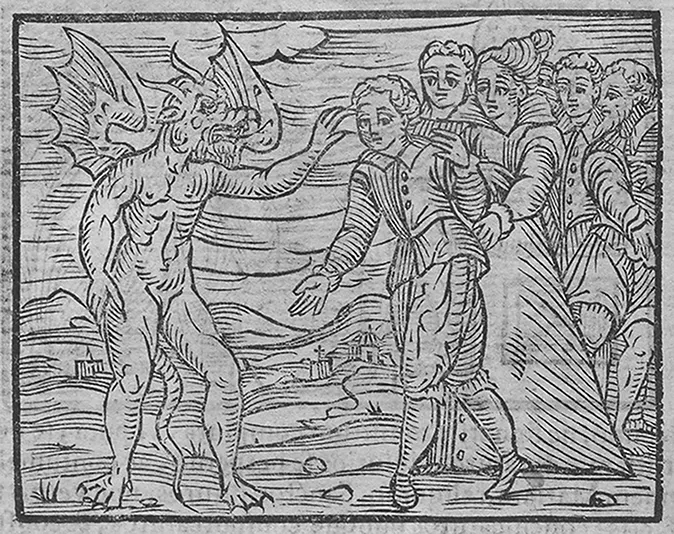
Figure 1.1 The devil marking his faithful at the sabbat, Francesco Maria Guazzo, Compendium Maleficarum (Milan: Apud Haeredes August. Tradati, 1608), 17. Beinecke Library, Yale University.
The mark that Satan imprints on his faithful is of great consideration for the judgment of the crime of witchcraft, as also testified by all the moderns who have been judges like myself, who believe that the marks are such strong pieces of evidence, and lead to such strong presumptions of guilt against witches, that being joined . . . with other evidence it is admissible to proceed with their condemnation.13
Demonologists recorded numerous shapes, sizes, and locations for the marks they found upon the skin of the accused. While they often saw the depraved nature of the devil reflected in cutaneous signs made in the shape of an animal—a hare, toad, bat, owl, spider, mouse, dog—or its footprint, they also frequently found more conventional marks in the form of warts, moles, excrescences of skin, and birthmarks, like the one found on Katherine Boyraionne, in the “shape of a small coin, from whose center emanated several filaments.”14 The devil’s mark also varied in size among reports, as De Lancre affirms, “sometimes big, and sometimes as small as the head of a pin.”15 The mark’s diversity of shape and size was equaled only by the multiplicity of its possible locations on the body. It traveled the whole surface of the witch’s skin, as Boguet attests:
[W]itches are marked, as they say, some on the shoulder, others underneath the tongue, or sometimes under the lip, others on the shameful parts. In short, there is not a witch who is not marked in some part of his body.16
Though Jacques Fontaine (†1621?), doctor to the young King Louis XIII and medical expert in the 1609–1611 trial for witchcraft of priest Louys Gaufridy in Aix-en-Provence, asserts that “for the most part one finds them marked very apparently,” most demonologists argue the contrary.17 While they suggest that the mark could be imprinted anywhere on the skin, they also agree that the devil generally favors more hidden spots to avoid detection, as De Lancre deplores:
[H]e often imprints them, either in parts so dirty that one is horrified to go look for them there, like in a man’s anus, or in a woman’s genitals, or, since he is extreme and unnatural, in the most noble and precious place that exists in a person, where it seems impossible to imprint them, like in the eyes, or in the mouth.18
The devil thus proves himself to be a prolific and prodigious marker of bodies, able to imprint a variety of marks, even in seemingly “impossible” places. The multiplicity of forms and locations he employs does not trouble most of the mark’s interpreters, who argue that he maintains flexibility in his choices so as to better thwart the efforts of those who would seek to control him. Indeed, he often buries his mark so well, De Lancre writes tellingly, “that you would have to tear the body in question to pieces to find it.”19
As the devil’s mark became commonplace through judicial repetition, the faith many judges placed in it as an objective sign of guilt also came to be shared by the wider population. While popular belief in supernatural signs on skin, as attested in common beliefs about birthmarks, undoubtedly contributed to the acceptance of the devil’s mark, people of the lower classes became well acquainted with the mark as an authenticating sign through what they witnessed at trials and executions.20 There they heard accusations and confessions that included marking by the devil or watched, in the case of public prickings, the mark be revealed upon the witch’s skin.21 In Aix, the local population reportedly saw in the revelation of the accused Gaufridy’s marks absolute confirmation of his identity as a witch: “The news about this spread quickly among all the common people, that he was truly a witch, and that it could not be otherwise because he was marked.”22 During trials, lay plaintiffs and witnesses regularly called upon the mark as a sign of proof. Jurist and political philosopher Jean Bodin (1530–1596) cites, for example, the 1571 case of a man who, offered amnesty in exchange for naming his accomplices, called on the authority of the mark to support his accusations: “And to prove the veracity of his testimony, he said that they were marked, and that they would find the mark by stripping them.”23 Those accused of witchcraft were themselves all too well aware of the mark’s power to convict. Some even voluntarily submitted to pricking, believing the absence of a mark would definitively prove their innocence, while others attempted to obliterate any potentially suspicious spots on their own skin prior to their examination, as De Lanc...
Table of contents
- Cover
- Half Title
- Title Page
- Copyright Page
- Table of Contents
- List of figures
- Acknowledgments
- Introduction: the impressionable body
- 1. Seals of Satan: demonologists and the devil’s mark
- 2. Demonic marks, divine stigmata: the female body inscribed
- 3. The Amerindian tattoo: signs of identity in New France
- 4. Jerusalem arms: the European pilgrim tattoo
- 5. Stigma and state control: branding the deviant body
- Conclusion: lasting impressions
- Bibliography
- Index
Trusted by 375,005 students
Access to over 1.5 million titles for a fair monthly price.
Study more efficiently using our study tools.
Frequently asked questions
Yes, you can cancel anytime from the Subscription tab in your account settings on the Perlego website. Your subscription will stay active until the end of your current billing period. Learn how to cancel your subscription
No, books cannot be downloaded as external files, such as PDFs, for use outside of Perlego. However, you can download books within the Perlego app for offline reading on mobile or tablet. Learn how to download books offline
Perlego offers two plans: Essential and Complete
- Essential is ideal for learners and professionals who enjoy exploring a wide range of subjects. Access the Essential Library with 800,000+ trusted titles and best-sellers across business, personal growth, and the humanities. Includes unlimited reading time and Standard Read Aloud voice.
- Complete: Perfect for advanced learners and researchers needing full, unrestricted access. Unlock 1.5M+ books across hundreds of subjects, including academic and specialized titles. The Complete Plan also includes advanced features like Premium Read Aloud and Research Assistant.
We are an online textbook subscription service, where you can get access to an entire online library for less than the price of a single book per month. With over 1.5 million books across 990+ topics, we’ve got you covered! Learn about our mission
Look out for the read-aloud symbol on your next book to see if you can listen to it. The read-aloud tool reads text aloud for you, highlighting the text as it is being read. You can pause it, speed it up and slow it down. Learn more about Read Aloud
Yes! You can use the Perlego app on both iOS and Android devices to read anytime, anywhere — even offline. Perfect for commutes or when you’re on the go.
Please note we cannot support devices running on iOS 13 and Android 7 or earlier. Learn more about using the app
Please note we cannot support devices running on iOS 13 and Android 7 or earlier. Learn more about using the app
Yes, you can access Signing the Body by Katherine Dauge-Roth in PDF and/or ePUB format, as well as other popular books in Literature & Literary Collections. We have over 1.5 million books available in our catalogue for you to explore.