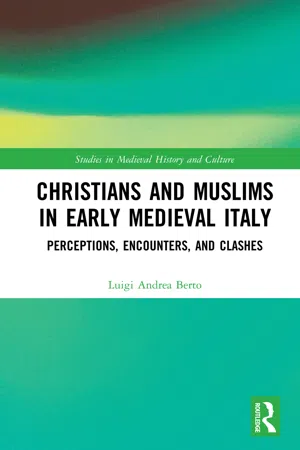
In the early Middle Ages, Italy became the target of Muslim expansionist campaigns. The Muslims conquered Sicily, ruling there for more than two centuries, and conducted many raids against the Italian Peninsula. During this period, however, Christians and Muslims were not always at war – trade flourished, and travel to the territories of the 'other' was not uncommon. By examining how Muslims and Christians perceived each other and how they communicated, this book brings the relationship between Muslims and Christians in early medieval Italy into clearer focus, showing that the followers of the Cross and those of the Crescent were in reality not as ignorant of one another as is commonly believed.
eBook - ePub
Christians and Muslims in Early Medieval Italy
Perceptions, Encounters, and Clashes
- 178 pages
- English
- ePUB (mobile friendly)
- Available on iOS & Android
eBook - ePub
Christians and Muslims in Early Medieval Italy
Perceptions, Encounters, and Clashes
1 References, definitions, and circulation of news
References
The Apulian historical texts, which briefly report the main events in southern Italy year by year between the ninth and eleventh centuries, well emphasize how dangerous the Muslims were to that area. At the same time, these works indicate that large Saracen raids did not constantly hit the region, that they took place over a long chronological period, and that they occurred in different parts of the South. For example, the Annals of Bari mentions attacks against Calabria (902), Taranto (927, 972, 991), Oria (924, 977), Matera (994), and Bari (988, 1003).1 In a similar text, perhaps written in Calabria, an area more exposed to Saracen incursions than Apulia, the number of attacks is greater, and minor raids are recorded as well. For example, this text mentions a large expedition from Africa against Calabria in 915 and the conquest of important cities – Taormina (902) and Taranto (928) – of medium-sized towns – Sant’Agata (922) and Oria (926) – and of small centers such as Bruzzano (924) and Tiriolo (930).2
Without minimizing the Muslim threat to the South, it is important to emphasize that most Christian writers did not want to create the idea of an obsessive Saracen presence in those territories. The biographies of the saints and the chronicles are divided into sections of different length, and calculating how many times the Muslims appear in them therefore only has an indicative value.3 In the Life of Saint Elias the Younger (ca. 823–ca. 903) they are mentioned very often (in twenty-nine chapters out of seventy-six).4 This work is, however, exceptional because Elias lived in one the ‘hottest’ periods for Muslim incursions into Sicily and Calabria and dwelt for a few years in North Africa and the Near East. This kind of percentage drastically decreases in the biographies of the other saints of those regions: Neilos (eleven chapters out of one hundred),5 Philaretos of Seminara (four pages out of fifty-five)6, Nicodemus of Kellarana (three chapters out of twenty-one),7 Vitalis of Castronovo (two chapters out of twenty-five),8 Luke of Demenna (three chapters out of sixteen),9 Gregory of Cassano (one chapter out of thirteen),10 and Bartholomew of Simeri (one out of thirty-one).11 The Muslims are never mentioned in the life of Saint Phantinus the Younger (d. ca. 974), who spent most of his life in the South.12 Another exception is the omnipresence of the Muslims in a Cassinese chronicle about the period from 839 to ca. 863 (nineteen chapters out of thirty-two)13 because that work is specifically devoted to explaining why the Saracens were in southern Italy. The number of references to them is much smaller in the other chronicles, especially in those that were not written in the South.14
The text about Saint Constantius’s deeds is a very rare exception for a couple of reasons. Not only does it mention the name of the Muslim leader and the year in which the incursion took place (991), but it also includes all the sites along the Amalfi Coast and the Gulf of Naples affected by these marauders, even including little towns and small islands. This work accurately explains what they did in each place (including how many Christians were taken prisoners or killed). It also illustrates how a small raid took place. The aforesaid Muslims were part of a larger expedition that a strong wind scattered between Sicily and Sardinia. This group was pushed to the coasts of Basilicata and from there moved to the Amalfi Coast and the Gulf of Naples. In such areas, the raiders only attacked small-sized centers, abandoning assaults when the inhabitants resisted them. The duke of Amalfi, instead of fighting, preferred to offer the Saracens gifts and food. The Muslims, however, kept away from Naples and its surroundings because of the presence of Neapolitan soldiers in that area. They subsequently planned to attack Capri, but a storm caused by Saint Constantius pushed them back south.15
Widespread distant echoes
The horizons of the narrative works of this period mirror the interests of their authors and their audiences and are essentially regional. These horizons, however, become larger in the case of events believed to be particularly relevant; such cases include episodes related to the Muslim campaigns throughout Italy. First, the reference to these events shows how news circulated across the Italian Peninsula and sometimes outside of it. These references also indicate that people were interested in what was happening in other areas, because those events could also be relevant for their home region. In addition, the existence of different versions of the same episodes sometimes provides valuable information about the authors and the contexts in which those texts were produced.
The Italian chroniclers do not mention the various phases of the conquest of Sicily by the Muslims, perhaps because little information was available or because of the lack of interest towards an area that was under Byzantine rule. They, however, did not neglect to record the beginning of that invasion (827), which brought far-reaching consequences for the history of all southern Italy. By comparing them to a bee-swarm, the monk of Montecassino Erchempert (second half of the ninth century) briefly describes the devastation the Muslims caused on the island and points out that almost all the inhabitants suffered under their rule.16 The Neapolitan John the Deacon (late ninth century/early tenth century), on the other hand, states that they arrived on the invitation of a Syracusan named Euthymius, who fled to Africa following the failure of his uprising against the Byzantine authorities.
The Syracusans, together with the faction of a certain Euthymius, rebelled against this Michael and killed Patrician Gregory. For this reason, the emperor sent a large army against them and the Syracusans were forced to flee because of the considerable number of soldiers. Also Euthymius went to Africa with his wife and children and led the ruler of the Saracens, Arcarius, against the Greeks with numerous ships. Since the Greeks could not resist, they retreated into the city walls of Syracuse and, after a hard siege, gave him fifty thousand solidi as a tribute. From that day, the Saracens plundered and devastated Sicily without fear. Eventually, they conquered the province of Palermo and took all their inhabitants into captivity.17
Other sources mention that a Sicilian rebel was responsible for the Muslims’ arrival. The version circulating in Constantinople, however, had details perhaps created with the intention of ridiculing the subject who had tried to become emperor. According to a ninth-century anonymous Byzantine author, Euphemius fell in love with a nun and married her. To escape the punishment imposed on him, the Sicilian fled to the Saracens in Africa and promised them a considerable sum of money if they helped him to take Sicily and to support his election as emperor, to which they agreed.18
The tenth-century anonymous Salernitan chronicler, on the other hand, uses that episode to blame an officer of the Byzantines, who are often criticized by this Lombard author, for that catastrophic event for southern Italy. The author reports that, in exchange for money, the Sicilian commander – called disdainfully Graeculus (little Greek) – kidnapped Euphemius’s wife and gave her to another man. In revenge, the disgraced husband promised that the wives of many others would also suffer the same fate. The Muslims immediately accepted his invitation to attack Sicily, sowing death and destruction. ‘Because of a single young woman,’ the writer comments, ‘many others were made widows. And those who once had banquets and parties had to pour out a lot of tears because of just one little Greek.’19 A vague echo of the Muslims’ military activities in Sicily emerges from the work of the Venetian chronicler John the Deacon (late tenth century – early eleventh century), who reports that in those years the Venetian fleet intervened twice in Sicilian waters at the request of Constantinople, but this author does not explain against whom.20
In 846 the Muslims attacked Rome. The city was not taken, but the assailants looted the basilicas of St. Peter and St. Paul, located outside the city walls. The fact that, in addition to those of central Italy,21 authors from other areas of the Peninsula and beyond the Alps remembered this event marks its especial relevance. The assault upon the heart of western Christianity did not, however, inspire them to make any comment, and that episode was reported with the detachment of a modern press agency. The authors probably felt torn between ...
Table of contents
- Cover
- Half-Title
- Series
- Title
- Copyright
- Contents
- Abbreviations
- Abbreviations
- Acknowledgments
- Introduction
- 1 References, definitions, and circulation of news
- 2 Religious otherness
- 3 Perceptions
- 4 Some light in the darkness: Reading between the lines of the zealots’ criticism
- 5 Supernatural events
- 6 Why is the enemy attacking us and winning?
- 7 Rewriting history
- 8 The enemy is coming
- 9 Prisoners
- 10 ‘Going’ to the other
- 11 Encounters
- Conclusions
- Appendix
- Maps
- Bibliography
- Index
Trusted by 375,005 students
Access to over 1.5 million titles for a fair monthly price.
Study more efficiently using our study tools.
Frequently asked questions
Yes, you can cancel anytime from the Subscription tab in your account settings on the Perlego website. Your subscription will stay active until the end of your current billing period. Learn how to cancel your subscription
No, books cannot be downloaded as external files, such as PDFs, for use outside of Perlego. However, you can download books within the Perlego app for offline reading on mobile or tablet. Learn how to download books offline
Perlego offers two plans: Essential and Complete
- Essential is ideal for learners and professionals who enjoy exploring a wide range of subjects. Access the Essential Library with 800,000+ trusted titles and best-sellers across business, personal growth, and the humanities. Includes unlimited reading time and Standard Read Aloud voice.
- Complete: Perfect for advanced learners and researchers needing full, unrestricted access. Unlock 1.5M+ books across hundreds of subjects, including academic and specialized titles. The Complete Plan also includes advanced features like Premium Read Aloud and Research Assistant.
We are an online textbook subscription service, where you can get access to an entire online library for less than the price of a single book per month. With over 1.5 million books across 990+ topics, we’ve got you covered! Learn about our mission
Look out for the read-aloud symbol on your next book to see if you can listen to it. The read-aloud tool reads text aloud for you, highlighting the text as it is being read. You can pause it, speed it up and slow it down. Learn more about Read Aloud
Yes! You can use the Perlego app on both iOS and Android devices to read anytime, anywhere — even offline. Perfect for commutes or when you’re on the go.
Please note we cannot support devices running on iOS 13 and Android 7 or earlier. Learn more about using the app
Please note we cannot support devices running on iOS 13 and Android 7 or earlier. Learn more about using the app
Yes, you can access Christians and Muslims in Early Medieval Italy by Luigi Andrea Berto in PDF and/or ePUB format, as well as other popular books in History & European Medieval History. We have over 1.5 million books available in our catalogue for you to explore.