Chapter 1
Performing home
It is early on a light, spring evening in April 2018. I am standing in a kitchen in Walmer Yard, London, a development of four houses, designed by the architect Peter Salter. Four people sit around a wooden table, in conversation (see Figure 1.1). Each one has a glass of white wine, from which they drink occasionally. There are other glasses and kitchen implements on the table: a metal bowl, a grater, a small chopping board. On a long, split level ‘island’, which divides the kitchen and dining areas of the room, there are dishes, plates and pans of food. While the four people and kitchen surfaces are well lit, the remainder of the room is darker and, until my eyes adjust, it is difficult to tell if other people are here too. In time, I become aware of a man sitting sketching the people at the table. At one point, he stands, continuing to draw, before retaking his seat. At the table, the participants are discussing a building with which they are familiar, one of them takes a sip from her wine, the man to the right stretches. It appears a quiet, comfortable but focused conversation on architecture that is taking place towards the end of a meal in one of four new homes in the city.
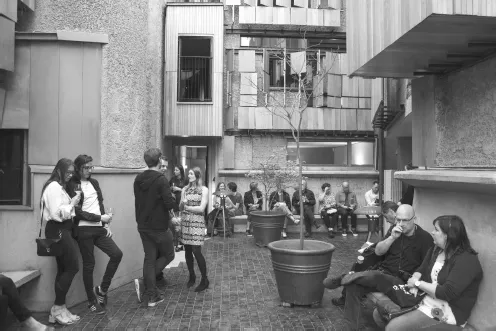
The events in the kitchen comprised one of a series of interventions in an ‘experiential encounter’ with Walmer Yard (Royal Academy, n.d.). These included movement installations, film screenings and time to explore these houses – which, while separate from one another, are also intricately interlinked. Through the windows and from the roof of one of the houses, I looked down on the path between the dwellings, and through windows into the upper levels of the other Walmer Yard houses. Movable panels at the windows revealed and obscured these neighbouring buildings. Throughout the evening, attendees walked around the houses, experienced events and gathered together over food and drink in the spaces between each one (see Figure 1.2). The evening comprised the first day of a two-day event, Experiencing Architecture: Inviting Dialogue, held by the Royal Academy of Arts (RA), London.1 The event followed on from Sensing Spaces: Architecture Reimagined, an exhibition at the Royal Academy in 2014, and a symposium and a subsequent publication (Hopkins, 2017). Both events were curated by Kate Goodwin, Head of Architecture at the Royal Academy, who was one of the four contributors to the kitchen conversation at Walmer Yard. The events mark continued interest by the RA in investigating experiences of architecture, and, as the interventions at Walmer Yard demonstrated, this includes a particular focus on domestic dwellings.
Figure 1.2Between the houses, Walmer Yard, London.
In ‘At home,’ the preface to this book, I reflect on my own awareness of – and fascination with – experiencing and practising domestic dwellings. I identify particular and somewhat discordant practices of renovating one house and emptying another – and sensations of becoming familiar with the first and loosening ties with the second. In beginning with these experiences and practices, I recognise my own sense that there is something significant in the lived experience of practising a domestic dwelling. This book investigates the ways in which artists practise a dwelling and thereby ‘perform’ a version of home, in order to think through the ways in which one might inhabit that, or any, dwelling as home. As such, it is grounded in three key questions:
- 1 How do artists engage with, and make sense of, domestic dwellings in installation/performance in those dwellings?
- 2 What does such work contribute to understandings of performance, particularly performances of place?
- 3 What does such work contribute to understandings of the practice of domestic dwellings, and, thereby, to the practice of buildings and architecture?
Taken together, the questions ask, ‘how do artists practise domestic dwellings as a form of home?’
In the experiential encounter at Walmer Yard, a printed programme explained that there would be a series of performances, installations and conversations in and between the houses – and it invited those attending to join in with conversations. Upstairs, in one of the houses, a woman lay on a window-ledge, another lay curled up at the base of a shower, two others moved slowly, precisely around a bedroom, often with some distance between them. The work drew attention to lines in the rooms, to objects, to degrees of movement, to places where bodies might rest. It marked these as rooms for quiet, for stillness, for finding a place to locate oneself in a building. The performers engaged with the building as much as the objects within. This, it appeared, was a work to notice, to take account of, but probably not a conversation to join.
The conversation in the kitchen was complex. On one level, this was a highly performative environment. Standing close to the entrance to the room, I was aware of the array of ingredients on the kitchen island. Closest to me, a plate of orange halves had been dressed with a thick layer of ground cinnamon, with herbs and with chocolates wrapped in yellow and green foil. A line of rock salt and two lines of herbs had been laid out, with some precision, on a wooden chopping board. As I took in the room, I was aware of the visual display and the strength, richness and combination of aromas. Indeed, the feast seemed premised upon smell as much as taste. The display might have been an artwork in itself, and I later discovered that a series of performers had created it earlier in the evening. Yet within the same room as the conversation, it marked that conversation as being an event to observe rather than join.
That said, the conversation itself seemed unrehearsed. It was genial, words shared between colleagues or friends. To watch this unfold from a distance felt voyeuristic. At one point, a young girl ran up to one of the women, presumably a daughter running up to her mother, revealing that the world of the conversation was connected to that of those who, periodically, entered the room or sat quietly in the shadows. This moment aside, those in the conversation did not invite others to join nor indicate we try the food laid out around the room. This was not exactly a dinner party, nor a ‘roundtable’ conversation on architecture; it was not a private event – it had been advertised to the public, we had been ticketed and invited to roam the site. Two worlds had been drawn together here: the viewing of artistic interventions and a conversation over food and wine – neither one excluded or entirely included the other.
Both the movement work upstairs and the conversation in the kitchen revealed ways of practising a building. In both instances, the engagement was durational. This was, most likely, partly practical, enabling spectators to experience projects during the evening, but it also offered opportunities for ‘performers’ to discover the houses through their practice of each space and the spaces between. Neither intervention was entirely comfortable to observe, particularly alone. Upstairs, I was distinctly uneasy watching dancers seek out places in which to curl up, to squeeze into, as if hoping to lose themselves within the building. Days after the event, I found myself thinking back to the kitchen, wondering whether I should have poured some wine, pulled up a chair, and joined the conversation at the table, whether it would have been better to risk intruding rather than watch at a distance. I wonder also if I should have read the movement scenes as an invitation to find ways to move in and through a room, rather than observe scenes unfolding in each space. In being present at specific interventions, I was acutely aware that the event was an experiment, it proposed a number of ways by which one might activate a house for others, testing forms of dialogue between places and ways of practising those places.
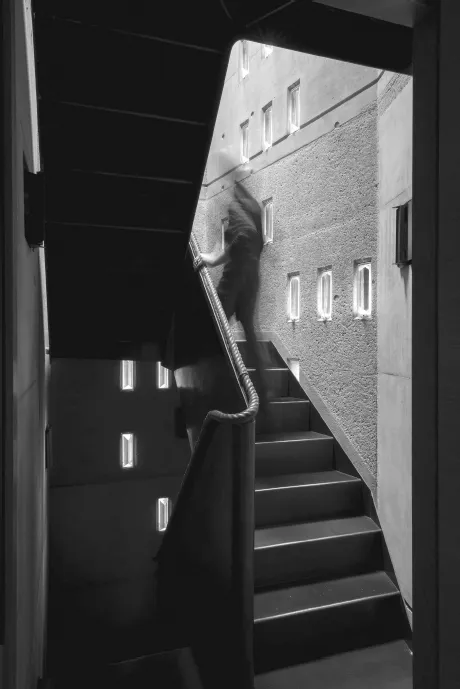
Aside from the interventions, the houses of Walmer Yard draw attention to the experience of architecture. The stairwells (see Figure 1.3) of each one are set within the main structure and are dark, with rope bannisters, which suggest a maritime but also perhaps sinuous structure; there are doors that are almost too narrow to slip through and stairs to the roof that reveal domes atop each of the buildings, as if each house breaches its expected envelope. To explore the buildings is to encounter spaces with distinctive features, to take in the sunlight that illuminates some rooms, the darkness that fills others and the tactility of materials: wood, rope, leather, metal, glass. The houses ask what a dwelling might be, just as the performance interventions asked how we might live in and with those buildings. Both the design and form of the buildings and the practices of intervention suggest that we may need to think anew about the form of a dwelling – in this case, in terms of its allowance for light, its shape, tactility and its relationship to buildings nearby. In terms of practice, the buildings and the exploratory practices within suggest we might also need to reconceive of ways of being in a building, particularly a domestic dwelling.
Practising domestic dwellings
In the following chapters, I discuss a series of artworks in which artists ‘practise’ domestic dwellings. In so doing, I identify and investigate five critical ways by which these artists practise dwellings. I consider the ways in which artists enquire into a dwelling, are resident in a dwelling, adapt the form of a dwelling, practise a mobile dwelling and make a dwelling. In focusing in detail on specific projects in each chapter, I demonstrate the breadth and significance of recent artistic engagement in and with domestic dwellings, and investigate the ways in which the projects speak to, and inform our understanding of these five practices of ‘performing home’. Through this study, I am interested in understanding the ways in which artists make sense of a particular domestic dwelling (rather than dwellings per se), whether their own or a dwelling they have taken on, adapted or even built themselves.
In terms of form, the book addresses a range of artworks in and between architecture, art installation, performance and theatre. In addressing this range, my concern is to avoid speaking to a single form of architecture or arts practice but rather to identify, articulate and reflect on the ways in which individual projects from a range of disciplines can contribute to definitions of the five practices of performing home. In so doing, I am concerned with the performance of home in domestic dwellings in broad terms, from work where artists frame their own, personal practices of being at home to those in which artists create versions of a dwelling that may bear little relation to any individual practice of making or being at home. Through this work, I seek to advance understanding of performance in dialogue with theories and practices of architecture, cultural geography, material culture and broader sociological enquiry. I focus on projects that are themselves difficult to pin down, that, as with the kitchen event at Walmer Yard, comprised multiple elements and forms. My purpose here is to demonstrate the importance of performance analysis as a means of engaging with difficult work and of revealing practices that can speak to and beyond performance research, to help us understand and articulate contemporary practices of place.
Figure 1.3Interior stairwell, Walmer Yard, London.
Aside from form, the book considers projects that vary in terms of location and issues at stake. In selecting work, I sought out projects that allowed for extended discussion of a particular practice of home. Some comprised single works, others were part of an extended series or built on previous practice; some work was ‘finished’, some in process; much has received relatively little academic attention. Projects included work in cities, in rural farmland, in the middle of a country and on an island toward the edge; there are projects that travelled around the UK and across Europe. There is work by people who identify in different ways in terms of gender, race, age and who work as individuals, in companies and collaboratively. There are established names and some that are less widely known. Throughout, I frame this as a study of specific projects to discover and theorise practices rather than being a survey of the field. The book identifies a series of works, thinks about these by way of specific terms and suggests that these terms might be useful ways to develop a continuing conversation on performances of home in domestic dwellings.
Intentionally, the book avoids some of the most widely discussed works in and of home in order to point to the breadth of activity in this field. It also avoids being a historical survey – much as that would be fascinating work. The focus is on work predominantly from the twenty-first century that helps reveal a contemporary lexicon of artistic practices. In discussing each of the artworks, a term used expansively to recognise the diversity of work, I focus on the architecture, material objects, local conditions or situations and the acts and processes in each artist’s work on, with and in a dwelling – as appropriate to the specifics of each project. In attending to these aspects, I consider the ways in which analysis of each artwork advances our understanding of the practice of home and, thereby, of architecture, art, performance and place – separately or in combination.
In selecting artworks I sought out projects in which artists were engaged in addressing and thinking through the practice of a domestic dwelling and, thereby, attending to their relationship with the world. I include a work I have seen myself, to recognise the significance of experiencing such projects. Several of the projects are from the UK or included work in the UK. Being based in the UK, this allowed relatively easy access to this work. I have balanced these with projects that I did not see but recognise as adding to our understanding of this field of practice and that reveal international engagement with such practice. For projects that I could not experience in person, I selected those where there were traces of the work that might productively be considered as source material in themselves. In discussing each one, I took a triangulatory approach, drawing together multiple sources, including, for instance, interviewing the artist or those who had participated in or experienced a work. This carries risks of making partial readings of a project, although many of the artworks involved multiple iterations or re-workings – with the effect that any engagement is necessarily particular and only one way of attending to each work. As a result, I concentrated on iterations of a work that appeared significant in themselves and that appeared to offer the most insightful elements in the context of developing a lexicon of terms.
Practically, it can be difficult to experience performances of home in domestic dwellings. These are, necessarily, specific to a place, they may be time limited and it can be difficult to discover these works with time to arrange travel, particularly where funding may be required. In that these projects take place outside conventional venues, they may well, at times consciously, escape conventional marketing practices. Some artists will never document their work; some will consciously address their work to local communities. There are issues of access to technology and to communities and networks that can promote work widely, which may well speak to (and compound) long-standing issues of representation. There is always a risk that those projects that are well-publicised will attract scholarship, and we will lose sight of small-scale, momentary and fragmentary works, particularly those that loop in and out of everyday practice of a home in small but compelling ways.
Several of the projects here involved multiple incarnations, often in ways that may not have been known or publicised at the outset of the work. Indeed, artists may intend some of the difficulties in discovering performances of home, or at least recognise them as being relevant to the work, and there may be value in avoiding any dominant framing of a work as a must-see artwork – or even framing it as arts practice at all. In The Dollhouse, for instance (Chapter 4), Heather Benning was interested in the lack of social contact that women in rural Canadian farmhouses would have experienced in the first half of the last century. The lack of visitors for days at a time and the potential for multiple spectators to arrive at the same time all speak to this historical context of occasional visits to otherwise isolated homes – some visits having been planned, others made by those who were passing by.
The extended activity of several of these projects, and the opportun...