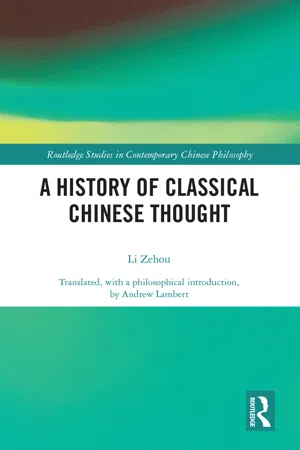
A History of Classical Chinese Thought
eBook - ePub

A History of Classical Chinese Thought

  1. 354 pages
  2. English
  3. ePUB (mobile friendly)
  4. Available on iOS & Android
eBook - ePub

A History of Classical Chinese Thought

About this book

Li Zehou is widely regarded as one of China's most influential contemporary thinkers. He has produced influential theories of the development of Chinese thought and the place of aesthetics in Chinese ethics and value theory. This book is the first English-language translation of Li Zehou's work on classical Chinese thought. It includes chapters on the classical Chinese thinkers, including Confucius, Mozi, Laozi, Sunzi, Xunzi and Zhuangzi, and also on later eras and thinkers such as Dong Zhongshu in the Han Dynasty and the Song-Ming Neo-Confucians.

The essays in this book not only discuss these historical figures and their ideas, but also consider their historical significance, and how key themes from these early schools reappeared in and shaped later periods and thinkers. Taken together, they highlight the breadth of Li Zehou's scholarship and his syncretic approach—his explanations of prominent thinkers and key periods in Chinese intellectual history blend ideas from both the Chinese and Western canons, while also drawing on contemporary thinkers in both traditions. The book also includes an introduction written by the translator that helpfully explains the significance of Li Zehou's work and its prospects for fostering cross-cultural dialogue with Western philosophy.

A History of Chinese Classical Thought will be of interest to advanced students and scholars interested in Chinese philosophy, comparative philosophy, and Chinese intellectual and social history.

Frequently asked questions

Yes, you can cancel anytime from the Subscription tab in your account settings on the Perlego website. Your subscription will stay active until the end of your current billing period. Learn how to cancel your subscription.
No, books cannot be downloaded as external files, such as PDFs, for use outside of Perlego. However, you can download books within the Perlego app for offline reading on mobile or tablet. Learn more here.
Perlego offers two plans: Essential and Complete
  • Essential is ideal for learners and professionals who enjoy exploring a wide range of subjects. Access the Essential Library with 800,000+ trusted titles and best-sellers across business, personal growth, and the humanities. Includes unlimited reading time and Standard Read Aloud voice.
  • Complete: Perfect for advanced learners and researchers needing full, unrestricted access. Unlock 1.4M+ books across hundreds of subjects, including academic and specialized titles. The Complete Plan also includes advanced features like Premium Read Aloud and Research Assistant.
Both plans are available with monthly, semester, or annual billing cycles.
We are an online textbook subscription service, where you can get access to an entire online library for less than the price of a single book per month. With over 1 million books across 1000+ topics, we’ve got you covered! Learn more here.
Look out for the read-aloud symbol on your next book to see if you can listen to it. The read-aloud tool reads text aloud for you, highlighting the text as it is being read. You can pause it, speed it up and slow it down. Learn more here.
Yes! You can use the Perlego app on both iOS or Android devices to read anytime, anywhere — even offline. Perfect for commutes or when you’re on the go.
Please note we cannot support devices running on iOS 13 and Android 7 or earlier. Learn more about using the app.
Yes, you can access A History of Classical Chinese Thought by Zehou Li, Andrew Lambert in PDF and/or ePUB format, as well as other popular books in Philosophy & Ancient & Classical Philosophy. We have over one million books available in our catalogue for you to explore.

Information

1
Reevaluating Confucius

A great deal of scholarly work has been done on Confucius (551 BCE–479 BCE), yet much divergence in opinion remains. An important reason for this divergence is a lack of clear understanding about the societal changes taking place around the time of Confucius, which has resulted in myriad interpretations of the nature and significance of Confucius’ ideas. Exploring the characteristics of that society is not possible in this work, which can only analyze some of Confucius’ ideas. These ideas include multiple mutually intersecting and reinforcing elements and dimensions, which gave rise to a cultural-psychological formation (wenhua xinli jiegou ę–‡åŒ– åæƒē† ē»“ęž„) that has exerted tremendous influence on the Chinese people.
How to accurately grasp and describe this formation is perhaps the key to understanding Confucius. The Spring and Autumn and the Warring States periods were marked by a transition from a nascent patriarchal clan system, which preserved the traditions of clan-based society, to a developed system of regional states. Although Confucius’ thought was an expression of certain aspects of clan and aristocratic society during this time of unprecedented change, its relative independence and stability meant that the cultural-psychological formation initiated by Confucius endured through the ages and continued to develop.

The Characteristics of ā€˜Ritual’

Regardless of which school of thought a scholar belongs to, it is difficult to deny that Confucius vigorously maintained and defended the codified ritual tradition of the Zhou dynasty (Zhouli 周禮). The Analects mentions ritual or ritualized practice (li 禮) numerous times, clearly expressing Confucius’ dismay at the decay of ritual in his social world, and demanding that people restore and abide by many aspects of the Zhou ritual tradition.
So, what is the Zhou ritual tradition? The general consensus is that it is a set of decrees, institutions, norms, and rules of etiquette or protocol that were fixed in the early Zhou dynasty. It might be characterized as the standardization and systematization of one kind of clan governance, which was itself based on primitive shamanistic ceremonies. As part of the nascent patriarchal clan system of the later Shang and the Zhou dynasties, it remained bound up with multiple aspects of clan and kinship life, and its structure and ideology were a direct extension of earlier primitive culture. What follows is a description of some of the characteristics of the Zhou ritual tradition.
On the one hand, there were clear and strict rules of order, which involved ordered hierarchies of seniority, class, status, and age, with the primitive clan ceremonies that previously included all in society being monopolized by small numbers of nobility. On the other hand, because the basic economic structure inherited the social structure of communal clan-based society, this set of ceremonies and rituals preserved a degree of primitive democratic and populist spirit. It is possible to find traces of this in the Yili 儀禮, a text which became known as the Book of Rites and was transmitted to the Han dynasty as the first of the three texts on ritual. The first chapter of the Yili, ā€œThe Capping of the Scholar Ceremonyā€ (shiguan li 士冠禮), constituted an extension and modification of the ceremonies in earlier clan society that marked coming of age and the entry into society. For example, ā€œDrinking Rituals in Country Districtsā€ (Xiangyinjiu li 鄉飲酒禮) emphasized great respect for elders, and the Book of Rites described this differential treatment for men of different ages as follows:
60 year-olds are seated, 50 year-olds stand in waiting and listen to the orders of government. This is how respect for the aged is made clear. 60 years gets three dishes, 70 gets four, 80 gets five, 90 gets six; this is how nourishing the elderly is made manifest. The people knowing respect for the aged and nourishing the old is the beginning of filial and fraternal conduct.1
From this it is clear that filial piety and fraternal responsibility presume respect for seniority. I agree with Yang Kuan’s view, that this kind of ritualized respect for seniority was not just a rite of respecting elders at a drinking party.2 Rather, it showed the characteristics of a primitive assembly, with a particular role in the structuring of political authority in ancient China. Both within and beyond China, many early clans had this kind of assembly. For example, among the Ewenki people in China, ā€œfor the past sixty plus years, at each level of the community, some important matters would be discussed and resolved through a ā€˜Wulileng’ ēƒ åŠ›ę„ž assembly. This assembly was mainly made up of elderly males and females from each family, and the longer a man’s beard the greater his authority.ā€3 The ā€˜Pinli’ 聘禮 (betrothal gifts) and ā€˜Sheli’ 射禮 (archery etiquette) chapters of the Yili, among others, also can all be traced back to various rites and shamanistic activity associated with clan society.4 Each chapter of the Yili described highly specific rites, and these could not be fabricated by later generations; nor were they meaningless literary flourishes; as primitive rites, their original form had an important social function. It was through such primitive ritual activity that ancient clans bound the collective together and created unity. Such social order and convention were instrumental to economic production and daily life and underpinned the entire society’s survival and success.
As a result, these rituals had, for each clan member, great power to compel and restrict, much as law had in later times. In effect, the rituals constituted a kind of unwritten common law. By the time of the later Shang and the Zhou dynasties, the rites and ceremonies that functioned as common law gradually became the exclusive preserve of the clan nobility.5 Confucius’ attitude to the Zhou ritual tradition was consistent with his defense of this system of clan government and the primitive ritual preserved by it. For example, Confucius and Mencius consistently ā€˜revere elders’: ā€œIn his ancestral village he was most deferential as though almost at a loss for wordsā€;6 ā€œWhen drinking wine in his village, he would wait for those with canes to depart before leavingā€;7 ā€œIn the world there are three objects of the highest respect, rank, age and virtue.ā€8
ā€˜Ritual’ is a capacious term, but its origins and core meaning is respect for and sacrifice to ancestors. Wang Guowei ēŽ‹åœ‹ē¶­ (1877–1927) wrote:
The vessel holding jades, presented to deities or ancestors during ceremonies, were known as li 豐 (vessel); by analogy, the wine used for sacrifice to deities were also called li 醓 [the character li 豐 with a wine radical added]. Further, offerings to deities were known as li 禮 or ritual [the character li 豐, with a deity radical added].9
Similarly, Guo Moruo éƒ­ę²«č‹„ (1892–1978) wrote:
The character for ritual came later. In the bronze inscriptions, we sometimes see the use of the character li 豐. Based on the composition of the character, it was a vessel that contained luxuriant stringed jade and was used for offerings to the spirits. The ā€œprecious shells and jadeā€ reference in the ā€˜Pan Geng’ ē›¤åŗš chapter of the Shangshu å°šę›ø should be understood in this way, thus confirming the original meaning of the character for ritual. The ritual was possibly generated from sacrifices to deities, and therefore the character for deity was combined with the character for vessel to form the character for ritual. Later, its meaning was extended to include people, and later still it expanded to include all rituals for auspicious and inauspicious affairs, as well as military matters and banquets.10
It is thus clear that the distinguishing feature of the Zhou ritual tradition was that it took primitive rituals and ceremonies, centered on sacrifices to ancestral spirits, and remade, systematized, and expanded them.11 They were transformed into a set of governing customary laws and regulations (a system of rites with legalistic force).12 The backbone of these laws and regulations was a hierarchical system of kinship and patrilineal succession, which was extended outward through a political and economic system based on enfeoffment, inheritance, the well-field system, and patriarchal clan rules. As for the Confucians or Ruists, represented by figures such as Confucius, they emerged from among the organizers and leaders of primitive rituals and shamanic practices—the shamans, officials, and scribes—to become the expert overseers and preservers of what was to become Confucian ritual and ceremony.
Late Qing scholar Zhang Binglin ē« ē‚³éŗŸ (1869–1936), also known as Zhang Taiyan ē« å¤Ŗē‚Ž wrote, ā€œIn the earliest times, humans were governed by shaman-officials.ā€13 Zhang believed that Confucians originally were ā€˜shaman-officials’ (shushi 蔓士, a term also used by Zhang’s teacher, Yu Yue äæžęØ¾ [1821–1907]) and were in charge of ritual and helping the ruler to accord with yin and yang forces in order to teach and transform the people. This meant that they were important figures both religiously and politically.14 The great Confucian figures of antiquity, such as Emperor Shun’s minister Gao Yao 臯陶, Shang minister Yi Yin 伊尹 and the Duke of Zhou 周公 were all such shaman-officials, serving as both overseers of ritual and auxiliary rulers. The later Confucian idealization of a ā€˜prime minister’ (zaixiang 宰相) who helped the emperor rule the empire originated from this earlier role.15
Qing scholar Zhang Xuecheng ē« å­øčŖ  (1738–1801) believed that men of virtue learned from the sages and the sages learned from the common people,16 and that the great synthesizing figure was not Confucius but the Duke of Zhou. Moreover, ā€œThe greatness of Confucius was that, in studying the Zhou ritual code, he could capture its essence in a single phrase.ā€17 It was not Confucius but the Duke of Zhou who comprehensively sorted, remolded, and standardized the primitive rituals of high antiquity up to the Shang dynasty. At the time this was a hugely important transformation. Wang Guowei argues in Yinzhou zhidu lun (On the Institutions of Shang and Zhou)18 that Confucius repeatedly emphasized that he ā€œloved the ancients but did not innovateā€;19 ā€œfollowed the Zhouā€;20 and ā€œdreamed of the Duke of Zhou,ā€21 indicating that he intended to preserve the Duke of Zhou’s legacy in toto. The following passages also show Confucius upholding a ā€˜governing by ritual’ that is founded upon customary norms that require trust or faith:22 ā€œA ritual vessel that is not a ritual vessel, ah, a ritual vessel indeed!ā€;23 ā€œJi has established eight lines of dancers in the court. If this is tolerated, what cannot be tolerated?ā€;24 ā€œYou begrudge the sheep, and I the ritualā€;25 ā€œIf the way consists of law and use of punishments to order them, people might follow the law but lack a sense of shame. If led by virtue (de),26 and ordered by means of ritual, then the people will have a sense of shame and act with proprietyā€;27 ā€œAll men must die but if there is no trust in the ruler, he cannot survive.ā€28
However, Confucius’ era was already one in which ritual and ceremonial music were in decline. The clan system of government and collectivist social structures were collapsing.29 In the Spring and Autumn period, many clan-based states were wiped out and many nobles could not hold on to their inherited status; some fell into poverty and some undertook minor civic duties. Some of the clan nobility abandoned old conventions and focused on land and private enterprise, forming a new rising class and quickly becoming powerful and wealthy. Han Fei 韓非 (ca. 280 BCE–233 BCE) commented, ā€œthe partition of Jin and the conquest of Qi were both the result of the great wealth of their many ministers.ā€30 Great eco...

Table of contents

  1. Cover
  2. Half Title
  3. Series Page
  4. Title
  5. Copyright
  6. Contents
  7. Foreword: Translator’s Introduction
  8. 1 Reevaluating Confucius
  9. 2 A Preliminary Exploration of the Mohists
  10. 3 Sunzi, Laozi, and Han Fei
  11. 4 Key Features of the Xunzi, Yizhuan and the Doctrine of the Mean
  12. 5 Qin and Han Dynasty Thought
  13. 6 Zhuangzi and Chan Buddhism
  14. 7 Some Thoughts on Neo-Confucianism
  15. 8 Engagement in Practical Affairs and Statecraft
  16. 9 Some Thoughts on Chinese Wisdom
  17. Afterword
  18. Bibliography
  19. Index