This volume addresses the issue of freedom in the philosophy of Deleuze and Guattari. This is all the more challenging in that Deleuze-Guattari almost never use the term freedom, preferring instead, the concept of the refrain. The essays collected in the volume show that freedom has been understood in a remarkably narrow sense and that in fact freedom operates as the refrain in every realm of thought and creation. The motivating approach in these essays is Deleuze-Guattari's emphasis on the irreality of media and capitalistic sign regimes, which they perceive to have taken over even the practices of philosophy, the arts, and science. By offering a clear and engaging treatment of the underexplored issue of freedom, this volume moves the discussion of Deleuze-Guattari's philosophy forward in ways that will appeal to researchers in Continental philosophy and a wide range of other disciplines.
eBook - ePub
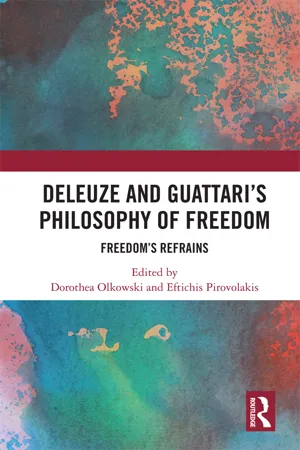
Deleuze and Guattari's Philosophy of Freedom
Freedom’s Refrains
- 232 pages
- English
- ePUB (mobile friendly)
- Available on iOS & Android
eBook - ePub
Deleuze and Guattari's Philosophy of Freedom
Freedom’s Refrains
About this book
Information
Part I
Infinite Speeds and the Machine
1 Deleuze and the Freedom of the Machines
There has been talk of play, for a long time now, whether talk of the divine play of Nietzsche or talk of the dice throw of Mallarmé. But when there is talk of play, chance, without a doubt, is never simply chance. We cannot assign finality or interiority to chance. Chance is not a thing; it is a milieu that holds necessary forms and connected lines. But to run through these lines, an encounter is necessary, like the incidence of the rays of the sun inside the water. The rays of the sun necessarily obey the laws of diffraction, and the same happens with their propagation inside the water. What is remarkable is their break, which elicits in Descartes’s case, for example, the image of a bent stick. It is the crossing of the two that generates patches of shade and elements of chance. Inside such a refraction, objects get deformed, creating singular combinations but also figures that we can still control. Perhaps given this break, we have a plane of recomposition that brings about some sort of redistribution. The redistribution presupposes out of sync and often incompatible ‘attributes’ for new formulas, a lot of ‘modes’ and singularities that, as Spinoza maintains, exist thanks to the infinite ‘ideas’ by means of which Nature assembles itself, even when a deformed lens affects it, half way between necessity and freedom.
Each one of us finds our unique formula swirling inside the grand ‘all’. These discoveries do not happen without effectuating combinations slowed down by organisms that filter them, although their concept does not close in on itself nor is it firmly attached to an end. Life, Deleuze used to say, does not die; only organisms do.1 Whatever the constituted order or the resulting organism may be, vital movement cannot be abolished nor can death annihilate the virtual idea on which the lens and the formula of my unique figure are fixed. My existence is irrevocable. I am; I have been! Nothing can suppress the idea, that is, the broken symmetry ordained by the great universal machine that no negation can ever stop. Life discovers an open road to follow and to extend its flow, folding the elements upon one another and breaking down the infinite relations that Nature has totally in its disposal. Life, in this Spinozist way of seeing things, sings the refrain of a machinic freedom—a machinism proper to the Deleuzian century entirely absorbed in the vital desire that resonates infinitely in everyone as a strongly affirmative power to exist. Freedom in Deleuze is also desire, but it has nothing to do with the ethics of action. The latter would always have an end, while machinic desire is connected with an industrious play that goes on to infinity.
This strange freedom of the triumphal formula that forms a life, this singular equation that constitutes the deformed essence of everyone, is not really opposed to the determinism of physics whose paradoxical game it also plays. The parts of a machine, the parts of a well-oiled mechanism, need a space of play to enter a universal machinism. The dentate wheels, those made best by the distance they travel, are able to link up only because of the interstices of the outside that slide inside the apparatus and bring about the separation. This chaotic outside, this jamming, enters the space of a machine where the intervals count more than the rest. A world of relations…. In every crossroad of an integrated existence, contingency releases the possibles and liberates the future as it profits from already accumulated determinisms. We have the feeling that, in the water, the stick bends, a curve is made of sand, but life does not break. Life goes on, and a certain logic presides over this deviation. We will speak of ‘determination’, not in the case of something determined, not even in the case of the determinant. Between the two, determination (just as much as motivation) is already in the process of being made, creating bifurcations the way that liberations would do.2 However, truth to tell, freedom is rarely conceived at this level of radicality. We never grasp it as something that liberates a passage or a way. Free is the movement that plays in a state of ‘indifference’with respect to goals and ends. We are far from the one who ‘wants’—far from the freedom of the will as a force of character. As a matter of fact, freedom opens up a game, a space of play where things evolve in a freewheeling manner. We need a ‘neutral point’ to engage what Deleuze calls the difficulty of thinking, the inability to put the decision in gear, to refer it to a certain rule or a regime, a longwinded and zig zag line. We are consequently on a new, very special mechanism, a mechanism that is at the center of Anti-Oedipus, as much as Jarry’s bicycle, the strange pataphysics that Deleuze displays in his Essays Critical and Clinical. It is here that the freedom of the schizo is given in many different ways by the contradictory movements of a machine whose wheels bifurcate. In this context, the free play, the floating between two pieces or two plateaus, the open space that permits their mobility—the interval—will be inseparable from an empiricism, and from an effort capable of lacerating the most solid forms and of augmenting the most closed organisms.
Every experience occurs on the verge of madness and its insane course, with an emptiness responsible for the change of speed, the change of plateaus, and discs in the wheel of a bicycle. We may then say that the experience of the bent stick in the water is a real change. It is the result of a certain danger, a certain peril, a certain difficulty of thinking, of thinking about its course. Free is the one whose course, even at great personal risk, is unfettered, in ‘free fall’, as we would say of a paratrooper who has not opened his or her parachute or like a cinematic movement that creates the feeling of flight. It resembles the case of someone pedaling unencumbered whose force suddenly would be passed on to a machine and made to follow directions that are not coordinated, as is the case in Man Ray’s mechanism called Danger or Impossibility.3 At the moment of the reorientation of the determination, we could expect that an experience occurs. How could we fail to hear in the word ‘experience’ the danger, the perishing, and the peril that the etymology of the word reveals? If we are more attentive, this word would even suggest something that derives from ‘pire’ (worse), or from the broken peak, or the reef. Experience suggests, as in Beckett’s A cap au pire (Worstward Ho), empirer (to worsen) or even empiricism.
It would take long to establish the set of words related to experiri. Experience and empiricism include many more phantoms. The peirates, the pirate, is not very far from the word ‘experience’, as we learn from Lean-Luc Nancy, who enters this very Deleuzian century and takes freedom outside the Kantian circle, which is contaminated by strange derailments and syncopes.4 The pirate, the one who leaves the rails, is the one who goes beyond, who transcends all limits and deterritorializes him- or herself so as to deploy a Deleuzo-Guattarian concept. The pirate leaves behind the worse (pire) and enters a determination whose end is unknown. There is no point in turning into an enfant terrible and forcing the concept of ‘experience’ in a delirium with no consideration for genealogy; there is no point in shaking a bent stick inside the water for the sake of strange reflections…. However, we can say, at least, that we have a ritornello here, ready to be hummed in the midst of words that break up, that recall memories and return the way the bicycle wheel turns…. The point of this machination of experience was to raise the question of the difficulties and the horrific trials confronting freedom in its effort to find its outside, its other, the crack and the rhythm of perishing, peril, pire (worse), empirer (worsen), or the empiricism that Deleuze tried to raise to its ‘superior’ form.5
Ever since Kant, freedom has nothing empirical about it; it is not limited by any peril, any trial, or any steep climb. It does not have to fear the worst, at least, if we take the concept of liberty in its most ethical sense. For Kant, freedom was certainly an abstract, immaculate Idea that did not have to put its hands in the dirty grease, or on a chain that goes off the track. We cannot really activate it in its attachment to reality. It is an Idea that cannot be presented on the phenomenal and tormented plane that is ours. In the already pacified experience where everything links with everything else, Kant tells us, there is no autonomy. But it looks as if Kant knows nothing of the autonomy of machines, nothing of the automata that life has taken over and made to transmit endlessly aberrant and discontinuous movements. This transmission has neither origin, nor end, and Kant is certainly right to think that in this stubborn experience nothing ever begins by itself. However, is this not the domain of automatism, of free passage, and of another freedom, despite the fact that this spiritual automatism does not appeal to Kant? For him, everything that happens in this world is already determined by a prior cause and is consequently unintentional. It follows that freedom is not thinkable. How can we imagine freedom if we place it inside an involuntary and unintentional system of links in a chain, with no escape from the track of its sprocket wheel and the derailleur gear that gives them direction?
From the point of view of causes, determinism reigns supreme. Kant admits only ‘effects’, but effects determine nothing; they are necessary consequences and determined results. This is why freedom cannot be reduced to an effect. It must be conceived, Kant insists, as unconditional. This is the great lesson of the third antinomy of the Critique of Pure Reason that Nancy presents in L’Experience de la liberté and Le Discours de la syncope. It is an antinomy whose crack and incorporeal effects Deleuze will often stress and rethink: another logic of sense. As a matter of fact, Deleuze has a very different idea of an effect, of incorporeal effects. It is very far from the Kantian freedom that works with an ethereal form of causality, a causality that would be ‘by itself’, a cause of itself, a first cause and a radical beginning. The experience of freedom, according to Kant, is a challenge that only a Subject is able to have, on the basis of a moral autonomy that owes nothing to the derailleur.6 On the other hand, Deleuze’s machinism is desire’s own automatism, alien to duty and to the feeling that, in the natural course of a life, would be imposed as a negative limit and as a conviction of what I cannot want or, alternatively, of what I ought to want to universalize as an instance of responsibility. We could say that freedom, as duty, denies the automated course of things, and as such, it is totally independent of happiness or of a personal satisfaction, or even of an ethics that is always in de droles de paris, machineries and machinations. For Kant, desire, in its voluntary form, is not happiness, and Deleuze would agree with him on this point, although he understands better than Kant the intrigues, the automatisms, and the infinite share that shape true desire.
It seems to me that Descartes, another foe of Deleuze, developed, better than Kant, a more rhizomatic view of freedom. There is something of the ‘century of Descartes’ inside the ‘century of Deleuze’, thanks to the machinic side of the latter, and the ‘animal-machine’ or the strange Body with Machine (although Deleuze finally retained the image of the Boy with Machine).7 We find in Descartes a very interesting concept, the ‘freedom of indifference’, which is not very rational. On the contrary, it is “the lowest degree of freedom”, which “reveals a weakness in knowledge rather than a perfection in the will”.8 It is clear then that the freedom Descartes envisages here is a very singular experience. It links up with the speeds of the machine, with the jolts of the animal machine. It is an experience that decreases our power to think. We learn, thanks to it, that in the final analysis our thought is finite, limited, bent as much as the stick plunged into water is bent or like the segments of a curve. It always presumes that there is an unthought that overflows thought and exceeds our faculty to assess a very complicated situation. Freedom decides without us ever knowing whether or not this was worth the trouble. Deleuze would say, undoubtedly and justifiably, that freedom is a silly inspiration and a “difficulty for thought”.9
In the case of Descartes, we are in the world of machines, with pulleys and belts, and with a pineal gland like a mechanized theater.10 Inside such a world, freedom—long before Deleuze—participates in a certain danger. It leads to the failure of reason, which is overcome by the passions, or by the infinity of a choice that is impossible to equilibrate. Reason gets off the rails in the labyrinth of being or in the “immense forest” that Descartres evokes, and loses itself in unknown roads.11 The will, leaning toward one road rather than another, does not know the ‘reason’ that made it choose. The subject, being an insane speed, loses its substance in front of the urgency to choose and to accept a decision wrought by the automatism of the body.
How can we decide? Blindly? Following the straight line? It is easy to understand why the idiot and the blind are in a better position to teach us about freedom and to turn into conceptual personages. Deleuze evokes the idiot and refers to Descartes as someone who comes back with ‘his eyes red’ in What Is Philosophy? But why does the Cartesian philosopher return from the forest or from the sea with red eyes? This is a strange question, but one that we can understand very well if we raise the question of freedom in a different context, a context where it does not yet have a moral authority. This is exactly what Deleuze and Guattari state, as if it were a kind of ritornello—the ritornello of freedom: “We head for the horizon, on the plane of immanence, and we return with bloodshot eyes, yet they are the eyes of the mind. Even Descartes had his dream. To think is always to follow the witch’s flight”.12
Acknowledging that balancing choices is an infinite process and that the understanding is limited, Descartes convinces us to let our eyes redden and to associate with sorcerers. Are these mere metaphors? Bloodshot eyes are wide open eyes, wounded by the sun and the salt and misled by the experience of the bent stick in the water. These are eyes forced to see but to see on the plane of immanence, in other words, on a plane where reason does not shed its light and a superior principle does not guide us from above. Here vision is the vision of the corsair and the pirate mentioned ear...
Table of contents
- Cover
- Half Title
- Title
- Copyright
- Contents
- Freedom’s Refrains, Deleuze, Guattari, and Philosophy: Introduction
- Translator’s Prologue
- Part I Infinite Speeds and the Machine
- Part II Philosophy and Language
- Part III Beyond Politics
- Part IV Art and Creation
- Part V Deleuze and Others
- Notes on Contributors
- Index
Trusted by 375,005 students
Access to over 1.5 million titles for a fair monthly price.
Study more efficiently using our study tools.
Frequently asked questions
Yes, you can cancel anytime from the Subscription tab in your account settings on the Perlego website. Your subscription will stay active until the end of your current billing period. Learn how to cancel your subscription
No, books cannot be downloaded as external files, such as PDFs, for use outside of Perlego. However, you can download books within the Perlego app for offline reading on mobile or tablet. Learn how to download books offline
Perlego offers two plans: Essential and Complete
- Essential is ideal for learners and professionals who enjoy exploring a wide range of subjects. Access the Essential Library with 800,000+ trusted titles and best-sellers across business, personal growth, and the humanities. Includes unlimited reading time and Standard Read Aloud voice.
- Complete: Perfect for advanced learners and researchers needing full, unrestricted access. Unlock 1.5M+ books across hundreds of subjects, including academic and specialized titles. The Complete Plan also includes advanced features like Premium Read Aloud and Research Assistant.
We are an online textbook subscription service, where you can get access to an entire online library for less than the price of a single book per month. With over 1.5 million books across 990+ topics, we’ve got you covered! Learn about our mission
Look out for the read-aloud symbol on your next book to see if you can listen to it. The read-aloud tool reads text aloud for you, highlighting the text as it is being read. You can pause it, speed it up and slow it down. Learn more about Read Aloud
Yes! You can use the Perlego app on both iOS and Android devices to read anytime, anywhere — even offline. Perfect for commutes or when you’re on the go.
Please note we cannot support devices running on iOS 13 and Android 7 or earlier. Learn more about using the app
Please note we cannot support devices running on iOS 13 and Android 7 or earlier. Learn more about using the app
Yes, you can access Deleuze and Guattari's Philosophy of Freedom by Dorothea Olkowski,Eftichis Pirovolakis in PDF and/or ePUB format, as well as other popular books in Philosophie & Philosophie analytique. We have over 1.5 million books available in our catalogue for you to explore.