While Erving Goffman's books are among the most widely read sociological works, covering issues including the presentation of the self, total institutions, interaction order to frame analysis, they are in fact guided by a single theme: the analysis of the form of interaction in social situations and the role that individuals play in it. This book stresses Goffman's central role as a sociological theorist, exploring the potentials of his work and uncovering the recondite layers of his oeuvre. In opening a path to understanding the complexity of his writings, it offers new directions for social theory and empirical research.
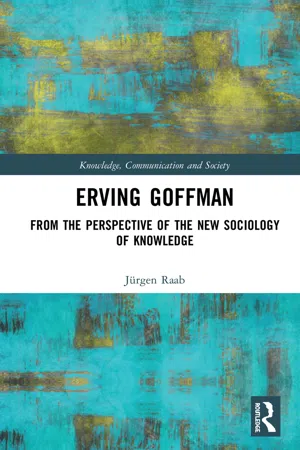
- 102 pages
- English
- ePUB (mobile friendly)
- Available on iOS & Android
eBook - ePub
About this book
Information
1 Erving Goffman: “Marginal man” and “key sociological thinker”
Erving Goffman was seen as an unconventional, ambivalent, and brilliant personality: a shy, somewhat difficult loner and a quirky outsider, but also headstrong. Just as difficult to characterize as his scientific attitudes, he was contradictory but at the same time, like his sociological perspectives, perceived to mediate between opposite poles.1
Through confidence, diligence, and tenacity, however, he managed to attain recognition, scale the professional and institutional heights of US-American sociology, and finally to rise to the status of a “key sociological thinker” (Williams 1998).2
Goffman was born in 1922 in Alberta, Canada—the second child of Jewish immigrants from Ukraine. He spent his childhood and youth in small towns in the same area of Canada prior to taking up his study of sociology in Toronto at the age of 22 and receiving his Bachelor of Arts degree. Shortly after, in the mid-1940s, he moved to the University of Chicago, which was—like US-American sociology on the whole—in the midst of a great upsurge. Although Chicago had attained a certain degree of influence, however, with respect to significance and renown it still stood considerably behind Columbia and Harvard, with their rich traditions of representing “hard sociology.” In 1949, Goffman received his Master of Arts in Sociology from Chicago. A one-year stay in the Shetland Islands led to his dissertation for the Doctor of Philosophy degree in 1953 and his first book, The Presentation of Self in Everyday Life (1956). From 1954 until 1957, he was a visiting scientist at the Laboratory of Socio-Environmental Studies at the National Institute of Mental Health (NIHM, Bethesda, Maryland), where he undertook his “clinic studies,” which included a year-long observation at St. Elizabeth’s Hospital. These studies led to his second book, Asylums (1961).
Between 1958 and 1969, Goffman worked at the University of California at Berkeley. During his time as visiting professor, then as associate professor, and finally as full professor, he not only was extremely productive but also attracted tremendous attention by virtue of his publications—especially Stigma (1963) and Interaction Ritual (1967). Indeed, he even rose to be somewhat of a “star” at the university. In September 1969, in order to flee all the furor around him, he left to take up a chair at the University of Philadelphia, which he would occupy until his death. The wide-ranging works produced under these calmer working conditions include Relations in Public (1971), Frame Analysis (1974), and Forms of Talk (1981a). In 1981, the American Sociological Association (ASA) elected Goffman to be its 73rd president. On November 20, 1982, at the age of 60, Goffman succumbed to cancer.
Goffman’s ethnic and geographic origins suggest he may be seen as a representative of the personality type described by Robert E. Park (1928) as the “marginal man.” Historically and typologically, the marginal man is the Jew: the foreigner and the stranger par excellence, whose qualities and characteristics had already been described by Georg Simmel (1921 [1908]). Park finds the new embodiment of the outsider, as well as the ideal type of the modern subject, in the immigrant who leaves Europe at the start of the 20th century and strives to find a place in the free, cosmopolitan, and complex life of the American city. On the account of Park’s student Everett V. Stonequist, once the immigrant has arrived, he becomes a cultural hybrid: “It is the fact of cultural duality which is the determining influence in the life of the marginal man.… Here the ‘crisis experience’ is the event which throws the individual back upon himself and produces a ‘disengagement and temporary withdrawal’” (Stonequist 1937: 217, 220). In the permanent crisis of cultural disjunction, the marginal man loses his historical consciousness and perceives himself as uprooted, homeless, and outside the localization schemata of others in society. At the same time, however, possibilities and spaces of freedom now open up through which new paths may be forged and other forms of thinking and living may arise (cf. Christmann 2007).
Goffman’s intellectual development took place in the 1940s and 1950s—the era in which lie the roots of the cultural upheavals and political and social problems that would become central issues in the USA during the 1960s. David Riesman’s The Lonely Crowd (1950), C. Wright Mills’ White Collar (1951), William H. Whyte’s The Organization Man (1956), and Vance Packard’s The Hidden Persuaders (1957) thematize, each in their own way, the moral crisis in the American self-image that would soon be deeply felt. The crisis would find expression, among other things, in the Cold War, the student protests, the Civil Rights movement, and, not least, in the sexual revolution3
and the feminist women’s liberation movement. Goffman’s “On Cooling the Mark Out” (1952) and The Presentation of Self in Everyday Life (1956) reflect this societal background as much they do the form of their sociological perception and appraisal. Goffman’s first essay, “Symbols of Class Status” (1951), in particular, as well as the commissioned work “The Service Station Dealer: The Man and His Work” (1953b) still follow the rather conventional scholarly standards both thematically and stylistically (cf. Lemert 1997).
Even during these early years, however, we can already recognize Goffman’s tendency to resist any appropriation or definition and live up to his reputation as an odd man out. Thus, Gary D. Jaworski interprets Goffman’s move to the University of Edinburgh and his research stay on the Shetland Islands as attempts to gain independence from his teachers in order to pursue his own interests and build his own competencies. “Goffman conducted his dissertation research on a tiny island in the Shetlands in order to escape from the influence of his teachers and to give full play to his own natural talent. The early geographic escape symbolizes his lifelong efforts to escape the influence of his past” (Jaworski 2000: 305). Furthermore, although he had been charged by his dissertation adviser W. Lloyd Warner with the recommendation to continue on the Shetlands the investigation of stratification structures that was already ongoing in other research projects, Goffman chose to study the interactions of the islanders and their dealings with strangers in his boarding house.
In the course of his academic career, the independence and marginality he repeatedly sought out intermingle with an inexorable drive for professional and institutional recognition to create the mix that would ultimately be characteristic of Goffman. Thus, he enjoyed an extraordinary level of popularity as a professor, but remained without research collaborators, attracted no students, and advised only a few doctoral candidates. When the chaotic atmosphere of political unrest and above all the hullabaloo around his own person at Berkeley clearly became too much for him, he first took a sabbatical year. Afterward, he took a post as the Benjamin Franklin Professor of Anthropology and Psychology at the University of Pennsylvania—a school that was in comparison to Berkeley rather more traditional and provincial and, moreover, a chair that explicitly omitted sociology from its name.
Goffman’s way of dealing with the conventions of academia is consistent with this image. He always cultivated a lively academic exchange beyond the bounds of his own discipline—although, characteristically, unlike many academics of the time, he left little trace of it in his correspondence—but he avoided contact with the colleagues in his field at his home institution. Moreover, he never published anything with a co-author and never became a member of a section of the ASA. In the same vein, he stayed away from the contemporary theoretical debates and took little part in the discussions of his works. He read no critiques or reviews dealing with his articles and books, or, if he did, he did not react to them. With one exception: When two representatives of the pure theory of interactionism, in their polemical reconsideration of his Frame Analysis, accused him of being infected by Structuralism and sought to excommunicate him from the circle of interactionists (Denzin & Keller 1981), Goffman reacted with a rigorous rectification in what would be the only reply to a critique of his career (Goffman 1981b, cf. Hazelrigg 1992).
Goffman cleanly separated his professional and private life from one another and guarded his private sphere almost jealously against outside observers. He followed the maxim that the academic work ranked far above the person and the only sensible path toward an understanding of the work led through the study of the writings. Given to a tendency toward understatement and withdrawal, he looked upon his own work with just as much skepticism as that of his colleagues. He therefore made it a principle never to thematize his own work outside of his own texts. After all, he operated on the conviction “that you can’t get a picture of anyone’s work by asking them what they do or by reading explicit statements in their texts about what they do. Because that’s by and large all doctrine and ideology. You have to get it by doing a literary kind of analysis of the corpus of their work” (in Verhoeven 1993b: 322).
This is probably also the reason that Goffman was extremely reluctant to give interviews. In fact, only three conversations have been published (David 1980, Winkin 1984, Verhoeven 1993b), so that Yves Winkin ultimately had to resort to testimony from Goffman’s friends, colleagues, and acquaintances for his “intellectual biography” (Winkin 1999). Moreover, Goffman refused to allow interviews to be recorded and asked for the conversations not to be quoted. Accordingly, he was not particularly forthcoming, repeatedly digressed from the subject, and occasionally even reversed the roles by questioning the interviewer.
Even more rare than the interviews are appearances in the media. Unlike many of his academic colleagues, Goffman did not use radio or television for public self-presentation and was reluctant to let himself be photographed—even though he apparently answered the question of why he ran for president of the ASA with a single word: vanity (Lofland 1984: 21). Thus, his publishers were forced to do without the reproduction of his picture. Russell R. Dynes, the former executive officer of ASA, reported: “He was irritated when people deferred to his ‘reputation’. I know, however, that being elected President was important to him and, in retrospect, so was the timing of his election. He also refused to send me a ‘presidential’ photo to be used in Footnotes [the official publication of the ASA, J.R.]. When I threatened to run a caricature of him or a blank space with his name under it, he promised to send me one but I knew he would not” (Dynes 1983: 2).
Many stories present Goffman as brilliant, witty, and charming, but also as someone who was provocative and even insulting in his social environment (cf. Scheff 2006). There are also countless stories that emphasize his singular powers of observation and his scientific stance as an observer. Goffman appeared to be always in action, always highly vigilant, attentively keeping watch, and constantly taking field notes. In the process, he was equally open with regard to the most varied social situations. Everything appeared to be noteworthy to him, so that it was completely unpredictable what he might find worthy of observing in the course of ordinary social reality. For instance, during his study of casinos in Las Vegas, he was seen riding for a long time up and down in the elevators, which prompted the casino management to have his strange behavior checked out by the police. Or, he would suddenly stop his taxi in order to observe the behavior of the rubberneckers at an accident, even though he was already late for an appointment. Goffman’s stance as an observer and his conception of himself as a sociologist is most vividly illustrated by a story of a personal encounter told by Hans-Georg Soeffner: “At a conference where Goffman was the keynote speaker, a reception was held in his honor in the observation tower of an observatory built by Schinkel—now a sociological institute. The guest of honor was greeted, said a few polite words, stepped back, and a few minutes later seemed to disappear. Finally, he was found: on the revolving platform originally intended for the telescope, tellingly, at the margin of the gathering whose object, participant, and observer he was” (Soeffner 2003: 251).
The renowned “key sociological thinker” remained true to his stance as “marginal man” throughout his life: though he was a part of the action, he kept himself out of the center of attention and away from the pressure of action and raised himself above society as an observer. Goffman considered sociology to be primarily a science of empirical observation that established and maintained distance. Distance was for him the condition of possibility that enabled the recalibration of one’s perspective on the all-too-familiar in order to approach what was supposedly natural and self-evident in a different way. For Goffman’s research strategy, this meant above all that he could draw upon data of all sorts, from ethnographic materials he himself had collected, to newspaper and magazine articles, to novels; from comics, to advertising photos and radio and television programs, to the movies.
This stance of observing society in the most multifaceted possible comparison of the most extensive data sources allowed Goffman to also simultaneously perceive himself as part of society and to take seriously his own perceptions, feelings, thoughts, and actions as scientific data. The capacity to observe his actions over his own shoulder was something he liked to demonstrate particularly in his later works in order to exemplify the specific problematic of self-perception and self-thematization in social situations—for instance, in his role as the author in the introduction to Frame Analysis (1974) or as the lecturer in the essay “The Lecture,” in Forms of Talk (1981a: 162–195), and finally, as the presiding officer of an academic society in the first sections of the inaugural address he never gave (1983b).
Both observational stances—the one from which he surveyed society, but also the one from which he reflected upon his own person—were regularly interpreted as arrogance and held out to him as a reproach. In reality, however, this cool distance and neutrality, shot through with irony and occasional sarcasm, were simply the expression of an attempt to approach social reality in a matter-of-fact, controlled, and disciplined way. Above all, they are the expression of the above-mentioned attempt to legitimate one’s own perception and experience as generalizable principles of scientific observation (cf. Fine & Martin 1990).
Goffman’s eccentricity and his occasionally cutting, ironic attitude did not spare his own profession either. Nonetheless, the latter offered him increasing respect and recognition, which—in addition to the extraordinary popularity of his writings as well as the gradual completion of the political turn in sociology from the so-called normative approach to the interpretive approach—certainly contributed to the fact that Goffman was ultimately entrusted with the most influential office of American sociology and named to be its representative. Yet up until the very end, Goffman continued to work—unintentionally—on his image as a nonconformist and an exotic: “Everyone wondered what he would do for his Presidential address: a straight, traditional presentation seemed unthinkable for Goffman with his reputation of an iconoclast … we got a far more dramatic message: Presidential address cancelled, Goffman dying. It was an appropriately Goffmanian way to go out” (Collins 1986: 112).
Notes
1 For a very long time there was scant verified information about Goffman as a person. Information was limited to the basic “official” dates of his biography—above all, those of his academic career, which no survey fails to provide. His publications, too, contain only a few autobiographical references (cf. Goffman 1961: 7–9, 1967: 47f. n. 2). Since 2009, extensive biographical material is available on the website of the Erving Goffman Archives (EGA): http://cdclv.unlv.edu//ega/. Here, I rely primarily on interviews (David 1980, Winkin 1984, Verhoeven 1993a, 1993b), obituaries (Bourdieu 1983, Collins 1986, Freidson 1983, Lofland 1984, Oswald 1983), and biographical accounts of his work (Marx 1984, Hettlage 1991a, 2000, Lemert 1997, Soeffner 2003, Winkin 1988a, 988b, 999).
2 A review of US-American monographs and professional journals shows Goffman to be among the ten most cited sociologists in the period from 1985 to 1993 (Cronin & Snyder 1997: 268f.).
3 Cf. the “Kinsey Reports,” Sexual Behavior in the Human Male (1948) and Sexual Behavior in the Human Female (1953), in which the biologist Alfred C. Kinsey applies insights from his studies of gall wasps to human sexual behavior. On the critical engagement with the Kinsey Reports, see Schelsky (1955).
2 Intellectual formation and influences
...Table of contents
- Cover
- Half-Title
- Series
- Title
- Copyright
- Dedication
- Contents
- Introduction
- 1 Erving Goffman: “Marginal man” and “key sociological thinker”
- 2 Intellectual formation and influences
- 3 Methodology and procedures
- 4 Social situations and the self
- 5 Normality and its frames
- 6 Reception and influence
- Literature
- Chronology
- Index
Trusted by 375,005 students
Access to over 1.5 million titles for a fair monthly price.
Study more efficiently using our study tools.
Frequently asked questions
Yes, you can cancel anytime from the Subscription tab in your account settings on the Perlego website. Your subscription will stay active until the end of your current billing period. Learn how to cancel your subscription
No, books cannot be downloaded as external files, such as PDFs, for use outside of Perlego. However, you can download books within the Perlego app for offline reading on mobile or tablet. Learn how to download books offline
Perlego offers two plans: Essential and Complete
- Essential is ideal for learners and professionals who enjoy exploring a wide range of subjects. Access the Essential Library with 800,000+ trusted titles and best-sellers across business, personal growth, and the humanities. Includes unlimited reading time and Standard Read Aloud voice.
- Complete: Perfect for advanced learners and researchers needing full, unrestricted access. Unlock 1.5M+ books across hundreds of subjects, including academic and specialized titles. The Complete Plan also includes advanced features like Premium Read Aloud and Research Assistant.
We are an online textbook subscription service, where you can get access to an entire online library for less than the price of a single book per month. With over 1.5 million books across 990+ topics, we’ve got you covered! Learn about our mission
Look out for the read-aloud symbol on your next book to see if you can listen to it. The read-aloud tool reads text aloud for you, highlighting the text as it is being read. You can pause it, speed it up and slow it down. Learn more about Read Aloud
Yes! You can use the Perlego app on both iOS and Android devices to read anytime, anywhere — even offline. Perfect for commutes or when you’re on the go.
Please note we cannot support devices running on iOS 13 and Android 7 or earlier. Learn more about using the app
Please note we cannot support devices running on iOS 13 and Android 7 or earlier. Learn more about using the app
Yes, you can access Erving Goffman by Jürgen Raab in PDF and/or ePUB format, as well as other popular books in Social Sciences & Sociology. We have over 1.5 million books available in our catalogue for you to explore.