This book introduces the concept of Water Diplomacy as a principled and pragmatic approach to problem-driven interdisciplinary collaboration, which has been developed as a response to pressing contemporary water challenges arising from the coupling of natural and human systems.
The findings of the book are the result of a decade-long interdisciplinary experiment in conceiving, developing, and implementing an interdisciplinary graduate program on Water Diplomacy at Tufts University, USA. This has led to the development of the Water Diplomacy Framework, a shared framework for understanding, diagnosing, and communicating about complex water issues across disciplinary boundaries. This framework clarifies important distinctions between water systems - simple, complicated, or complex - and the attributes that these distinctions imply for how these problems can be addressed. In this book, the focus is on complex water issues and how they require a problem-driven rather than a theory-driven approach to interdisciplinary collaboration. Moreover, it is argued that conception of interdisciplinarity needs to go beyond collaboration among experts, because complex water problems demand inclusive stakeholder engagement, such as in fact-value deliberation, joint fact finding, collective decision making, and adaptive management. Water professionals working in such environments need to operate with both principles and pragmatism in order to achieve actionable, sustainable, and equitable outcomes. This book explores these ideas in more detail and demonstrates their efficacy through a diverse range of case studies. Reflections on the program are also included, from conceptualization through implementation and evaluation.
This book offers critical lessons and case studies for researchers and practitioners working on complex water issues as well as important lessons for those looking to initiate, implement, or evaluate interdisciplinary programs to address other complex problems in any setting.
Part I Problem-driven interdisciplinary collaboration
A principled pragmatic approach to addressing complex problems using Water Diplomacy as an example
1 Origins
Conceptualization, implementation, and evolution of an interdisciplinary graduate program on Water Diplomacy
Shafiqul Islam, Kent E. Portney, J. Michael Reed, Timothy S. Griffin, and William Moomaw
Prelude
Interdisciplinarity has been hailed as one of the most promising and inspiring contemporary academic pursuits (Klein 1990; National Academy of Sciences 2005). In its ideal form, interdisciplinarity is the answer to achieving integrative understanding and action in the midst of disciplinary fragmentation. However, despite its widespread adoption as an idea, whether this promise is borne out in reality remains highly contested (e.g., Leahey et al. 2017). One of the central issues in measuring the success of interdisciplinary efforts is disagreement on what constitutes interdisciplinarity in both theory and practice. Is interdisciplinarity simply an integration of disciplinary depth across a breadth of methods, assumptions, and tools? Is it really integration that is at stake, or is it the ability to converse freely across previously guarded borders that broadens the possibility of exploring and executing actionable ideas? What kind of conversations and actions count as truly interdisciplinary?
Many books, articles, and reports have been written about interdisciplinarity. We didn’t write this book because we have developed a new theory of interdisciplinary research. Nor have we found the perfect recipe for effective interdisciplinary collaboration. We wrote this book, particularly this opening chapter, because we found – whether one is a champion or a critic of interdisciplinarity or whether one agrees on the why, what, and how of interdisciplinarity – that there is a widespread consensus that interdisciplinarity broadens the solution space by remaining open to a diversity of values, interests, and tools. The idea that diversity fosters creativity has deep roots. Cognitive diversity – differences in perspectives, methods, and models from different domains and disciplines – improves performance at problem solving and reduces bias toward the received wisdom of “conventional” approaches. However, introducing greater diversity into the problem-solving process is almost bound to increase the variance in successful outcomes. This finding is consistent with the mixed results recorded by many interdisciplinary pursuits. This leads to a central question in interdisciplinary studies: what factors improve the success rate of interdisciplinary programs without jeopardizing their requisite diversity? Through the stories we share in this book, we hope to share a few lessons about the factors we’ve found to be important.
Why do we believe we need to improve interdisciplinarity in the water space? By way of comparison, consider the 1962 book Design of Water-Resource Systems: New Techniques for Relating Economic Objectives, Engineering Analysis, and Governmental Planning that summarized the evolution of the Harvard Water Program (Maass et al. 1962). In the 1960s, we addressed our water problems with reservoirs and treatment facilities. At that time, a water professional’s objectives could all be written down and quantified in objective functions. Today, we are tasked with satisfying both quantitative and qualitative objectives, such as value-laden water claims made by and on behalf of individuals, industries, and ecosystems; a prudent balance between the utilization and conservation of our natural resources; the facilitation of industrial and economic growth; and ensuring a sustainable future for our next generations. Satisfying these increasingly diverse objectives demands the integration of scientific learning with the complex political reality of real-world problem solving. Water professionals cannot easily translate solutions born out of scientific findings into the messy context of the real world. We need to bridge this divide between theory and practice and resolve complex water management problems – where natural, societal, and political elements cross multiple boundaries and interact in unpredictable ways.
It is often difficult to distinguish between multidisciplinarity, interdisciplinarity, and transdisciplinarity (Klein 2010). In fact, a single project can go through various types and stages of disciplinary integration. We neither think interdisciplinary knowledge is per se better than disciplinary nor do we think numbers are better or worse than narratives. Different kinds of problems and questions require different kinds of integrative understanding, thinking, and acting. The nature of complex water problems, however, demands a problem-driven, principled, and pragmatic approach to interdisciplinary research and practice. This interdisciplinarity needs to go beyond collaboration among experts, as professionals will need to participate in inclusive stakeholder-centered processes (e.g., fact–value deliberation, joint fact-finding, collective decision making, and adaptive management) in order to achieve sustainable and equitable outcomes. In this chapter, we explore the story of how we conceived of and eventually implemented an integrative graduate program aimed at training professionals who could be effective in such situations. Our program was funded in large part through a grant from the National Science Foundation (NSF) through their (now-retired) Integrative Graduate Education and Research Traineeship (IGERT) program.
This is neither a systematic literature review nor a formal methodology to develop a theory of interdisciplinarity. This is the telling of stories of the development of our program and what we have learned from those experiences. These stories cost a huge monetary investment from NSF and tremendous time investment from the faculty and participants; it represents a decade from our academic life and about five or more years from each of the students who came along for the ride in a shared experience. We feel this shared experience – gained through our decade-long trials, tribulations, and excitement – can be best communicated and understood by weaving together stories from the conceptualization, implementation, and evolution of the program. While details of our experience may be contextual to Tufts, we hope our choice of storytelling lens will evoke multiple meanings and provide varied perspectives of interdisciplinarity for actionable outcomes across different contexts and boundaries.
Conceptualization of an interdisciplinary program
Acknowledging boundaries
Water doesn’t care about disciplinary or jurisdictional boundaries. Whether it takes the form of a storm surge flooding roadways, a river exceeding its banks, or contested flows across arbitrary human-drawn lines on a map, this fact is the same. Water’s indifferent disregard for the barriers we build, the lines we draw, and the human and ecological needs to which we allocate specific quantities are often at the core of the most pressing challenges and intractable conflicts involving water.
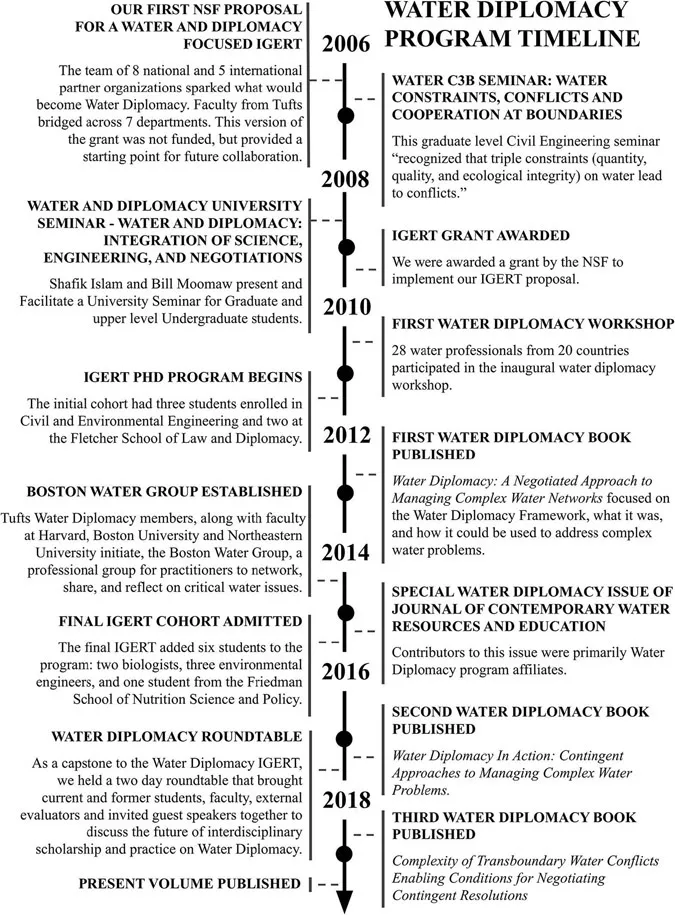
Several years before the Water Diplomacy IGERT was funded and the first cohort was recruited (see Figure 1.1 for a timeline of program development and evolution), we were considering how we could take water – a catalyst for cooperation and a compounding factor in conflicts – and transform it to a vehicle for fruitful outcomes to contentious water problems. Specifically, we were considering how this could be achieved through conversation and action facilitated by engaged, scholarly professionals who could think and act across boundaries. This was envisioned not as a technical interdisciplinary collaboration that merges multiple sciences but as something broader: a merging of science and engineering with diplomacy and negotiation – what current intelligentsia refer to as “convergence” (National Research Council 2014). Much in the way water will rise to flood a field, the next generation of scholars and practitioners working within the context of contested waters would need to fill the organizations involved in addressing these challenges with new ways of conceptualizing and seeking actionable resolution to seemingly intractable and increasingly complex water problems.
Minding the gaps
We set out an ambitious goal to break disciplinary boundaries interfacing water science, policy, and politics. We sought to achieve high levels of convergence between sciences and engineering on one hand and diplomacy and policy on
Figure 1.1 A timeline detailing some of the major milestones in the development and evolution of the Water Diplomacy Program at Tufts University.
the other. We recognized that scientists and engineers are trained to avoid making value-based judgments, while real-world water problems have value-laden aspects that cannot be disregarded or disaggregated. Indeed, when the way forward is presented as a competition between facts and values, we are faced with a false choice. Achieving actionable outcomes in the messiness of the real world does not entail decision between facts or values; rather, it requires an integration of facts and values. As a result, pure science-based approaches to complex water resource management that don’t engage in fact–value deliberation will seldom work in practice. Unfortunately, the training pipeline for top scientists and expert negotiators has little overlap between disciplines or even between subdisciplines within the same broader field, leading to multiple sets of highly trained professionals that cannot even speak the same technical language.
This lack of overlap is perhaps the most critical gap to address boundary-crossing water conflicts with competing needs. Here, existing laws, economic instruments, or best management practices may not be sufficient. We argued that these problems can only be adequately addressed through effective negotiation processes that include multiple perspectives and preferences of stake-holders and a broad range of technical professionals to frame, understand, and ultimately resolve their competing and often conflicting needs.
Different facets of science related to water and its multiple uses traditionally encouraged curricula with strong disciplinary emphases. Historically, scientifically trained water managers aspired to rise above politics, because in the political realm, science is construed to be free of value judgments. In this view, science is politically neutral, data are objective, and every problem has a true, unique, and well-defined solution. In reality, however, this has become increasingly problematic with the proliferation of institutional boundaries and organized special-interest groups. Opposing interest groups may interpret the same data to arrive at conflicting conclusions or dismiss science that does not support their preferred outcome (e.g., Fort et al. 2003; Biswas 2004; Lankford and Cour 2005; Pahl-Wostl et al. 2007).
At least two important gaps continue to persist in the design and implementation of water programs that aspire to interdisciplinarity (e.g., Groves and Moody 1992; Pahl-Wostl et al. 2007). First, many of these programs simply draw members from a mixture of disciplines without any systematic attempt to bridge their distinct vocabularies. Consequently, these programs offer limited inter- or cross-disciplinary opportunities and may amount to little more than a contest of ideas originating from individual disciplines. Since conflicts of vocabulary are not addressed, it is hard to assess whether there is even joint agreement on the nature of the problem under consideration. Current literature on human learning suggests that to achieve interdisciplinary solutions to boundary-crossing problems, we need to jointly define a problem with an explicit recognition of interdependencies. Second, while science-based management of water issues has received much attention in designing water programs, other elements – such as negotiation in the context of competing needs and different governance systems – have not.
We envisioned that Water Diplomats would be a new type of water professional who would be competent in multiple water-related academic and applied fields. A key challenge was how to develop these competencies as an interdisciplinary skill set for students entering the program with diverse undergraduate preparation in natural sciences, social sciences, and engineering. While we saw this as a particularly needed skill set, it was additionally imperative that students exiting the program had an array of appropriate career opportunities open to them, as “Water Diplomat” was not a recognizable career option. Therefore, each student had to be an expert in his or her discipline as well as having the skills to work effectively across disciplines.
Prior to securing funding for our program, special university funding supported a Tufts-wide graduate seminar run by Islam and Moomaw, two of the founding members of the IGERT program. The seminar was entitled “Water Constraints, Conflicts and Cooperation at Boundaries.” In it, students explored the idea that the boundaries and constraints in biophysical, social, and political processes are woven into water resource management challenges. This laid the groundwork for further exploration of the integration of science, engineering, and negotiation in water-related problem solving.
Special NSF funding was obtained to catalyze what would become the inaugural Water Diplomacy Workshop, an intensive five-day course designed and taught by Islam and Susskind. In this workshop, we shepherded mid-career water practitioners and scholars from more than 40 countries through a process designed to teach them how to apply ideas from complexity science and key theories of mutual-gains negotiation to the water problems they interacted with in their work. A book (Islam and Susskind 2013) was drafted and published to assemble these ideas together for the first time. And the refinement of ideas through these experiments and activities helped us to hone the initial design and proposal for a grand experiment in graduate educational excellence. Our IGERT proposal was funded in 2009, and we thought we were prepared to begin breaking down boundaries.
What were the thematic basis and unifying aspects?
We began from a recognition that science alone will not solve major water problems nor will policy operating in a vacuum without inputs from science. Moreover, we recognized the importance of a mutual-gains approach to negotiating sustainable and equitable outcomes for water problems with competing stakeholder interests and boundary-crossing aspects. We needed professionals who could think across boundaries, integrate knowledge, link it to action from multiple perspectives, and develop creative options ...
Table of contents
Cover
Half Title
Series Page
Title
Copyright
Contents
Foreword
Preface
List of contributors
PART I Problem-driven interdisciplinary collaboration: a principled pragmatic approach to addressing complex problems using Water Diplomacy as an example
PART II Problem-driven interdisciplinary collaboration in action: case studies from the Tufts Water Diplomacy program
PART III Looking back and looking forward: reflections and lessons from the Tufts program on Water Diplomacy
Index
Trusted by 375,005 students
Access to over 1.5 million titles for a fair monthly price.
Study more efficiently using our study tools.
Frequently asked questions
Yes, you can cancel anytime from the Subscription tab in your account settings on the Perlego website. Your subscription will stay active until the end of your current billing period. Learn how to cancel your subscription
No, books cannot be downloaded as external files, such as PDFs, for use outside of Perlego. However, you can download books within the Perlego app for offline reading on mobile or tablet. Learn how to download books offline
Perlego offers two plans: Essential and Complete
Essential is ideal for learners and professionals who enjoy exploring a wide range of subjects. Access the Essential Library with 800,000+ trusted titles and best-sellers across business, personal growth, and the humanities. Includes unlimited reading time and Standard Read Aloud voice.
Complete: Perfect for advanced learners and researchers needing full, unrestricted access. Unlock 1.5M+ books across hundreds of subjects, including academic and specialized titles. The Complete Plan also includes advanced features like Premium Read Aloud and Research Assistant.
Both plans are available with monthly, semester, or annual billing cycles.
We are an online textbook subscription service, where you can get access to an entire online library for less than the price of a single book per month. With over 1.5 million books across 990+ topics, we’ve got you covered! Learn about our mission
Look out for the read-aloud symbol on your next book to see if you can listen to it. The read-aloud tool reads text aloud for you, highlighting the text as it is being read. You can pause it, speed it up and slow it down. Learn more about Read Aloud
Yes! You can use the Perlego app on both iOS and Android devices to read anytime, anywhere — even offline. Perfect for commutes or when you’re on the go. Please note we cannot support devices running on iOS 13 and Android 7 or earlier. Learn more about using the app
Yes, you can access Interdisciplinary Collaboration for Water Diplomacy by Shafiqul Islam,Kevin M. Smith in PDF and/or ePUB format, as well as other popular books in Politica e relazioni internazionali & Ecologia. We have over 1.5 million books available in our catalogue for you to explore.