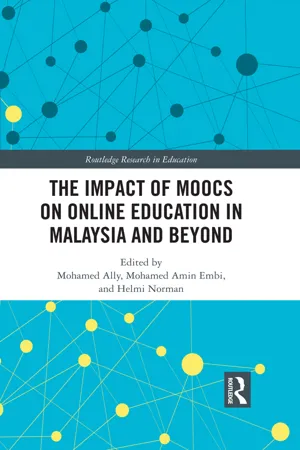
This book provides theoretical and empirical discussions around the impact of MOOCs and other pedagogical strategies for online learning in international contexts. Through discussions of inverse blended learning and other teaching and learning approaches, Part I navigates the pressing conceptual issues around global online education. By analyzing the Malaysia MOOC Initiative—the first governmental MOOC project in the world—Part II offers insight into the developmental strategies, learning design, and integrative approaches of these pioneering efforts. Edited by leading scholars in the field of globalized online learning, this volume offers a valuable contribution to research around collaborative initiatives between governments and universities, especially ones dedicated to open and distance education.
eBook - ePub
The Impact of MOOCs on Distance Education in Malaysia and Beyond
- 230 pages
- English
- ePUB (mobile friendly)
- Available on iOS & Android
eBook - ePub
The Impact of MOOCs on Distance Education in Malaysia and Beyond
About this book
Information
Part B
Case Studies of MOOCs in Malaysia Online Education
8
The Malaysia MOOC Initiative
The Universiti Kebangsaan Malaysia Experience
Introduction
In the past few years, the education landscape has changed rapidly with the emergence of massive open online courses (MOOCs) (Daniel, 2012). MOOCs have been dubbed a disruptive innovation in education with its massiveness in terms of number of students, such as Udacity’s Computer Science 101 course that enrolled over 300,000 students (Grover, Franz, Schneider, & Pea, 2013). Compared to traditional learning management systems (LMS), MOOCs’ attraction is a global one—where commonly there are no boundaries for a student to be enrolled in a course (Siemens, 2013). Regardless of age, nationality, or education qualifications, a student usually can access learning content and activities in an MOOC with an online connection (Kop, 2011; Mackness et al., 2013). In MOOCs, students are able to personalize and pace their own learning, where they control learning activities that can fit their own learning requirements (Grover et al., 2013). MOOCs have also promoted the emergence of the flipped classroom, where students are provided with online lectures individually, then discuss them collaboratively via online or face to face (Byerly, 2012; Grover et al., 2013).
Malaysia too has recently embarked on the MOOC phenomenon by introducing the first MOOCs to be developed in Bahasa Malaysia (Malaysia Language) (MOE, 2015). The Malaysia MOOC initiative is introduced in line with the “globalised online learning” (GOL) core shift in the Malaysia Education Blue Print 2015–2025 for Higher Education. This core shift emphasizes the next horizon for ICT-based learning that is aimed in disseminating knowledge to a global scale as well as deployment of e-content that is of international standard. In realizing the GOL shift, the Ministry of Education Malaysia has collaborated with four public universities in the development of Malaysia MOOCs (MOE, 2015).
This chapter discusses one of the Malaysia MOOCs that was developed in the National University of Malaysia (UKM) termed the UKM-MOOC. The chapter starts with the background sections, where an introduction of Malaysia MOOCs is described. The chapter then touches on the policies that impacted the MOOC’s development. It is continued with the development approach that was implemented as well as findings related to the MOOC’s implementation. The chapter ends with issues, implications, and future directions of MOOCs in Malaysia.
Background of Malaysia MOOCs and the UKM-MOOC
Malaysia MOOCs is an initiative by Ministry of Education Malaysia in collaboration with four public universities as content developers of the MOOC. The universities are (i) National University of Malaysia (UKM); (ii) University Putra Malaysia (UPM); (iii) MARA University of Technology (UiTM); and (iv) University of Malaysia Sarawak (UNIMAS). The initiative was pre-launched on September 18, 2014, by the Higher Learning Minister II in Putrajaya, Malaysia. The MOOCs developed by each university are Ethnic Relations (UKM), Introduction to Entrepreneurship (UiTM), Asia and Islamic Civilization (UPM), and ICT Competency (UNIMAS). The learning platform chosen for Malaysia MOOCs is the OpenLearning platform and the courses can be found via www.openlearning.com/malaysiamoocs. The courses chosen for development are foundation courses for undergraduates in Malaysian universities. In the initial phase of the deployment of Malaysia MOOCs, the MOOCs were developed to cover at least 30% of the whole course syllabus. All the course instructors teaching the four courses were recommended to apply the MOOC in a blended learning environment. In other words, the four courses were implemented as a blended learning course, where 30% of the course was delivered by the MOOCs, while the rest was conducted face to face in respective universities.
As stated before, the National University of Malaysia developed an MOOC for the Ethnic Relation course named “Kesepaduan dan Hubungan Etnik di Malaysia”. The course is aimed to expose issues, practices, and challenges related to ethnic relations in Malaysia from a social cohesion view. The learning content and tasks developed in the MOOC are developed in Bahasa Malaysia (Malaysia Language). The UKM-MOOC was carried out from September 2014 to January 2015. Its implementation is discussed further in the implementation of UKM-MOOC section.
Policies Influencing the Development of the UKM-MOOC
Under the ninth shift of the Malaysia Education Blue Print 2015–2025 for Higher Education, Malaysia has outlined the “globalised online learning” (GOL) as one of the 10 shifts. The GOL shift underpins Ministry of Education Malaysia’s (MOE) aim in disseminating and extending the courses offered by Malaysia’s higher education institutions to a larger audience, which includes all segments of the society. In addition, MOOCs can also become platforms for cross-regional discussions, where students from different universities in Malaysia as well as from around the world can discuss and collaborate with one another in creating a global and local meaningful learning community and building a nation of lifelong learners. Furthermore, MOE points out that MOOCs can resolve the issues with large numbers of students per course, over-subscribed courses, physical spaces, and on-campus costs (MOE, 2015).
The Malaysia MOOC development is also influenced by the National e-Learning Policy (Dasar e-Pembelajaran Negara DePAN). DePAN is a framework initiated by the National Higher Education Strategy Plan (Pelan Strategik Pengajian Tinggi Negara PSPTN) as a guide to maintain the level of quality of e-learning deployment in Malaysia Higher Learning Institutions. The framework consists of five pillars, which are infrastructure, structure of organization, curriculum and content, professional development, and enculturation. The DePAN policy has currently been revised to integrate the GOL shift into the Malaysia Education Blueprint 2015–2025 (MOE, 2015).
Development of the UKM-MOOC for Ethnic Relations
The UKM-MOOC for ethnic relations was developed by the Center for Teaching and Learning Technologies, UKM, in collaboration with subject matter experts from the CITRA Center and content developers from the Information Technology Center. The MOOC can be accessed at www.openlearning.com/courses/etnik. We applied a modified version of the ADDIE (analyze, design, develop, implement, and evaluate) approach (citation) and termed it the “iterative ADDIE instructional design framework”, shown in Figure 8.1. Similar to the original ADDIE, the iterative ADDIE approach consists of five phases, which are: analyze, design, develop, implement, and evaluate phases. The difference in the modified framework is that we implemented in two iterations (cycles) where the phases are iterated as users/content developers/subject matter experts that provide feedback to each of the phases. The iteration starts with the “analyze” phase and stops at the “evaluate” phase as perceived learning needs and requirements in the MOOC are met (Nordin, Embi, & Norman, 2016a).
The development of the UKM-MOOC involved two iterations of the iterative ADDIE instructional design framework, as shown in Figure 8.2. The first iteration was carried out as follows: First, a need analysis was conducted to elicit students’ requirements about ethnic relations (analyze phase). The analysis was carried out with a panel of subject matter experts (i.e., lecturers teaching ethnic re...
Table of contents
- Cover
- Half Title
- Series Page
- Title
- Copyright
- Contents
- Foreword
- Preface
- PART A MOOC Concepts in Online Education
- PART B Case Studies of MOOCs in Malaysia Online Education
- Contributors
- Index
Trusted by 375,005 students
Access to over 1.5 million titles for a fair monthly price.
Study more efficiently using our study tools.
Frequently asked questions
Yes, you can cancel anytime from the Subscription tab in your account settings on the Perlego website. Your subscription will stay active until the end of your current billing period. Learn how to cancel your subscription
No, books cannot be downloaded as external files, such as PDFs, for use outside of Perlego. However, you can download books within the Perlego app for offline reading on mobile or tablet. Learn how to download books offline
Perlego offers two plans: Essential and Complete
- Essential is ideal for learners and professionals who enjoy exploring a wide range of subjects. Access the Essential Library with 800,000+ trusted titles and best-sellers across business, personal growth, and the humanities. Includes unlimited reading time and Standard Read Aloud voice.
- Complete: Perfect for advanced learners and researchers needing full, unrestricted access. Unlock 1.5M+ books across hundreds of subjects, including academic and specialized titles. The Complete Plan also includes advanced features like Premium Read Aloud and Research Assistant.
We are an online textbook subscription service, where you can get access to an entire online library for less than the price of a single book per month. With over 1.5 million books across 990+ topics, we’ve got you covered! Learn about our mission
Look out for the read-aloud symbol on your next book to see if you can listen to it. The read-aloud tool reads text aloud for you, highlighting the text as it is being read. You can pause it, speed it up and slow it down. Learn more about Read Aloud
Yes! You can use the Perlego app on both iOS and Android devices to read anytime, anywhere — even offline. Perfect for commutes or when you’re on the go.
Please note we cannot support devices running on iOS 13 and Android 7 or earlier. Learn more about using the app
Please note we cannot support devices running on iOS 13 and Android 7 or earlier. Learn more about using the app
Yes, you can access The Impact of MOOCs on Distance Education in Malaysia and Beyond by Mohamed Ally,Mohamed Amin Embi,Helmi Norman in PDF and/or ePUB format, as well as other popular books in Education & Education General. We have over 1.5 million books available in our catalogue for you to explore.