The Dramaturgy of the Door examines the door as a critical but under-explored feature of theatre and performance, asking how doors function on stage, in site-specific practice and in performances of place.
This first book-length study on the topic argues that doors engage in and help to shape broad phenomena of performance across key areas of critical enquiry in the field. Doors open up questions of theatrical space(s) and artistic encounters with place(s), design and architecture, bodies and movement, interior versus exterior, im/materiality, the relationship between the real and the imaginary, and processes of transformation. As doors separate places and practices, they also invite us to see connections and contradictions between each one and to consider the ways in which doors frame the world beyond the stage and between places of performance.
With a wide-ranging set of examples – from Shakespeare's Macbeth to performance installations in the Mojave Desert – The Dramaturgy of the Door is aimed at performance makers and artists as well as advanced students and scholars in the fields of performance studies, cultural theory, and visual arts.
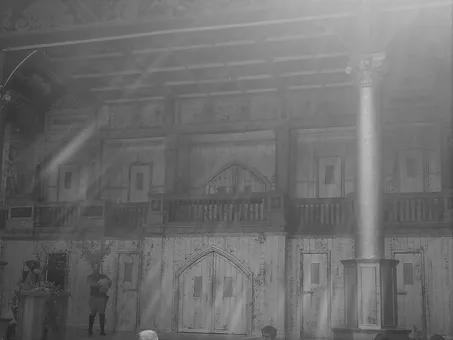
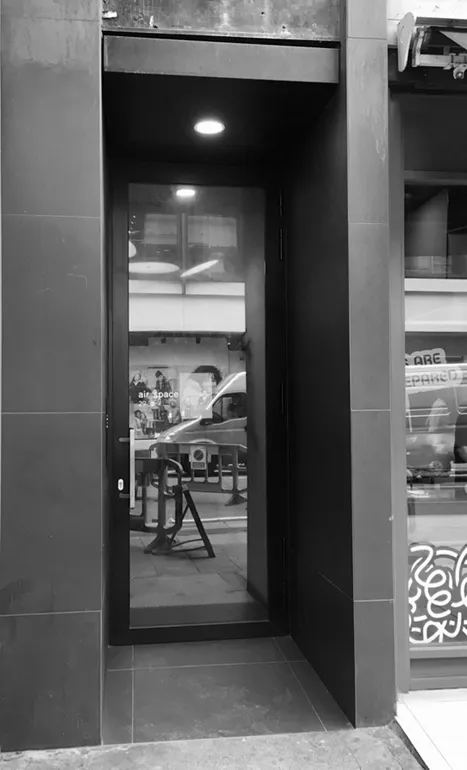
Shakespeare’s Globe, 2015: an extra façade, both on stage level and balcony level, is created for a production of Richard II. This addition seemed to serve two key purposes: 1) to be painted with a slightly faded, chipped gilt, offering an air of decaying glory and excess; and 2) to provide five doors on both stage and balcony level. On the stage level, the central doors were positioned slightly forward (downstage), and they were arched, double doors. The four flanking doors on each level (two on either side) were single, and antiquated in appearance, each with a rusted sliding bolt visible from on-stage (suggesting the stage space itself is an interior September 2013. I follow emailed instructions to a door on Oxford Street, a broad shopping street in the West End of London. The door is situated between shop-fronts. It is open and I cross into a small hallway, from which steps lead up to the first floor. There is a small ticket desk and, tickets checked, I climb the stairs and open a door with a small window, entering what might be an office or storage space. As I walk in, a performer greets me, as if we are long-time colleagues. This is the farewell party and last hurrah for the location). Throughout the production, for the most part, these single doors were used as simple ingress and egress. But the fact that they were there – as a clearly added, intentionally present part of the mise en scène – is worthy of note. Multiple ways in and out of the playing area creates a specific kind of stage world. In addition to the ten doors crafted for this production, the performers (as is often the practice at the Globe) also made use of the four ‘audience’ entrances into the Yard of the theatre: ten material doors and four immaterial (‘implied’) doors. What kind of performance needs 14 doors?
London Mortgage Company, in Cheese [a play], a performance by FanSHEN. Outside the door, I had been about to see a show, but, while passing through the door, I was invited to become part of the world of the performance. The invitation caught me as I was crossing from one place to another, shaping the place into which I was arriving, revealing a very different world to that on the other side. As I watched others walk through the door, I found it difficult to discern the world I had left behind. What happens when artists include existing doors in performance? How do they, and we as spectators, practise existing doors, and what do they and we leave behind in using these doors to cross from one place to another?
Our Opening, ‘Doors remembered’, details a very few of the doors that we recall and carry with us; they are personal to us. That introduction, and the preceding photo essay, are ways of foregrounding the materiality of doors, and of the activities and practices that occur at and with them. Those two sections also attempt to move us from doors in the everyday toward the principal focus of this book: doors in theatre and performance. As co-writers, we come to the subject from different backgrounds, both in terms of scholarly expertise and performance practice and, as such, we read ‘theatre and performance’ as entailing a broad set of creative practices in the arts.1 Core to our approach is a fascination with the performance of doors, whether in a written play, on a stage, in a gallery installation, or in projects in which artists find or create work in specific places. As such, while our areas of work differ, we share a set of interrelated questions, and curiosities, about both performance and doors that have brought us to this project. These questions, which underpin this book, might be summed up in the following terms:
What are the key kinds of artistic practices of and with doors, and what do these contribute to our understanding of performance?
In what ways are doors ‘dramaturgical’?
In what ways do some of the basic elements of performance practice – particularly place, text, body, audience, and time – illuminate our understanding of doors in theatre and performance, and, conversely, how does a study of doors inform and perhaps expand our understanding of those elements?
These questions might be gathered together under one larger query: what is the dramaturgy of the door?
To begin unpacking that query, let’s briefly consider the examples above. In Cheese [a play], FanSHEN performed an invitation at the moment of entering a room. The performers added a context and conditions to the act of passing through each door. At the door to the building, our tickets were checked, and we prepared to watch a show. At the door to the room, we became spectators and also ex-employees attending a party to bid farewell to a now insolvent mortgage company. The glass panel of the internal door blurred the boundary between the places either side. This, then, was not a hermetically sealed world, separate from everyday life; instead, it re-framed everyday life from within the performance. Situated on one side of a door, one’s view and experience of the world beyond is framed by that performance. The door appeared not to be ‘used’ again until the end of the show, when spectators began to leave, although throughout the performance, it borrowed the corridor to imply that the world of the performance extended beyond the room, or certainly did not contradict the action of the play.2
On the night I (Stuart) saw the show, there was a post-show discussion, which meant it was some time before many in the room left. As we did so, in the act of leaving through each of these two doors, we were simultaneously leaving a party, a job, a performance, a discussion, and leaving behind performers who had also been co-workers of a kind for the duration of the show. We were also leaving an office to which we would, most likely, never return. On the street, it was difficult to imagine that such other spaces existed between the broad shopfronts, or that companies on the street might be in any danger of insolvency at all, such was the scale of consumption in the surrounding shops. And yet, after most of the shops had shut, looking in through closed doors, the resonance of the doors in Cheese [a play] prompted questions of the viability of companies and the risks for those that worked the other side of each door.
Turning from ‘found’ doors in Oxford Street to carefully crafted, bespoke doors on the stage of Shakespeare’s Globe, the answer to the question posed above about the production of Richard II is, in one sense, fairly simple. No production needs 14 doors. But as another inhabitant of the Globe might suggest, “O, reason not the need” (King Lear, II.ii.430).3 Perhaps the question is not precisely the right one: it is not so much a matter of needing a certain number of doors, but rather a matter of what happens when there are 14 (or ten, or two) doors? What material effect does the presence of a door have on performance? Those familiar with the history of the new Globe theatre, and the scholarship and debates that have surrounded it over the past three decades, may well recognise such a question: as will be detailed later in this book, much has been said about whether the original Globe theatre had two or three doors at stage level (never mind five on each level). Such debates speak, at the very least, to the dramaturgical impact doors might have, on either specific performances or on theatrical spaces and conventions more broadly.
This particular production of Richard II is a good example. On one hand, the doors operated as fairly conventional signifiers. They – along with the activities that took place at them – let the audience know where in the world of the play we were: inside or outside, in one room or house, or another. They also stood, in not always uncomplicated ways, as signifiers of class and status: the principal characters mostly used the flanking doors, the un-named characters mostly used the audience entrances, and the lead characters had the right of use of the central doors.
An exception to this pattern, however, might help sketch the idea of the ‘dramaturgy of the door’ that we are pursuing. Early in the play – but, notably, after the pattern of aligning points of entrance with character class had been established – comes a significant scene transition, between I.iv and II.i. During I.iv, King Richard is at court and has determined to lay claim to the estate of John of Gaunt’s banished son; he then receives news that Gaunt is “grievous sick” (I.iv.53) and, we are told, very much on his death bed and has begged Richard to visit him. For the scene transition, then, King Richard and his train (in this production, about four or five other characters) need to leave the stage so the scene can move to Ely House, the residence of John of Gaunt. But Gaunt also needs to be wheeled in on a bed or wheelchair, signifying the severity of his illness, and as such, he requires the use of the central double doors for his entrance at precisely the moment that the king and his courtiers are making their exits. The king and his train, therefore, leave by one of the single doors upstage left, which produces a stark effect of undermining his status and authority, especially as their exit necessitates a kind of awkward queuing up at the door, a process which is a far cry from the tone of a ‘regal’ exit.
One might argue that this effect contributes nicely to the production: a subtle way of foreshadowing the much more material and consequential undermining of the king’s authority that will come later in the play. Or one might argue that this moment, operating as a conflict of signifiers, creates a muddy and uncomfortable effect, undermining not only the character in the play, but the event of the play (or at least the scene) in itself. Our point here, and that which we wish to explore in greater detail in the following pages, is that the doors – which were created specifically for this performance – have a direct and material impact upon the action of the stage and on how the audience may receive and respond to that action. The doors, in other words, are significant components of the dramaturgical make-up of the performance.
In taking up this term, ‘the dramaturgy of the door’, we are positioning the door alongside other elements of performance that constitute the dramaturgy of a particular artistic practice. We are arguing, in other words, that doors are part of the composition of performative activity much in the same way that bodies, words, or specifically delineated spaces or places might be. Where present, physically or figuratively, doors contribute to the dramaturgical weave of the performance, or the “work of actions in the performance”, as Eugenio Barba defined dramaturgy (Barba and Savaresse, 1991, p. 66). In more detail, Barba suggests that:
The word ‘text’, before referring to a written or spoken, printed or manuscripted text, meant ‘a weaving together’. In this sense, there is no performance which does not have ‘text’. That which concerns the text (the weave) of the performance can be defined as ‘dramaturgy’, that is, drama-ergon, the ‘work of the actions’ in the performance. (ibid.)
In the first place, Barba’s definition helps locate the idea of dramaturgy beyond the realm (and dominance) of what we might conventionally understand as ‘the text’ – that is, the scripted play text, the piece of dramatic literature. As will become evident in the pages that follow, our interest is in doors as they occur and operate in a range of artistic practices; later in this chapter, we will mark out some of the parameters of that range, but what is crucial here is that our sense of dramaturgy is not burdened by an exclusive association with ‘plays’, but is instead a more expansive means of understanding the ways in which ‘performance’, broadly construed, comes into being.4
This desire to maintain some attentiveness to performance practice has its roots in the project’s genesis. The current book began life as a funded research project, running between April 2014 and March 2015.5 The project comprised a one-day symposium and two four-day laboratories: one on doors on stage, and one on doors in performances of place. We are not positioning this book as a collection of findings from that project, nor are we laying claim to practice-as-research as a central methodology; our thinking and our approaches have expanded since then. But it is important to mark here, at the outset, the predominantly practice-led developmental stages of the research; this is partly because we refer to some of the work undertaken in those stages as the book progresses (most notably, but not exclusively, in Chapter 2, when Stuart uses the laboratory on doors in everyday performance as a key case study), and more broadly because the conceptual and practical underpinnings of that work inevitably haunt the analyses in these pages. Indeed, it is from those underpinnings that the idea of doors participating in a dramaturgical weave of actions emerged.
Our interest in arts and architecture practice, in specific doors, in understanding doors as a place, an object and a threshold led us to invite colleagues in the project and the field to offer contributions to our photo essay. Chris Romer-Lee, an architect, selected a painting, Interior (1914), by Vilhelm Hammershøi (see Figure 00.9). The title appears to underplay the depth of the interior, the multiple interiors, one leading off from another. In a text accompanying the image, Chris writes:
It wasn’t until art school when I encountered Vilhelm Hammershøi’s paintings that I began to think more specifically about the door as a powerful device in architecture. The hanging of a door determines the exact transition from one space to the next but also how the spaces within are encountered. I often reflect on this & Hammershøi’s paintings when designing.
In the text that accompanies his image (Figure 00.15), Mike Pearson writes:
Our front door: French Gothic – in rock-faced Pennant Sandstone with Bathstone liners and patterned tiles; favoured style of William Burges, preferred architect of the 3rd Marquess of Bute. On their Cardiff land, the Butes offered leases to speculative builders, whilst maintaining exclusive control of materials and layouts. The result: a robust, terraced cityscape that escaped demolition thanks to the Leasehold Reform Act (1967). Portal into reflections on fabric, design, planning, civic history, political intervention, contemporary archaeology… (Mike Pearson, 2018)
Their images and reflections situate doors as being central to understandings of architecture and performance practices. The two images sit in interesting relation depicting, in one, internal doors and, in the other, a door that is viewed externally (but which also, we assume, has an interior). Doors speak to ways that things are done, be that entering a room or building a section of a city. Doors become interesting as forms, as parts of buildings and environments, as mobile, as embodied, as inspiration, as a tool of politics, planning, structuring the world – and more.
These images, and responses to images, return us directly to the idea of the ‘weave’. In addressing doors in and as performance, we want to suggest here that the door often stands as a significant part of such a performative weave: as one of the actions, where those actions may be layered, complex, and where the detail of the actions may not be easily read from the material forms alone. Doors, despite our interest in material forms, might be difficult to account for...
Table of contents
Cover
Half Title
Series Page
Title Page
Copyright Page
Dedication Page
Table of Contents
List of figures
Acknowledgements
Preface: time with doors
Openings: doors remembered
1 The dramaturgy of the door
2 At home with doors: practising architectural elements
3 “This is the door”: threshold phenomena in Shakespearean dramaturgy
4 Bodies at doors, bodies with doors
5 Together at doors: situating spectators in the city
6 The Janus effect: doors and theatrical time
Closings: doors reflected
Index
Trusted by 375,005 students
Access to over 1.5 million titles for a fair monthly price.
Study more efficiently using our study tools.
Frequently asked questions
Yes, you can cancel anytime from the Subscription tab in your account settings on the Perlego website. Your subscription will stay active until the end of your current billing period. Learn how to cancel your subscription
No, books cannot be downloaded as external files, such as PDFs, for use outside of Perlego. However, you can download books within the Perlego app for offline reading on mobile or tablet. Learn how to download books offline
Perlego offers two plans: Essential and Complete
Essential is ideal for learners and professionals who enjoy exploring a wide range of subjects. Access the Essential Library with 800,000+ trusted titles and best-sellers across business, personal growth, and the humanities. Includes unlimited reading time and Standard Read Aloud voice.
Complete: Perfect for advanced learners and researchers needing full, unrestricted access. Unlock 1.5M+ books across hundreds of subjects, including academic and specialized titles. The Complete Plan also includes advanced features like Premium Read Aloud and Research Assistant.
Both plans are available with monthly, semester, or annual billing cycles.
We are an online textbook subscription service, where you can get access to an entire online library for less than the price of a single book per month. With over 1.5 million books across 990+ topics, we’ve got you covered! Learn about our mission
Look out for the read-aloud symbol on your next book to see if you can listen to it. The read-aloud tool reads text aloud for you, highlighting the text as it is being read. You can pause it, speed it up and slow it down. Learn more about Read Aloud
Yes! You can use the Perlego app on both iOS and Android devices to read anytime, anywhere — even offline. Perfect for commutes or when you’re on the go. Please note we cannot support devices running on iOS 13 and Android 7 or earlier. Learn more about using the app
Yes, you can access The Dramaturgy of the Door by Stuart Andrews,Matthew Wagner in PDF and/or ePUB format, as well as other popular books in Literature & Performance Art. We have over 1.5 million books available in our catalogue for you to explore.