I Introduction
In the contested North American borderlands of European empires, establishing a mission was a profoundly political act. The Society for the Propagation of the Gospel in Foreign Parts (SPG) – the Church of England’s primary missionary organization in the eighteenth century – hoped that Protestant Christianity and the British Empire would advance in this region together. Its efforts to Christianize Native Americans, who along with African-American slaves made up the key “heathen” populations among whom the eighteenth-century SPG worked, were born of desires to simultaneously advance Episcopal Protestantism, English culture, and British military and political power. Progress in all these areas would be to the glory of God, king, and country. At the center of the SPG outreach to Indians was a sustained effort to proselytize among the Mohawks and other nations of the Haudenosaunee or Iroquois Confederacy, which stretched from the first decade of the eighteenth century to beyond the American Revolution. This mission “bore fruit”: by mid-century, a group of Mohawks had adopted Anglicanism as their own within the context of a wider political, military, and cultural alliance with the British.
Other Mohawks and Iroquois had already forged similar connection with French Catholic missionaries, while still others strove to keep Christianity at arm’s length. Given the intricate and intertwined cultural, spiritual, economic, and political implications of these choices, it is not surprising that as individuals and communities Mohawks assessed the Society’s presence among them in multiple ways. Perhaps more surprisingly, eighteenth-century British and Anglo-American assessments of this sustained missionary encounter were also mixed, variable, and complex. Missionary networks shaped hearts and minds, not just at mission stations but also among metropolitan and settler reading publics that avidly consumed the accounts, sermons, and calls for aid that groups like the SPG produced. By eighteenth-century standards, the SPG’s commitment to the circulation of texts was extraordinary. According to a reasonable estimate produced by one of the organization’s leading members, by 1741 the Society had already distributed more than 10,000 Bibles and prayer books and “above a hundred thousand other pious tracts” as part of its work.1 The scale of this endeavor probably increased over time. Most of these works were sent to the colonies in the hopes of aiding missionaries in the field, but the SPG also distributed printed works in Britain to encourage donations. Especially important and prominent were the SPG’s “annual sermons.” Leading metropolitan Church of England clergymen, usually bishops, delivered these sermons before the Society’s assembled membership, and then the SPG printed and sent them to supporters and others in both Britain and the colonies. While largely intended to elicit financial contributions, these sermons also provided opportunities for those connected with the Society to reflect upon the organization’s history and future and to connect its missionary program to other theological, philosophical, and political concerns. These broadly circulated texts contributed to transatlantic discourses on race and human difference, religion and missions, and the wider European imperial project.2
The reflections that the Society’s leaders and members offered on their organization’s encounter with the Mohawks are also important because of the outsized role that the Iroquois long played in Anglo–American thinking about Native Americans. Political relationships between the Iroquois and the British colonies – the Covenant Chain – dominated Anglo–Indian diplomacy in the eighteenth century and resonated in Anglo-American culture. Because of their military and political power, the Iroquois were “the most well known Native Americans in Imperial circles” in the eighteenth century.3 For example, the visit of the so-called four Indian “kings” to London in 1710, popularly understood as an Iroquois embassy to the imperial capital, sparked an outpouring of English art, poetry, reporting, and commentary that contributed to “the imaginative construction of the first British empire.”4 The SPG was heavily involved in choreographing the visit, and the Mohawks’ reported receptivity to Protestant Christianity was repeatedly celebrated and emphasized in discourses surrounding it. The poet Elkanah Settle, for example, celebrated the “kings” as “a Christian Splendour from an Ethnick Sky” and their visit as the dawn of a new age for Protestant missions.5 The Mohawks, however, could at other moments be taken to encapsulate the supposed savagery of American Indians. The “Mohock scare” of 1712, for example, saw Londoners panicked by tales of a probably imaginary urban gang said to model themselves after their fearsome Indian namesakes.6
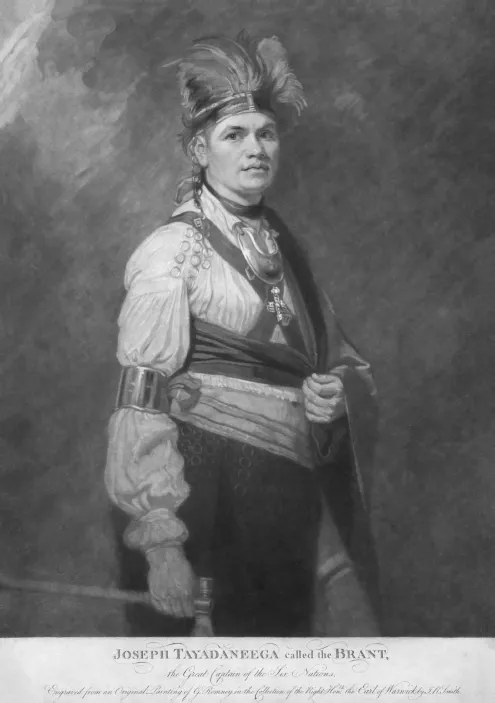
Mohawk prominence in Anglo–American discourses surrounding Native Americans continued for decades. The Iroquois were the subjects of an in-depth history first published in New York in the 1720s and London in the 1740s.7 The Mohawks’ influence was magnified by their close ties to leading figures in imperial governance. Molly Brant, or Konwatsi tsiaienni (c. 1736–1796), who may have been educated by an SPG-supported schoolmaster as a child, was an influential leader among her fellow Mohawks. From the late 1750s, she was also the common-law wife of the powerful New York-based British Superintendent of Indian Affairs, Sir William Johnson, and the matriarch of a large Anglo–Iroquois family.8 Her younger brother, Thayendanegea (1743–1807), also known as Joseph Brant, was connected to the British and the Johnson family from his youth and became a prominent Mohawk leader in his own right. Thayendanegea was painted by George Romney in the 1770s, Gilbert Stuart in the 1780s, and Charles Wilson Peale in the 1790s.9 Through these images and others, including more widely circulated engravings, Thayendanegea became a figure of transatlantic reputation (see Figure 1.1). In the crisis of the American Revolution, the Mohawks were used as symbols in complex ways when rebellious colonists both dressed themselves as Mohawks to dump tea into Boston harbor and burned an effigy of King George wearing feathers like “Johnson’s savages” and wrapped in the Union flag.10 When Anglo-Americans spoke about Native Americans, they often did so through references to the Iroquois. In this context, the SPG’s connections with the Mohawks and what they told the public about them in sermons and elsewhere shaped perceptions of Indian peoples around the Anglophone Atlantic world.
In considering Anglican missions to the Mohawks, scholars have often – explicitly or implicitly – compared them to earlier Puritan efforts in New England or to those of Catholic orders among Native Americans.11 They have rarely, however, compared them to the SPG’s own concurrent and interconnected work among enslaved people. Doing so reveals important similarities but also a striking difference: while a group of pro-British Mohawks became a sustained community of self-identified Anglicans before the American Revolution, African-American slaves largely rejected the Church of England. Those enslaved black people that did come to affiliate with it tended to do so in small numbers and within predominantly white congregations.12 The eighteenth century did not see the creation of a widely recognized cohesive, multi-generational, and distinct community of black Anglicans comparable to that created by some Mohawks.
In light of this, considering the SPG’s missions to Mohawks and slaves comparatively puts in to sharp relief the substantial role that Iroquois power and autonomy played in structuring encounters between the Mohawks and Anglican clergymen, and how different this was from the context in which most African-Americans interacted with the Church of England. Mohawk autonomy played an essential part in their ability and willingness to adopt and adapt Anglicanism, helping give it meaning in their own lives. Ironically, while this autonomy was crucial to the emergence of Mohawk Anglicanism, it was regarded with increasing frustration by the Euro-American supporters of English missions.
A growing negativity towards Indian missions, documented in part in SPG annual sermons, was partly due to the Society’s inability to replicate its success with the Mohawks among other Native American peoples. Even in the case of the Mohawks, though, the SPG’s missionaries in America and supporters in England grew skeptical about whether their “conversions” were genuine. Ultimately, this internal assessment of their own missionary history led SPG supporters to increasingly promulgate the view that a real Christianization of Indian peoples could only happen after the completion of a radically transformative process of Indian “civilization.” Because these calls for “civilization first” were often bolstered by critical characterizations of Indian manners, morals, and even capacities, this internal debate over missionary strategy led to stridently negative portrayals of Native Americans appearing regularly in widely circulated SPG publications. In this way, the vacillating fortunes of the Society’s missionary program intersected with and contributed to a circum-Atlantic dialogue about Indians and the nature of human difference. While not informed by “scientific” racial thinking that would emerge subsequently and in different venues, many later eighteenth-century SPG sermons presented harsh and sweeping assessments of Native Americans that had much in common with later attitudes.
Figure 1.1 “Joseph Tayadaneega, Called the Brant”