This book discusses the role of capital markets and investment banking in Nigeria, the largest frontier market economy in the world by both population size and gross domestic product.
Offering a systematic framework combining conceptual principles with real practice, the book enables the reader to gain useful insight into how capital markets and investment banking work in the real world of a frontier market. The book provides a synopsis of the economic attractiveness, financial systems intermediation and capital markets, as well as the regulatory framework within a frontier market. It explores capital raising through equity and underwriting and private equity, paying particular attention to putting capital to work on mergers and acquisitions, project and infrastructure finance and real estate finance. Furthermore, it analyses asset management, pension industry and securities trading in a frontier market. The authors use detailed case studies from Nigeria to illustrate the operations of investment banking in frontier markets. The cases, tables and charts serve as useful illustrations of the topics under discussion.
With the authors' combined experience of more than 50 years as economists, finance and investment professionals and in executive leadership positions in the financial services industry, this book will interest the academic community, professionals in the financial industry, retail and institutional investors interested in frontier markets, development practitioners in international organizations and policy makers including securities and capital market regulators.
Frontier economies are developing countries that are more advanced than the less developed countries (LDCs). However, such economies are considered less advanced than emerging economies – China, Brazil, India and Russia. Emerging economies were among the fastest-growing markets in the 1990s and 2000s.
Frontier economies is a group of fast-growing lower-middle-income countries that are attracting international investors interest. The International Monetary Fund ( IMF) and the World Bank (2015) classify 14 frontier market (FMs) – countries which receive assistance from these international financial institutions, as those that resemble emerging market economies with regard to international market access. These countries are Bangladesh, Bolivia, Cote d’Ivoire, Ghana, Kenya, Mongolia, Mozambique, Nigeria, Papua New Guinea, Senegal, Tanzania, Uganda, Vietnam and Zambia.
Frontier economies are diverse and widespread across regions of the globe. Based on FM indices of Financial Times (FTSE; 2018) and Morgan Stanley Composite Index (MSCI; 2018a and 2018b), they include Bangladesh, Siri Lanka and Vietnam in Asia; Bulgaria, Estonia and Croatia in Eastern Europe; Kenya; Nigeria, Ghana and Cote D’Ivoire in Africa; Argentina and Bolivia in Latin America; and Kuwait and Qatar in the Middle East.
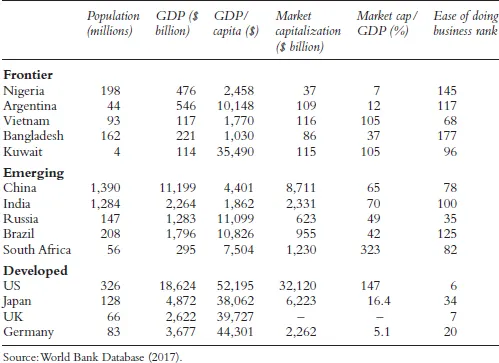
Table 1.1 shows the diversity of frontier economies by comparing key economic and market indicators of the largest frontier economies to those of emerging market economies. Among the selected frontier economies, Nigeria has the largest population but the second-largest economy with a market capitalization to GDP ratio of only 7.4 percent. Argentina has the largest economy, while Kuwait has a per capita income of more than $35,000 compared to Bangladesh with only $1,030 of per capita income. Vietnam has the highest market capitalization among frontier economies, which stands at $117 billion coupled with the best ranking in terms of ease of doing business (EODB).
Among the emerging market countries, China has the largest with regard to the following parameters of population, economy and market capitalization followed by India. However, South Africa has the largest market capitalization to GDP ratio at more than 320 percent, which dwarfs that of Nigeria at less than 10 percent. Overall, the table shows that the US economy, per capita income and market capitalization are well ahead of those of emerging markets, which, in turn, are also more advanced than the frontier economies.
Table 1.1 Features of frontier economies
Frontier economies are growing at a faster pace than some emerging economies. They have been implementing sustained reforms efforts that include deepening their financial markets, building business-friendly environment, lowering trade restrictions to achieve macroeconomic stability and lowering inflation through prudent fiscal and monetary policy. Frontier economies have been able to tap the international capital markets, especially raising capital from the Eurobond markets, while attracting investors to their sovereign and corporate bonds (IMF, 2017).
As a region, Africa meets the criteria of an FM as most countries in the continent have low per capita income and small and illiquid financial markets. Nigeria is the largest world FM by population. Nigeria is also Africa’s most populous country with a population of 200 million people in 2018. The recent projection by the United Nations states that Nigeria will more than double its population to about 450 million by 2050 (United Nations, 2015), behind only China and India.
Nigeria is also Africa’s largest frontier economy and a member of what Oshikoya (2011) termed as the SANE – South Africa, Algeria, Nigeria and Egypt. These particular countries account for more than half of Africa’s GDP, while the remaining 51 countries constitute slightly less than half of the GDP of the continent.
Nigeria’s economy is projected by PwC (2016) to be among the top 15 largest global economies by 2050. Goldman Sachs (2005) projected that Nigeria is one of the identified Next 11 (N11) countries with the potential to be like the BRIC – Brazil, Russia, India and China. O’Neil, 2014), who coined the BRIC acronym, came up with MINT – Mexico, Indonesia, Nigeria and Turkey – which is used to referred to as the next key emerging economies.
Criteria for FMs
In 1992, the International Finance Corporation (IFC), an affiliate of the World Bank, first came up with the term frontier markets to describe “emerging markets.” The IFC sold its Emerging Markets Database in 2000 to Standard & Poor’s (S&P, 2018), which created a Frontier Market Index in 2007. There are now three FM indices: Standard & Poor’s, Morgan Stanley Composite Index (MSCI) and Russell Investments and Financial Times (FTSE), with a varying number of countries from Africa, Asia, Eastern Europe, Latin America and the Middle East. The indices move countries from frontier and emerging markets indices and vice versa; a case study is Argentina.
The MSCI Frontier Markets Index captures large and mid-cap representation across 29 FM countries. The index includes 109 constituents, covering about 85 percent of the free float–adjusted market capitalization in each country. MSCI Frontier Markets’ largest countries as of March 2018 are Argentina (19 percent), Kuwait (17.7 percent), Vietnam (14.7 percent), Morocco (8.2 percent) and Nigeria (7.8 percent). The other countries, such countries are Bahrain, Bangladesh, Burkina Faso, Benin, Croatia, Estonia, Guinea-Bissau, Ivory Coast, Jordan, Kenya, Lebanon, Lithuania, Kazakhstan, Mauritius, Mali, Niger, Oman, Romania, Serbia, Senegal, Slovenia, Sri Lanka, Togo and Tunisia, make up 32 percent of the indices.
FTSE (2018) classification criteria include the depth and breadth of financial markets, legal and regulatory infrastructure and general ease with which foreign investors can do business. FTSE classifies a country as a frontier market based on specific factors, including a formal stock market regulatory authority, no significant restrictions on repatriation of capital, good clearing and settlement practices and a timely trade reporting process. Based on these criteria, FTSE categorizes 22 countries in its FM index: Out of 102 countries that do have the potential to be termed an FM, Nigeria made the list of 22 countries that are referred by the FTSE (2018) as an FM.
Bloomberg (2018) used a variety of criteria, from government debt to labour force participation ratios, GDP growth, average annual inflation, and government debt-to-GDP ratio projections from 2013 to 2017, as well as a ranking of how easy it is to conduct business in the nation, to rank 25 FM countries. These 25 countries are dominated by Asian and African nations, including Nigeria, though a few European and South American countries are also represented.
Nigeria’s opportunities and challenges
Nigeria has challenges of consolidating its nascent democracy, the inherent over-dependency on hydrocarbon commodity and overcoming institutional government issues. In spite of these challenges, Nigeria as an FM still has attractive economic fundamentals, a large and young population, a rising middle class, rapid urbanization and abundant natural resources. Such dynamics bode well for accelerating financial intermediation by banks, including investment banks.
Nascent democracy and institutional challenges
Nigeria’s democracy, which saw the transfer of power from the military to civilian administration in 1999, is still nascent. The transition of political power from one civilian administration to another, thereby transferring power to the opposition for the first time in 2015. With elections in 2018 and 2019, the sociopolitical environment has heated up. Political factors sometimes do impede structural reform processes as evidenced by the delay of the Petroleum Industry Bill (PIB), which was designed to improve the efficiency and transparency of the hydrocarbon industry. Nigeria ranks low on several global indicators relating to governance, institutional effectiveness, transparency and corruption.
Natural resources and oil dependency
Like many frontier markets, Nigeria has an abundant wealth of natural resources, including oil, natural gas, petroleum, tin, iron ore, coal, limestone, niobium, lead, zinc and arable land. It is one of Africa’s major oil producer and exporter, with oil exports contributing to more than 85% of total exports and more than two-thirds of government revenue. Nigeria is the eighth-largest oil exporter, accounting for about 4 percent of the world’s total. It is a key exporter of liquefied natural gas (LNG). Over the last 15 years, Nigeria h...
Table of contents
Cover
Half Title
Series
Title
Copyright
Dedication
Contents
List of figures
List of tables
List of boxes
List of abbreviations
Preface
Acknowledgements
Part I Frontier markets’ environment
Part II Investment banking in frontier markets
Part III Raising capital in frontier markets
Part IV Putting capital to work in frontier markets
Part V Managing capital in frontier markets
Part VI Future direction
Appendix
Index
Trusted by 375,005 students
Access to over 1.5 million titles for a fair monthly price.
Study more efficiently using our study tools.
Frequently asked questions
Yes, you can cancel anytime from the Subscription tab in your account settings on the Perlego website. Your subscription will stay active until the end of your current billing period. Learn how to cancel your subscription
No, books cannot be downloaded as external files, such as PDFs, for use outside of Perlego. However, you can download books within the Perlego app for offline reading on mobile or tablet. Learn how to download books offline
Perlego offers two plans: Essential and Complete
Essential is ideal for learners and professionals who enjoy exploring a wide range of subjects. Access the Essential Library with 800,000+ trusted titles and best-sellers across business, personal growth, and the humanities. Includes unlimited reading time and Standard Read Aloud voice.
Complete: Perfect for advanced learners and researchers needing full, unrestricted access. Unlock 1.5M+ books across hundreds of subjects, including academic and specialized titles. The Complete Plan also includes advanced features like Premium Read Aloud and Research Assistant.
Both plans are available with monthly, semester, or annual billing cycles.
We are an online textbook subscription service, where you can get access to an entire online library for less than the price of a single book per month. With over 1.5 million books across 990+ topics, we’ve got you covered! Learn about our mission
Look out for the read-aloud symbol on your next book to see if you can listen to it. The read-aloud tool reads text aloud for you, highlighting the text as it is being read. You can pause it, speed it up and slow it down. Learn more about Read Aloud
Yes! You can use the Perlego app on both iOS and Android devices to read anytime, anywhere — even offline. Perfect for commutes or when you’re on the go. Please note we cannot support devices running on iOS 13 and Android 7 or earlier. Learn more about using the app
Yes, you can access Frontier Capital Markets and Investment Banking by Temitope W. Oshikoya,Kehinde Durosinmi-Etti in PDF and/or ePUB format, as well as other popular books in Economics & Business General. We have over 1.5 million books available in our catalogue for you to explore.