At once an invitation and a provocation, The Socio-Literary Imaginary represents the first collection of essays to illuminate the historically and intellectually complex relationship between literary studies and sociology in nineteenth and early twentieth-century Britain. During the ongoing emergence of what Thomas Carlyle, in "Signs of the Times" (1829), pejoratively labeled a new "Mechanical Age," Britain's robust tradition of social thought was transformed by professionalization, institutionalization, and the birth of modern disciplinary fields. Writers and thinkers most committed to an approach grounded in empirical data and inductive reasoning, such as Harriet Martineau and John Stuart Mill, positioned themselves in relation to French positivist Auguste Comte's recent neologism "la sociologie." Some Victorian and Edwardian novelists, George Eliot and John Galsworthy among them, became enthusiastic adopters of early sociological theory; others, including Charles Dickens and Ford Madox Ford, more idiosyncratically both complemented and competed with the "systems of society" proposed by their social scientific contemporaries. Chronologically bound within the period from the 1830s through the 1920s, this volume expansively reconstructs their expansive if never collective efforts. Individual essays focus on Comte, Dickens, Eliot, Ford, and Galsworthy, as well as Friedrich Engels, Elizabeth Gaskell, G. H. Lewes, Virginia Woolf, and others. The volume's introduction locates these author-specific contributions in the context of both the international intellectual history of sociology in Britain through the First World War and the interanimating intersections of sociological and literary theory from the work of Hippolyte Taine in the 1860s through the successive linguistic and digital turns of the late twentieth and early twenty-first centuries.
eBook - ePub
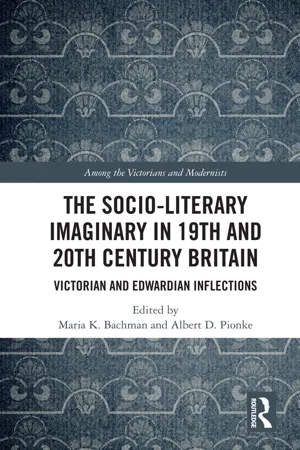
The Socio-Literary Imaginary in 19th and 20th Century Britain
Victorian and Edwardian Inflections
- 238 pages
- English
- ePUB (mobile friendly)
- Available on iOS & Android
eBook - ePub
The Socio-Literary Imaginary in 19th and 20th Century Britain
Victorian and Edwardian Inflections
About this book
Information
Table of contents
- Cover
- Half Title
- Series
- Title
- Copyright
- Contents
- Notes on Contributors
- Introduction
- 1 Mill, Comte, and the Literature of Sociological Critique
- 2 Harriet Martineau, Sociological Foremother
- 3 “The Shortest Way Out of Manchester”: Literary Sociology, Sociological Literature, and the Substance Abuse Question
- 4 Harriet Martineau and the Narrative Transmission of Social Knowledge
- 5 World Making: Character as Goffmanian Co-presence in The Pickwick Papers and Our Mutual Friend
- 6 Goffman Goes to Middlemarch
- 7 Character and Life: Sociological Method in George Eliot’s Fiction
- 8 Keeping Up Appearances: Criminality, Durkheim, and the Case of A. J. Raffles, Gentleman-Thief
- 9 The Persistence of Social Groups: Georg Simmel and John Galsworthy
- 10 “A More Emotional, a More Keenly Analytical Picture”: Impressionism, Naturalism, and Sociology in Ford Madox Ford
- Bibliography
- Index
Trusted by 375,005 students
Access to over 1.5 million titles for a fair monthly price.
Study more efficiently using our study tools.
Frequently asked questions
Yes, you can cancel anytime from the Subscription tab in your account settings on the Perlego website. Your subscription will stay active until the end of your current billing period. Learn how to cancel your subscription
No, books cannot be downloaded as external files, such as PDFs, for use outside of Perlego. However, you can download books within the Perlego app for offline reading on mobile or tablet. Learn how to download books offline
Perlego offers two plans: Essential and Complete
- Essential is ideal for learners and professionals who enjoy exploring a wide range of subjects. Access the Essential Library with 800,000+ trusted titles and best-sellers across business, personal growth, and the humanities. Includes unlimited reading time and Standard Read Aloud voice.
- Complete: Perfect for advanced learners and researchers needing full, unrestricted access. Unlock 1.5M+ books across hundreds of subjects, including academic and specialized titles. The Complete Plan also includes advanced features like Premium Read Aloud and Research Assistant.
We are an online textbook subscription service, where you can get access to an entire online library for less than the price of a single book per month. With over 1.5 million books across 990+ topics, we’ve got you covered! Learn about our mission
Look out for the read-aloud symbol on your next book to see if you can listen to it. The read-aloud tool reads text aloud for you, highlighting the text as it is being read. You can pause it, speed it up and slow it down. Learn more about Read Aloud
Yes! You can use the Perlego app on both iOS and Android devices to read anytime, anywhere — even offline. Perfect for commutes or when you’re on the go.
Please note we cannot support devices running on iOS 13 and Android 7 or earlier. Learn more about using the app
Please note we cannot support devices running on iOS 13 and Android 7 or earlier. Learn more about using the app
Yes, you can access The Socio-Literary Imaginary in 19th and 20th Century Britain by Maria Bachman, Albert Pionke, Maria K. Bachman,Albert D. Pionke,Maria Bachman,Albert Pionke, Maria K. Bachman, Albert D. Pionke in PDF and/or ePUB format, as well as other popular books in Literature & Literary Criticism. We have over 1.5 million books available in our catalogue for you to explore.