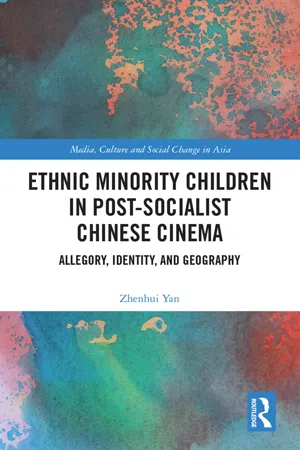
This book examines the surprisingly large number of films about ethnic minority children in China, considering key questions such as Why are ethnic minority children becoming more intriguing to Chinese filmmakers? What are their roles in the films literally and allegorically? And how are they placed on screen geographically and why? It argues that ethnic minority children's appeal lies in their special relationship with childhood, ethnicity, nationalism, and rurality; and that for dominant Han urban adults and elite ethnic minorities they serve as "the other" for these people's construction of themselves as self-conscious modern subjects during China's rapid social-political transformations. This book explores the diversity of ways in which both Han and ethnic minority filmmakers take up the special features of ethnic minority children to facilitate their expression of certain ideas or ideals, as well as the roles of these films in their directing careers.
eBook - ePub
Ethnic Minority Children in Post-Socialist Chinese Cinema
Allegory, Identity, and Geography
- 148 pages
- English
- ePUB (mobile friendly)
- Available on iOS & Android
eBook - ePub
Ethnic Minority Children in Post-Socialist Chinese Cinema
Allegory, Identity, and Geography
About this book
Information
1
Introduction
Ethnic minority children’s allegorical functions, identity construction, and geographies in post-socialist Chinese cinema
In a movie released in 1991 in the People’s Republic of China (PRC), an extremely talented rural Uyghur boy is seen in a variety of natural landscapes creating outstanding music with his hand drum. Pursuing his dream of becoming a professional instrumentalist, the boy overcomes many difficulties to ultimately merge into an urban space. He finally appears in one of the most famous state-owned refineries in the Xinjiang Uyghur Autonomous Region in China’s northwest, receiving ‘advanced’ education. In another Chinese movie released in 2008, a Miao boy looks after a nest of baby birds in his hometown village in Guizhou, southwest China. After joining villagers in rescuing a wounded bird, he sets out on a journey to Beijing, the nation’s capital. He is then pictured in both traditional and modern landscapes of Beijing. In particular, he is set against the National Stadium, known to most as the Bird’s Nest. Designed by celebrated architects Herzog and De Meuron in collaboration with artist Ai Weiwei, it was one of the main venues for the Beijing 2008 Olympic Games and is a national symbol of modern China. When the boy runs towards the building in a panning-up landscape shot accompanied by non-diegetic solemn music, a national narrative of ethnic unity is produced on screen. However, the irony lies in the boy’s desire to persuade his father, a migrant worker in Beijing, to return home. As his mother says, ‘A wife needs a husband, and a son needs a father’.
In the Han-dominated nation-state in the Chinese mainland, the child characters in these movies belong to the 55 non-Han ethnic groups, generally known as ethnic minorities. The people of these groups have been ‘living within China’s borders’ ‘since time immemorial’ (Mackerras 1994, 3–4). During certain historical periods, they controlled the national governments, such as the famous Yuan (1271–1368) and Qing (1644–1912) dynasties founded by the Mongols and the Manchus respectively. However, these groups were formally identified only quite recently, after a long and tortuous classification project undertaken by the PRC from 1953 to 1979 (Wang 2004, 7). They comprise less than 10 per cent of the nation’s population but take up over 60 per cent of its territory (Rao et al. 2011, 6). In terms of their geographical locations, ethnographer Louisa Schein (1997, 71) says that ‘While Han Chinese tend to be concentrated in the fertile plains and trading ports of central and coastal China, minorities occupy the strategic, resource-rich periphery to the north, south, and west’. With regard to their relationship to the dominant Han, the Chinese constitution stipulates three basic principles (the ethnic policies of the PRC), including ethnic equality and unity, regional autonomy, and the development of economy and culture in ethnic minority regions. Currently, over 70 per cent of ethnic minorities live in ethnic autonomous regions, especially the five provincial-level areas: Inner Mongolia Autonomous Region, Xinjiang Uygur Autonomous Region, Tibet Autonomous Region, Ningxia Hui Autonomous Region, and Guangxi Zhuang Autonomous Region (Wang 2004, 26–29).
Throughout the history of Chinese mainland cinema, ethnic minorities have been featured regularly on screen. For historical, political, and cultural reasons, Han people have monopolised this endeavour over a long period of time. When film was first imported to China as a foreign technology and an entertainment product, it was first consumed in the Han-dominated metropolises. Since then, Han people have dominated Chinese film production due to their better economic, educational, and technical conditions. Politically, films about ethnic minorities are particularly important to the Han-dominated nation-state. They contribute to both the construction and the rhetoric of national unity in the PRC. Chinese anthropologist Fei Xiaotong (1988) has famously proposed the concept of ‘plurality and unity’ in the understanding of Chinese people, on the basis of Chinese history.1 Zhang Haitao, deputy director general of the former SARFT (State Administration of Radio, Film and Television), once commented, ‘Tibetan film is not an issue of the market but an issue of the battlefield’ (as quoted in Rao et al. [2011, 382]).
In Mao’s communist regime (1949–1976), films about ethnic minorities were known as Chinese ethnic minority–themed films (Zhongguo shaoshu minzu ticai dianying).2 They were all directed by Han filmmakers and carried the political message of ethnic unity. They facilitated the envisioning of a unified nation-state for the newly established country (Anderson 1983). Moreover, they served as foreign films, entertaining the Han audience with the ‘exotic’ and the ‘erotic’ – outlandish settings, colourful costumes, folksongs, dances, and love stories that could not be found locally (Li 1999; Clark 1987). However, since the 1980s, there has been a significant change. First of all, despite increased output, films about ethnic minorities have less of an impact on the Han audience. According to Paul Clark (1987), a prominent Western critic of this type of film, this is mainly because Chinese people have regained access to foreign films since Deng Xiaoping’s economic policy of reform and opening up in 1978. Secondly, the emergence and increase in ethnic minority filmmakers has given rise to a more commonly used but highly debated term in this era, to refer to films about ethnic minorities: Chinese ethnic minority film (Zhongguo shaoshu minzu dianying).3 This term highlights the ethnic minority identity of the filmmaker, despite the fact that Han Chinese remain the majority in the production of this type of films. Finally, the messages of these films have expanded from political imperative to cultural, economic, and ecological concerns.
For example, in the 1980s, some dominant Han filmmakers started to appropriate ethnic minorities as the ‘cultural other’, ‘a contrasting mirror’ (Lo 2009, 235) to reflect on China’s destiny after the Cultural Revolution (1966–1976) (Clark 2005; Zhang 1997; Berry 2006). This phenomenon is inseparable from Han filmmakers’ desire for ‘primitive passions’, as theorised by cultural critic Rey Chow (1995).4 Although the type of ‘primitive materials’ Chow (1995, 21) identified in Chinese cinema is the woman in the dominant Han culture, primitivism is arguably equally at play across cultures within China’s borders. In Schein’s (1997) view, this type of Han-minority relationship in cultural representation is internal orientalism. In the 1990s, film productions about ethnic minorities diminished partly because of the nation’s transition from a planned economy to a market economy, which signified fewer subsidies to state-owned studios from the government (Rao et al. 2011, 397). However, in the 2000s, films about ethnic minorities revived, although they continued to stay at the margins of mainland cinema, in contrast to commercial entertainment ‘mainstream films’ (zhuliu dianying) or state-funded ‘main melody films’ (zhuxuanlü dianying).5 Funding sources have greatly expanded in the context of the market reform of the whole Chinese film industry. Moreover, as China becomes the second largest economy in the world and its modernisation is characterised by industrialisation, urbanisation, and internal migration of erstwhile farmers from the countryside to cities (Cao 2005; McGee, Lin, and Wang 2007), the negative impacts of rapid development have started to emerge. Among the most serious negative consequences are environmental destruction, unequal development, and intensified social stratification and injustice (Cao 2005). Because ethnic minorities are ‘a fragmented and forgotten realm separated from the rapidly industrializing China’ (Lo 2009, 242), who reside primarily away from the urban centres of the nation and thus on the periphery of China’s economic achievement, films about ethnic minorities lend themselves to Han filmmakers’ contemplations on the impacts of modernisation.
Films about ethnic minority children
Wucai lu/Five Colour Road (1960) is the first film in the PRC that features ‘ethnic minority children’ in leading roles; however, they were actually played by Han children (Rao et al. 2011, 111). Like other films about ethnic minorities in this period, this film was directed by a Han filmmaker (Wei Rong), was produced by a state-owned studio (Beijing Film Studio), and focused on a group of Tibetan children who support the Chinese Communist Party (CCP) in ‘liberating’ Tibet from its old serf system. During the Cultural Revolution, another film about ethnic minority children was produced, Axia hede mimi/Secret of Axia River (1976), which also was directed by Han filmmakers (Yan Bili, Shen Fu, and Wu Zhennian), was produced by a state-owned studio (Shanghai Film Studio), and starred Han children. Corresponding to its historical context, the film highlights three children from Han, Hui, and Tibetan groups respectively, acting as little ‘red guards’ of Chairman Mao to defend national property from being stolen by individual opportunists. Immediately after the Cultural Revolution, the third film on ethnic minority children was produced. The film Huowa/The Fire Boy (1978, dir. Xie Fei and Zheng Dongtian) focuses on a Miao child. However, it has the same production background and was concerned with the same issue of class struggle and socialist revolution as in the Mao era.
In the 1980s and 1990s, films about ethnic minority children increased steadily, and each decade generated about six films. In the new century, the total output of the first ten years has touched 20 or so. All of the child characters in these films from the post-socialist period are played by real ethnic minority children.6 Moreover, an increasing number of ethnic minority filmmakers and Han film-makers with varied professional backgrounds and funding sources are engaged in the production of this type of films, which has rendered diverse images of ethnic minority children and messages of the films. The filmmakers also cinematically emphasise the binary divide between rural and urban living with varied landscape shots. They reflect on the cultural, economic, ecological, and social impacts of Han-dominated modernisation on the lives of ethnic minority children who are at a critical period of forming their ethnic and national identities.
Take the two movies discussed in the beginning as examples. One was directed by a filmmaker of Xibo ethnicity (a non-Han ethnic group in China), who is also affiliated to a state-owned film studio. The other was directed by an independent Han filmmaker. Although both films place their ethnic minority child protagonist first in a rural space and then in an urban area, their messages differ. In this context, it is important to ask what roles the ethnic minority children play in these films literally and allegorically, what their relationships are with ethnic traditions and the nation-state in the filmmakers’ representations, and what their specific geographies are on screen and the implications of these. The answers to these questions are important not only because these children occupy a larger proportion of China’s territory than Han children but also because a growing conflation of reel life and real life renders the understanding of this group of children on screen a critical part of understanding their peripheral existence in reality. Moreover, these children live in a peculiar sociopolitical environment in contemporary China – in which ethnic solidarity is highly stressed by the Chinese state, while the power relationship between Han and ethnic minorities is increasingly off-balance.
This book focuses on the five groups of ethnic minority children most represented in post-socialist Chinese cinema in the mainland: Uyghur, Tibetan, Mongol, Miao, and Dai.7 For a variety of reasons, children from these ethnicities are cinematically emphasised in contrast to children of other ethnic minority groups.8 However, as this book argues, what they share in common are their special relationships with childhood, ethnic traditions, the nation-state, and rural spaces. They serve as the other for both Han and ethnic minority adults to reflect on the impacts of industrialisation, urbanisation, and migration on Chinese nationals. They embody not only the national discourse of ethnic unity in an enforced Han-dominated nation-state but also the confrontation between tradition and modernity in the course of China’s transformation. The contradictions and flexibility in the construction of identity in these children, in relation to their ethnic traditions and the nation-state, provide filmmakers with ample opportunities to imagine an ideal past, a creative and alternative way of thinking, and a reconstruction of ethnic relationships. Moreover, their geopolitical shifts from initial rural autonomy to later urban integration, and their final reincorporation into rural minority enclaves, illustrate Chinese people’s changing attitudes towards rural and urban living.
Specifically, ethnic minority children are a special group in the Chinese population. In contrast to ethnic minority adults, they are minors (children). In contrast to the majority Han Chinese, they are ethnic minorities. As minority minors, they are in the early stage of acquiring ethnic traditions, and thus their ethnic identity is not fixed or settled. Meanwhile, their identification with the nation can be surprisingly conventional, owing to a lack of critical thinking that is more commonly possessed by adults. In a Han-dominated nation-state, they can conveniently symbolise childlike citizens paying homage to the father figure of the nation-state from the peripheries. Their geographies in the rural environments take on extra significance in the present era of urbanisation and migration. In the next section, I elaborate on these features of ethnic...
Table of contents
- Cover
- Half Title
- Series Page
- Title
- Copyright
- Contents
- Foreword
- Acknowledgements
- Abbreviations
- List of figures
- Notes on romanisation, translation, and time periods
- 1 Introduction: ethnic minority children’s allegorical functions, identity construction, and geographies in post-socialist Chinese cinema
- 2 Children, nature, and animals: Dai children’s adventure in a forest
- 3 Natural landscapes as musical spaces: Uyghur children’s yearnings in a national narrative
- 4 Beijing and rural Guizhou in focalisations: Miao children’s relationships with the nation-state and ethnic tradition
- 5 Cinematic space in a relational construction: heroes and a reconstruction of ethnic relationships through children’s interethnic interactions
- 6 Grasslands as transitional spaces of play: Mongol children’s reimagination of the world
- 7 A young lama as Sun Wukong: contradictions and flexibility in a contemporary Tibetan child’s identity construction
- 8 Conclusion: some observations about the images of ethnic minority children in post-socialist Chinese cinema
- Index
Trusted by 375,005 students
Access to over 1.5 million titles for a fair monthly price.
Study more efficiently using our study tools.
Frequently asked questions
Yes, you can cancel anytime from the Subscription tab in your account settings on the Perlego website. Your subscription will stay active until the end of your current billing period. Learn how to cancel your subscription
No, books cannot be downloaded as external files, such as PDFs, for use outside of Perlego. However, you can download books within the Perlego app for offline reading on mobile or tablet. Learn how to download books offline
Perlego offers two plans: Essential and Complete
- Essential is ideal for learners and professionals who enjoy exploring a wide range of subjects. Access the Essential Library with 800,000+ trusted titles and best-sellers across business, personal growth, and the humanities. Includes unlimited reading time and Standard Read Aloud voice.
- Complete: Perfect for advanced learners and researchers needing full, unrestricted access. Unlock 1.5M+ books across hundreds of subjects, including academic and specialized titles. The Complete Plan also includes advanced features like Premium Read Aloud and Research Assistant.
We are an online textbook subscription service, where you can get access to an entire online library for less than the price of a single book per month. With over 1.5 million books across 990+ topics, we’ve got you covered! Learn about our mission
Look out for the read-aloud symbol on your next book to see if you can listen to it. The read-aloud tool reads text aloud for you, highlighting the text as it is being read. You can pause it, speed it up and slow it down. Learn more about Read Aloud
Yes! You can use the Perlego app on both iOS and Android devices to read anytime, anywhere — even offline. Perfect for commutes or when you’re on the go.
Please note we cannot support devices running on iOS 13 and Android 7 or earlier. Learn more about using the app
Please note we cannot support devices running on iOS 13 and Android 7 or earlier. Learn more about using the app
Yes, you can access Ethnic Minority Children in Post-Socialist Chinese Cinema by Zhenhui Yan in PDF and/or ePUB format, as well as other popular books in Media & Performing Arts & Film & Video. We have over 1.5 million books available in our catalogue for you to explore.