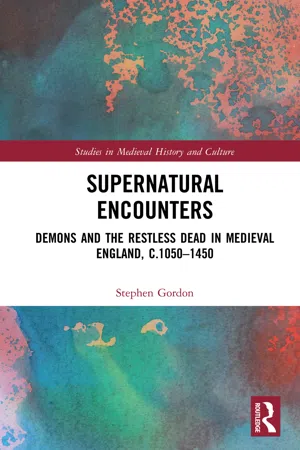
The belief in the reality of demons and the restless dead formed a central facet of the medieval worldview. Whether a pestilent-spreading corpse mobilised by the devil, a purgatorial spirit returning to earth to ask for suffrage, or a shape-shifting demon intent on crushing its victims as they slept, encounters with supernatural entities were often met with consternation and fear. Chroniclers, hagiographers, sermon writers, satirists, poets, and even medical practitioners utilised the cultural 'text' of the supernatural encounter in many different ways, showcasing the multiplicity of contemporary attitudes to death, disease, and the afterlife. In this volume, Stephen Gordon explores the ways in which conflicting ideas about the intention and agency of supernatural entities were understood and articulated in different social and literary contexts. Focusing primarily on material from medieval England, c.1050–1450, Gordon discusses how writers such as William of Malmesbury, William of Newburgh, Walter Map, John Mirk, and Geoffrey Chaucer utilised the belief in demons, nightmares, and walking corpses for pointed critical effect. Ultimately, this monograph provides new insights into the ways in which the broad ontological category of the 'revenant' was conceptualised in the medieval world.
eBook - ePub
Supernatural Encounters
Demons and the Restless Dead in Medieval England, c.1050–1450
- 232 pages
- English
- ePUB (mobile friendly)
- Available on iOS & Android
eBook - ePub
1 The Witch of Berkeley in context
Introduction
The question of how to deal with the misuse of supernatural power was one of the many Christian inheritances from the Classical world. Treatises against illicit magic and the veneration of evil spirits – formerly pagan daemones – formed the very bedrock of nascent theological discourse. From Tertullian’s declaration that giving honour to airy demons was an affront to God,1 to Augustine’s polemics against augury,2 astrology,3 and the practice of divination through Holy Scripture,4 patristic writers provided an intellectual framework through which later churchmen could express their own concerns about non-normative religious practice. Indeed, the socio-spiritual danger presented by the synthesis of Classical (and Germanic) magical beliefs into Judeo-Christian thought was a key concern for early medieval law makers. Detailing and denouncing such nefarious practices as love magic, the manipulation of the weather, and the creation of medical charms, the corpus of penitential handbooks and law codes (c.600–1000) also contain numerous references to the use of demonic agents to predict the future.5 Such condemnations should not be just read as recapitulations of old literary archetypes. The personal correspondences of St. Boniface (d.754),6 Alcuin of York (d.804),7 and Lanfranc (1075)8 – to take a broad diachronic sample – betray a deep pastoral concern about contemporary interests in ‘wearing amulets’ (filacteria), ‘soothsayings’ (auguria), and ‘casting lots’ (sortes).
The intricacies and ambiguities of early medieval magic have been the subject of much scholarly interest in recent years.9 Likewise, numerous studies have been conducted on the ‘diabolication’ of magic in the fourteenth and fifteenth centuries and the consolidation of the idea that practitioners – whether learned necromancers or folk healers – did not just coerce spirits to do their bidding, but formed an unholy pact with the devil.10 It suffices to say that literature on the emergent ‘witch craze’ is also incredibly abundant. By contrast, scholarship on the practice of magic in the late eleventh and early twelfth centuries (c.1067–1150) is still somewhat scarce; a function, perhaps, of the dearth of primary written sources from this era.11 Although ‘magic’, divination specifically, remained a cause for concern amongst educated lawmakers and churchmen,12 it did not provoke the same level of condemnation as in earlier or later centuries, where the need to eradicate the final vestiges of paganism (early medieval) and curtail the devil’s active agency (late medieval) was firmly on the agenda. Likewise, the increasing influence of Islamic astrological, alchemical, and quasi-mystical treatises in the intellectual milieu of the Latin West may explain why there was a reluctance, initially at least, to delve too deep into the profane mechanics of the diviner’s art.13 Hugh of St. Victor’s Didascalicon (c.1127), Gratian’s Decretum (c.1139), and Bartholomew Iscanus’s Penitential (c.1184) drew upon earlier authoritative precedents – notably Augustine, Isidore of Seville14 and the early tenth-century Canon Episcopi 15 – in their rote denunciations of magic. John of Salisbury’s Policraticus (c.1159) includes a vivid childhood account of being coerced by a priest to divine the future using fingernails and a polished bowl, but such personal testimonies are few and far between.16 Despite the relative lack of first-hand accounts of magical activity in the decades following the Conquest, the figure of the magical practitioner already existed as a fully-formed literary (and mental) concept, epitomised by the demonically-sired Merlin in Geoffrey of Monmouth’s Historia regum Britanniae (c.1136).17 Beyond the Arthurian sources, William of Malmesbury’s story of the ‘Witch of Berkeley’ is, alongside his own retelling of the necromantic activities of Gerbert of d’Aurillac (Pope Sylvester II, d.1003), perhaps the most famous narrative of its type to emerge in the early years of the twelfth century. Included in book two of the Gesta regum Anglorum (c.1125), a monumental and highly influential overview of English history from 449 to 1120, the Berkeley narrative records the post-mortem fate of an inveterate soothsayer whose corpse is ripped from its tomb by demons and taken to hell on the back of a wild, demonic horse.18 Given that the narrative is often used as a key reference point in studies of witchcraft and magic, it is surprising that no true attempts have been made to explore its literary-critical function within the Gesta regum Anglorum. Similarly, previous attempts to analyse the Witch of Berkeley’s textual transmission and appropriation by later compilers have amounted to only a few brief sentences and footnotes.19
The first part of this chapter, then, will involve a close, critical analysis of the narratologial elements of the extract itself, interrogating the extent to which the story – ostensibly based on first-hand testimony20 – was shaped by classical and patristic antecedents. Particular emphasis will be given to the seeming vitality of the witch’s corpse and whether this is suggestive of a pervasive local belief in the restless dead. With reference to the narrative’s manuscript context, it will also be seen whether the witch’s fate can be read as a piece of ironic historical criticism. Specifically, I will argue that William is making an allusive and elliptical reference to the events that led to the expulsion of Godwin of Wessex from England in 1051 and, more generally, the idea that the fracture (and subsequent re-mending) of the English state c.1066 can be reflected in a similar ‘fracture’ of the boundaries between the physical and metaphysical worlds. It is certainly no accident that William places the story between the political tumults of the 1040s and the Conquest of 1066. Nor is it a coincidence that Godwin stood in direct political contrast to the royal Wessex lineage represented by Matilda of Scotland, whose marriage to Henry I unified the Anglo-Saxon and Norman royal dynasties, and whose request for a more complete history of her iconic forefathers laid the foundations for the entire Gesta regum project.21 As we shall see, wonder stories were not just amusing digressions from the main body of the text, but could also play an important moralistic and socio-critical function.
The final part of the chapter will involve an attempt to chart the transmission of the narrative across different contexts, genres, and media, from its initial appearance in the Gesta regum Anglorum and appropriation by later chroniclers and artists, to its use as an exemplum in preachers’ manuals and, finally, as the basis of a ballad by the future poet laureate, Robert Southey (c.1798). Sources to be analysed include Roger of Wendover’s Flores Historiarum (c.1220–1235), Vincent of Beauvais’ Speculum Historiale (c. late 1240s), Arnold of Liège’s Alphabetum narrationum (c.1307), Hartmann Schedel’s Liber Chronicarum (1493), and Olaus Magnus’s Historia de Gentibus Septentrionalibus (1555), amongst others. By mapping out the textual history of a single supernatural encounter from its twelfth-century orig...
Table of contents
- Cover
- Half-Title
- Series
- Title
- Copyright
- Dedication
- Contents
- List of illustrations
- Acknowledgements
- Abbreviations
- Introduction
- 1 The Witch of Berkeley in context
- 2 The critical function of the walking corpse in William of Newburgh’s Historia rerum Anglicarum
- 3 Satirising the undead: Walter Map and the ambiguation of wonder
- 4 Between demons and the undead : Preaching practice and local belief in the sermons of John Mirk
- 5 ‘But whan us liketh we kan take us oon’: Vain surfaces and walking corpses in Chaucer’s Friar’s Tale
- 6 Nightmares and the supernatural encounter
- Epilogue
- Index
Trusted by 375,005 students
Access to over 1.5 million titles for a fair monthly price.
Study more efficiently using our study tools.
Frequently asked questions
Yes, you can cancel anytime from the Subscription tab in your account settings on the Perlego website. Your subscription will stay active until the end of your current billing period. Learn how to cancel your subscription
No, books cannot be downloaded as external files, such as PDFs, for use outside of Perlego. However, you can download books within the Perlego app for offline reading on mobile or tablet. Learn how to download books offline
Perlego offers two plans: Essential and Complete
- Essential is ideal for learners and professionals who enjoy exploring a wide range of subjects. Access the Essential Library with 800,000+ trusted titles and best-sellers across business, personal growth, and the humanities. Includes unlimited reading time and Standard Read Aloud voice.
- Complete: Perfect for advanced learners and researchers needing full, unrestricted access. Unlock 1.5M+ books across hundreds of subjects, including academic and specialized titles. The Complete Plan also includes advanced features like Premium Read Aloud and Research Assistant.
We are an online textbook subscription service, where you can get access to an entire online library for less than the price of a single book per month. With over 1.5 million books across 990+ topics, we’ve got you covered! Learn about our mission
Look out for the read-aloud symbol on your next book to see if you can listen to it. The read-aloud tool reads text aloud for you, highlighting the text as it is being read. You can pause it, speed it up and slow it down. Learn more about Read Aloud
Yes! You can use the Perlego app on both iOS and Android devices to read anytime, anywhere — even offline. Perfect for commutes or when you’re on the go.
Please note we cannot support devices running on iOS 13 and Android 7 or earlier. Learn more about using the app
Please note we cannot support devices running on iOS 13 and Android 7 or earlier. Learn more about using the app
Yes, you can access Supernatural Encounters by Stephen Gordon in PDF and/or ePUB format, as well as other popular books in History & World History. We have over 1.5 million books available in our catalogue for you to explore.