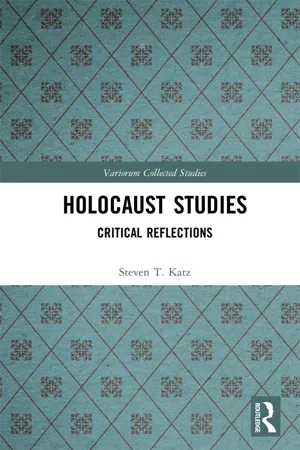
The great majority of Holocaust scholarship concentrates heavily, if not almost completely, on the Final Solution from the German side. The distinctive feature of this book, both individually and as a collection, is its concentration on the Holocaust from a Judeo-centric point of view. The present essays make a unique contribution by exploring issues such as: the effect of events specifically on Jewish women and children; the character of the Nazi policy of slave labor in as much as this essential program resulted in different treatment with regard to Jews as compared to other workers; how the destruction of European Jewry has been responded to by Jewish thinkers; and how Jewish values, such as the well-known principle that "all Jews are responsible for each other," were exemplified and lived out during the war. The collection also includes an essay on Elie Wiesel, and another that explores the much discussed, very controversial issue of Jewish resistance, as well as several essays on philosophical and comparative issues raised by the Shoah. (CS1075)
- 354 pages
- English
- ePUB (mobile friendly)
- Available on iOS & Android
eBook - ePub
1
On the Holocaust and Comparative History
(Leo Baeck Memorial Lecture, 1993)
I
The special opportunity offered by the Leo Baeck Memorial Lecture is an appropriate occasion to reflect on the fate, and the meaning of the fate, of European Jewry under the Third Reich. Emerging out of the conflict and confusion of the Weimar years, Hitler came to power first in Germany and then in almost all of western and central Europe, creating in turn the Nuremberg racial laws to dis-emancipate the German Jews, ghettos in which to incarcerate the Polish and Baltic Jews, Einsatzgruppen to murder the Russian Jews, and in the end, death camps to exterminate all the remaining Jews of Europe. East and west, north and south, male and female, young and old, six million out of nine-and-a-half million European Jews were consumed, with active designs existing for the annihilation of the remainder of world Jewry, beginning with the Jews of Britain, the Sephardic communities of North Africa, and the growing community of the yishuv (the Jewish settlement in the Land of Israel).
This is what we know as the Holocaust. The ideologically driven plan to make the world Judenrein. But it is not only as a Jewish phenomenon that this event has entered into the contemporary consciousness. Given its uncompromising project of genocidal elimination coupled with its technological-bureaucratic characters, directed by a capacious racial-Manichean dogmatic, the Shoah has become one of the defining symbols of our age. And as such, given its iconic status, an intense debate has emerged regarding its singularity. This is not least because to the degree that it has become the symbol of evil in our time, it has been co-opted as the standard, the model, by which, through which, and over against which, the writing of other histories of persecution and mass death now take place.1 In consequence, the historiographical placement of this event cannot be avoided. Or, to put the question very simply and directly: to what degree is the destruction of European Jewry a unique historical event?
In trying to answer this vexing and by now much discussed question I would begin with three hermeneutic principles.2 (1) The Shoah can and must be historicized, i.e., it must be held to be a subject open to historical investigation free of a priori theological and metaphysical judgments that would “mystify” it by definition. (2) The Shoah is not individuated as a historical happening by the number of Jewish victims, either as regards the absolute number of dead or the percentage of loss these deaths represent. As to the aggregate, at least four cases surpass Jewish losses during World War II, namely, New World Indian deaths in the sixteenth century, the depopulation of the USSR under Stalin, Chinese casualties during the Taiping Rebellion of the 1850s, and the long series of bloody occasions in China in the twentieth century that, according to at least one recent estimate, has claimed a total of one hundred million persons.3 As to the percentage of decline – a loss of 40 percent of world Jewry and 60 percent of European Jewry – these figures are matched or exceeded by, for example: the Native American catastrophe following conquest that claimed up to 96 percent of the total indigenous population within a century; by the Armenian massacres of World War I that were in the range of 40 percent (higher on many projections, though I disagree with these higher figures); and by the decimation of the Australian aborigines following European contact. And other examples could be provided. (3) When making historical comparisons and distinctions of the kind I will offer in my analysis this evening I am not making moral comparisons. Nor again, in defending uniqueness, am I simultaneously endorsing the injudicious claim that the Holocaust is more evil than alternative occurrences of extensive and systematic persecution, organized violence, and mass death. The character of the uniqueness that I am prepared to champion is not tied to a scale or a hierarchy of evil (i.e., of event X being more or less malevolent than another event Y, or all previous events E1 to E11).
II
I have elsewhere described why it is that the comparison regularly made between the Holocaust and medieval forms of persecution, including medieval antisemitism, are in fact incorrect.4 Here let me only summarize this complex issue by saying that in no case of medieval persecution – not the Church’s persecution of the Jews, nor of witches, nor again in the Crusade against Albigensians and Cathars, and finally against sodomites – was it the intention of the Church or Christian State to carry out a policy of physical (not cultural) genocide. In every instance theological doctrines and practical necessities intervened to constrain the form of the persecutory campaign tool. Those who regularly, if confusedly, see medieval anti-Jewish bigots as Nazis, who misunderstand the attempt to destroy heresy as the equivalent of racial immolation, who mistake the violence against women incarnate in the witch craze for physical genocide, and lastly, those who liken the rhetoric again homosexual acts with the actuality of gas chambers, are both constructing fictions and manipulating the symbol of the Holocaust in ways that are unwarranted by the historical evidence.
The reality is that most Jews survived the outbursts of medieval anti-Judaism. For example, the Crusades, for all their real and terrible violence, probably claimed only 3,000 to 4,000 Jewish lives; relatively few Jews were killed by the Flagellants in 1348–49; and the Inquisition murdered only a very small number of conversos, certainly only a small percentage of the converso population in a statistical sense. It should also be clearly understood that most women in the medieval era survived the misogynistic clerics who pursued witches – on my figures 99.9+ percent of women so survived. Likewise, the overwhelming majority of Christian heretics were able to successfully abjure and re-enter the Catholic Church after the destruction of the heretical centers of southern France. The same social and theological logic prevailed in the case of the hundreds of thousands of Huguenots who preferred to remain in France rather than go into exile after the revocation of the Edict of Nantes. Finally, very few sodomites were killed for their sexual deviance, though a small number were put to death in sixteenth-century Spain and Italy. Thus, the likening of the Holocaust to these medieval precedents, given their actuality, has produced very little by way of substantive historical insight.
III
As regards the modern period the situation is more complex not least because of the occurrence of a number of instances in which there has been large-scale loss of life. Here one immediately thinks of at least seven relevant cases: the massive losses experienced in the sixteenth century by the native peoples of North and South America (counted as two); the millions of blacks who died in the enterprise of slavery; the large Armenian losses during World War I; the millions consumed by the Gulag; the tens of millions who lost their lives in the Chinese Civil War and the so-called Cultural Revolution; and more recently, the one million or so Cambodians murdered by their own government in the bizarre episode that went by the name of Kampuchea. Each of these events has, with some good reason, been called a Holocaust and likened to the destruction of European Jewry. And this inventory could easily be extended to include the Nigerian Civil War, the tribal conflicts in Burundi and Rwanda, the decimation of Indonesian Communists, the Civil War in Pakistan/Bangladesh, and, for some – though incorrectly – Yugoslavia today (in 1993), and this brief list by no means exhausts the catalogue of possible candidates.
However, I would like to make a bold historical and phenomenological counterclaim: none of these events is, at least on what I will call the genocidal criteria, comparable to the Holocaust; efforts by historians and others to make the contrary case are in error. Here I would introduce two elements that will help individuate the phenomenological character of the Shoah: (1) the intention of the victimizers including, in particular, the complete physical extermination of the targeted victim population; and (2) the multi-layered category of mediation present in other cases but not in the Holocaust, as I shall explain as I proceed.
As regards the former, note that in none of the modern cases mentioned as putative parallels do we find comparable genocidal intent, that is, the intention to totally extirpate the victim community. Though we have several cases where the losses experienced in these other historic tragedies exceed the rate of loss – as well as the absolute number – of Jewish victims during the Shoah, in no case other than the Holocaust do we have evidence that the killer was single-minded about murdering all the members of the victim group. The Conquistadors needed native slaves and did not seek to murder the indigenous population of the New World. Blind pathogenic forces did this work against the will of the European conquerors. Europeans involved in the black slave trade, which came about because of the unintended death of the indigenous population, participated in this vile traffic in order to make a profit: dead slaves brought no profit. The Gulag was a vast slave empire created in large part to finance the modernization of Russia. Stalin needed his Gulag population if only so that he could exploit them – he did not set out purposely to murder them. The Khmer Rouge hated the old Cambodia and its bourgeois elements, but it aimed at creating a new Kampuchea in which seven-eighths of the pre-revolutionary population would continue to live, if now in dramatically altered circumstances. This is to say, the intent to murder an entire people, even amidst the vast slaughters that have marked the modern historical epoch, is an historical exception.
IV
I would support this repercussive claim by considering in some detail what many consider the closest historical parallel to the Shoah – the destruction of the Armenian community of Turkey during World War I. There are many good reasons to argue for this comparison but, ultimately, it is incorrect. While intending no diminution to the Armenian tragedy, and in no way denying the enormous proportions of the Armenian massacres, I would contend that the intentionality of the two victimizers – and hence, the character of the two historic events – was, in fact, fundamentally dissimilar and does not provide grounds for an argument as to the convergence of the Armenian and Jewish circumstance. Despite the intense, almost millenarian, talk of “total liquidation” and “total extermination of all non-Turkish elements” to be found in the diverse Turkish materials of the 1915–1916 period, the actual, systematic nature of the savage Turkish assault reflects a distinctive policy determination that was significantly different from that operative in the German context. The controlling ambition, the collective civic agenda, behind Turkish inhumanity was primarily nationalist in character and, in practice, limited in scope and purpose. The Armenian massacres were an indecent, radicalized, manifestation of a most primitive jingoism activated by the exigencies of war without and the revolutionary collapse of the Ottoman Empire from within. Turkish nationalism, the extreme nationalist elites in control of the Turkish state, now under the violent cover of war, envisioned and pursued the elimination (not the murder) of all non-Turkish elements – and most especially and specifically the eradication of the Armenian community – from the national context. The anti-Armenian crusade was, as a result, for all its lethal extravagance, a delimited political crusade. Of course, mixed into the noxious brew that represented itself as national destiny were other obsessions: a loathing of Christians if not all non-Muslims, xenophobia, greed, jealousy, fear, desire, and the like. But, above all else, the “war against the Armenians” was a vulgar and desperate manifestation of raw nationalist politics.
As a direct and immediate consequence, anti-Armenianism is not expressed in the baroque language of metaphysical evil, not does it require – paraphrasing Himmler’s asserting that “all Jews without exception must die” – the complete annihilation of every Armenian man, woman, and child. It does not represent a racial collision as that term came to be understood in the ornate ontological schema of Nazism. There is no assertion of primordial reciprocity between power and being, between intra-human aggression and meta-historic causations, between biological contingencies and noumenological principles. Rather, the elemental rational almost universally cited by the Turks in defense of their actions is political: the Armenians are secessionists, Russian spies, fifth-columnists, divisive nationalists, who would subvert the Turkish people’s revolut...
Table of contents
- Cover
- Series Page
- Half Title
- Title
- Copyright
- Dedication
- CONTENTS
- Acknowledgments
- Introduction
- 1 On the Holocaust and comparative history
- 2 Mass death under Communist rule and the limits of “otherness”
- 3 Auschwitz and the Gulag: A study in dissimilarity
- 4 Children in Auschwitz and the Gulag: Alternative realities
- 5 On the definition of genocide and the issue of uniqueness
- 6 Exploring the Holocaust and comparative history
- 7 Extermination trumps production: On the issue of Jews as slave laborers
- 8 The murder of Jewish children during the Holocaust
- 9 Thoughts on the intersection of rape and Rassenschande during the Holocaust
- 10 Irving Greenberg on history and Halakha: The implications of the Holocaust
- 11 Exploring the concept of Kol Yisrael Arevim Zeh L’Zeh
- 12 Thinking about Jewish resistance during the Holocaust
- 13 Elie Wiesel: The man and his legacy
- 14 The issue of confirmation and disconfirmation in Jewish thought after the Shoah
- 15 Jewish theologians respond to the Holocaust
- Index
Trusted by 375,005 students
Access to over 1.5 million titles for a fair monthly price.
Study more efficiently using our study tools.
Frequently asked questions
Yes, you can cancel anytime from the Subscription tab in your account settings on the Perlego website. Your subscription will stay active until the end of your current billing period. Learn how to cancel your subscription
No, books cannot be downloaded as external files, such as PDFs, for use outside of Perlego. However, you can download books within the Perlego app for offline reading on mobile or tablet. Learn how to download books offline
Perlego offers two plans: Essential and Complete
- Essential is ideal for learners and professionals who enjoy exploring a wide range of subjects. Access the Essential Library with 800,000+ trusted titles and best-sellers across business, personal growth, and the humanities. Includes unlimited reading time and Standard Read Aloud voice.
- Complete: Perfect for advanced learners and researchers needing full, unrestricted access. Unlock 1.5M+ books across hundreds of subjects, including academic and specialized titles. The Complete Plan also includes advanced features like Premium Read Aloud and Research Assistant.
We are an online textbook subscription service, where you can get access to an entire online library for less than the price of a single book per month. With over 1.5 million books across 990+ topics, we’ve got you covered! Learn about our mission
Look out for the read-aloud symbol on your next book to see if you can listen to it. The read-aloud tool reads text aloud for you, highlighting the text as it is being read. You can pause it, speed it up and slow it down. Learn more about Read Aloud
Yes! You can use the Perlego app on both iOS and Android devices to read anytime, anywhere — even offline. Perfect for commutes or when you’re on the go.
Please note we cannot support devices running on iOS 13 and Android 7 or earlier. Learn more about using the app
Please note we cannot support devices running on iOS 13 and Android 7 or earlier. Learn more about using the app
Yes, you can access Holocaust Studies by Steven T. Katz in PDF and/or ePUB format, as well as other popular books in History & British History. We have over 1.5 million books available in our catalogue for you to explore.