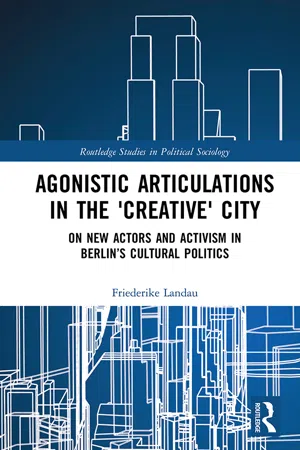
This book offers an empirically-grounded account of the emergence and political activities of a new collective actor in Berlin's art field. Investigating the organizational and representative practices of Koalition der Freien Szene (Coalition of the Independent Scene) – a trans-disciplinary action platform assembling a wide variety of cultural producers in Berlin – the author unpacks the political organization of one of the most compelling contemporary art scenes, or 'creative' cities, worldwide, analysing both its concrete policy 'success' and the means by which it seeks to challenge and rearticulate the meaning of Berlin as a 'creative' city from the producers' point of view. The book thus opens new opportunities for long-term transformations of the cultural political field. Theoretically sophisticated and based on empirical material including interviews with spokespeople and cultural administrators, Agonistic Articulations in the 'Creative' City presents a unique conceptualization of new modes of political collectivization, representation and legitimacy that imagine new avenues of political engagement at a time when political institutions, parties and regimes of representation are in crisis. As such, it will appeal to scholars of sociology, political science and urban studies with interests in social movements and cultural activism.
eBook - ePub
Agonistic Articulations in the 'Creative' City
On New Actors and Activism in Berlin’s Cultural Politics
- 224 pages
- English
- ePUB (mobile friendly)
- Available on iOS & Android
eBook - ePub
Agonistic Articulations in the 'Creative' City
On New Actors and Activism in Berlin’s Cultural Politics
About this book
Information
1 Introduction
(Cultural) politics in a supposedly post-political age
Politics cuts across all areas of our lives. Diversely shaped and formed, implications of political decision-making concern the different ways we live, think and act. Hence, within and out of the inherent diversity of social life, a political dimension arises. The irrevocably political character of social and human relations evokes the question how and where multiple interpretations and practices of politics come to life. This book follows the assumption that, on the one hand, contemporary societies are caught in tensions between political disenchantment and people’s growing political indifference. On the other hand, societies across the globe witness a growth of new civil and social movements that redefine the meanings, places and faces of politics. This book sets out to explore interventions in or beyond traditional principles of political representation and decision-making. I argue that it is important to consider and study these newly emerging, informal actors, especially in times when people might think that their voices or votes do not really matter (anymore).
In a state of crisis for international, national and local political institutions and organizations, citizens express skepticism and mistrust about the effectiveness, transparency, accountability and adequate representation of the will(s) of the people (Haus 2005). In response, classic representative modes (e.g., elections, public opinion polling) are increasingly challenged or channeled into alternative arenas of political expression and decision-making. If representational practices are seemingly decoupled from the causal origins of political rationales for large-scale decisions – political choices seemingly be made regardless of what was promised prior to elections – these disconnects elicit citizens’ lack of understanding or identification with ‘politics’. In short, people’s sense of having a say, or owning decisions politicians take, becomes compromised.
Amidst this crisis of political representation, the alarming rise of (both left- and right-wing) populist political movements and parties across Europe and beyond can deform sentiments such as fear and discouragement into nationalism, racism and homophobia. Politically divisive movements can create conflicts that might manifest in low voter turn-outs or the ‘democratic’ election of political leaders or parties who matter-of-factly disrespect and threaten democracy and strong civil societies. In such scenarios, democratically elected leaders erode democracy with democratically conferred mandates. Opposing this new version of a ‘democratic paradox’, citizens who are dissatisfied with the defunct system might choose to exit and quit to participate in that very democratic system, leaving the criticized structures unchanged and unchallenged. While both options to exit the system or choose simplifying populism have problematic consequences for political cultures of engagement and participation, they urge us to examine the partial failures of existing representative political institutions. If the latter fall short of addressing controversies about their own political system within the structures they provide, we need to look elsewhere to track and trace new forms of political emancipation.
Out of this critical diagnosis of contemporary liberal democracies, it becomes apparent that new forms of political expression and representation move center-stage to rethink, reinterpret and reconceptualize politics. In this vein, I set out to discuss new modes and actors of ‘politics’ in the narrow sense and in the wider sense of ‘the political’, asking how, where and by whom the inherent contestations of political life are articulated. While investigating new forms of political action and representation, questions about the legitimacy of these new movements and actors arise: Who are these new political agents? In what ways is their political behavior different or acceptable, especially if they question or challenge given political contexts? Why and how should their concerns, claims and ideas be considered in relation to existing political structures and agents? Are new political actors marginal enough to be ignored or do they represent significant populations or social groups? Does it matter who represents whom? Who and what makes new political actors powerful for how long? All these questions not only point to the necessity to empirically study new modalities of contemporary political life, but also draw attention to the need to conceptualize these forms of activism and social movement formation from a perspective of conflict rather than consensus.
Following Belgian political philosopher Chantal Mouffe (2005, 2009, 2013), I align with the critique that contemporary (liberal) political discourse is centered around and aims for fully transparent and complete consensus. In accordance with Mouffe, I assume that notions of universal consensus are dangerous and detrimental to vital pluralistic democracies because they foreclose the active negotiation of diverging views, and thus bury potentially emancipatory ideas. Deliberative approaches, prominently advocated by Jürgen Habermas (1984) and others (Dryzek 2000; Lijphart 2008, 2012) might tend to reify consensus or idealize communicative rationality or deliberation as unquestionable bases of (liberal) democracy. Consequently, these approaches negate or underestimate the irrevocably conflictual nature of social relations. Put simply, liberal or deliberative democratic approaches can only inadequately address and explain conflicts in political decision-making processes. In contrast, the active embrace of conflict among controversial political parties or groups could stimulate ‘radical’ democracy, as proposed by Mouffe and Laclau in their classic Hegemony and Socialist Strategy: Towards a Radical Democratic Politics (2001), pointing to the problematic implications of consensus-oriented democracy models. Since the consensus-obsessed model assumes that social life could coherently pursue one idea of ‘the good life’ or society, this imprudent universalism runs the risk of glossing over or oppressing alternative understandings of good lives or politics. Ultimately, the reductionism of consensualist liberal approaches, epitomized in Margaret Thatcher’s slogan ‘There is no alternative’ (TINA), might depoliticize citizens’ counter-voices and preclude emancipatory ideas and actions. Critiquing the consensus narrative as (implicitly) positivist, rationalist and teleological (i.e., that ‘full’ consensus is considered achievable), this book considers new modes of political expression and representation as conflictual negotiations to contest notions of ‘politics’ as merely problem-solving, technocratic or crisis management operations. The TINA paradigm embodies what scholars have called ‘post-politics’ (Mouffe 2005; Rancière 2008, 2010; Swyngedouw 2005, 2009; Žižek 2009), announcing a condition in which politics becomes devoid of political rigour, foreclosing the ‘proper’ political moment of politics. As part of this post-political condition, Swyngedouw (2011, p. 373) points to the common misunderstanding that politics would be ‘something one can do without making [a decision] that divide[s] and separate[s].’ To the contrary, both politicization and post- or depoliticization are always incomplete, and can never be fully realized, because the human condition remains inescapably conflictual. Hence, when governments or political institutions portray overarching struggles such as poverty, injustice, spatial displacement, institutional racism or homophobia as given or immutable ‘facts’, and consequently present disembodied or neutral bureaucratic tasks as ‘solutions’ to these problems, these seemingly uncontroversial acts might trigger depoliticization and discourage citizens from actively engaging in ambiguous political attempts to fight these crises.
In this supposedly post-political atmosphere, the perception of political institutions’ post-political or depoliticizing proceedings, and the inadequate representation of the people’s will(s), have sparked the emergence of new movements and modes of political mobilization and organization. Global and local protests like the New York-based Occupy Wallstreet, the Spanish Podemos movement, or Berlin’s Kotti&Co. tenant uprising, as well as the occupation of public places like Tahrir Square in Cairo or Istanbul’s Gezi Park, have materialized the dissatisfaction and politicization of citizens (Mayer et al. 2016). These public collective gatherings show a variety of novel forms of public encounter, community formation, decision-making and protest. Slogans such as ‘You do not represent us and you can never represent us!’ (Newman 2014, p. 93; emphasis original) illustrate how new social movements refuse (democratic) representation with exodus-like or anti-institutionalist rhetoric and collectivize via non-representational practices. However, withdrawing from or challenging representation might not be the final, but rather the initializing point of debate to discuss (democratic) emancipatory politics.
This book aims to unpack the representational and organizational dynamics of a new political actor in its temporariness, incoherency, fleetingness and potential ‘impact’ or ‘success’ as an exemplary case to understand new paradigms that drive social movements in the 21st century. Considering new political actors as moving between manifestations of institutionalized ‘politics’ and wider expressions of ‘the political’, these activist groups allow us to reflect and rethink the potentialities of new social movements with regard to innovations in political representation and practice. Dikeç and Swyngedouw (2017, p. 10) assess the emergence of ‘the political’ as taking place
when the few claim the name of the many (…) and are recognized as such. A sociological minority of activists takes on the generic political name of the people as a whole and becomes the stand-in for the many, the multiple.
Anticipating the representative tension inscribed in the activities of this ‘sociological minority of activists’ to be explored throughout this book, my theoretical objective is to grasp and uncover new modes of political interaction and representation between state and non-state actors to refute the diagnosis that we live in a post-political age. The proclamation of the seemingly intractable presence of post-politics itself is a political act. In contrast, it is my aim to avoid the ‘post-political trap’ (Beveridge and Koch 2016; Davidson and Iveson 2014) and conceptualize the articulation of new political actors and their claims, critiques and collaborations with formal actors of politics as a means to repoliticize the debate about post-politics (Jessop 2014; Larner 2015; Uitermark and Nicholls 2014).
According to Boonstra and Boelens (2011, p. 113), new social movements diversely organize to tackle pressing questions and formulate political demands via ‘processes of group formation and deformation’, which rely on the discontinuous making of networks and collectivities driven by self-organization. Attending to self-organized actors, they argue, helps to understand experiments with potentially emancipatory ways of policy-making and politics. In a similar vein, the case study of this book explores the relations between politicization and depoliticization and subsequent negotiations between depoliticizing consensus and emergent, potential politicizing of urban protest and conflict. Taking the city as an insightful arena to develop new forms of political dialogue and protest, Dikeç and Swyngedouw (2017, p. 2) identify
an urgent need to rethink urban politics and urban political theory in ways that are much more sensitive to consider the city as an immanent site of nurturing political subjectivation, mediating political encounter, staging interruption and experimentally producing new forms of democratization that prefigure radical imaginaries of what urban democratic being-in-common might be all about.
Their reference to the city as site of analysis to investigate the (un)making of political subjectivities resonates with the focus on Berlin’s contemporary urban cultural politics. Without essentializing ‘the city’ as a fixed entity (Landau and Roskamm 2018), Berlin’s material and discursive political terrain has evoked the specific politicization and collectivization of independent cultural producers. The Koalition transdisciplinary action platform, which assembles independent artists1 and cultural workers from all artistic genres pertaining to ‘the independent scene’, is examined with regard to the group’s self-organized activism, political representation and legitimacy. Kucher’s (2013, p. 7) preliminary definition of ‘the independent scene’ as
[t]he totality of all freely producing, Berlin-based artists, ensembles, facilities and structures in free sponsorship from the realms of architecture, visual arts, dance, drama, performance, new media, music – ranging from baroque, electro, jazz, classical music to new music – musical theater, children and youth theater, literature as well as all other inter- or transdisciplinary forms
undergirds this exploration. Out of a rich corpus of empirical data, gathered in qualitative interviews and participatory observation between 2013 and 2016, I demonstrate what can be learned from the internal organization and political representation of the Koalition with regard to new paradigms of representation and legitimacy enacted by new political actors.
Contesting the hegemonic narrative of the ‘creative’ city
Berlin’s current cultural political developments and institutional transformations can be situated in the urban political discourse of the ‘creative’ city (Florida 2003; Landry 2008). This seemingly intractable paradigm has received noticeable attention in both academic and practitioners’ and policy-makers’ discourses. In the following, I unfold a critical dialogue between ongoing scholarly debates about the role of arts and creativity in urban politics and its concurrent criticisms (Byrne 2012; Gibson and Kong 2005; Hutton et al. 2009). Creating a nexus between discourses on urban cultural production, artists’ precarity and resulting counter-movements on the one hand, and the increasing political and administrative interest in arts and culture as marketable ‘resources’ in neoliberal urban politics on the other hand, I underpin the cultural political discursive ramifications of the Koalition’s emergence.
Cognizant that the link between cultural production and urban revitalization has long been recognized (Bain 2013; Deutsche 1992, 2002; Markusen 2006; Markusen and Gadwa 2010; Zukin 2014), this book introduces an emerging contesting voice of the ‘creative’ city narrative. While Florida’s contributions have undoubtedly triggered hopes and expectations of cultural and urban planners, policy-makers, developers and city marketers in mid-sized and large cities around the globe, this investigation shows how the formation of the Koalition, and the subsequent reconfiguration of the city’s urban cultural governan...
Table of contents
- Cover
- Half Title
- Series Page
- Title Page
- Copyright Page
- Table of Contents
- List of tables
- List of abbreviations
- Acknowledgements
- 1. Introduction: (Cultural) politics in a supposedly post-political age
- 2. Mapping a conflictual cultural landscape
- 3. Articulation of an agonistic actor
- 4. Bridge How to institutionalize agonistic agency?
- 5. (Re)negotiating steering and rowing in governance
- 6. Distillate and outlook
- Appendix: List of conducted interviews
- Index
Trusted by 375,005 students
Access to over 1.5 million titles for a fair monthly price.
Study more efficiently using our study tools.
Frequently asked questions
Yes, you can cancel anytime from the Subscription tab in your account settings on the Perlego website. Your subscription will stay active until the end of your current billing period. Learn how to cancel your subscription
No, books cannot be downloaded as external files, such as PDFs, for use outside of Perlego. However, you can download books within the Perlego app for offline reading on mobile or tablet. Learn how to download books offline
Perlego offers two plans: Essential and Complete
- Essential is ideal for learners and professionals who enjoy exploring a wide range of subjects. Access the Essential Library with 800,000+ trusted titles and best-sellers across business, personal growth, and the humanities. Includes unlimited reading time and Standard Read Aloud voice.
- Complete: Perfect for advanced learners and researchers needing full, unrestricted access. Unlock 1.5M+ books across hundreds of subjects, including academic and specialized titles. The Complete Plan also includes advanced features like Premium Read Aloud and Research Assistant.
We are an online textbook subscription service, where you can get access to an entire online library for less than the price of a single book per month. With over 1.5 million books across 990+ topics, we’ve got you covered! Learn about our mission
Look out for the read-aloud symbol on your next book to see if you can listen to it. The read-aloud tool reads text aloud for you, highlighting the text as it is being read. You can pause it, speed it up and slow it down. Learn more about Read Aloud
Yes! You can use the Perlego app on both iOS and Android devices to read anytime, anywhere — even offline. Perfect for commutes or when you’re on the go.
Please note we cannot support devices running on iOS 13 and Android 7 or earlier. Learn more about using the app
Please note we cannot support devices running on iOS 13 and Android 7 or earlier. Learn more about using the app
Yes, you can access Agonistic Articulations in the 'Creative' City by Friederike Landau in PDF and/or ePUB format, as well as other popular books in Social Sciences & Sociology. We have over 1.5 million books available in our catalogue for you to explore.