This volume showcases previously unpublished research on theoretical, descriptive, and methodological innovations for understanding language patterns grounded in a Systemic Functional Linguistic perspective. Featuring contributions from an international range of scholars, the book demonstrates how advances in SFL have developed to reflect the breadth of variation in language and how descriptive methodologies for language have evolved in turn. Taken together, the volume offers a comprehensive account of Systemic Functional Language description, providing a foundation for practice and further research for students and scholars in descriptive linguistics, SFL, and theoretical linguistics.
eBook - ePub
Systemic Functional Language Description
Making Meaning Matter
- 362 pages
- English
- ePUB (mobile friendly)
- Available on iOS & Android
eBook - ePub
Systemic Functional Language Description
Making Meaning Matter
About this book
Information
1
Describing Languages, Understanding Language
Systemic Functional Theory and Description
1. Systemic Functional Linguistics (SFL)
For most readers SFL is probably best known for its descriptions of English grammar (e.g. Halliday 1985 and subsequent editions), cohesion and discourse structure (e.g. Halliday and Hasan 1976; Martin 1992), genre (e.g. Martin and Rose 2008), appraisal (e.g. Martin and White 2005) and multimodality (e.g. Kress & van Leeuwen 1990 and subsequent editions; Bateman 2008). Less well known are its descriptions of a wide range of languages and language families, as exemplified in Caffarel et al. (2004), Martin and Doran (2015a), Martin (2018), Martin et al. (in press a)—and surveyed in Mwinlaaru and Xuan (2016). In this section we introduce the basic theoretical architecture informing all this work. In order to maximize the accessibility of this introduction we will take English grammar as a point of departure, leaving it to subsequent chapters to deploy SFL’s basic principles for other languages and modalities. Examples are taken or adapted from the legal discourse text presented at the end of this chapter.1 The key references for this introduction are Matthiessen and Halliday (2009), Martin, Wang and Zhu (2013), and Martin et al. (in press b); for foundational papers see Halliday and Martin (1981) and Martin and Doran (2015b); for SFL handbooks see Bartlett and O’Grady (2017), Thompson et al. (2019); for surveys of the range of work carried out in SFL see Hasan et al. (2005, 2007), Halliday and Webster (2009), Webster (2015).
Like all linguists, SFL linguists are concerned with non-random (i.e. informationally redundant) combinations of linguistic entities—be they phonological, grammatical, discoursal or beyond. Consider for example the words making up There will be a seat for him. In this example we can begin by naming the word classes involved (leaving aside the word there for now):

We can take a further step by combining these words into three significant combinations (technically, syntagms): will be, a seat and for him. We can name these syntagms of words as classes in their own right—as verbal group, nominal group and prepositional phrase in this example. This means that if we encounter a syntagm like a seat elsewhere (e.g. it might give him a seat), we can refer to it as a whole (i.e. as a nominal group) and not simply as a non-random sequence of determiner and noun.

In this grammar, we can push up by naming non-random sequences of groups and phrases as a class of clause (e.g. declarative); and we can push down to allow for non-random sequences of morphemes constituting words (e.g. do-n’t and seat-s). This gives us a scale of units in our grammar, with clause classes consisting of one or more group/phrase classes, group/phrase classes consisting of one or more word classes, and word classes consisting of one or more morpheme classes. This SFL constituency hierarchy is referred to as rank.
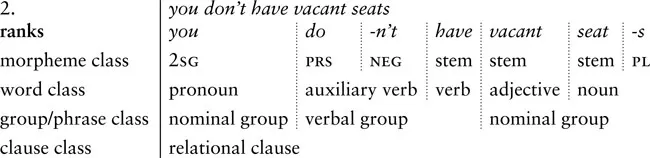
For a given grammatical unit, syntagmatic relations of this kind are often represented as an image in a phrase structure tree—popularized in the formal syntax inspired by Chomsky’s postgraduate research 1955–1956, 1957.2 Phrase structure trees are typically binary branching, drawing on what American structuralists referred to as “immediate constituent (IC) analysis” (cf. Wells 1947). Various abbreviations, regularly drawing on Harris (1946), are used in these visualizations for the names of classes.
In SFL, recognizing classes is just one step as far as grammatical description is concerned. We also need to understand what each class is doing in any instance—i.e. we need to determine the function of each class. One reason for this is that the same function can be performed by more than one class and the same class can perform more than one function.3 A verb for example can be used as the Event function in a verbal group:
(verb as Event)
3. So you always overbook
or it can be used as a Classifier function in a nominal group:
(verb as Classifier)
4. the overbooking policy
Similarly, a Classifier can also be realized by a noun or an adjective.
(noun as Classifier)
5. a plane booking (noun as Classifier)
(adjective as Classifier)
6. a standard booking
When functioning as Classifiers, potentially gradable classes (e.g. adjectives and verbs) cannot be graded because they are making categorical distinctions. The overbooking policy is here a type of policy, and similarly the standard booking here is opposed to a non-standard booking (rather than being relatively more or less standard);
- 7. *the heavily overbooking policy
- 8. *a rather standard policy4
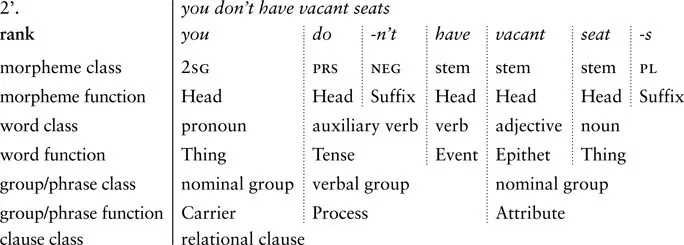
We can accordingly expand 2 as 2’, including an analysis of alternating syntagms (configurations of classes) and structures (configurations of functions). By convention in SFL, class labels are written in lower case and function labels being with an initial upper case letter (with the exception of the morpheme classes where we have followed the standard non-SFL Leipzig glossing conventions for capitalization):
An analysis of this kind can be alternatively presented as a tree, with nodes labeled for function and class (i.e. for both what they do and for what they are; see Figure 1.1).
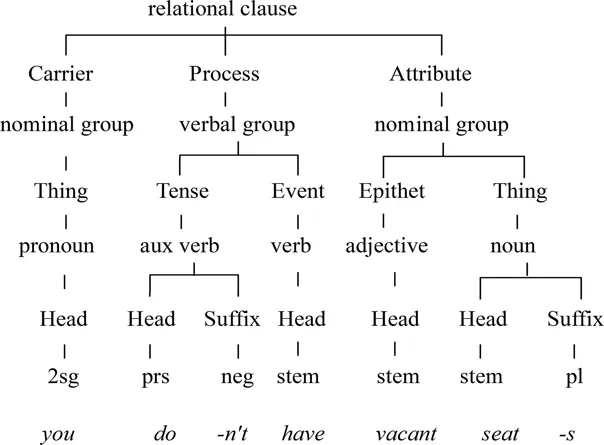
Figure 1.1 Syntagms and Structures (Visualization) for Example (2)
The distinction between class and function is of course a familiar one in linguistics, although many theories make little or no use of function labels in grammatical analysis per se. In SFL this distinction between syntagms (as sequences of classes) and structures (as configurations of functions) is crucial because it is relations among structures that are the focus of the theory.5 This enables SFL to produce richer grammatical descriptions than if it focused on syntagms alone. In our focus text, for example, the lawyer Taylor is introduced as representing his client Edmonds, which means that he was acting on Edmond’s behalf in a legal disputation. The clause syntagm in (9) is the same as that in (2)—nominal group followed by verbal group followed by nominal group;
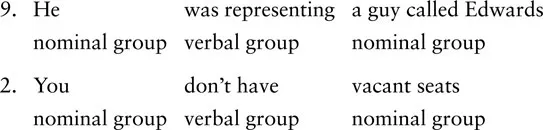
Despite the similarity in the syntagm, these sequences of classes realize different structures. We can see this from the fact that they enter into distinctive relationships with other clauses that distinguish one structure from the other. For example, (9) alternates with passive clauses, but (2) does not.
- 10. Edmonds was being represented by Taylor.
- 11. *Vacant seats weren’t had by the airlines.
And for activity concurrent with the moment of speaking (9) uses [present in present] tense, whereas (2) uses [present].
- 12. He is representing Edmonds.
- 13. *You aren’t having vacant seats.
Had [present] tense been deployed in (2) it would have shifted the temporality from concurrence with the moment of speaking to habitual behavior, as in (14).
- 14. Taylor represents Edmonds (whenever he needs legal aid).
Note that we are focusing on relations between clauses here, not relations among verbs. The verb represent can be used in clauses which pattern like (2) as far as tense is concerned—but when it does, as in (15), the structure does not construe forensic activity but rather a representational relationship between an entity and its symbolization.
- 15. The logo represents British Airways.
Unlike (2) this clause does have a passive.
- 16. British Airways is represented by that logo.
But unlike (10), it doesn’t have an ‘agentless’ one; both nominal groups have to be present.
- 17. Edwards is being represented (by Taylor).
- 18. British Airways is represented * (by that logo).
We will not pursue further this discussion of the different structures that can be realized through a nominal group followed by verbal group followed by nominal group syntagm (for one comprehensive SFL description of these in English see Halliday 1985 and subsequent editions). Rather, what we are foregrounding here is the way in which SFL reasons about relationships among structures rather than focusing simply on classes and their sequence (i.e. syntagms). In doing so, SFL draws on Gleason’s (1965) notions of agnation and enation and Whorf’s (1945) discussion of overt and covert categories (his phenotypes and cryptotypes respectively), explored in detail in Quiroz (this volume). The distinction between 1, 2, 15 and 16 on the one hand and 3, 9, 10, 12, 14 and 17 on the other for example is a distinction between relational vs. material clauses (Halliday 1985)—in Whorf’s terms a cryptogrammatical distinction. Cryptogrammars are based on what Whorf called reactances—the distinctive syntagms that emerge or not as agnate units are explored (such as those involving the alternations of tense and voice touched on earlier).
1.1 Cryptogrammatical Reasoning
Cryptogrammatical reasoning of this kind is the basis for the development of systems in SFL (such as the simplified network of clause types in Figure 1.2). Each type of clause has distinguishing agnation patterns that motivate the distinctions (just some of which we noted earlier). As far as structure is concerned, distinctive configurations of functions are typically proposed for more general systems. Halliday 1985 suggests Actor, Process and Goal for material clauses (e.g. He [Actor] was representing [Process] a guy called Edwards [Goal]), Senser, Process and Phenomenon for mental clauses (e.g. Edmonds [Senser] liked [Process] that sunshine [Phenomenon]) and Token, Process and Value for relational clauses (the logo [Token] represents [Process] British Airways [Value]). For further discussion of axial reasoning in relation to networks of this kind see Quiroz (this volume).
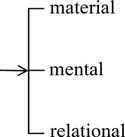
Figure 1.2 Simplified Network of Clause Types (English TRANSITIVITY)
At this point we can return to the rank scale outlined previously and reconsider it from a paradigmatic perspective (i.e. from the perspective of system). What ranks actually represent are generalized points of origin for system networks. That is, they are bundles of relations among structures realized as clauses, among structures realized as groups and phrases, among structures realized as words and among structures realized as morphemes.
For example, the nominal groups realizing the participant functions Actor, Goal, Senser Phenomenon, Token and Value in material, mental and relational clauses can be generalized in simplified terms as [designating] or [specifying]; if [designating], as [naming] involving a name, or [pronaming] involving a pronoun; and if [specifying], as optionally [classified], by inserting a Classifier, and/or [...
Table of contents
- Cover
- Half Title
- Series Page
- Title
- Copyright
- Contents
- List of Illustrations
- List of Contributors
- 1 Describing Languages, Understanding Language: Systemic Functional Theory and Description
- PART I Understanding Grammar
- PART II Contextualizing Grammar
- Index
Trusted by 375,005 students
Access to over 1.5 million titles for a fair monthly price.
Study more efficiently using our study tools.
Frequently asked questions
Yes, you can cancel anytime from the Subscription tab in your account settings on the Perlego website. Your subscription will stay active until the end of your current billing period. Learn how to cancel your subscription
No, books cannot be downloaded as external files, such as PDFs, for use outside of Perlego. However, you can download books within the Perlego app for offline reading on mobile or tablet. Learn how to download books offline
Perlego offers two plans: Essential and Complete
- Essential is ideal for learners and professionals who enjoy exploring a wide range of subjects. Access the Essential Library with 800,000+ trusted titles and best-sellers across business, personal growth, and the humanities. Includes unlimited reading time and Standard Read Aloud voice.
- Complete: Perfect for advanced learners and researchers needing full, unrestricted access. Unlock 1.5M+ books across hundreds of subjects, including academic and specialized titles. The Complete Plan also includes advanced features like Premium Read Aloud and Research Assistant.
We are an online textbook subscription service, where you can get access to an entire online library for less than the price of a single book per month. With over 1.5 million books across 990+ topics, we’ve got you covered! Learn about our mission
Look out for the read-aloud symbol on your next book to see if you can listen to it. The read-aloud tool reads text aloud for you, highlighting the text as it is being read. You can pause it, speed it up and slow it down. Learn more about Read Aloud
Yes! You can use the Perlego app on both iOS and Android devices to read anytime, anywhere — even offline. Perfect for commutes or when you’re on the go.
Please note we cannot support devices running on iOS 13 and Android 7 or earlier. Learn more about using the app
Please note we cannot support devices running on iOS 13 and Android 7 or earlier. Learn more about using the app
Yes, you can access Systemic Functional Language Description by J.R. Martin, Y.J. Doran, Giacomo Figueredo, J.R. Martin,Y.J. Doran,Giacomo Figueredo in PDF and/or ePUB format, as well as other popular books in Languages & Linguistics & Linguistics. We have over 1.5 million books available in our catalogue for you to explore.