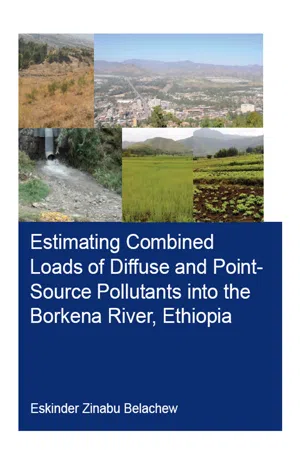
This book is an initial attempt to estimate the loads of heavy metal and nutrient loads into an industrial effluent receiving rivers of a typical industrializing catchment. It shows the effects and impacts of diffuse and point sources of these loads into the rivers, and illuminate management, capacity and policy gaps of riverine water and sediment monitoring in the sub-Saharan countries perspective from Ethiopia. The study was done in semi-arid catchments of Kombolcha city with industrialising urban and peri-urban areas in north-central Ethiopia. The Leyole and Worka rivers, which receives industrial effluent and wash-off from the catchments' areas, were monitored for two years. This book contribute to our understanding on applicable methods to quantify loads of diffuse and point sources in data poor areas, and the most important contribution is to address the gaps in in controlling emission changes and. The results of this book contribute to the theory of river protection and understanding of water quality management of sub-Saharan African tropical rivers and sediments and provides policy options for improvement in rivers water quality of the sub-Saharan countries. In bridging this gap, this book proposed a model to estimate the total loads of nitrogen and phosphorus from a catchment.
eBook - ePub
Estimating Combined Loads of Diffuse and Point-Source Pollutants Into the Borkena River, Ethiopia
- 152 pages
- English
- ePUB (mobile friendly)
- Available on iOS & Android
eBook - ePub
Estimating Combined Loads of Diffuse and Point-Source Pollutants Into the Borkena River, Ethiopia
About this book
Trusted by 375,005 students
Access to over 1.5 million titles for a fair monthly price.
Study more efficiently using our study tools.
Information
Subtopic
InfrastructureIndex
BusinessChapter 1
1.1 General introduction
In many developing countries, water pollution is an ongoing and acute challenge for sustainable development. The transport of pollutants into surface waters has mainly increased because of anthropogenic factors (Hove et al., 2013; Alcamo et al., 2012; Crutzen and Steffen, 2003). As African countries gained political independence in the 1960s, they turned their attention to economic development mainly through industrial production and agricultural intensification (Steel and Evans, 1984). While many of these countries are committed to the 2030 Agenda for Sustainable Development and the Africa Union’s Agenda 2063 (African Union, 2018), pressures to attract investors for industrialization and modern agriculturalization may reduce regard to progress with these Agendas (Xu et al., 2014; Sikder et al., 2013; Bertinelli et al., 2012). This Thesis focused on investigating the transfer of two groups of pollutants: heavy metals and nutrients in the rivers of a typical industrializing catchment of a sub-Saharan African city.
The term “heavy metals” refers to those metal and metalloid elements with relatively high densities (>5,000 kg/m3). They are associated with eco-toxicity due to their non-degradable nature and accumulation in waters, sediments, and biota through the food chain (Goher et al., 2014; Xu et al., 2014). However, the term “heavy metal” is not always accepted; instead, some researchers recommend to just use the term “metal” (Duffus, 2002), (as used in the published paper of Chapter 2). This study focused on four heavy metals that include chromium, Cr (7,150 kg/m3), copper, Cu (8,960 kg/m3), zinc, Zn (7.134 kg/m3) and lead, Pb (11,300 kg/m3).
Nutrients includes the sum total of nitrogen (N) and phosphorus (P) that may be available in various forms. Total nitrogen may comprise nitrate (NO3−), nitrite (NO2−), ammonium (NH3 + NH4+), and organic nitrogen (Kjeldahl-N). (N.B. charges will be left out in the various texts). Nitrite is generally unstable in surface water and contributes little to the total nitrogen. The main components of total phosphorus are soluble reactive phosphorus or orthophosphate (PO43− + HPO42− + H2PO4− + H3PO4) and particulate phosphorus (PP). Dissolved phosphates are the most common forms of phosphorus found in in rivers where there are not large sediment loads. Phosphates are rather immobile in surface waters because of their strong attachments to soil particles. They can have a significant impact, however, because eroded soils can transport considerable amounts of attached phosphorus to surface waters. Too much N and P causes eutrophication and pollutes surface waters, with far-reaching impacts on public health, the environment and the economy (Delkash et al., 2018; EPA, 2017)
High releases of heavy metals and nutrients are a global challenge for surface water pollution (EPA, 2017; Landner and Reuther, 2004). The problems are increasing in sub-Saharan countries, arising from anthropogenic activities like industrial activity and intensive agriculture; while monitoring and reporting on pollutant emissions are often absent, insufficiently reported, or of uncertain quality (Moges et al., 2016; Duncan, 2014; Mustapha and Aris, 2012). In Ethiopia, agriculture is the leading sector in the economy accounting for 43% of the country’s gross domestic product. Increased food production through intensive agriculture is the primary goal of Ethiopian government policy (Awulachew et al., 2010). Also, government policy promotes a drive for industrialization, which stimulates growth of industries in specific zones throughout the country. Information on heavy metals and nutrients loads in rivers is often scant and their associated pollution risk unknown (Hove et al., 2013; Alcamo et al., 2012). The implication of the environmental policies is unclear and environmental institutions at regional and local levels are yet to be evaluated with respect to their roles for sustainable development (Sikder et al., 2013;Alcamo et al., 2012). With the fast industrialization and agricultural intensification and no understanding on effectiveness of regulatory structures and water quality monitoring, these problems will likely risk efforts towards environmental management and sustainable development.
1.2 Source and transfer of heavy metal and nutrient loads into surface waters
Heavy metal and nutrient loads can be released from diffuse (non-point) sources and point sources and transferred into surface waters (Novotny and Chesters, 1981). Quantifying the transfer and loads of these pollutants from their sources, and understanding the related managements are important, if environmental risks and hazards to receiving surface waters are to be addressed (Rudi et al., 2012). Characteristics of the receiving surface waters, like dilution capacity, pH and hardness of the receiving surface waters, influence the effects of the heavy metals and nutrients in the waters and are equally necessary to understand the associated risks (Pourkhabbaz et al., 2011; Ipeaiyeda and Onianwa, 2009; Besser et al., 2001).
In peri-urban environments, point sources usually comprise industrial effluent emissions and sewage treatment outflows. Depending on the raw materials and chemicals used in production processes, industrial effluents can contain, next to e.g. organic micro pollutants, heavy metals and nutrients. Ammonia, nitrate and phosphate are released by textile industries (Ghoreishi and Haghighi, 2003), while chromium, ammonia and organic nitrogen are released in tannery wastewater (Satyawali and Balakrishnan, 2008; Akan et al., 2007; Whitehead et al., 1997). Steel processing industries release effluents that are rich in metals (Rungnapa et al., 2010). The influence of these effluents to affect water quality depends on the extent of industrial activity and the level and the efficiency of pre-discharge treatment processes (Ometo et al., 2000). Although industrial pollutants entering to waters have been investigated worldwide (Landner and Reuther, 2004; Nriagu and Pacyna, 1988), they have yet to be assessed in many sub-Saharan countries (Oyewo and Don-Pedro, 2009). In these regions, in addition to the presence of relatively traditional and small-scale textiles and tanneries factories, there is a tendency to import cheaper technologies to cope with environmental requirements under increasing pressure of economical returns, often with treatment facilities that have low efficiency in reducing pollutants discharges to the waters (Rudi et al., 2012; Jining and Yi, 2009). This trend, which is realistically a “pollute now; clean-up later” action, may temporarily promote economic gains, but jeopardize the efforts to sustainable industrial development (Sikder et al., 2013; Alcamo et al., 2012; Rudi et al., 2012).
The diffuse sources of heavy metals and nutrients may comprise manures and commercial fertilizers in agricultural lands, weathering of rocks, and atmospheric deposition. The loads for these sources are transferred primarily during high rainfall events and enter into catchment streams with surface runoffs (Gil and Kim, 2012; Wang et al., 2006; Chiew and McMahon, 1999). The distribution of these pollutants into surface waters is affected by natural factors like precipitation, catchment surface characteristics (for e.g. topography and soil characteristics) and anthropogenic factors such as urbanization and land uses. The spatial variation of these factors affects their relationship with the hydrological chemistry of the streams in catchments (Johnson et al., 1997). The anthropogenic factors usually have greater impact on polluting surface water compared with natural processes (Hoos, 2008). However, both factors covary together, and hence, their combined effect has to be considered to understand the transfer of diffuse pollutants (Allan, 2004).
Land use intensification is a major anthropogenic factor that increases pollutants, especially nutrients, transfers into catchment streams (Gashaw et al., 2014; Griffith, 2002). The loading rate from each land use generally varies throughout the landscape depending on local factors such as precipitation, source activities, and soils (McFarland and Hauck, 2001; Johnson et al., 1997). Catchment-based water quality models mainly use such factors to estimate loads for management of water quality in catchments (Álvarez-Romero et al., 2014; Wang et al., 2013). In sub-Saharan countries, information on these factors are usually unavailable, even for the smaller catchments. While there can be temptation to invest in quite complex modelling, this does not necessarily result in a more accurate understanding of the underlying processes on which such models are based. The models can also be costly and subject to large errors in predictions from deficiencies in the data (Ongley and Booty, 1999). Therefore, starting with a basic model, for e.g. a generalized export coefficient of land uses (Soranno et al., 2015; Shrestha et al., 2008; Ierodiaconou et al., 2005), and gradually employing more detailed and comprehensive models, is a sensible approach.
With the presence of multiple point and diffuse sources into the pathway of surface waters, it is important to understand their loads and contribution, both as individual and combined sources. Many studies have examined industrial pollutants only from the perspective of the industry (Fuchs, 2002; Vink and Behrendt, 2002). In sub-Saharan countries, the attempt is customarily on reduction of point sources, neglecting other sources along pathways. However, the impact from a variety of sources can be significant and it is important to consider both the point and diffuse sources. Incorporating these sources is vital to include effects from the interaction among the complex system of water and landscapes and understand water flows through linked subcatchments in uplands and downstream lands that are far from the upstream lands. In this regard, catchment wide measurement of heavy metals and nutrients transfer into rivers is important to include sources and achieve a wider environmental benefit far beyond the obvious on-site and downstream impacts. With growing awareness of integrated catchment-scale natural resources in many African countries, (Darghouth et al., 2008), this has additional contribution to the advancement of global environment benefit.
1.3 The Borkena river basin and Kombolcha sub-basin in Ethiopia
1.3.1 Location, landforms, climate and land use
The study area of this research is located in the NE of Amhara Region, Ethiopia, between 11°4′59.74″N and 11° 4′44.14″N latitude, and 39°43′57.48″E and 39°39′31.26″E longitude (Figure 1.1.a, b). The Borkena river basin starts from the uplands of south Wollo Zone of the Amhara Regions and extends 300 km to the low lands of the Afar Region, draining an estimated area of 1735 km2 (Figure 1.1.b). The basin comprises three hydrological sub-basins: upper (Dessie), middle (Kombolcha) and lower (Cheffa) sub-basins (Figure 1.1.c), and their main surface water drainage is controlled by the Borkena grabens that forms a regional linear drainage pattern. The Borkena River is the tributary of the Awash River, the largest river of Eastern Ethiopia (Figure 1.1.c.). The study area of this Thesis lies within 40 km2 of the Kombolcha sub-basin including industrialized urban and peri-urban areas (Figure 1.1.c). The area is considered an ideal location for economic activities because of its intermediate location for domestic markets exports via the Djibouti port, which has been the only functional port to the land-locked Ethiopia (Figure 1.1.a).
The landform of the study area includes rolling and undulating hills, with high plateaus to the west, the Borkena graben in the centre and the southward sloping ground to the Borkena River (Figure 1.2.a). The elevation of the lands ranges from 1,750 m a.s.l. in the alluvial plain up to greater than 2,000 m a.s.l. in the uplands (Figure 1.2.b). Large parts of the built-up areas of the Kombolcha city have from 2.6 % to 10 % slope, and in the hilly areas, the slope increased to more than 20%. The local soils comprise alluvial/lacustrine deposits covering a large part of the town, with Fluvisols at the banks of the tributaries of Borkena, Colluvial screed deposits found mostly at the foot of hilly areas of the town and where Cambisols are developed, and Vertisol on the top of the Alluvial or Colluvial deposits, and covering most parts of the catchment areas (Zinabu, 2011). Several industrial effluents are discharged into the rivers of the Kombolcha catchment, eventually flowing into the Borkena River (Figure 1.2.a, b). The Leyole River receives effluents from industries including the steel processing factory, textile, tannery and meat processing factory (Plate 1.1.b.), while a brewery discharges its effluent into the Worka River. The Kombolcha basin has a semi-arid climate. According to the Kombolcha Meteorological Branch Directorate report in 2013, the average annual rainfall is 1,030 mm, and the mean annual monthly temperature ranges from 24°C in January to 28°C in August. Kombolcha has two wet seasons, with the early wet season from February to April, and later in the summer from July to September. The rains in the early wet season have been very low in recent years because of recurrent droughts with high annual potential evapotranspiration, reaching up to 3,050 mm/year in 2014. (Kombolcha Meteorological Branch Directorate, 2015). The rainfall in the wet season of June to September has been remained relatively heavy and extensive (with a monthly average 710 mm) compared with the early wet season (having an average rainfall of 130 mm) (Kombolcha Meteorological Branch Directorate, 2015).

Figure 1.1. The map of the study area that is located in the horn of Africa, north-central Ethiopia (a), in the Amhara State (b), within the Kombolcha city administration, which is found in the Kombolcha sub-basin of the Borkena River basin (c)

Figure 1.2. The location of the study area within the industrializing Kombolcha city administration including main rivers the Borkena River and its tributaries and factories discharging effluents into the Leyole and Work rivers (a), and surface land elevation of the Leyole and Worka rivers catchments in the Kombolcha sub-basin (b)
1.4 Problem statement and research framework
Based on the 2007 national census of the Central Statistical Agency of Ethiopia, Kombolcha district has a total population of 85,000. Industrial activities are notably one of the main economic forces in the urban, and agriculture is the main livelihood of the peri-urban and rural areas. Plantation forest and grazed land is common in the uplands of the catchments. Barren land is, however, evident in these uplands of catchments largely because of overgrazing and deforestation on the hillsides of the lands (Plate 1.1.c.) (Zinabu, 2011). The land use in the peri-urban area comprises crop and grazing lands, with moderate irrigation both up and downstream of the industrial areas (Plate 1.1.d.). The lower part (south-central) of the Kombolcha catchments consists of residential and industrial areas. Being topographically varied, both the rural upland landscape and lowland urban areas are prone to erosion (Plate 1.1.c). Diffuse loads are transported from these catchment areas into the Leyole and Worka rivers rising from the surrounding escarpments and draining eventually into Borkena River (Figure 1.2.a.). The hydrological flows of these rivers are modified by up-downstream agricultural irrigation and discharges of industrial effluents along the riv...
Table of contents
- Cover
- Half Title
- Title Page
- Copyright Page
- Table of Contents
- Summary
- Chapter 1: General introduction
- Chapter 2: Impacts and policy implications of heavy metals effluent discharges into rivers within industrial Zones: A sub-Saharan perspective from Ethiopia
- Chapter 3: Preventing sustainable development: policy and capacity gaps for monitoring heavy metals in riverine water and sediments within an industrialising catchment in Ethiopia
- Chapter 4: Evaluating the effect of diffuse and point source nutrient transfers on water quality in the Kombolcha River Basin, an industrializing Ethiopian catchment
- Chapter 5: Estimating total nitrogen and phosphorus losses in a data-poor Ethiopian catchment
- Chapter 6: Synthesis and conclusions
- References
- Samenvatting
- About the author
Frequently asked questions
Yes, you can cancel anytime from the Subscription tab in your account settings on the Perlego website. Your subscription will stay active until the end of your current billing period. Learn how to cancel your subscription
No, books cannot be downloaded as external files, such as PDFs, for use outside of Perlego. However, you can download books within the Perlego app for offline reading on mobile or tablet. Learn how to download books offline
Perlego offers two plans: Essential and Complete
- Essential is ideal for learners and professionals who enjoy exploring a wide range of subjects. Access the Essential Library with 800,000+ trusted titles and best-sellers across business, personal growth, and the humanities. Includes unlimited reading time and Standard Read Aloud voice.
- Complete: Perfect for advanced learners and researchers needing full, unrestricted access. Unlock 1.5M+ books across hundreds of subjects, including academic and specialized titles. The Complete Plan also includes advanced features like Premium Read Aloud and Research Assistant.
We are an online textbook subscription service, where you can get access to an entire online library for less than the price of a single book per month. With over 1.5 million books across 990+ topics, we’ve got you covered! Learn about our mission
Look out for the read-aloud symbol on your next book to see if you can listen to it. The read-aloud tool reads text aloud for you, highlighting the text as it is being read. You can pause it, speed it up and slow it down. Learn more about Read Aloud
Yes! You can use the Perlego app on both iOS and Android devices to read anytime, anywhere — even offline. Perfect for commutes or when you’re on the go.
Please note we cannot support devices running on iOS 13 and Android 7 or earlier. Learn more about using the app
Please note we cannot support devices running on iOS 13 and Android 7 or earlier. Learn more about using the app
Yes, you can access Estimating Combined Loads of Diffuse and Point-Source Pollutants Into the Borkena River, Ethiopia by Eskinder Belachew,Eskinder Zinabu Belachew in PDF and/or ePUB format, as well as other popular books in Business & Infrastructure. We have over 1.5 million books available in our catalogue for you to explore.