This book examines the architectural design of housing projects in Ireland from the mid-twentieth century. This period represented a high point in the construction of the Welfare State project where the idea that architecture could and should shape and define community and social life was not yet considered problematic. Exploring a period when Ireland embraced the free market and the end of economic protectionism, the book is a series of case studies supported by critical narratives. Little known but of high quality, the schemes presented in this volume are by architects whose designs helped determine future architectural thinking in Ireland and elsewhere. Aimed at academics, students and researchers, the book is accompanied by new drawings and over 100 full colour images, with the example studies demonstrating rich architectural responses to a shifting landscape.
eBook - ePub
Irish Housing Design 1950 – 1980
Out of the Ordinary
- 244 pages
- English
- ePUB (mobile friendly)
- Available on iOS & Android
eBook - ePub
Irish Housing Design 1950 – 1980
Out of the Ordinary
About this book
Information
1 Housing indigenous industry
Bord na Móna settlements in the 1950s
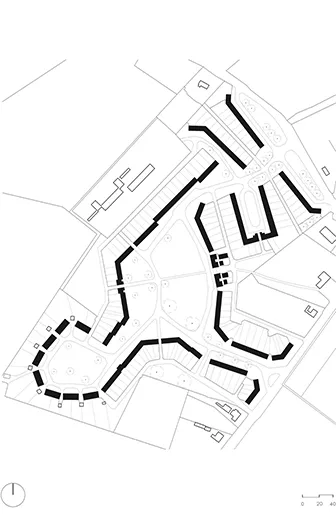
Drawing 1.1 Coill Dubh, Bord na Móna Housing – site plan
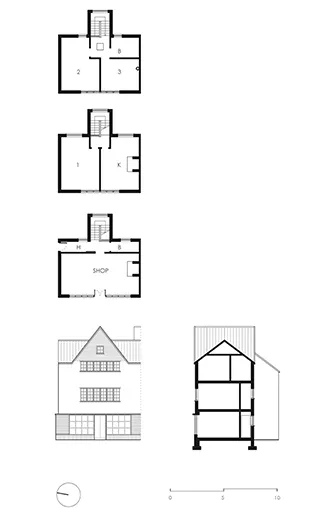
Drawing 1.2 Coill Dubh, Bord na Móna Housing – residential shop unit plans, section and elevation
Introduction
In the 1950s, architect and town planner, Frank Gibney (1905–1978) designed and built almost 600 houses for workers of Bord na Móna, the semi-State company responsible for the development and management of Ireland’s peat bogs.1 With the exception of Coill Dubh, which created an entirely new community, the schemes – ranging from eight houses at Billivor, County Meath, to 156 at Coill Dubh, County Kildare – were realised as self-contained ‘villages’ appended to the edge of existing settlements. Gibney’s legacy to the Irish midlands is a collection of unique settlements expressing a forthright but romantic vision of a rural utopia: rhythmic terraces of houses with accentuated architectural features arranged around ‘village greens’, with carefully aligned vistas to the pastoral delights beyond. Eschewing the traditional linear street patterns typical of Irish villages and towns, the settlements sit somewhere between the philosophy of Ebenezer Howard’s Garden City movement, the vernacular stylism of C. F. A. Voysey, the social endeavours of Otto Neurath and a fundamental desire to improve the lot of the Irish rural worker.
The Bord na Móna housing represented a pastoral vision for occupants who otherwise worked a mechanised, denatured landscape of regular drainage ditches and the scraping and drying of peat. This landscape in turn proceeds from a political aspiration – borne from and made manifest in a trade war with Great Britain in the 1930s – to make Ireland approach self-sufficiency by, amongst other things, harnessing its bogs as the means of supplying its own heat and power. Depopulation of rural Ireland began in the nineteenth century with the economic and political demise of large estate landowners, accelerated by the famines of the 1840s. This, coupled with the international phenomenon of increased mechanisation in agricultural activities, led to the reduction of numbers employed in rural enterprise while improved transportation facilitated migration within Ireland and beyond. The establishment of the new Irish State in 1921 failed to halt these patterns and rural depopulation continued destabilising communities and fragmenting national identity. This national dilemma resonated particularly strongly with the Fianna Faíl party which came to power in 1932 and immediately embarked upon the Anglo-Irish Trade War (1932–1938). Its leader, Éamon de Valera, viewed Irish identity through the lens of ruralism – Ireland’s urban centres spoke too clearly of the colonial past and the legacy of foreign rule. The countryside of Ireland, on the other hand, seemed to epitomise a true national identity.
As well as following the geology of Ireland’s peat bogs then, Gibney’s Bord na Móna housing also occupied an ideological, nationalist landscape designed in part to halt the processes of rural depopulation by fostering indigenous rural industry. This context underpins not only Gibney’s personal aspiration for an ‘Irish picturesque’ architectural style in each of the villages but also his ambitious town planning schemes. Proposing the decentralising of urban settlement on the island, his Framework for a National Plan, published by the Educational Company of Ireland in 1943, essentially attempted to establish a postcolonial spatial strategy (Rowley 2016: 20–21; MacCabe 2018: 38–41). Gibney was a prolific practitioner. He produced many ambitious, and often unrealistic, town planning schemes ranging from an entirely new civic proposal for Waterford City (1941) to more modest-sized but equally flamboyant schemes, for example, Tullamore (1945), Killarney (1948) and Castlebar (1950). The Bord na Móna settlements may channel the paternalism of philanthropic housing and the idealism of the Garden City, but the ordered landscape of village greens, pitched roofs, axes, arches and brick quoins found at the villages also represent the most tangible embodiment and legacy of Gibney’s strategic national visions.
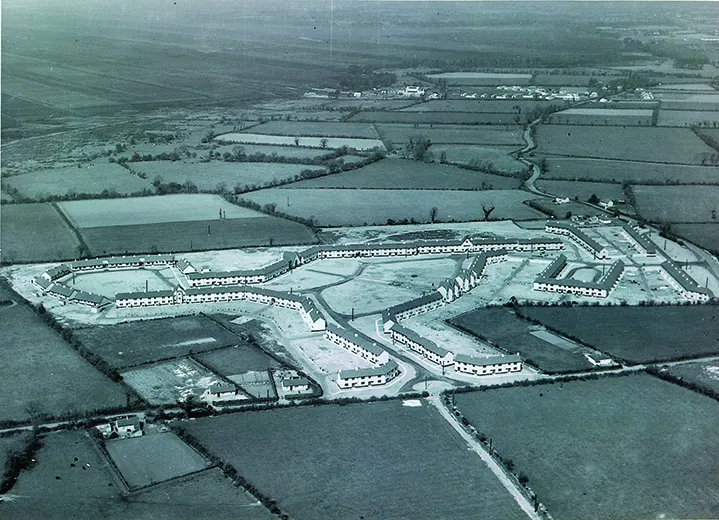
Figure 1.1 Aerial view of Coill Dubh estate during construction (image from the Bord na Móna archives)
An indigenous industry
The issue of rural depopulation – as something of an affront to a particular vision of the new country – was returned to frequently in the decades following independence. In 1948, for example, the Minister for Social Welfare appointed a Commission ‘to investigate the causes and consequences of the present level and trend in population’ (Newman 1958: 388). Ten years later, much of its findings were criticised by Jeremiah Newman who, in response to the apparent inadequacies of the report, proposed the need for the consolidation of rural towns. Only the creation of a population density would sustain the industry and services necessary to retain and nourish rural inhabitants (1958: 398–399). At the end of his paper, Newman quoted a Minority Report by a Professor Dennison of the Scott Committee in Britain (1942):
I see no reason why the benefit of economic progress should not be extended to the countryside. Indeed it is by the introduction of some industrial development that there is most hope of the improvement of the social and economic conditions in the countryside, in the future as in the past … Our duty is to foster [the] ‘well-being’ of rural communities, and not to ‘preserve’ them. Indeed, in our view they can be ‘preserved’ only by being ‘developed’.
(1958: 399)
Ireland has few natural resources that can be harnessed for industry, particularly the type of industry that drove other world economies in the first half of the twentieth century. Between 1921 and 1931, the first ten years of the new country’s existence, apart from the famous Shannon hydro-electric scheme at Ardnacrusha and the development of a fledgling sugar-beet industry, little in the way of rural industrial or infrastructural development was achieved (O’Halpin 2003: 115). The potential of peat had sustained a long-standing fascination amongst pre-independence private enterprise and the British military (Boyd 2011). This laid the groundwork for a resurgence of interest in Ireland’s bogs which, focussed by the Anglo-Irish trade war, precipitated the identification of their development as a possible saviour for the floundering agricultural industry (providing fertiliser for soil) but also, and more acutely, as a way of reducing reliance on imported fuel supplies. The Turf Development Board (from 1946, Bord na Móna) was established by the Irish Government in 1934 as a limited company under the Companies Act and financed by the exchequer. C. S. (Todd) Andrews, a loyal Fianna Faíl supporter, appointed to manage the company by Seán Lemass (Minister at the Department of Industry and Commerce) was instrumental in its formation as a semi-State body rather than as an off-shoot of the civil service: ‘we had almost complete freedom of action to tackle the development of the bogs as [we] thought best, and this freedom was fully availed of’ (Andrews 1982: 131). If Andrews’ task was to maximise the industrial output and economic value of Ireland’s bogs, the enthusiasm with which he accepted the job was moderated only by his lack of knowledge about them:
What I did know was that the word ‘bog’, or any phrase containing it, had become the symbol of poverty and backwardness … But there was another view of the significance of the bogs in the economic geography of Ireland … a valuable source of wealth if they could be properly utilised.
(1982: 399)
In an effort to ‘tap’ this resource Turf Development Board works were established in various parts of the country, with a heavy concentration around the midlands where there was extensive raised bogland. In these formative years, employment on the bogs was for the most part seasonal and workers were accommodated in specially built hostels or huts (often referred to in militaristic terms, as ‘billets’) with a number of individual houses built for managerial and supervisory staff who had few options to rent or purchase houses in isolated rural areas. The ad hoc nature of the environment created in this way was brought into relief when in 1935, a select group of Turf Development Board representatives including Andrews made the first of several trips to Germany and the Soviet Union to visit comparative peat industries. While the trips were important in terms of the development of production expertise, Andrews was also struck by the quality of the built environment he encountered in Germany:
As we travelled from plant to plant over flat countryside we passed through many villages and small towns and I was greatly attracted by their tidiness and order … which, at that time, impressed on me a sense of order and care for the environment which we so lacked at home. It was a lesson I never forgot. I made up my mind then, that if ever I had the opportunity, I would recognise as a priority the value of maintaining a decent environment for people at work.
(1982: 143)
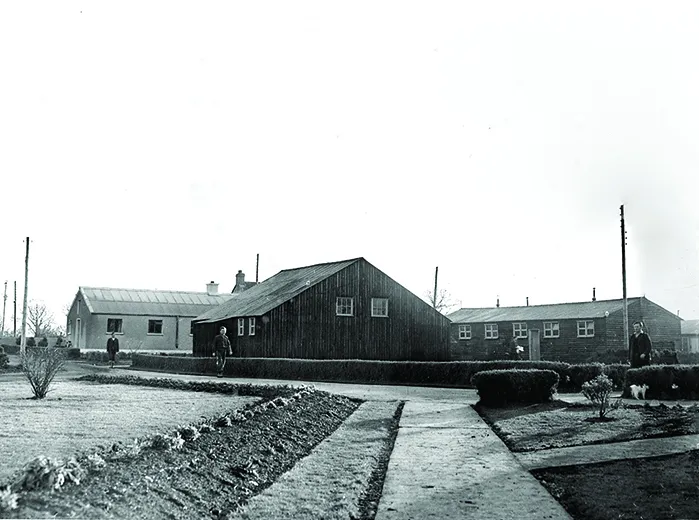
Figure 1.2 Camp Ballydermot, Killinthomas (image from the Bord na Móna archives)
By 1948, a development programme was well established and new bogs had been identified to increase turf harvesting and production. With increased mechanisation the need for seasonal workers diminished and the company foresaw the benefit of a smaller but more stable labour force to maintain the productivity of the bog all year round. The existing male-only hostel accommodation was not conducive to the establishment of such a workforce – those who worked on the bogs were isolated from their families, the work was hard and the wages were poor. Through the provision of permanent good quality housing that would promote family life, it was hoped that the social problems associated with the billets could be overcome. Initial approaches to local authorities to provide such housing did not bear fruit and so Bord na Móna embarked on its own ambitious programme, authorised by the Turf Development Act (1950) and funded by the national exchequer.
According to Andrews, ‘[they] were determined from the start that the houses would be models for rural living’ (1982: 203). In light of this ambition, Gibney was an obvious choice – his profile as a visionary town planner was widely recognised. Although he had no formal training as an architect, as a young man he had been awarded a scholarship in building trades and in 1928 became apprenticed to Francis P. Russell (1883–1967), taking over his practice in 1930. He was never a member of the Royal Institute of Architects of Ireland but was associated with the now defunct Institute of Registered Architects and was also a member of the Irish Town Planning Institute. In 1945, he had submitted a copy of his hand-drawn atlas of Ireland – a monumental undertaking containing both factual information and a personal analysis of Ireland’s geographical and economic conditions – to Taoiseach Éamon de Valera. He also frequently took part in public debate on planning and architectural matters. In retrospect, many of Gibney’s contributions seem germane to the Bord na Móna housing he subsequently built: in 1937, he published an article in the Irish Builder and Engineer calling for ‘A Council for the Preservation of Rural Ireland’ (1937: 1097); in 1943, he proposed the establishment of a Trust to oversee the development of ‘Virgin Villages’ to be built and occupied by slum dwellers (MacCabe 2018: 45).
In June 1949, Gibney was appointed by Bord na Móna as consultant architect and town planner and, in 1950, he submitted proposals to the Department for nine village housing schemes (Clarke 2010: 114). The sites for these settlements were identified on the basis that they fulfilled certain criteria: they were within a maximum of three miles of a bog railhead; they were proximate to an existing village (for access to shops and community amenities); and the land was ...
Table of contents
- Cover
- Half Title
- Title Page
- Copyright Page
- Table of Contents
- List of figures
- List of drawings
- Editor biographies
- Contributor biographies
- Acknowledgements
- Introduction: Irish housing design at the crossroads
- 1. Housing indigenous industry: Bord na Móna settlements in the 1950s
- 2. ‘As easy as plugging in a fire: modernity, morality and the Mespil apartments 1958–1972
- 3. The high life: Ardoyne house 1962–1967
- 4. The sharp edge of newness: situating the Simmonscourt Apartments 1964–1966
- 5. Shared vision, shared courtyards: Dundanion Court, Cork 1964–1968
- 6. An architecture of connections: the Ballybrack Cooperative 1969–1972
- 7. Castlepark: a vernacular architecture for modern Ireland 1969–1972
- 8. The Coombe North: roads, activism and an architecture for Dublin’s Liberties 1968–1978
- 9. The expression of method: six houses at Herbert Road 1976–1979
- Index
Trusted by 375,005 students
Access to over 1.5 million titles for a fair monthly price.
Study more efficiently using our study tools.
Frequently asked questions
Yes, you can cancel anytime from the Subscription tab in your account settings on the Perlego website. Your subscription will stay active until the end of your current billing period. Learn how to cancel your subscription
No, books cannot be downloaded as external files, such as PDFs, for use outside of Perlego. However, you can download books within the Perlego app for offline reading on mobile or tablet. Learn how to download books offline
Perlego offers two plans: Essential and Complete
- Essential is ideal for learners and professionals who enjoy exploring a wide range of subjects. Access the Essential Library with 800,000+ trusted titles and best-sellers across business, personal growth, and the humanities. Includes unlimited reading time and Standard Read Aloud voice.
- Complete: Perfect for advanced learners and researchers needing full, unrestricted access. Unlock 1.5M+ books across hundreds of subjects, including academic and specialized titles. The Complete Plan also includes advanced features like Premium Read Aloud and Research Assistant.
We are an online textbook subscription service, where you can get access to an entire online library for less than the price of a single book per month. With over 1.5 million books across 990+ topics, we’ve got you covered! Learn about our mission
Look out for the read-aloud symbol on your next book to see if you can listen to it. The read-aloud tool reads text aloud for you, highlighting the text as it is being read. You can pause it, speed it up and slow it down. Learn more about Read Aloud
Yes! You can use the Perlego app on both iOS and Android devices to read anytime, anywhere — even offline. Perfect for commutes or when you’re on the go.
Please note we cannot support devices running on iOS 13 and Android 7 or earlier. Learn more about using the app
Please note we cannot support devices running on iOS 13 and Android 7 or earlier. Learn more about using the app
Yes, you can access Irish Housing Design 1950 – 1980 by Brian Ward, Michael Pike, Gary Boyd, Brian Ward,Michael Pike,Gary Boyd in PDF and/or ePUB format, as well as other popular books in Architecture & Architecture General. We have over 1.5 million books available in our catalogue for you to explore.