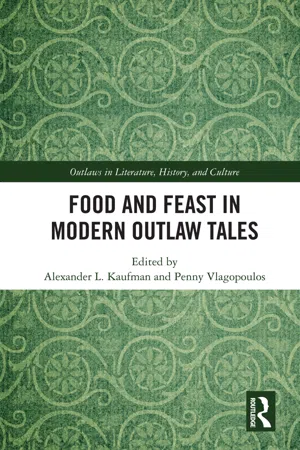
This collection of scholarly essays presents new work from an emerging line of inquiry: modern outlaw narratives and the textual and cultural relevance of food and feasting. Food, its preparation and its consumption, is presented in outlaw narratives as central points of human interaction, community, conflict, and fellowship. Feast scenes perform a wide variety of functions, serving as cultural repositories of manners and behaviors, catalysts for adventure, or moments of regrouping and redirecting narratives. The book argues that modern outlaw narratives illuminate a potent cross-cultural need for freedom, solidarity, and justice, and it examines ways in which food and feasting are often used to legitimate difference, create discord, and manipulate power dynamics.
- 198 pages
- English
- ePUB (mobile friendly)
- Available on iOS & Android
eBook - ePub
Food and Feast in Modern Outlaw Tales
1 ‘Bred Up a Butcher’
The Meat Trade and Its Connection with Criminality in Eighteenth-Century England
In May 1685, two men named Thomas Blanke and Edward Gardner were convicted of robbery and sentenced to be hanged at Tyburn in London.1 On 5 December 1707, Edward English was executed at St. Stephen’s Green, in Dublin, likewise for the crime of robbery.2 On 21 January 1727, also at St. Stephen’s Green, Dublin, another man named John Dobin was hanged for having committed a similar crime.3 All of these men’s cases are relatively unremarkable, but the one thing that they have in common is the fact that all of them were involved, at some point in their lives, in the butcher’s trade.
In light of such cases, the neo-Marxist historian, Peter Linebaugh, argues that ‘in Tyburnography, we found that among those who had been hanged a disproportionate number had been butchers.’4 The reason for the over-representation of butchers in contemporary criminal accounts, according to Linebaugh, can be explained solely in terms of economics and the rise of capitalism; the erosion of the butchers’ guilds’ monopoly on meat meant that they were undercut by people who sold sub-standard meat.5 It is no surprise that many butchers turned to robbery in order to support themselves when business was bad, as the highwayman William Johnson did in 1711.6 Some of them, if they did not themselves rob, acted as fences for local poachers, as Henry Cook, a butcher-turned-highwayman, was forced to in the early part of his criminal career.7
Linebaugh’s data is taken from court records and he says little about the contemporary cultural reasons that highwaymen were seemingly predisposed to criminality, apart from citing a poem by John Gay entitled Trivia, or The Art of Walking the Streets of London, which implies that butchers were violent people: ‘Butchers whose hands are dy’d with blood’s foul stain,/And always foremost in the hangman’s train.’8 He rarely references literary accounts of crime such as Alexander Smith’s A Complete History of the Lives and Robberies of the Most Notorious Highwaymen (1719), Charles Johnson’s Lives and Exploits of the Most Noted Highwaymen (1734), and Johnson’s Lives of the Most Remarkable Criminals(1735). These books were collections of short biographies of the most notorious criminals, with a particular emphasis upon highway robbers. These were more popular and reached a wider audience than the Proceedings, and they were reprinted frequently throughout the eighteenth and early nineteenth centuries.9
This chapter argues that we must look beyond social and economic factors towards more cultural factors to find out why butchers were viewed as potentially criminal by some contemporary writers. The declining economic status of the trade intersected with wider cultural fears regarding violence and depravity, and animal cruelty.10 Yet as we shall see, sometimes membership of the butchers’ trade was viewed as immaterial, and it was crimes that were committed as a result of overindulgence in alcohol which were blamed for their criminality. Master butchers, additionally, often worked with apprentices. In the case of butchers’ apprentices, fears surrounding butchers’ apparent predisposition for violence was often overshadowed by other moral panics, such as the figure of the unruly and idle apprentice who spent his nights in taverns and chocolate houses. However, far from being depraved, the sources examined here also highlight occasions where apprentices shunned the meat trade because it physically disgusted them. The discussion of apprentices is particularly useful because the history of the lives of supposedly unruly apprentices before the nineteenth century is difficult to investigate fully due to the lack of records available, a contributing factor to which is the fact that contemporary court papers and newspapers rarely make reference to any offenders’ ages.11 Clearly, when it comes to assessing eighteenth-century butchers’ criminality, it is too simplistic to say that those involved in the preparation of meat were criminal because their businesses took a turn for the worse and they were already desensitized to violence.
Butchers could hardly be classed as members of polite society. Their appearance was unseemly: they were usually stocky and overweight, and descriptions of them from the seventeenth and eighteenth centuries refer to the blood-stained aprons, which contrasts with the fine laced clothing that polite gentlemen would have worn.12 Furthermore, the environment that they worked in was unpleasant. Nowadays, when animals are slaughtered, it is generally not the local town butcher who carries out this task, for it is a job which is carried out in an abattoir or slaughterhouse. During the eighteenth century, however, most animals were carried ‘on the hoof’ to towns to be slaughtered and then sold. This was often done at the butcher’s stall and, if in London, it was likely done at Smithfield Market, a site which had facilitated the slaughter of animals and the sale of meat since the medieval period.13 The practice continued until the 1850s.14 It was only c. 1900 that the slaughter of animals began to be hidden from public view.15 Butchers shops were often spoken of as being pictures of barbarity. For example, an essay written by Alexander Pope in the Guardian in 1713 says that,
I know nothing more shocking or horrid than the prospect of [butchers’] kitchens covered with blood, and filled with the cries of creatures expiring in tortures. It gives one an image of a giant’s den in a romance, bestrewed with the scattered heads and mangled limbs of his victims.16
One writer in The General Entertainer put a more poetic slant upon the fear that he imagined some animals would have felt before their slaughter:
Against an elm a sheep was ty’d.
The butcher’s knife in blood was dy’d;
The patient flock, in silent fright,
From far beheld the horrid sight;
…
With purple hands and reeking knife,
He strips the skin yet warm with life:
Your quarter’d fires, your bleeding dams,
The dying bleat of harmless lambs,
Call for revenge.17
Other writers expanded upon the description of the suffering endured by animals in butchers’ shops, speaking of how these tradesmen ‘mangle [the] bodies’ of Oxen, and of how after they have been slaughtered, the animals retain ‘a Sensation of Life three times longer than any known Creature in the Creation.’18
Allusions to the grim interior of butchers’ shops are made in accounts of the legendary highwayman and murderer Sawney Beane, who is said to have flourished in Scotland during the reign of King James VI (later James I of England). His biography was one of the most disturbing narratives to appear in the annals of the highwaymen, for he was not only a thief but also a cannibal (his story was adapted by Wes Craven for the 1977 movie entitled The Hills Have Eyes). That the story has no basis in fact was beside the point for criminal biographers, who often invented stories, drew upon folklore, or adapted fictional criminals’ stories.19 In Johnson’s account, Sawney and his family, which number over forty souls who are all the product of incest, live in a cave in the highlands of Scotland, and prey upon lonely travelers. Eventually, they are hunted down when King James VI leads an army into the area. Upon entering Sawney’s lair,
The soldiers were shocked to behold a sight unequalled in Scotland, if not in any part of the universe. Legs, arms, thighs, hands, and feet, of men, women, and children, were suspended in rows like dried beef. Some limbs and other members were soaked in pickle.20
Johnson is clearly using the imagery of the butcher’s private slaughterhouse to describe the cannibals’ lair. The humans who fell into Sawney’s captivity must have been terrified, much like the animals some writers at the time recognized.21
Butchers’ willingness to kill helpless, harmless animals was assumed by some writers to have been easily transferable to humans, and allegedly contributed to the development of a ‘bloody and barbarous disposition.’22 Johnson’s Remarkable Criminals illustrates this point:
John Hewlet was born in Warwickshire, the son of Richard Hewlet, a butcher, and though not bred up with his father, he was yet bred to the same employment at Leicester, from which, malicious people said he acquired a bloody and barbarous disposition.23
Early advocates of vegetarianism, such as Thomas Tryon (1634–1703), argued that shedding animal blood awakened ‘poysonous fires’ which, once released from the carcass, would infect those exposed to it, principally butchers, with all manner of wicked inclinations.24 Tryon, in fact, was quite vehement in his arguments that butchers were potentially violent and criminal. In a letter to a friend, which he titled ‘Of the Employments Arising from the Fountain of Darkness,’ butchers, as well as other people involved in food preparation such as poulterers and even fishermen, ‘are toucht [sic] with the like pernicious evil.’25 Perhaps the idea of these poisonous fires released from the spilling of animals’ blood contributed to the butcher/highwayman Whitney’s irascible and sometimes unhinged temperament: he was prone to violent outbursts and acted without any form of civility or politeness when he was robbing his victims. For example, in Smith’s Highwaymen, when Whitney, a former butcher-turned-highwayman, met a gentleman on the road, he commands the latter to stand and deliver, ‘or else I must be obliged to send a brace of balls through your head.’26 This is in stark contrast to the idealized and gentlemanly highwayman, Captain Macheath, found in John Gay’s The Beggar’s Opera (1728), who gives the following caution to his fellow highwaymen: ‘act with conduct and discretion. A pistol is your last resort.’27 Perhaps Whitney’s former trade had made him desensitized to violence, unlike the gallant and heroic Macheath. Towards the end of the century, the antiquary Joseph Ritson (1752–1803) argued that butchers were often desensitized to violence:
The butcher knocks down the stately ox with no more compass...
Table of contents
- Cover
- Half Title
- Series
- Title
- Copyright
- Contents
- Acknowledgments
- Introduction
- 1 ‘Bred Up a Butcher’: The Meat Trade and Its Connection with Criminality in Eighteenth-Century England
- 2 The Fare of ‘Sanguinary Devils’: Feast and Storytelling in The Life and Adventures of Joaquín Murieta
- 3 ‘I’d Dream of Feasts’: Reading Southworth’s The Hidden Hand as a Dual Outlaw Narrative
- 4 Breaking Bad While Baking Bread: The Cereal Politics of Belle Starr’s Outlaw Reputation
- 5 The Twentieth-Century American Outlaw Feast: Tom Wolfe’s The Electric Kool-Aid Acid Test
- 6 Food Fight!: Excess and Deficiency in National Lampoon’s Animal House
- 7 Post-Apocalyptic Outlaws: Weaponizing Food and Community in Cormac McCarthy’s The Road and Suzanne Collins’ The Hunger Games
- 8 Succulent Texts: Desire, Outlaws, and Consumption in Popular Romance
- List of Contributors
- Index
Trusted by 375,005 students
Access to over 1.5 million titles for a fair monthly price.
Study more efficiently using our study tools.
Frequently asked questions
Yes, you can cancel anytime from the Subscription tab in your account settings on the Perlego website. Your subscription will stay active until the end of your current billing period. Learn how to cancel your subscription
No, books cannot be downloaded as external files, such as PDFs, for use outside of Perlego. However, you can download books within the Perlego app for offline reading on mobile or tablet. Learn how to download books offline
Perlego offers two plans: Essential and Complete
- Essential is ideal for learners and professionals who enjoy exploring a wide range of subjects. Access the Essential Library with 800,000+ trusted titles and best-sellers across business, personal growth, and the humanities. Includes unlimited reading time and Standard Read Aloud voice.
- Complete: Perfect for advanced learners and researchers needing full, unrestricted access. Unlock 1.5M+ books across hundreds of subjects, including academic and specialized titles. The Complete Plan also includes advanced features like Premium Read Aloud and Research Assistant.
We are an online textbook subscription service, where you can get access to an entire online library for less than the price of a single book per month. With over 1.5 million books across 990+ topics, we’ve got you covered! Learn about our mission
Look out for the read-aloud symbol on your next book to see if you can listen to it. The read-aloud tool reads text aloud for you, highlighting the text as it is being read. You can pause it, speed it up and slow it down. Learn more about Read Aloud
Yes! You can use the Perlego app on both iOS and Android devices to read anytime, anywhere — even offline. Perfect for commutes or when you’re on the go.
Please note we cannot support devices running on iOS 13 and Android 7 or earlier. Learn more about using the app
Please note we cannot support devices running on iOS 13 and Android 7 or earlier. Learn more about using the app
Yes, you can access Food and Feast in Modern Outlaw Tales by Alexander L. Kaufman,Penny Vlagopoulos in PDF and/or ePUB format, as well as other popular books in History & Social History. We have over 1.5 million books available in our catalogue for you to explore.