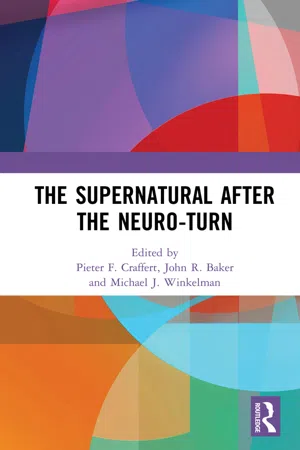
This book takes what is often referred to as the "supernatural" to be normal natural phenomena that are closely linked to the neurobiology of the human species. Reflecting the neurocultural and biocultural perspective, the chapters cover phenomena such as out-of-body experiences, ghosts, and experiences of spirit entities. The contributors consider the "supernatural" as emerging from innate neurobiological structures and functions, and reflecting known neurobiological processes that explain their universality and persistence.
eBook - ePub
The Supernatural After the Neuro-Turn
- 180 pages
- English
- ePUB (mobile friendly)
- Available on iOS & Android
eBook - ePub
The Supernatural After the Neuro-Turn
About this book
Information
Chapter 1
The supernatural
A range of neurocultural phenomena
Pieter F. Craffert
The supernatural is everywhere
The supernatural is not disappearing from our world. Looking at popular culture through literature, films and television it is apparent that every theme and topic in the broad repertoire of the supernatural has found its way onto the big screen or the TV tube, and recently the computer screen. Spirits, zombies, ghosts, possessions, clairvoyance, premonitions, magic, curses, shape shifting, doppelgängers, immortality—you name it, and it has become real and realistic on screens (see Braak, 2015; Laursen, 2015; Leeder, 2015). Moreover, an overview of world literature reveals that the supernatural or paranormal has been part of literary traditions in all cultures for centuries (see Mitchell, 2015). In its folk meaning, supernatural is used to describe entities or agents, such as, gods, demons, ghosts and spirits; but also events, such as, healings, exorcisms, witchcraft and miracles; as well as unusual experiences, such as, apparitions, visions (revelations), out-of-body experiences (soul journeys), UFOs, extrasensory perception, contact with the dead and trances.
The term “supernatural” is regularly used not only in popular parlance but also in academic circles. Sooner rather than later most anthropologists and scholars of religion, to mention only the most obvious disciplines, will employ the term supernatural. In anthropology the supernatural “is a venerable term” (Lohmann, 2003b, p. 176), and it is used, as Saler points out, in its folk meaning where it contains “rather foggy notions” that include God, angels, miracles and a “groaning smorgasbord of preternatural items that may heat or chill the blood” (1977, pp. 32, 49). The evidence is overwhelming that people keep on experiencing supernatural entities and phenomena on a worldwide scale. If ever there was an era in human history preoccupied by supernatural phenomena, it must be ours. In fact, it is the ubiquity and universality of such entities, beliefs and phenomena that nowadays needs explanation (see McCutcheon, 2001, p. 57). But what is the supernatural? For many scholars this is the most interesting and pressing question regarding the supernatural (see Sered, 2003, p. 214).
Coming to terms with the complexity of the term supernatural will be done by means of three steps. It will be done by focusing in turn on the complex range of supernatural phenomena, on the cultural concept, and on supernatural research.
The supernatural as a range of complex cultural phenomena
The term supernatural refers to a range of cultural phenomena of which each instance is a complex phenomenon. It includes everything that anthropologists have traditionally called “magical and religious, as well as everything that could be called occult, superstitious, or pseudoscientific” (Lett, 1991, p. 305). It is often associated with religion but does not completely overlap with it. While it is still common practice to define religion as somehow related to the supernatural (see, e.g., Saler, 1977, p. 51; Hultkrantz, 1983, p. 253; McClenon, 1997, p. 345; Boyer, 2001, p. 6; Atran, 2002, p. 8; Petrus, 2006, p. 1; Pennycook, Cheyne, Seli, Koehler, & Fugelsang, 2012, p. 337), the term refers to many experiences and phenomena that are not actually labelled “religion,” such as extrasensory perception, UFOs and astrology. Often the lines are blurred; for example, it is used to describe the evil eye in Greece (see Roussou, 2014) as well as the ability to converse with the spirits of the dead, as is done by half of the population in Iceland (see Anderson, 2003). It is used to describe witchcraft and traditional healing among Xhosa people in South Africa, where supernatural agents (such as the lightning bird, the baboon, the snake and the uThikoloshe [a dwarf-like spirit entity similar to the Old Hag]) belong to the “supernatural realm” which is “invisible to ordinary humans” but “conceptualised as recognisable animals in the natural world” (Petrus & Bogopa, 2007, p. 3) of the Xhosa people.
The term is also used for the phenomena that psychical research investigates and had historically been explained in terms of the paranormal, such as experiences pertaining to survival of bodily death (for example, near-death experiences, deathbed visions, apparitions and ghosts) and psychical abilities that became known as psi (for example, clairvoyance, telepathy and psychokinesis) (see Saunders, 2015, p. 191). Sometimes, the supernatural refers to things related to perception, such as, in the definition of Cassaniti and Luhrmann, who take supernatural as “something inferred to be present but without material form, something that is ‘real’ but not ‘natural’” (2011, p. 38). Other times it refers to inexplicable material events that are not directly subject to perceptual variance but are open for all to perceive. The term supernatural is also used to describe inexplicable extraordinary events while many examples exist of natural human phenomena that are labelled supernatural (see Raman et al., 2016).
Where the term is used in particular communities, the same meaning is not necessarily shared by all. The example of ghost beliefs among a group of students in China, studied by Bosco (see 2003, p. 146), shows that they do not all agree in their understanding of ghosts since the ghosts are real in two different senses: For some because they belong to the natural world, and for others because they belong to a supernatural realm which also exists (and is considered real).
From this it should be obvious that neither a single explanation nor a unified definition of the supernatural is possible. Things labelled “supernatural” vary significantly, which means that distinct instances demand specialised analyses or explanations. While all of these instances play a role in academic discussions of the supernatural, they do not yet cover all the issues in the scholarly debate. Besides the great variety of entities, experiences and phenomena that are covered by the term, it turns out that the term itself is a complex cultural concept with an intricate history where it has been influenced by theological, philosophical and scientific assumptions.
The supernatural as a complex cultural concept
Any good dictionary will show that the term is commonly used both as a noun and an adjective and covers a wide spectrum of meanings. As adjective it can describe what is unnatural, abnormal or extraordinary, and as a noun it is used to refer to things, occurrences, causes, effects, agencies or beings (see OED, 2016). The term can either mean “unnatural,” which goes back to the Enlightenment understanding of that which is “outside the natural,” or it can simply mean “extraordinary,” “abnormal” and “mysterious” (see Saler, 1977, p. 34; Hultkrantz, 1983, p. 237). The latter can be included in the former, but not necessarily. In its first meaning it presupposes some concept of the “natural” while in the second it is a categorical term referring to a variety of anomalous entities, events and phenomena (Raverty, 2003, pp. 188–9). For most scholars it probably means extraordinary instead of not-natural.
However, already 40 years ago Saler (1977, p. 34) pointed out that few social scientists who employ the term, anthropologists included, clearly state precisely what it is that they mean by it—a complaint echoed repeatedly (see Hultkrantz, 1983, p. 232; Lohmann, 2003a, p. 118; White, 2003, p. 205; Dein, 2016, p. 42). But it is particularly significant in view of the stream of researchers objecting to its use and application in cross-cultural interpretation. Such objections not only illustrate the interpretive problems faced when encountering the supernatural but also highlight the necessity of coming to terms with the complexity of its history.
In a recent article the anthropologist Simon Dein repeated an argument that has been promoted many times over the last few decades; namely, that the term supernatural “is problematic and has little in the way of cross-cultural validity” (2016, p. 41). The claim is that it cannot be used outside its limited scope in Western settings because it imposes an etic view of reality on cultures that may differ in their epistemologies. This objection comes with a rather extended list of anthropologists concerned with the ethnocentrism that goes with the application of Western categories to non-Western cultures (see, e.g., Hallowell, 1955, p. 92; Saler, 1977, pp. 32ff; Klass, 1995, p. 27; Aragon, 2003, p. 131). A similar objection is raised by the religious studies scholar Jeffrey Kripal in one of the most extensive studies of the supernatural in recent years. He warns against the use of the term “supernatural” because the “category’s roots in medieval theology … delimit its meanings and make it highly problematic for studying other cultures, or even other time periods” (2017, p. xix). He states that on a conceptual level the category “presupposes a model of the natural” (2017, p. xix), whereas Dein also suggests that the term “only makes sense in relation to the term natural” (2016, p. 41). However, that is not the only and definitely not necessarily the best definition of the term. These terminological objections obscure the fact that the lack of a concept does not mean the absence of the phenomenon (see Saler, 2008; Block, 2015).
Despite their rejection of the term supernatural for cross-cultural purposes, both Dein and Kripal maintain that people around the world make a distinction between different “worlds.” Indigenous communities may not categorise their lived worlds in terms of a distinction between the supernatural and natural, but rather they may view these “worlds” as inextricably linked, Dein says (see 2016, p. 42). How can people view “these ‘worlds’ as inextricably linked” if they make no distinction between them? And even if the term supernatural is not used it seems apparent that beliefs regarding the concept or entities do exist. In fact, there is widespread support for the view that most people do make some distinction between normal and extraordinary events and entities. For example, the world of the dead is considered different and set apart from the world of the living; the distinction between normal and extraordinary events is found in many (most) cultures. In this sense scholars commonly claim that the category of the supernatural is a human universal (see Jindra 2003; Shanafelt, 2004). Even if the term supernatural is not used, how do we account for the cross-cultural data that suggest the people everywhere experience extraordinary things, encounter spirits or ancestors, claim their souls left their bodies or that a deity spoke to them, to mention only a few instances?
Even if the term supernatural is not used nor the same distinction made, it seems obvious from these examples that varying distinctions of ordinary and extraordinary phenomena are drawn across cultures. Neither a rejection of the term nor replacing it with another (such as, “super natural”—the term suggested by Kripal, 2017, p. xvii) addresses the actual issue, namely, that the term supernatural refers neither to a single nor a monolithic entity. It is also the case that in the history of Christian theology the concept has a chequered history with many different meanings.
The concept of the supernatural appeared in Christian theology in the 9th century prior to the Enlightenment and was used to describe the reality of souls as of “superior nature” because it belongs to the “order of Grace,” as opposed to the “order of Nature,” which included everything that was created, even entities such as angels and demons (see Saler, 1977, pp. 43–8). But in the history of Christianity it was also used in the Church’s missionary endeavours to denounce the superstitions of the pagans or non-believers. The Christian West, whose spiritual entities are thought of as natural, true and superior, is opposed to the pagan rest of the world, whose deities are [considered] supernatural, false and inferior (Anderson, 2003, pp. 125–6; Aragon, 2003, p. 135). A third meaning of the term supernatural, in the Christian tradition, can be attributed to an intra-Christian conflict that developed during the 18th century. It started with the Enlightenment’s questioning of both theological dogma and religious authority and uses the term supernatural to describe the extraordinary and miraculous within the Jesus traditions. To this day it is common practice in Jesus research to refer to the miraculous and extraordinary elements (i.e., the virgin birth, Jesus’ miracles, healings and exorcisms, as well as the resurrection) as “supernatural”—implying they did not belong to the natural order of things but are sui generis and were caused by divine intervention. Therefore, one of the features of Jesus research is the internal debate about how to treat the supernatural events reported in the sources (see Craffert, 2012, for examples). From this it is clear that the supernatural is not consistently, and indeed never was originally, contrasted with “the natural,” and does not have a single meaning. In view of this it is not surprising that as a folk category it is truly a catch-all term. In summary, even as a concept within the Christian religion it has positive and negative connotations: It has been used both for describing Christian entities and adverse or outside entities.
To complicate the picture, in academ...
Table of contents
- Cover
- Half Title
- Title Page
- Copyright Page
- Contents
- Contributors
- Acknowledgements
- Introduction
- Chapter 1 The supernatural: A range of neurocultural phenomena
- Chapter 2 Supernatural and the invisible: A biogenetic structural account
- Chapter 3 The evolutionary origins of the supernatural in ritual behaviours
- Chapter 4 Neurocognitive processes and supernatural beliefs
- Chapter 5 The supernatural as innate cognitive operators
- Chapter 6 Embodied experiences and the neurobiological, cognitive and psychological production of ghosts
- Chapter 7 Shamanic alterations of consciousness as sources of supernatural experiences
- Chapter 8 Extraordinary knowing within the framework of natural science: Toward a theory of “scientific mysticism”
- Index
Trusted by 375,005 students
Access to over 1.5 million titles for a fair monthly price.
Study more efficiently using our study tools.
Frequently asked questions
Yes, you can cancel anytime from the Subscription tab in your account settings on the Perlego website. Your subscription will stay active until the end of your current billing period. Learn how to cancel your subscription
No, books cannot be downloaded as external files, such as PDFs, for use outside of Perlego. However, you can download books within the Perlego app for offline reading on mobile or tablet. Learn how to download books offline
Perlego offers two plans: Essential and Complete
- Essential is ideal for learners and professionals who enjoy exploring a wide range of subjects. Access the Essential Library with 800,000+ trusted titles and best-sellers across business, personal growth, and the humanities. Includes unlimited reading time and Standard Read Aloud voice.
- Complete: Perfect for advanced learners and researchers needing full, unrestricted access. Unlock 1.5M+ books across hundreds of subjects, including academic and specialized titles. The Complete Plan also includes advanced features like Premium Read Aloud and Research Assistant.
We are an online textbook subscription service, where you can get access to an entire online library for less than the price of a single book per month. With over 1.5 million books across 990+ topics, we’ve got you covered! Learn about our mission
Look out for the read-aloud symbol on your next book to see if you can listen to it. The read-aloud tool reads text aloud for you, highlighting the text as it is being read. You can pause it, speed it up and slow it down. Learn more about Read Aloud
Yes! You can use the Perlego app on both iOS and Android devices to read anytime, anywhere — even offline. Perfect for commutes or when you’re on the go.
Please note we cannot support devices running on iOS 13 and Android 7 or earlier. Learn more about using the app
Please note we cannot support devices running on iOS 13 and Android 7 or earlier. Learn more about using the app
Yes, you can access The Supernatural After the Neuro-Turn by Pieter F. Craffert, John R. Baker, Michael J. Winkelman, Pieter F. Craffert,John R. Baker,Michael J. Winkelman in PDF and/or ePUB format, as well as other popular books in Social Sciences & Anthropology. We have over 1.5 million books available in our catalogue for you to explore.