This book revisits the issue of China English as a developing variety of English and scrutinises students' and teachers' attitudes towards their own and other English accents from the critical phenomenological perspective of Global Englishes (GE) in the Chinese context. The research contributes to the field of GE by proposing a model of pronunciation teaching called ToPIC (Teaching of Pronunciation for Intercultural Communication) informed by interculturally responsive language pedagogy. Combining theory and empirical data, the book presents ground-breaking research on accent attitudes in the Chinese context within the GE paradigm and raises issues and concerns regarding teaching English, particularly speaking and pronunciation, from the GE perspective. Unpacking attitudes towards English accents from a critical perspective, this book will both show policy makers the need to consider the impacts of GE and help practitioners and language learners re-evaluate the goals and needs of English learning. The ToPIC approach also has significance for curriculum reform as it readdresses various issues in language policy and practice. The ToPIC approach is recommended for those interested in teaching and learning English in the expanding circle context and those seeking to learn more about learning and using English across the world.
eBook - ePub
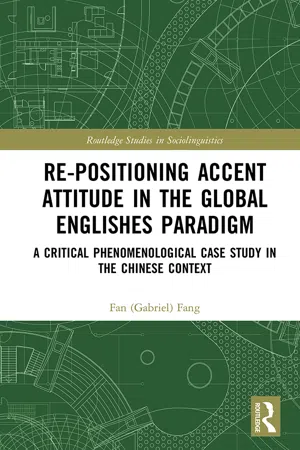
Re-positioning Accent Attitude in the Global Englishes Paradigm
A Critical Phenomenological Case Study in the Chinese Context
- 140 pages
- English
- ePUB (mobile friendly)
- Available on iOS & Android
eBook - ePub
Re-positioning Accent Attitude in the Global Englishes Paradigm
A Critical Phenomenological Case Study in the Chinese Context
About this book
Information
1 Introduction
We are never just teaching something called English but rather we are involved in economic and social change, cultural renewal, people’s dreams and desires.
(Pennycook, 2017, p. xii)
Why this book?
The quote by Pennycook indicates the transformation of the English language and the field of English language teaching (ELT) under a new era in that policy makers, researchers and language practitioners are re-positing English from a socio-cultural and socio-political perspective. The goals and needs of ELT are also being re-addressed and re-negotiated as English is used worldwide as a global language. At present, approximately two billion people speak English (with this number still increasing), the majority of whom use it as a second or foreign language (Crystal, 2008). The number of non-native speakers of English (NNSEs) has surpassed the number of those who traditionally use it as their native language. These trends have sparked on-going debate over the ownership of English (Holliday, 2005; Norton, 1997; Widdowson, 1994). Against the backdrop of globalisation in the 21st century, re-addressing some language ideologies related to English and ELT is therefore necessary from a broader perspective. Witnessing the transformation of ELT in many contexts, researchers and language practitioners may want to explore a better practice that could fulfil the needs and aims of various types of language learners. People should understand the diversity, fluidity and complexity of the English language from a socio-cultural, socio-economic and socio-political perspective instead of viewing English as a language per se from a monolithic and unified perspective in which it is owned by its native speakers.
However, this background is not yet well represented in mainstream ELT practices. As a researcher of socio-linguistics and language practitioner myself, I am aware of the ELT gap from the many critical incidents I have experienced. For example, many language practitioners view English as a language with a fixed standard so that they simply teach the four skills of English, namely, listening, speaking, reading and writing (Crookes, 2015; Fang, 2018a; Pennycook, 2017; Widodo, Wood & Gupta, 2017); many practitioners and students may also worship native varieties of English and view native speakers of English (NSEs) as privileged (Faez, 2011; Fang, 2018b; Yazan & Rudolph, 2018). English is viewed as the property of its native speakers and is being taught as a language subject in many contexts. In particular, many language practitioners would simply position themselves as English language teachers but are not trained and are therefore unaware of the broader socio-cultural and socio-political aspects of English as a global language. Thus, students also perceive themselves as perpetual learners of English and regard it as a subject only. They may gradually lose confidence and motivation if they do not use English to actively communicate with other people or fulfil various purposes in their daily lives. The concepts of diversity and complexity of the English language are neglected in many ELT settings; students may also complain that what they have learnt does not match what they encounter when communicating with people from various linguistic and cultural backgrounds, especially when they have experiences in studying or travelling abroad. In many cases, students are taught (and are forced to learn to a large extent as related to assessment) to understand English produced by Anglophone speakers, particularly British and American people. Many individuals, including students, parents and many ELT practitioners themselves, misperceive that Anglophone speakers should be the only and ultimate model and target of ELT and English language learning. Such a homogeneous ideology is still salient in today’s ELT, and all these issues will need further research in order to be addressed.
I therefore believe that a book on understanding and re-positing people’s understanding of the English language in this globalised world will be necessary and timely. With a focus on language attitude and identity construction, further linking to implications on English language education in the Chinese context – my current context – would also provide a lesson for people who are both familiar and unfamiliar with ELT in China. This book will particularly focus on Chinese university students’ attitudes towards their own and other accents of English, and propose a model of pronunciation teaching from a global Englishes (GE) perspective called Teaching of Pronunciation for Intercultural Communication (ToPIC). This approach will hopefully challenge the traditional (and restricted) model of pronunciation teaching based on a fixed native standard and will serve as an alternative means of pronunciation teaching from the GE paradigm for the majority of English learners who will use English for intercultural communication purposes, if they can start to re-construct their identities as language users instead of perpetual learners of English out of language classrooms.
Global Englishes today
As this book is based on the GE paradigm, starting with the notion and development of GE is necessary. This book uses the term GE simply because I wish to be more inclusive when discussing the phenomenon of the spread of English and the use of English particularly in non-Anglophone settings. I will discuss the relevant terms in more detail in Chapter Two, but for readers who are unfamiliar with the epistemological aspects of GE, the following is a brief introduction.
The field of GE was developed from the field of World Englishes (WE), pioneered by the late Professor Braj Kachru, in which he argued that post-colonial varieties of English should be recognised and are different rather than deficient compared with Anglophone varieties of English (see the English Today debate by Quirk (1990) and Kachru (1991). Many studies then investigated the phonological and morphosyntactic features of post-colonial varieties of English, including Singapore English, Nigeria English, Indian English, Hong Kong English, among others. More systematic features of post-colonial varieties of English are also being codified. However, WE involves some criticisms (see e.g. Bruthiaux, 2003; Canagarajah, 1999; Kubota, 2018; Saraceni, 2015; and Chapter Two), such as the difficulty in using a theory to explain the complexity of English worldwide across borders, as well as local hybrid English and creoles in various social and cultural contexts.
Another similar field is the theory and language ideology of English as a lingua franca (ELF). ELF was developed from WE with both similar and different focuses. Both WE and ELF challenge the ideology of native speakerism and celebrate linguistic and cultural diversity, although WE mainly focuses on codifying the phonological and morphosyntactical features of post-colonial varieties of English. The key research figures of ELF, called its three mothers, are Jennifer Jenkins, Anna Mauranen and Barbara Seidlhofer. ELF was first introduced as English as an international language (EIL) when Jenkins published her monograph named The Phonology of English as an International Language (Jenkins, 2000). Although scholars of ELF in the first stage were interested in codifying a universal variety of ELF and they attempted to summarise the common features of ELF, the field has shifted to recognise the diversity and fluidity of people’s second or additional language use of English in order to unpack how people would use communication skills and strategies to accommodate and negotiate for intercultural communication (see Jenkins, 2015a). This shift does not exclude native speakers of English, but they no longer act as the arbiters of the use of English from an ELF paradigm (Jenkins, 2007; Seidlhofer, 2011). Whilst another school of scholars may still prefer to use term EIL (Alsagoff, McKay, Hu & Renandya, 2012; Matsuda, 2017), the main focus is similar to ELF but probably places more emphasis on increasing people’s awareness of multiculturalism and cultural diversity (Alsagoff et al., 2012; Renandya & Widodo, 2016), as well as developing materials for ELT. Some EIL scholars, though, still perceive ELF as in its early stage, arguing that ELF research aims ‘to document the features of exchanges that occur between L2 speakers of English’ (McKay & Brown, 2016, p. xvii). More recently, another linguistic phenomenon – translanguaging – has also been enacted to recognise multilingual speakers’ various language practices (García & Li, 2014; Li, 2018). García and Li (2014) distinguish translanguaging from code-switching, arguing that translanguaging refers to ‘the speakers’ construction and use of original and complex interrelated discursive practices that cannot be easily assigned to one or another additional definition of a language, but that make up the speakers’ complete language repertoire’ (p. 22).
Other terms and theories, including translingual practice (Canagarajah, 2013) and metrolingualism (Pennycook & Otsuji, 2015), both largely recognise the diversity and complexity of the English language from various perspectives. As this book discusses the impact of the global spread of English in relation to ELT, such terms and ideologies will not be explored in further detail. However, readers should bear in mind that no single language ideology can fully and correctly explain and represent the picture of the global spread of English. The GE paradigm was used in this book because GE not only explains the socio-linguistic perspective of English but also provides a certain avenue for ELT reform, which I believe will be relevant for policy makers, researchers and language practitioners of the English language. The term GE is used as an umbrella term and is more inclusive, as it encompasses recognised English varieties from the WE paradigm, as well as linguistic and cultural diversity from the ELF paradigm (Galloway, 2017; Jenkins, 2015b). GE is operationalised as the metamorphosis of English across borders in today’s globalised world (Jenkins, 2015b). Global English language teaching (GELT), as discussed by Galloway and Rose (2015, 2018), aims to ‘raise students’ awareness of the diversity of English and to challenge the traditional ELT approach’ (Fang & Ren, 2018, p. 386). GELT also recognises learners’ first language (L1) as a resource rather than a hindrance, and challenges the ownership of English to emphasise the importance of multilingualism in contrast to the traditional monolingual practices in ELT. Based on the GE paradigm, this book will therefore propose some interesting findings that will shed light on ELT in the Chinese context and beyond in the 21st century.
The English language and English language teaching in China
As the development of the English language and ELT in the Chinese context will be discussed in detail in Chapter Three, in this chapter, I shall present a general overview only. ELT in China has experienced its ebb and flow. A detailed socio-linguistic history of English in China can be found in the work of Bolton (2003), whereas an overview of the history of English in Chinese education can be found in the work of Adamson (2004). Fang (2018a) also discusses the ideological and identity debate of the English language in the Chinese context. As discussed by Bolton (2003) and Adamson (2004), English has been widely present in China since the Qing dynasty and has functioned for various purposes throughout history. The tension between English and Western culture and Chinese and local culture is an issue that still exists. During the Republican Era (1911–1949), English was viewed as a language of contact between China and the West, with ‘resistance from nationalistic scholars and politicians fearing unwanted cultural transfer’ (Adamson, 2004, p. 22). After the founding of the People’s Republic of China, English had to compete with Russian as a subject in the national curricula, and the Cultural Revolution Period (1966–1976) also made English vulnerable. It was the reform and opening policy of the late 1970s and the inclusion of English as a subject in the national college entrance examination (Gaokao) in 1977 that promoted English competence. Later, ‘English competence is a key component in the tertiary level entrance examinations, a factor that enhances the status of the subject on the school curriculum’ (Adamson, 2004, p. 3). More recently, with China’s entry into the World Trade Organisation and the hosting of the Beijing Olympic Games, the Shanghai Expo, the Guangzhou Asian Games and a series of other events, ‘English learning has transformed into a popular, fashionable trend, with a booming English learning industry in recent decades’ (Fang, 2018a, p. 17).
We recognise the complexity of the status of the English language and the situation of ELT in the Chinese context. That is why presenting a clear picture of the ELT situation in China in a book is a challenge. China has the largest number of English language learners in the world; according to the GE paradigm, it has approximately 400 million English language learners/users (Wei & Su, 2015). English is not regarded as a post-colonial language in China, but ELT is in its heyday, despite the various issues and concerns of the public about it. This ideological debate will be elaborated further in Chapter Three, but I will discuss this issue briefly in this chapter.
The ideological debate involves whether a variety of English exists in China. One school of scholars argues the existence of a Chinese variety of English and calls it China English (CE)1 (He & Li, 2009; Hu, 2004). Some believe that CE is an interlanguage that impedes international communication and thus should not be recognised as a variety of English (Li, 1993; Yang & Zhang, 2015). Fang (2017a) has reviewed in detail a rather complex issue concerning whether CE should be placed in a WE or ELF framework, and argued the importance of acknowledging and researching the use of English both within the Chinese community and across the boundaries encompassing the speakers of different L1s.
Structure of the book
This book consists of eight chapters with three main parts. The first part includes Chapter Two to Chapter Four, which focus on the theoretical framework and the literature on language attitude research in the Chinese context. The second part, which consists of Chapters Five and Six, summarises the findings from both the questionnaire and the interviews investigating students’ attitudes towards their own and other accents of English, as well as how they construct and negotiate their identities through the journey of English learning. The last part, Chapter Seven, presents the proposal of ToPIC for pronunciation teaching from the GE paradigm. A short epilogue as the final chapter provides further research avenues for people who are interested in this area.
In detail, Chapter Two discusses some language ideologies, including standard English (StE), WE, ELF and translanguaging. By reviewing these ideologies that are directly linked to the global spread of English, this chapter presents an argument for moving beyond the StE ideology, which has neglected the reality and complexity of the spread of English, against the backdrop of globalisation to envisage the current linguistic landscape of GE. Finally, this chapter links the discussion on language ideology to the research context, which will be the focus of Chapter Three.
Chapter Three moves to the culture-geographic research context of China and discusses debates on the status of CE as a variety of English and the views on English in China within both the WE and ELF frameworks. This chapter summarises the various literature on such issues and puts forward the view of CE used in this book. Based on discussion put forward in earlier literature, this chapter argues that it is still too early to place CE in the WE paradigm because CE is not yet well codified at present. The ELF paradigm, however, recognises the fluidity of English use across borders, so the English in China is better considered in the ELF framework, which is what Mauranen (2012) calls a similect. The background of English language education in China will then be reviewed, with a focus on higher education, followed by an account of the popularity of English learning and the complexity of students’ learning motivations. The chapter then discusses the debate on ELT in China. It concludes by investigating the degree to which the notion of Chinese learning for essence (tĭ), Western learning for utility (yòng) is applied to alleviate the impact that English and its cultures have on Chinese language and culture.
Chapter Four introduces relevant research on attitudes towards CE in the new millennium, as research on CE has flourished in the 21st century. This chapter reviews various attitudes towards CE and the complexity of dealing with CE accents. Drawing on previous literature on accent attitudes, this chapter outlines the need to research language and accent attitudes in the Chinese context. It also describes the development and popularity of English in China and reviews concerns related to identity loss and native speakerism awakened by the English craze. After establishing the significance of exploring language and accent attitudes in relation to identity in the GE framework, the chapter reports that these issues are not currently well recognised or understood in ELT in China.
Chapter Five outlines the research setting presented in this book. It first explores the selection of the phenomenology approach and then describes the main research setting and the geographic and linguistic backgrounds of the participants. The methodology used for the research is also explained before moving to the findings chapter. The research findings on accent attitudes from the GE paradigm are also presented in this chapter. The questionnaire data show the complexity of attitudes regarding accents, although the current literature still reflects an entrenched native ideology in ELT.
Building on the previous chapters’ discussion of the relationship between attitude and identity, Chapter Six emphasises the importance of revisiting English accents in relation to identity from a GE perspective. This chapter reports qualitative data from the interviews and concludes the complexity of identity (re)construction and (re)negotiation of both teachers and students, particularly with some contradictory comments regarding the priority of intelligibility in communication but with an ultimate, unrealistic goal of being native-like in English learning and teaching. Even with some voices of resistance, many students still see themselves as perpetual language learners, but most teachers realise the importance of identity construction when learning and teaching English.
Drawing on the findings and echoing Kumaravadivelu’s (2001, 2003) post-method pedagogy, Chapter Seven proposes the ToPIC approach of pronunciation teaching based on the wider perspective of an interculturally responsive language pedagogy that challenges the native standard ideology and native speakerism. This teaching approach can serve as a reference for most language practitioners teaching English in expanding circle contexts. However, the point made is that in the GE framework it i...
Table of contents
- Cover
- Half Title
- Series Page
- Title Page
- Copyright Page
- Dedication
- Table of Contents
- List of illustrations
- Foreword
- Acknowledgements
- Abbreviations
- 1. Introduction
- 2. Language ideology and geopolitics: From Standard English and World Englishes to English as a lingua franca
- 3. The social psychology of English language pedagogy in China
- 4. Attitudes towards China English in 21st century China
- 5. Revisiting teachers’ and students’ accent attitudes through a questionnaire
- 6. Interviews: Unpacking identity construction and negotiation from teachers and students
- 7. A step forward: Teaching pronunciation for intercultural communication
- 8. Epilogue
- Appendix 1: The questionnaire
- Appendix 2: The semi-structured interview questions to students and teachers
- Appendix 3: Transcription conventions for interviews and focus groups (adapted from Jenkins (2007, 2014) and VOICE corpus (2013))
- References
- Index
Trusted by 375,005 students
Access to over 1.5 million titles for a fair monthly price.
Study more efficiently using our study tools.
Frequently asked questions
Yes, you can cancel anytime from the Subscription tab in your account settings on the Perlego website. Your subscription will stay active until the end of your current billing period. Learn how to cancel your subscription
No, books cannot be downloaded as external files, such as PDFs, for use outside of Perlego. However, you can download books within the Perlego app for offline reading on mobile or tablet. Learn how to download books offline
Perlego offers two plans: Essential and Complete
- Essential is ideal for learners and professionals who enjoy exploring a wide range of subjects. Access the Essential Library with 800,000+ trusted titles and best-sellers across business, personal growth, and the humanities. Includes unlimited reading time and Standard Read Aloud voice.
- Complete: Perfect for advanced learners and researchers needing full, unrestricted access. Unlock 1.5M+ books across hundreds of subjects, including academic and specialized titles. The Complete Plan also includes advanced features like Premium Read Aloud and Research Assistant.
We are an online textbook subscription service, where you can get access to an entire online library for less than the price of a single book per month. With over 1.5 million books across 990+ topics, we’ve got you covered! Learn about our mission
Look out for the read-aloud symbol on your next book to see if you can listen to it. The read-aloud tool reads text aloud for you, highlighting the text as it is being read. You can pause it, speed it up and slow it down. Learn more about Read Aloud
Yes! You can use the Perlego app on both iOS and Android devices to read anytime, anywhere — even offline. Perfect for commutes or when you’re on the go.
Please note we cannot support devices running on iOS 13 and Android 7 or earlier. Learn more about using the app
Please note we cannot support devices running on iOS 13 and Android 7 or earlier. Learn more about using the app
Yes, you can access Re-positioning Accent Attitude in the Global Englishes Paradigm by Fan (Gabriel) Fang in PDF and/or ePUB format, as well as other popular books in Languages & Linguistics & English Language. We have over 1.5 million books available in our catalogue for you to explore.