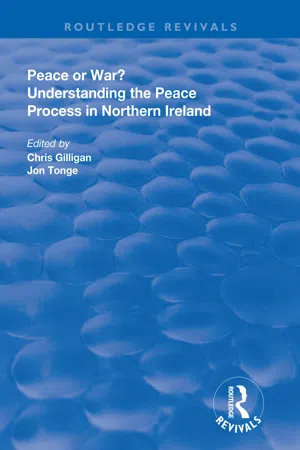
First published in 1997, this volume responded to the peace process of the 1980s and 1990s between Great Britain and Northern Ireland, emerging just prior to the 1998 Good Friday Agreement. It constituted one of the first major academic examinations of the attempts to bring peace to Northern Ireland in the 1990's, and explores the historical origins of the process, before moving towards a critical account of the role of political parties in the development of the peace process. Critics have argued equally that the process was a sham, tactically repositioning Irish republicanism, and that it provided a framework for reconciliation or even conflict resolution. This book outlines the political changes which allowed the peace process to develop, along with analysing specific themes divided into three broad sections: the general aims of the peace process, the political perspectives and the issues under discussion. Aiming to promote discussion, these contributors explore the origins and function of the peace process, followed by an analysis of political perspectives including the Unionists, the SDLP and Irish Republicanism. Finally, they consider key issues of interest for the peace process, including the ever-present border debate, security strategies, education, and economics, whilst Rachel Ward makes the case for the skilled contributions of women available to formal politics.
eBook - ePub
Peace or War?
Understanding the Peace Process in Northern Ireland
- 167 pages
- English
- ePUB (mobile friendly)
- Available on iOS & Android
eBook - ePub
About this book
Trusted by 375,005 students
Access to over 1.5 million titles for a fair monthly price.
Study more efficiently using our study tools.
Information
Subtopic
PoliticsPart One
INTRODUCTION AND OVERVIEW
1 Introduction
The peace process of the 1990s appeared to offer the best chance yet of ending violent conflict in Northern Ireland. If a temporary peace did not arrive until 1994, the gestation of the peace process occured from the mid-1980s onwards. The very term ‘peace process’ is controversial. Critics might argue that the process was a sham, based upon a tactical repositioning of republicanism which proved extremely short-lived. Supporters of the peace process argue, often from different political perspectives, that it provided a framework for reconciliation or even conflict resolution.
This book explores the nature of the peace process, outlining the political changes which allowed it to develop and examining specific themes within the process itself. For this reason, the book is divided into three main sections. The first provides general discussions of the aims and objectives of the peace process. The second section analyses the changing roles of the political parties and party ideology in shaping the peace process and responding to developments within that process. The third section offers discussion of some of the most important themes within the peace process. In carefully selecting these themes, the co-editors are aware that it is impossible to cover in detail every important aspect of the peace process. The book is designed to promote discussion, rather than provide a definitive account of the peace process. Peace or War? begins with an overview of the peace process from Jon Tonge in chapter two. When and why did it start? What did it major participants anticipate? Why did it stumble? Following this, Chris Gilligan discusses whether the peace process was genuine attempt at resolving the conflict, or merely an attempt at creating non-violence. Gilligan highlights the seeming contradiction between the stress upon the need for inclusive dialogue and the lack of citizen involvement in the peace process.
In Part two, Jim McAuley assesses the attempt to reconstruct Unionism as a response to the peace process. He suggests that attempts at remodelling have been rendered problematic by the pressure placed upon Unionists not to participate in the peace process. Mark McGovern provides an assessment of how the SDLP’s pursuit of internal consociationalism and external intergovernmentalism have shaped the peace process. He examines the tensions within the Party’s approach to a lasting settlement. The SDLP’s traditional historical analysis of British responsibility for the problem rests uneasily alongside the Party’s beliefs of unity in diversity and parity of esteem. In chapter six, Mark Ryan argues that Irish republicanism has undergone a slow death, masked by a continuing ‘armed struggle’. Sinn Fein’s recognition of the southern state in 1986 contributed significantly to republicanism’s loss of distinctiveness. Concurrently, the pursuit of inclusive dialogue and emphasis upon parity of esteem for the nationalist community have led to greater recognition of the northern state.
Part three’s exploration of themes within the peace process begins with an analysis of attempts to promote cross-border cooperation. In exploring different models of cooperation, Alan Greer makes the point that such cooperation is not new, but its attempted extension raises hopes or fears amongst nationalists and unionists. The Framework Documents attempted extensions of cross borderism allied to a limited series of checks upon such activity. In the following chapter Paddy Hillyard provides a critical account of the lack of, reform of policing in Northern Ireland and a similar lack of urgency on the issue of release of prisoners. Following this, Kevin Rooney offers a sceptical view of Education for Mutual Understanding as a vehicle by which community tension might be defused. Rooney suggests that such problems seek only to obfuscate the true nature of the problem. In chapter 10, Peter Shirlow points out that social exclusion and a deprivation amongst the nationalist and unionist working classes have fostered an intra-class war. He urges the establishment of a wide ranging Commission for Economic Reconstruction and Social Inclusion as a remedy. Finally Rachel Ward rejects the idea of women as neutral peacekeepers in the peace process. Whilst welcoming the increased profile of women in politics in Northern Ireland, Ward points to the criticism of the Northern Ireland Women’s Coalition by other Women’s groups over its lack of policies. As in so many other aspects of the peace process, ambiguity prevails.
2 The origins and development of the peace process
Introduction
Providing an overview of the peace process presents a number of difficulties. The first problem lies in deciding whether the process was one with a definitive beginning and conclusion. One account suggests that the process ‘was a self-contained one with a beginning, a middle and, sadly, an end’ (Bew and Gillespie, 1996, p.7). Certainly the IRA bomb at Canary Wharf in February 1996 appeared to end the peace process. Nonetheless much speculation continued that another ceasefire was possible and a limited political process continued. If one accepts that the process ended in February 1996, the origins of the peace process were of considerably longer duration than the period of peace. A second problem is that of labelling. To speak of the Northern Ireland peace process is in a sense misleading. Much of the impetus and some of the ramifications of the process lay outside Northern Ireland. Thirdly, there lie the much broader problems of identifying how and why a peace process developed. Finally, the reasons why that process encountered a series of obstacles require analysis.
A movable starting line
The start of a peace process has been identified as early as the Papal visit to Ireland in 1979 (Coogan, 1995). After the Pope condemned violence whilst insisting he sought justice, leading elements in Sinn Fein sought dialogue with the Catholic Church concerning interpretations of a just war. Such talks were centred more upon the anxiety of the republicans to justify war rather than engage in peace negotiations. Accordingly, two more conventional starting points for the peace process have been offered.
In 1986 at its ard-fheis, Provisional Sinn Fein voted by a three to one majority to end abstentionism in elections to the Dail. Henceforth, in the unlikely event of Sinn Fein candidates being elected, they would take their seats. If the practical impact of the decision was negligible in terms of the electoral politics of the south, it was of immense importance in respect of Northern Ireland.
The decision was hugely symbolic. It represented a tacit acceptance of the twenty-six county in the state, recognising the legitimacy of its parliament. Previously the southern state was viewed as a neo-colonial British satellite. This volte-face was achieved at astonishing speed. Only one year earlier, the President of Sinn Fein had insisted that the Dail was Irish in name only, amounting to ‘a British parliamentary system handed down by ex-colonial rulers’ (Adams, 1985, p. 8).
There was considerable irony in the policy reversal. The Provisional IRA had split from what became the ‘Official IRA’ in 1970 due to the latter’s willingness to end abstentionism in the south, The wheel had come full circle and it was scarcely surprising that the traditionalist wing of the party left to form Republican Sinn Fein, based upon ‘purist’ republican principles. No longer did Provisional Sinn Fein claim an enduring mandate from its success in the last all-Ireland elections of 1918. Moreover, no longer did Sinn Fein and the IRA see themselves as ‘sole liberators’ of Ireland. From now, the existing twenty-six county state would be accepted by northern republicans as articulator of the interests of a thirty-two county nation. Pannationalism began here.
Not everyone would accept 1986 as the crucial building block in the peace process. There was little change in IRA activity and the Irish Government did not display an immediate willingness to construct an Irish-led peace process. Alternatively therefore, the Hume-Adams dialogue of 1988, revived in 1992, might be seen as the ‘kick-starter’. The discussions between the leaders of the SDLP and Sinn Fein were based upon an attempt to convince the latter of three things. Firstly, IRA violence was counter-productive to the nationalist cause. Secondly, the British Government was now neutral on the constitutional future of northern Ireland. It might even be prepared to become a persuader to Unionists of the merits of a united Ireland. Thirdly, Sinn Fein must accept that Unionists had their own identity within the island of Ireland. They were not merely neo-colonial settlers.
Placement of Hume-Adams at the starting point of the peace process depends to some extent upon whether its objectives were achieved. IRA violence was halted, albeit temporarily. Sinn Fein accepted, albeit privately, that Britain was no longer a colonial ruler in Ireland (Mallie and McKittrick, 1996). Against this, Hume-Adams broke up in 1988 and its agreements in 1992–93 were arguably merely a reassertion of a longstanding nationalist principle of self determination i.e. that all the people of Ireland should determine its future. Undoubtedly Hume-Adams was significant in further ending the political isolation of Sinn Fein. By engaging in dialogue with republicans, Hume removed barriers to dialogue confronting others within the ‘nationalist family’.
One might argue that the real peace process began with the involvement of the British Government. The opening of a secret line of communication between the British Government and the IRA in 1990 indicated the view of the Secretary of State Peter Brooke that republicans might wish to end the violent pursuit of their goals. This ‘Back Channel’ of communication was opened against a political backdrop of avowedly increased British neutrality on the constitutional future of Northern Ireland. This was illustrated not merely in the agreements and declarations discussed below, but in the assertion by Brooke that Britain had no ‘selfish strategic or economic interest’ in Northern Ireland.
Finally, the beginning of the true peace process could be identified as the paramilitary ceasefires. The ‘complete cessation’ of military operations declared by the IRA in August 1994 deliberately excluded the word permanent. Its omission emphasised that there was no possibility of a surrender by the Provisionals. A plethora of unresolved wrangles over the inclusion if Sinn Fein in all-party dialogue resulted. Six weeks later, the umbrella organisation, the Combined Loyalist Military Command, announced a reciprocal ceasefire. The ceasefires were predicated upon entirely different conclusions; Republicans believed that substantial political progress was possible. Loyalists had devoted the six week interlude to establishing that the Union was safe (Rowan, 1995). A formal peace process was underway, but it appeared extremely fragile.
British policy: neutrality versus integration
By the mid-1980s, the British Government had become exasperated by the failure of local politicians to reach agreement in Northern Ireland. The attempted consociationalism of 1974 had been broken by the Ulster Workers Council Strike. Attempts at very weak devolutionary imitations in 1975 and 1982 had foundered. Equally the Conservative Government had realised the limitations of the Ulsterisation and criminalisation approaches of its Labour predecessor as amounting to mere ‘keeping the lid on’ strategies. The response was to construct arrangements for governance within an intergovernmental framework, predicated upon core assumptions. These were firstly, that a purely internal settlement was impossible in Northern Ireland; secondly, constitutional nationalism should be actively promoted; thirdly, this promotion could only be achieved through concessions to the Republic in return for a bolstering of cross-border security measures.
The Anglo-Irish Agreement of 1985 suggested to some that the British Government was neutral on the future of Northern Ireland. An appearance of neutrality was heightened by the public outrage towards the Agreement generated within Unionist circles. Britain no longer sought to act as a persuader for the Union. Instead, the aim of a united Ireland or support for the retention of Northern Ireland’s position within the Union were of equal validity. There was no longer such a thing as disloyalty within Northern Ireland.
For Unionists, the facilitation of a possible united Ireland contained within the Agreement were disingenuous. The desire for a united Ireland had never been prevented, but was now promoted to a status equal with that of the status quo of the Union (Aughey, 1994). Yet the Agreement produced only weak Irish input into decision-making in the North. Its denial of constitutional change without internal consent differed in mechanism only from that provided in the Ireland Act of 1949.
Perceptions of neutrality were aided by the public stance of republicans. Gerry Adams argued that the Agreement ‘copper-fastened partition’. A supportive echo was found in the criticism of Charles Haughey, whose Fianna Fail Party led opposition in the Republic. Yet the public utterances of Sinn Fein masked a shift in analysis away from the idea contemporary conflict was essentially colonial. Unsurprisingly, the British Government was anxious to facilitate this shift. It wished to foster a ‘no favoured solution’ approach to conflict resolution.
The lasting significance of the Anglo-Irish Government lay more in its framework than its impact. It was imposed above the heads of local politicians. Unionist opposition was ignored. The Agreement placed the Northern Ireland problem within the joint domain of the British and Irish governments. By granting a role for the Republic in the affairs of Northern Ireland through the deliberations of the Anglo-Irish Conference, it placed the government of the twenty-six county state in the vanguard of appeals from other nationalists. It was thus likely to act in future years as a harbinger for nationalist aspirations.
Accordingly, when the peace process began to gather momentum in the 1990s, both the constitutional and ultra strands of northern nationalism bargained with the Irish...
Table of contents
- Cover
- Half Title
- Dedication
- Title Page
- Copyright Page
- Table of Contents
- List of Tables
- List of Figures
- List of contributors
- Acknowledgements
- List of abbreviations
- Part One: Introduction and overview
- Part Two: Political perspectives
- Part Three: Issues in the peace process
- Part Four: Conclusion
Frequently asked questions
Yes, you can cancel anytime from the Subscription tab in your account settings on the Perlego website. Your subscription will stay active until the end of your current billing period. Learn how to cancel your subscription
No, books cannot be downloaded as external files, such as PDFs, for use outside of Perlego. However, you can download books within the Perlego app for offline reading on mobile or tablet. Learn how to download books offline
Perlego offers two plans: Essential and Complete
- Essential is ideal for learners and professionals who enjoy exploring a wide range of subjects. Access the Essential Library with 800,000+ trusted titles and best-sellers across business, personal growth, and the humanities. Includes unlimited reading time and Standard Read Aloud voice.
- Complete: Perfect for advanced learners and researchers needing full, unrestricted access. Unlock 1.5M+ books across hundreds of subjects, including academic and specialized titles. The Complete Plan also includes advanced features like Premium Read Aloud and Research Assistant.
We are an online textbook subscription service, where you can get access to an entire online library for less than the price of a single book per month. With over 1.5 million books across 990+ topics, we’ve got you covered! Learn about our mission
Look out for the read-aloud symbol on your next book to see if you can listen to it. The read-aloud tool reads text aloud for you, highlighting the text as it is being read. You can pause it, speed it up and slow it down. Learn more about Read Aloud
Yes! You can use the Perlego app on both iOS and Android devices to read anytime, anywhere — even offline. Perfect for commutes or when you’re on the go.
Please note we cannot support devices running on iOS 13 and Android 7 or earlier. Learn more about using the app
Please note we cannot support devices running on iOS 13 and Android 7 or earlier. Learn more about using the app
Yes, you can access Peace or War? by Chris Gilligan,Jonathan Tonge in PDF and/or ePUB format, as well as other popular books in Politics & International Relations & Politics. We have over 1.5 million books available in our catalogue for you to explore.