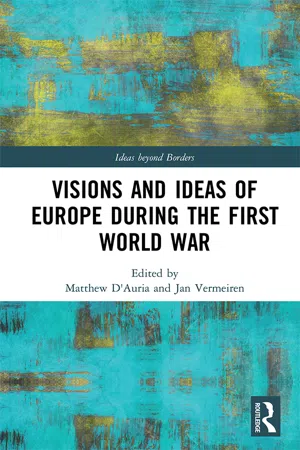
Given the destruction and suffering caused by more than four years of industrialised warfare and economic hardship, scholars have tended to focus on the nationalism and hatred in the belligerent countries, holding that it led to a fundamental rupture of any sense of European commonality and unity. It is the central aim of this volume to correct this view and to highlight that many observers saw the conflict as a 'European civil war', and to discuss what this meant for discourses about Europe. Bringing together a remarkable range of compelling and highly original topics, this collection explores notions, images, and ideas of Europe in the midst of catastrophe.
eBook - ePub
Visions and Ideas of Europe during the First World War
- 264 pages
- English
- ePUB (mobile friendly)
- Available on iOS & Android
eBook - ePub
Visions and Ideas of Europe during the First World War
About this book
Trusted by 375,005 students
Access to over 1.5 million titles for a fair monthly price.
Study more efficiently using our study tools.
Information
Subtopic
British HistoryIndex
History1 Introduction
Notions, images, and ideas of Europe in the midst of disaster, 1914–1918
Matthew D’Auria and Jan Vermeiren
Conversing with his friend Jean Variot in 1908, the French philosopher Georges Sorel trenchantly remarked that in Europe peace was ‘an abnormal condition’. Inhabited by a number of different peoples with disparate interests, desires, and ways of life, Europe was the place of ‘warlike cataclysms’. In his view, anyone advocating the continent’s unification was a fool:
The United States of Europe, on the model of the United States of America?! How dare they compare a land like northern America, inhabited by immigrants sharing identical interests, with Europe, a land occupied by old races that are hereditary enemies? It is pure folly. […] Ten years from now it will sink into war and anarchy, just as it has always done two or three times a century.
The bitter conclusion was that the ‘people of Europe are united only by a single idea: to wage war with one another’.1 The premonition of the author of the Réflexions sur la violence (1908) might be striking, but equally noteworthy is his adamant denial of there being any such thing as a European civilisation. Many at the time would have disagreed – and, importantly, some did so even after 1914. Among those who voiced the opposite view was the French novelist Jules Romains who in 1915 contended that the Great War was but ‘an armed conflict within a homogenous civilisation’. Comparing it to the American Civil War, he saw the causes of its virulence in the fact that fighting one another were peoples that held much in common: a war ‘between two peoples truly strangers to one another is colder, more impersonal, and its violence maintains the form of the political endeavour’.2 It would be difficult to find more distinct views, and much might be said about the radically different backgrounds and intentions of the two writers. However, they do beg the question of whether or not a discourse about Europe and its unity, in whatever form, existed during the Great War, of whether or not Europe was something more than the place where the history of nations – much more ‘real’ entities, capable of moving men and women to great or atrocious deeds – unravelled.
It is usually argued that public debates about European unification prominently emerged in the interwar period, influencing political projects only after the Second World War. Indeed, increasingly threatened by the economic and cultural supremacy of the United States and facing the ideological and military menace of the Soviet Union, European politicians felt compelled to seek ways of overcoming their national rivalries. Discussions about European unification were accompanied by the growing sense of an impending doom that was inspired by a vast ‘literature of crisis’. Authors such as Paul Valéry, Oswald Spengler, Albert Demangeon, and René Guénon all wrote profusely about Europe’s tragic decline in books that deeply affected the cultural and intellectual atmosphere of their day.3 Moreover, for many of them the issue of Europe’s unity was indissolubly tied to that of its identity and to the values and visions shared by its people. The impact of the Great War on such views was momentous. According to Benedetto Croce and Georges Duhamel, both writing in the 1930s, the war had made Europeans aware of their commonalities; ‘wounded by the same pains, proud of the same ideal heritage’, it had given them ‘a strong consciousness of Europe and of what it represented in the world’.4
Recently, a growing number of intellectual and cultural historians have stressed the need to consider the First World War a watershed in the history of the idea of Europe. Menno Spiering and Michael Wintle, for instance, have argued that the impact of the war on ideas and images of Europe, as well as on the projects of its unification, can hardly be overemphasised. Like Croce and Duhamel, they have claimed that a political, social, and cultural predicament over the role of European civilisation emerged from the conflict. The experience of the trenches, the collective mourning for millions of victims, the mobilisation of entire societies on an unprecedented scale, and the promises or the threats of the Russian Revolutions led to a profound ‘crisis of the European mind’. Clearly, the radical re-thinking of Europe’s identity during the 1920s and 1930s cannot be properly grasped without constantly bearing in mind that the changes intellectuals were witnessing and interpreting were the outcome of the most destructive war ever experienced on the Old Continent – until then, at least. The awareness that the age of European supremacy had abruptly come to an end, the feeling that everything that Europe represented was now at risk, and, for some, the need to pursue at least enhanced cooperation to arrest the decline all arose as direct consequences of the war. To understand how discourses and visions of Europe were shaped in the interwar period, Spiering and Wintle have insisted, it is necessary to consider them as the complex legacy of the conflict.5
While the present volume shares and builds on such a perspective, it proposes nonetheless a shift of focus from the writings and the representations of the interwar period to ideas, images, and discourses shaped between the summer of 1914 and the last months of 1918 – that is, in the midst of Armageddon. There are a number of reasons for doing so. First, many of the notions informing the writings of the interwar period were already present in some of the works produced during the conflict. The feeling of decadence of European civilisation emerged long before 1914.6 Calls and even projects for a European federation (in some form or another) were circulating as early as August 1914, and fears of a twofold threat, the American and the Russian, so central to the post-war writings of a Richard von Coudenhove-Kalergi or a Hermann von Keyserling, possessed many intellectuals as early as 1917. Admittedly, these issues, crucial to the discourses about Europe in the 1920s and 1930s, were not as prevalent during the First World War. But, as this book will show, they were more widespread than is usually assumed; they deeply affected the way the ongoing struggle was interpreted and how it influenced ensuing visions of Europe. These are aspects that have been unduly neglected or marginalised. But there is at least one other reason that makes wartime notions and images of Europe particularly interesting – that is, that amid the nationalistic intoxication references to Europe were present at all. This tells us much about the way Europeans saw their civilisation, and it shows the resilience – and in some cases even the heightening – of the feeling of Europeanness shared by intellectual and artistic elites. The fact that the question of European identity was very much at the centre of many writings of the time tends to be occluded by focusing exclusively on those who campaigned for immediate truce, on the one hand, and the nationalistic fervour of well-known intellectuals and lesser-known pamphleteers, on the other. Obviously, in the works of pacifists such as Romain Rolland, Bertrand Russell, Alain (i.e. Émile Chartier), Rudolf Pannwitz, Annette Kolb, and Ernesto Teodoro Moneta calls for reconciliation and possibly even a political unification of Europe were central – although pacifism and Europeanism were not necessarily identical. Yet, marginalised at a time when the war effort required the unconditional support of every citizen, their works have been largely neglected by historians, partly because of the seeming ineffectuality of their views.7 But, importantly and less obviously, the question of Europe’s identity was also central to the writings of many nationalists who saw the efforts of their countries as part of a mission to save or regenerate Europe. Hastily dismissed as paying mere lip service to higher values, references to Europe and its civilisation made in this vein have been overlooked by the current historiography. It is partly for these reasons that the central place of Europe in wartime writings still needs to be properly reconstructed. Many books on the history of the idea of Europe, in fact, often interrupt their narratives in 1914 to resume them in 1919 or, at best, offer only fleeting remarks on discourses about Europe’s identity during the First World War. The issue is briefly touched upon by Carl H. Pegg, Peter Stirk, and Patrick Pasture, as well as in the volume edited by Spiering and Wintle mentioned above.8 But, generally, when looking at the current literature, especially in the English-speaking world, one might be left with the impression that ‘between 1914 and 1919, there was no Europe’.9 It is the central aim of this book to correct this view, to highlight that many observers of the time saw the conflict as a ‘European civil war’, and to discuss what this meant for discourses about Europe. The ongoing slaughter was a ‘war of ideas’, a war between ‘different and irreconcilable conceptions of government, society and progress’.10 Inevitably, as we shall see, it was also a struggle between radically different visions of Europe.
Of course, the ways in which intellectuals, novelists, and artists portrayed or understood Europe at the time need to be considered in relation to the wider sphere they were part of – a prominent and influential part. Their role in the war efforts, in interpreting the conflict’s meaning and in the ‘organization of enthusiasm’ can hardly be overstated.11 Indeed, many contributed to the spiritual mobilisation and nationalistic atmosphere of the moment, feeling the moral duty to support their country with pamphlets, articles, and books printed in the thousands. This ‘betrayal of the clerks’ was apparent even to the more detached observers.12 According to Romain Rolland, for instance, the conflict was partly ‘their war’, as they had ‘poisoned thousands of minds with their deadly ideologies’.13 But the jingoistic celebration of war so magisterially recalled in Stefan Zweig’s memoirs, Die Welt von Gestern (1942),14 would be later repudiated by many in the face of the tragedy of trench warfare, so impersonal and so costly in terms of lives.15 Others, right from the start, found themselves torn between their national loyalty and a feeling of European belonging, and tried, in different ways and with different results, to reconcile the two. As a class, their situation was peculiar and their viewpoint clearly differed from that of other groups. Often speaking several languages, reading and discussing books and ideas of foreign authors, and with strong transnational connections, men and women of letters shared a sense of belonging to the same European civilisation that existed alongside their feeling of national attachment. Attributing to one’s own nation a special role in Europe became commonplace for many intellectuals. According to the writer and poet Gabriele Reuter, for example, the ‘unbounded love for the universality of European culture’ had driven many ‘thousand people with German souls to reach out over the boundaries of our own Fatherland for intellectual conquests, for permeation, and coalescence with all the world’s riches, goodness, and beauty’.16 This inevitably affected their views about politics, society, and the arts, creating discourses that might be traced transnationally. In many cases, it led to painful intellectual, personal, and emotional dilemmas. Hugo von Hofmannsthal, for instance, who had initially sympathised with the German war effort, in 1917 lamented that having been brought up with the notion of Europe, ‘its collapse is a shattering experience’.17 It was largely because of their predicament between two allegiances, national and cosmopolitan, that Rolland and Zweig, to name but two, reserved to intellectual elites a special role in reconstructing Europe and its unity.18
Although the nation remained the main point of reference for many writers and thinkers, several did try to reconcile it with the idea of a un...
Table of contents
- Cover
- Half Title
- Series Page
- Title Page
- Copyright Page
- Table of Contents
- List of figures
- Acknowledgements
- List of contributors
- 1. Introduction: Notions, images, and ideas of Europe in the midst of disaster, 1914–1918
- 2. Decadence, messianism, and redemption: Thinking Europe’s Apocalypse, 1914–1918
- 3. In defence of Europe: Russia in German intellectual discourse, 1914–1918
- 4. Europe in the German pacifists’ discourse during the Great War
- 5. A new world?: German and French debates about America and Europe during the First World War
- 6. Élie Faure, his visions of war and his image of Europe
- 7. Max Waechter, Anglo-German rapprochement, and the European Unity League, 1906–1924
- 8. ‘La Jeune Europe’: Masses, anti-militarism and moral reformation in the Banfi–Caffi correspondence (1910–1919)
- 9. Eagle and dwarf: Polish concepts of East Central Europe, 1914–1921
- 10. Ideas of Europe in neutral Spain (1914–1918)
- 11. Europe under threat: Visual projections of Europe in Raemaekers’ First World War cartoons
- 12. The tenacity of European self-esteem at the time of the First World War: Examples from architecture and the visual arts
- 13. The legacy of war and the idea of Europe in the 1920s
- Index
Frequently asked questions
Yes, you can cancel anytime from the Subscription tab in your account settings on the Perlego website. Your subscription will stay active until the end of your current billing period. Learn how to cancel your subscription
No, books cannot be downloaded as external files, such as PDFs, for use outside of Perlego. However, you can download books within the Perlego app for offline reading on mobile or tablet. Learn how to download books offline
Perlego offers two plans: Essential and Complete
- Essential is ideal for learners and professionals who enjoy exploring a wide range of subjects. Access the Essential Library with 800,000+ trusted titles and best-sellers across business, personal growth, and the humanities. Includes unlimited reading time and Standard Read Aloud voice.
- Complete: Perfect for advanced learners and researchers needing full, unrestricted access. Unlock 1.5M+ books across hundreds of subjects, including academic and specialized titles. The Complete Plan also includes advanced features like Premium Read Aloud and Research Assistant.
We are an online textbook subscription service, where you can get access to an entire online library for less than the price of a single book per month. With over 1.5 million books across 990+ topics, we’ve got you covered! Learn about our mission
Look out for the read-aloud symbol on your next book to see if you can listen to it. The read-aloud tool reads text aloud for you, highlighting the text as it is being read. You can pause it, speed it up and slow it down. Learn more about Read Aloud
Yes! You can use the Perlego app on both iOS and Android devices to read anytime, anywhere — even offline. Perfect for commutes or when you’re on the go.
Please note we cannot support devices running on iOS 13 and Android 7 or earlier. Learn more about using the app
Please note we cannot support devices running on iOS 13 and Android 7 or earlier. Learn more about using the app
Yes, you can access Visions and Ideas of Europe during the First World War by Matthew D'Auria, Jan Vermeiren, Matthew D'Auria,Jan Vermeiren in PDF and/or ePUB format, as well as other popular books in History & British History. We have over 1.5 million books available in our catalogue for you to explore.