This book introduces an events-based approach to understanding digital experience. Focusing on the event-ontologies of Bergson and Whitehead's process metaphysics, it explores subjective experience and objective reality as unified 'events' in the form of concrete slabs of existence. Such slabs are temporally defined by a term or period, in which all physical-chemical processes and personal subjective experience are included. Bringing together insights from a range of different specialisms, it urges us to consider a science of nature that includes both physical and non-physical realities and, from this ontological position, draws on philosophy, media, and user experience practice to provide a new account of the technological or virtual world of today. An examination of the manner in which process philosophy may be applied to contemporary digital experience, this volume will appeal to scholars of philosophy, science and technology studies and information systems.
eBook - ePub
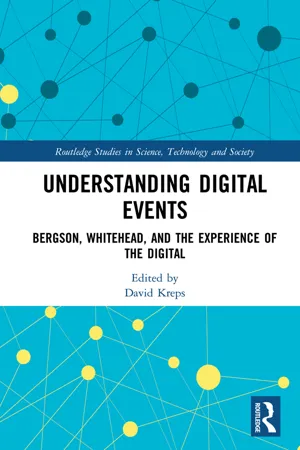
Understanding Digital Events
Bergson, Whitehead, and the Experience of the Digital
- 134 pages
- English
- ePUB (mobile friendly)
- Available on iOS & Android
eBook - ePub
About this book
Trusted by 375,005 students
Access to over 1.5 million titles for a fair monthly price.
Study more efficiently using our study tools.
Information
1
Introduction
This is a philosophy (of technology) book about how the process philosophy of Henri Bergson and Alfred North Whitehead might be used to better understand the nature of (digital) experience. As such, this book is a piece of critical information systems research; both the Editor, David Kreps, and one of the contributors, Bernd Stahl, are active in the field of Information Systems. But at the same time, it is an exploration into philosophy of technology and metaphysics: three of the contributors – Mark Coeckelbergh, Yasushi Hirai and Tina Röck – are philosophers; into media arts: through design guru Malcolm Garrett; and into digital business practice: through Chris Bush and Elizabeth Buie from user experience specialists Sigma UK Ltd. This book seeks, then, through a very transdisciplinary foray, both to address the nature of the digital from a number of relevant angles, and to query where the digital may be taking us, ontologically, in relation to our understanding of the real. No small task!
The Editor, David Kreps, was awarded, in late Summer 2017, a British Academy Mid-Career Fellowship, to last for 12 months from January–December 2018, entitled Understanding Digital Events: A philosophical and sociological study of virtual experience in the everyday. This research – the UDE project – sought to explore analysis techniques by which a philosophical approach based in a study of process philosophers Henri Bergson and Alfred North Whitehead might be incorporated into sociological studies of engagement with digital interfaces, and the techniques of designers and user experience practitioners. As part of the project, a Colloquium was created, designed to bring together insights from a range of different specialisms into this multi-dimensional and transdisciplinary question. This book is the permanent record of the Colloquium. Yet it is more than merely a Proceedings. Alongside this Introduction and the Conclusion, each of the chapters was not formally written up until after the Colloquium, enabling each author to refer to the others’ work, where appropriate, making this book a far more coherent work addressing these issues than a simple ‘proceedings’. In addition, a round-table discussion following the presentations gave an opportunity for each presenter to answer to the presentations of the others, and some of that discussion and thoughts arising are included in Chapter 8 of this volume.
All interdisciplinary works, as one philosopher noted, “are notoriously problematic: sections that appear overly simplistic and old hat to one audience strike another as brand-new and difficult” (Juarrero, 2002, p. 10). Our hope is that in the interconnections, arguments and thrust of this book, readers will discover both interest and insight, alongside a range of new avenues to explore. Such an attempt must, inevitably, comprise merely glimpses of what the Editor is seeking to convey. This book may be taken as a companion volume, then, to a further book, Infomateriality: Bergson, Whitehead and Digital Experience, where the philosophies of the two thinkers, Bergson and Whitehead, are explored and compared, and a unique synthesis derived, with which to confront the results of the UDE project. The two volumes together, it is hoped, will help the reader to better understand this new digital world, from this new perspective. Crucially, in this book, the voices of other authors working in this field are to be heard, greatly enriching the picture the Editor is trying to convey. We are indebted to these authors for their time, their interest in this project and their enthusiasm, and hope the reader will find much food for thought within these pages.
Digital experience
The digital-virtual world that has crept up behind us over the past decade is now poised to completely take over our societies: digital transformation is here and here to stay – with all the extraordinary advantages of communication and access to information that it brings, and the huge pressure upon the planet’s resources that it implies. As these digital technologies have begun to permeate our everyday lives, a generation of young people have grown up developing natural skills – and each older generation adapted and learned new skills, as best they can – to exist in such a digital world. This has led to something of a divide in the use of digital technologies and consequent online interactions between younger and older people.
There are many competing terms for younger people with high digital competencies and immersion, including digital natives (Prensky, 2001), the net generation (Tapscott, 1999) and Generation Z based on Strauss and Howe’s (2008) generational theory. Each of these terms encapsulates the idea that those who have grown up with digital technologies use them much more fluidly through their lives, with more of their day-to-day existence based on an online presence. Many of these young people prefer to engage in a digital world, seamlessly crossing the virtual-offline boundary to synthesise their experiences within both environments (Mäntymäki & Riemer, 2014). It seems clear that the use of such social technologies can deepen relationships, with the younger generation naturally managing their connections in different ways with varying tools, resulting in the perception that the particular tool used does not impact on the quality of the relationship (Subrahmanyam, Reich, Waechter, & Espinoza, 2008). But this age group is not uniform “in terms of Internet skills and use” (Correa, 2016). Digital fluency can be learned, and this can have quite an impact on the experiences of such ‘digital natives’.
By contrast, older adults who have not become digitally fluent can find themselves without the necessary skills to complete daily activities as more of “the business of society is transferred and conducted online” – which can lead to social exclusion. Prensky (2001) terms these people as ‘digital immigrants’, signifying their lack of technical abilities and their difficulties engaging with those with more ‘natural’ skills. Despite this divide, the use of digital technologies has been shown by a range of research projects to in fact empower older adults, contributing to their independence and well-being through knowledge acquisition, access to services and social communications (Hill, Betts, & Gardner, 2015; Ihm & Hsieh, 2015). Informal networks – friends, charities, activity groups – are often used to gain information, mirroring the offline information seeking that this cohort became used to, over decades, in a non-digital world (Godfrey & Johnson, 2009). Emerging mobile communications technologies are of course contributing to ease of use and thus reducing the learning barrier (Tsai, Shillair, Cotten, Win-stead, & Yost, 2015). The Editor’s 87-year-old mother, for example, is completely at home with her iPad, but remains rather frightened of the laptop. There is often an initial barrier to engagement with digital technologies, caused by a lack of self-confidence in skills and the fear of breaking social rules in an online world (Lehtinen, Näsänen, & Sarvas, 2009), and this can be hard to overcome.
This is not to say that everyone falls into such categories. One finding from the research undertaken in the project of which this book is one of the outputs, was that there are in fact a number of older adults who of course have been involved in computing technologies since the 1950s and 1960s, and who know a lot more about it all than we do!
Early surveys of digital experiences focused on the haves vs. the have nots, classifying the users of digital technologies as either those with an Internet connection or those without, a key facet of social inclusion at the time (Selwyn, 2004). As Internet use has become more ubiquitous within our daily lives, the focus has shifted to examine the differences in individuals’ skills, recognising that technical competency can have an impact on the outcomes of the use of digital tools (Hargittai, 2002; Van Deursen & Van Dijk, 2011). This skill level can be quite challenging to measure as it can be based on a number of factors such as technical knowledge, familiarity with software and the level of peer support for its continued use. Recent research has started to compare the differences in experiences of ‘digital natives’ and ‘digital immigrants’, focusing on the varying dependence on smartphones (Ahn & Jung, 2016), use of social media (Metallo & Agrifoglio, 2015) and online trust (Hoffmann, Lutz, & Meckel, 2014).
The study undertaken as part of the UDE project builds on these explorations of the contrast between younger and older people, discovering insights into their everyday use of digital technologies and the impact on the perceptions of online experiences.
It is important also to bear in mind that all this is in no way merely a ‘first world’ phenomenon. The terminology of ‘first world’ or ‘developed world’ versus ‘third world’ or ‘developing countries’ is fast becoming obsolete. When celebrated anthropologist Jared Diamond published his extraordinary insights into the collapse of ancient societies due to environmental pressures – and their lessons for us today – in his book, Collapse, in 2006, such terms were still current, but already beginning to be misleading. The year after, Steve Jobs announced, the new iPhone in hand, ‘this changes everything’. In 2018, the binary us and them nature of such first/third and developed/developing is more to do with anti-immigrant propaganda than accurate depiction. Most people in the world, today, are in the middle – regardless of where they live – and not at the extremes of wealth and poverty. The smartphone phenomenon is a clear illustration of this. It has brought both ease of communication, and the Internet, not just to Rosling’s (2018, p. 33) Level 4 Income people (over $32 a day), but also to those on Level 3 (over $8) and even many on Level 2 (over $2), while the number of those on Level 1 (less than $2 a day) is dwindling fast. In 2018 only 1 billion of the 7 billion people in the world were on Level 1, and only 1 billion on Level 4. Three billion lived on somewhere between $2 and $8 a day, and 2 billion on somewhere between $8 and $32 dollars a day. In other words, 5 of the 7 billion people alive in 2018 were in the middle, neither wealthy nor living in extreme poverty, and this is both something to be celebrated – as Rosling does – and, in terms of its impact on the environment, feared – as Diamond does. Because, according to Statista, 4.5 billion people, in 2018, had access to a mobile phone, which means that probably all Level 4, all Level 3 and about half of those on Level 2 income must be included in that figure. Digital transformation is here, and it is global.
Emerging and frontier technologies that are ‘always on’ and connected both to local and international networks – e.g. cloud platforms now available all over the world, through the smartphone – are transforming social, business, institutional and governmental modus operandi, disrupting established patterns of socialising, managing, trading, governing and working. This phenomenon is so rapid and so inclusive it is hard to grasp. It is happening, moreover, with little oversight and less foresight. The Tech Giants – Apple, Google, Amazon, Facebook, Microsoft (to name just some of the US ones) – are entities each with more power than several nation states put together, in an era when global regulation is weakening and has yet to even begin to truly tackle these changes. Digital interfaces, such as the smartphone touchscreen, have the unique property of being interactive symbologies where virtual tasks are driven by precise physical gestures, directed by mental will, and by sociological forces. Those unfamiliar with these interfaces, forced by circumstance – or in the drive to move, for example, from Rosling’s Level 2 to Level 3 – to engage with them, provide a contrast with the (Level 4) ‘digital natives’ who were born into a world where such interfaces are ubiquitous and culturally familiar, and are able to explore and drive them with alacrity and skill.
As we move into an ever more automated and mediated world of ‘infomateriality’,1 questions of personal experience and its place within the real need asking in new terms, and with potentially new and challenging answers. There is an urgent need, in other words, from the academic community, therefore, for critical philosophical understanding of what is happening and an urgent requirement, moreover, to address these changes from a transdisciplinary and critical standing. Philosophy in computing and information systems has in the past been almost exclusively concerned with logic. There are now loud calls for much more philosophy – and axiology, the philosophical study of value – in information systems research (e.g. Rowe, 2018), and for greater collaboration between IS researchers, philosophers (of technology), and media arts and digital business practitioners. This book brings together experts in all these fields.
The UDE project
The UDE project built upon previous work by the Editor, David Kreps, exploring the philosophy of Henri Bergson and how it might be understood today in light of the advent of complexity theory: Bergson, Complexity, and Creative Emergence (Kreps, 2015), and a growing fear that the products of the information systems field – the digital world described above – are built upon philosophical foundations that are profoundly anti-environmental and detrimental to human survival, a view expressed in the short polemic Against Nature: The Metaphysics of Information Systems (Kreps, 2018). This appreciation of Bergson’s philosophy, and a critical understanding of the role of the digital in contemporary society, underpin this work.
The UDE project sought to examine personal experience of everyday digital tasks – paying a bill online, playing a digital game, receiving smartphone messages. The project sought to discover if such digital experiences can usefully be re-conceived as a set of ‘events’ within a ‘structure of events’. This ‘structure of events’ approach uses Whitehead’s process philosophy, where the ‘event’ comprises both the subjective consciousness of duration (Bergson’s durée ré elle), the experience and dexterity (or otherwise) of our physical gestures, and all the material and virtual artefacts of computing technology, and their interfaces, unified conceptually into a set of Digital Events. This approach seeks to encompass subjective experience in a durational understanding of ‘events’ as concrete slabs of existence defined by a term or period, in which all physico-chemical processes and personal subjective experience are included. Each ‘event’ naturally forms part of a structure of events contained, overlapping and containing other events. The research project sought, therefore, to explore analysis techniques by which this philosophical approach might be incorporated into sociological studies of engagement with digital interfaces.
Those unfamiliar with these interfaces, forced by circumstance to engage with them (the over 65s), provide, as we have seen, an often stark contrast with the ‘digital natives’, born into a world where such interfaces are commonplace. The UDE project involved, therefore, three interlinked subprojects: a) social research on digital experience with over 65s and under 25s; b) the Colloquium combining academics and practitioners on the notion of an IS ‘Event’ – published in this volume; and c) a book manuscript on the philosophy and the social research – the companion volume described above. The sociological fieldwork (a) consisted in three phases: recruiting participants; managing diary studies, interviews; analysing results. Diary studies were undertaken detailing the mental and physical experiences of participants using digital technologies, and were kept for 4 weeks, 3 entries a week, by most participants. Some of the participants were also invited to a semi-structured interview. Collecting diary entries from participants in a consistent, structured manner and managing response patterns such as 3 entries per week is a complex challenge that has not been addressed by any existing online services. To ensure ease of participation, an online web application accessible from any Internet-connected device was created to collect the entries. This combined a number of qualitative and quantitative questions to obtain insight into each participant’s daily experiences, identifying their patterns of use and perceptions of digital technologies. Additional questions were included at key stages to capture the evolving reaction of participants to technology...
Table of contents
- Cover
- Half Title
- Series Page
- Title
- Copyright
- Contents
- List of tables
- List of figures
- List of contributors
- 1 Introduction
- 2 Technology, narrative, and performance in the social theatre: how digital technologies write, direct, and organize the narrative and temporal structures of our social existence
- 3 Not merely physical
- 4 Event and mind: an expanded Bergsonian perspective
- 5 From darkness to light: design to evoke the unconscious
- 6 Digital events and the ethics of neuro-ICT
- 7 Experiencing reality alive: Bergson and Whitehead on engaged experience
- 8 Discussion and conclusions for the notion of infomateriality
- Bibliography
- Index
Frequently asked questions
Yes, you can cancel anytime from the Subscription tab in your account settings on the Perlego website. Your subscription will stay active until the end of your current billing period. Learn how to cancel your subscription
No, books cannot be downloaded as external files, such as PDFs, for use outside of Perlego. However, you can download books within the Perlego app for offline reading on mobile or tablet. Learn how to download books offline
Perlego offers two plans: Essential and Complete
- Essential is ideal for learners and professionals who enjoy exploring a wide range of subjects. Access the Essential Library with 800,000+ trusted titles and best-sellers across business, personal growth, and the humanities. Includes unlimited reading time and Standard Read Aloud voice.
- Complete: Perfect for advanced learners and researchers needing full, unrestricted access. Unlock 1.5M+ books across hundreds of subjects, including academic and specialized titles. The Complete Plan also includes advanced features like Premium Read Aloud and Research Assistant.
We are an online textbook subscription service, where you can get access to an entire online library for less than the price of a single book per month. With over 1.5 million books across 990+ topics, we’ve got you covered! Learn about our mission
Look out for the read-aloud symbol on your next book to see if you can listen to it. The read-aloud tool reads text aloud for you, highlighting the text as it is being read. You can pause it, speed it up and slow it down. Learn more about Read Aloud
Yes! You can use the Perlego app on both iOS and Android devices to read anytime, anywhere — even offline. Perfect for commutes or when you’re on the go.
Please note we cannot support devices running on iOS 13 and Android 7 or earlier. Learn more about using the app
Please note we cannot support devices running on iOS 13 and Android 7 or earlier. Learn more about using the app
Yes, you can access Understanding Digital Events by David Kreps in PDF and/or ePUB format, as well as other popular books in Social Sciences & Sociology. We have over 1.5 million books available in our catalogue for you to explore.