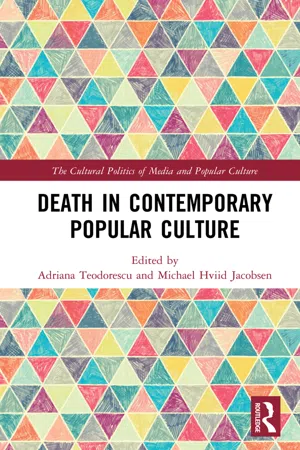
With intense and violent portrayals of death becoming ever more common on television and in cinema and the growth of death-centric movies, series, texts, songs, and video clips attracting a wide and enthusiastic global reception, we might well ask whether death has ceased to be a taboo. What makes thanatic themes so desirable in popular culture? Do representations of the macabre and gore perpetuate or sublimate violent desires? Has contemporary popular culture removed our unease with death? Can social media help us cope with our mortality, or can music and art present death as an aesthetic phenomenon? This volume adopts an interdisciplinary approach to the discussion of the social, cultural, aesthetic, and theoretical aspects of the ways in which popular culture understands, represents, and manages death, bringing together contributions from around the world focused on television, cinema, popular literature, social media and the internet, art, music, and advertising.
eBook - ePub
Death in Contemporary Popular Culture
- 254 pages
- English
- ePUB (mobile friendly)
- Available on iOS & Android
eBook - ePub
Death in Contemporary Popular Culture
About this book
Information
Part 1
Collective attitudes towards and responses to death and mortality
1
Thoughts for the times on the death taboo
Trivialization, tivolization, and re-domestication in the age of spectacular death
Introduction
For decades, it has been fashionable among social researchers, psychologists, historians, and others with an interest in thanatology to declare death a taboo. The existence of this taboo, it is often suggested, fundamentally mirrors modern society’s and modern man’s [sic] inability to deal adequately and openly with the fact of the finality of life. Today, however, it seems as if death has, at last, been liberated from the heavy shackles of its previous taboo, denial, and repression. Many studies thus point out that death – alongside sexuality – has now finally come out of the closet in which it was kept and is no longer confined to a shadowy existence. This chapter critically discusses such claims by examining a variety of examples from contemporary culture. Simultaneously, the chapter questions the claim that death was in fact ever a taboo. First, the chapter revisits and recapitulates the arguments of the so-called ‘death taboo thesis’. Following this, the chapter turns its attention to the notion of so-called ‘spectacular death’ and some of its defining features, such as the new mediated visibility of death, the commercialization of death, the re-ritualization of death, the palliative care revolution, and death as academic specialization. Finally, the chapter discusses whether the taboo on death has in fact been lifted or whether it has rather been replaced by a trivialization, tivolization, or re-domestication of death in contemporary society. The purpose of this opening chapter is thus to frame or to set the broader historical, social, and cultural scene for the subsequent chapters more specifically concerned with death in contemporary popular culture.
When one is researching death and dying and in that capacity is thus invited to circulate and proliferate one’s knowledge and ideas by participating in debates in the media, publishing research-based outputs, giving public lectures, and interacting and communicating with people who have an academic or private interest in the topic, it happens quite often that one is confronted with the tricky yet almost unavoidable question: is death taboo? From my own personal experience, journalists often seem particularly keen to ask this question as if the clarification of that particular question would lead to media headlines or breaking news. British sociologist Tony Walter (2014) has reported the same frequently occurring kind of experience with inquisitive journalists keen to boil our culture of death down to ‘taboo’ or ‘not taboo’. At the end of the day, however, we all know that the answer to the question of death as taboo would hardly reach the front pages of the newspapers or the top stories in the news. Social science knowledge in general, and perhaps particularly knowledge about a rather obscure and morbid topic like death, is not and never will be a hot potato. The reason for the suggested trickiness of the question about death as taboo primarily relates to the expectation of the asking person (journalist or not) that a definitive ‘yes’ or ‘no’ will eventually be spelled out. The dissatisfaction with any hesitant, ambivalent, or inconclusive answer is sometimes hinted at or even openly expressed and is often accompanied by an ill-concealed suspicion that one does not really know what one is talking about despite being designated a ‘death expert’. It seems as if a direct question about the presence or non-presence of a death taboo – or other matters relating to our attitudes towards death and dying – should be readily answered. From my experience, however, this is not the case. Death is indeed difficult to communicate meaningfully about, especially in sensation-seeking media settings allowing only for quick one-liners or either-or answers. A telling story of this fact was once reported by death scholar Michael A. Simpson, who took part in a televised debate about the topic of death in the mid-1970s with the presence of a sociologist, a priest, and a surgeon. He recalled this following incident:
I turned to the Sociologist first: You’ve spent the last five years in research on our national attitudes to death, could you tell us some of your findings?’ ‘We’re scared of it’, he said. There was an awkward pause. ‘Are there any differences between men and women, or young and old?’ I tried. ‘No’, he said, ‘we’re all scared of it’. He sat back looking profoundly satisfied. The next pause was more awkward and fast becoming ugly. He made one final comment. ‘I think it all starts when we’re three, and stand at the toilet watching everything disappear down the drain’.
Simpson 1978–1979:94
Surely also other scholars working with death and dying who are asked to provide the public with their findings, and perhaps particularly those with a social science background who are asked about either hard facts or professional interpretations, will find at least something recognizable in this description: the fact that just because one intensively studies an exotic topic such as death as an object of scientific and intellectual curiosity, one cannot always provide hardcore data or clear-cut answers or reveal the deepest of secrets or the most insightful understandings of that which is studied. The human experience of death is simply too complex and too difficult to boil down to all-clarifying and definitive one-liners.
Thus, the reason it is extremely difficult to obtain an adequate answer to such an otherwise-relevant question about the existence of a death taboo from a death researcher has to do with the deep-seated complexity of such a question. It almost unavoidably opens up a torrent of related questions such as “Has death always/ever been a taboo? How is it a taboo? Why is it a taboo? Should death be a taboo? and What can we do to break the taboo on death?” It is thus my contention that the discussion about death as taboo is almost as impossible to decide definitively as it is to authoritatively determine if something tastes good or bad, if men are smarter than women, or if life was better in the old days. It is, after all, a matter of perspective, contention, and personal judgement (depending on who you ask in which social and cultural context and with not least depending on what one means by the concept of ‘taboo’ on death in the first place).
In our society, it seems as if the notion of ‘taboo’ is being used and abused for anything exotic that we not only don’t want to avoid but also seem to revel in, almost as if the taboo is nowadays synonymous with = the strange, the deviant, the dangerous, and the immensely interesting. Scanning media stories using the notion of ‘taboo’ in recent article headings, one will, for instance, come across how today it is seemingly taboo to allow hair to grow on intimate parts of the body, how one’s personal income is taboo, how loneliness among young people is taboo, how sexual fantasies are taboo, how men who cry are taboo, and so on. It is obvious that the concept of taboo is far reaching and covers quite a broad range of phenomena and experiences related to these. This obviously makes it even more difficult to answer the question of ‘death as taboo’ in any qualified and meaningful manner.
In this chapter, we will venture into a delineation and discussion of the status of death in our ‘postmodern’, ‘late-modern’, ‘liquid-modern’, ‘second-modern’, or ‘hypermodern’ society. (The sociological epithets invented to capture the present phase of social development are as many as they are abstract.) The chapter does not aspire to provide any in-depth or comprehensive account of death or on the taboo on death, but rather to provide a commentary on some of the social and cultural changes that seem to accompany the way we talk about and understand death and dying in contemporary society.
Death as modern taboo
Reading through a lot of the published research on our attitudes towards death and dying in modern Western society from the early 20th century onwards, one is almost immediately convinced that death for quite some time has remained a taboo topic. One will find ample illustrations and proclamations that death is hidden, forbidden, suppressed, sequestered, and moved to the margins of society. Death is also medicalized, institutionalized, and professionalized. Death is not something we talk about, witness directly, or want to spend our living hours contemplating or planning. We want, as French historian Philippe Ariès (1974a:106) would have it, to live happy lives and as if we were ultimately immortal. For all practical intents and purposes, it seems that death is tabooed. But what does it actually mean that death is taboo? The concept of ‘taboo’ has a long history, dating back to the voyages of Captain James Cook and his acquaintance with Polynesian culture on the island of Tonga in 1777. Relying on his observations, the notion of taboo (in Tongan, tapu) has been used to describe those forbidden objects, places, or topics that, for example due to their sacredness, dangerousness or uncleanliness, were regarded off-limits for ordinary people, being primarily the domain of chieftains, witch doctors, shamans, priests, or other initiated groups. Taboo thus spells out prohibition, restriction, and isolation – tabooed topics are no-go areas (see Steiner 1967).
Within academic circles, the notion of ‘taboo’ was first embraced and used by psychoanalysts and anthropologists trying to understand different cultural and/or sexual practices that were deemed dangerous or forbidden. For example, Sigmund Freud was one of the first specifically and systematically to investigate the notion of taboo. In his book Totem and Taboo (1913), Freud concerned himself with cultural taboos in relation to religion, totemism, animism, and incest and the continued impact of primitive societies on modern society. In the later essay ‘Thoughts for the Times on War and Death’ (1915), published during the early months of World War I, Freud elaborated more specifically on taboo in regard to death in modern society. His view was that death in general – and not least the horror associated with the mass death of war – was an incomprehensible phenomenon to people because individuals maintain some sort of unconscious sense of immortality, thus not believing in either the reality or the inevitability of their own deaths. Also, elsewhere in Freud’s writings, the topic of death taboo appears either directly or indirectly in relation to notions of ‘castration anxiety’, ‘death instinct’, and the ‘uncanny’. In the wake of the writings of Freud and other early psychologists and psychoanalysts, it became increasingly commonplace throughout the 20th century to uncritically declare death a modern taboo (Feifel 1959; Farberow 1963; Gifford 1971).
Psychologists and anthropologists, however, were not the only ones concerned with our changing attitude towards death in modern society. Before the rise of the academic niche or sub-discipline known as ‘Death Studies’, the aforementioned Philippe Ariès was one of the first key intellectual figures to draw attention to the study of death as a topic in its own right, deserving of in-depth empirical study. (Obviously, we must not forget classical sociological works such as Émile Durkheim’s famous study of suicide from 1897, Robert Hertz’s Death and the Right Hand from 1907, and other of the more psychologically informed pieces of work to which we return later). In several formidable pieces of historical work published from the early 1970s to the mid-1980s, Ariès showed with a great sense of systematic overview as well as of incredible detail how our so-called ‘death mentality’ had changed in the Western world from the Middle Ages to the present modern society (Ariès 1974a, 1981a, 1985). Ariès – although not systematically employing the specific notion of ‘death taboo’ – is today perhaps still the most quoted scholar in ‘Death Studies’, despite the fact that his work has also been heavily criticized for, for example, being excessively normative, relying on a unilinear model of change, making sweeping generalizations, and at times lacking substantial empirical foundation. His general thesis was that our cultural understanding and handling of death and dying (and also of immortality) does not stand still but changes – however slowly – over time. In his work, Ariès outlined four so-called ‘death mentalities’ or ‘death phases’ that gradually over a thousand years gave way to one another: ‘tamed death’ (covering the high Middle Ages and late Middle Ages), ‘death of the self/death of one’s own’ (approximately covering the Renaissance and Enlightenment periods of European history), ‘death of the other/thy death’ (the 19th century or the ‘Victorian Age’), and ‘forbidden death’ (the 20th century). It was his contention – which is relevant to this chapter – that our death mentality at the threshold of the 20th century began to change quite drastically from that of earlier times. Even though he already saw a ‘turning of the tide’ between the phases of ‘death of the self/death of one’s own’ and its familiarity with death and the increasing alienation associated with the phases of ‘death of the other/thy death’, it was nevertheless particularly during the 20th century’s ‘forbidden death’ that our discomfort with and distance towards death and dying decidedly began to set in. Death, previously a tamed and natural occurrence in communal and everyday life, had now become something alien, incomprehensible, and ‘wild’. In Ariès’s own aptly chosen words:
In a world of change the traditional attitude toward death appears inert and static. The old attitude in which death was both familiar and near, evoking no great fear or awe, offers too marked a contrast to ours, where death is so frightful that we dare not utter its name. This is why I have called this household sort of death ‘tamed death’. I do not mean that death had once been wild and that it has ceased to be so. I mean, on the contrary, that today it has become wild.
Ariès 1974a:13–14
As mentioned, although Ariès’s work was indeed ground-breaking with its deep insight, sweeping scope, and general appeal, he was neither the first nor the last to declare death a problem for modern society, and many others – well before Ariès – had also prominently proclaimed ‘the dying of death’, ‘the decline of mourning’, and the ‘passing of the world of the dead’ as a trademark of this development in modern death mentality from the late 19th to the early 20th century (see, e.g., Jacobs 1899; Jac...
Table of contents
- Cover
- Half Title
- Series Page
- Title
- Copyright
- Contents
- List of contributors
- Preface and acknowledgements
- Introduction: Death as a topic in contemporary popular culture
- PART 1 Collective attitudes towards and responses to death and mortality
- PART 2 Aesthetical aspects and mythical structures
- PART 3 Death as a significant narrative device
- Index
Trusted by 375,005 students
Access to over 1.5 million titles for a fair monthly price.
Study more efficiently using our study tools.
Frequently asked questions
Yes, you can cancel anytime from the Subscription tab in your account settings on the Perlego website. Your subscription will stay active until the end of your current billing period. Learn how to cancel your subscription
No, books cannot be downloaded as external files, such as PDFs, for use outside of Perlego. However, you can download books within the Perlego app for offline reading on mobile or tablet. Learn how to download books offline
Perlego offers two plans: Essential and Complete
- Essential is ideal for learners and professionals who enjoy exploring a wide range of subjects. Access the Essential Library with 800,000+ trusted titles and best-sellers across business, personal growth, and the humanities. Includes unlimited reading time and Standard Read Aloud voice.
- Complete: Perfect for advanced learners and researchers needing full, unrestricted access. Unlock 1.5M+ books across hundreds of subjects, including academic and specialized titles. The Complete Plan also includes advanced features like Premium Read Aloud and Research Assistant.
We are an online textbook subscription service, where you can get access to an entire online library for less than the price of a single book per month. With over 1.5 million books across 990+ topics, we’ve got you covered! Learn about our mission
Look out for the read-aloud symbol on your next book to see if you can listen to it. The read-aloud tool reads text aloud for you, highlighting the text as it is being read. You can pause it, speed it up and slow it down. Learn more about Read Aloud
Yes! You can use the Perlego app on both iOS and Android devices to read anytime, anywhere — even offline. Perfect for commutes or when you’re on the go.
Please note we cannot support devices running on iOS 13 and Android 7 or earlier. Learn more about using the app
Please note we cannot support devices running on iOS 13 and Android 7 or earlier. Learn more about using the app
Yes, you can access Death in Contemporary Popular Culture by Adriana Teodorescu, Michael Hviid Jacobsen, Adriana Teodorescu,Michael Hviid Jacobsen in PDF and/or ePUB format, as well as other popular books in Social Sciences & Popular Culture. We have over 1.5 million books available in our catalogue for you to explore.