Iran's role as a regional power is more significant than many in the West may realise. The country lies between Central Asia/the Caucasus and the Gulf region on the one hand, and, on the other, between the Mediterranean/Levant region and South Asia. Many of these areas are of increasing strategic importance. This book explores Iran's role as a regional power, focusing on relations with South Caucasus countries - Azerbaijan and Armenia. It outlines the historical context, including Persia's rule of these countries before the nineteenth century, and discusses Iran's approach to foreign and regional policy and how both internal and international factors shape these policies. The book assesses Iran–Azerbaijan and Iran–Armenia bilateral relations to demonstrate how those policies translate in Iran's regional and bilateral relations. The book concludes by considering how Iran's relations in the region are likely to develop in the future.
eBook - ePub
Iran's Foreign Policy in the South Caucasus
Relations with Azerbaijan and Armenia
- 304 pages
- English
- ePUB (mobile friendly)
- Available on iOS & Android
eBook - ePub
Iran's Foreign Policy in the South Caucasus
Relations with Azerbaijan and Armenia
About this book
Trusted by 375,005 students
Access to over 1.5 million titles for a fair monthly price.
Study more efficiently using our study tools.
Information
1 Introduction1
In the introduction of his 2013 book, Ramazani, a prominent scholar who spent a decade providing the first systematic study of Iran’s foreign policy back in the 1950s and 1960s, describes how he has been continuously struck by “the poor understanding in the United States of Iran’s international role,” which existed even under the Shah and under friendly circumstances, and the fact that “more than three decades after the revolution, Americans still do not really understand Iran” (ibid.). This failure to comprehend Iran and its foreign policy is not limited to the United Sates; it is indeed a widespread phenomenon that was exacerbated in the post-1979 revolution era due to a variety of reasons. While several factors such as lack of consistent (if any) diplomatic relations and Tehran’s feeble public diplomacy and miscommunications have played their role in creating such circumstances, it is difficult to imagine that overcoming these shortcomings would eradicate the problem completely. The most important factor in creating such a dilemma is the complexity of Iran’s foreign policy, which quite frequently defies conventional rules of analysis and makes its examination and modelling difficult.
One reason for such complexity is Iran’s particular geostrategic location situated on the Eurasian crossroads, straddling two important waterways of the world: the Persian Gulf in the south and the Caspian Sea to the north, both home to a significant volume of valuable hydrocarbon resources. Hence, as a land bridge, Iran connects Central Asia/the Caucasus to the Persian Gulf sub-region, on the one hand, and, on the other, the Mediterranean/Levant to South Asia. As such, Iran is directly involved in, and influenced by, geopolitical developments of four sub-regions of the Persian Gulf, Eastern Mediterranean, Central Asia/Caucasus and South Asia. The division of Persia into spheres of influence under the 1907 Anglo–Russian Treaty or Iran’s occupation by the British and Russian forces during the Second World War to secure the Allied supply line through the Persian Corridor, despite Tehran’s official neutrality, is evidence of the importance of Iran’s geostrategic location. Map 1.1 demonstrates the centrality of Iran’s strategic location in Eurasia.
Although being among the countries with the highest volume of proven hydrocarbon resources, and despite the control that Iran has over the Strait of Hormuz, through which 30% of the world’s annual consumption of oil passes, providing it with significant strategic importance, this also creates further challenges by involving the country in the global politics of energy security.
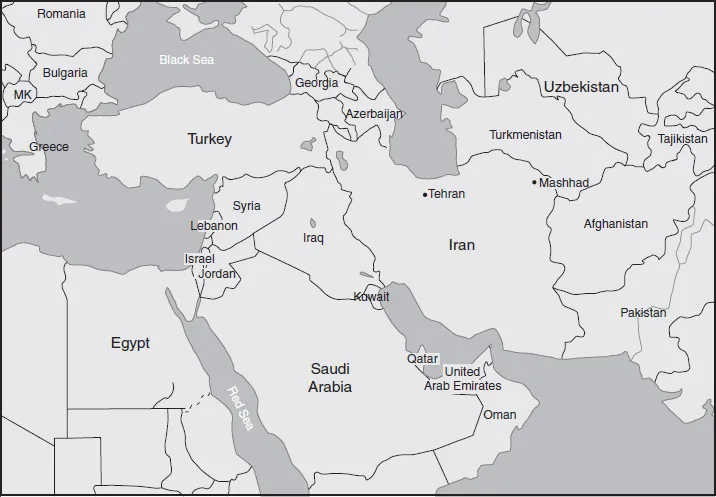
Map 1.1 Iran’s geostrategic location
In addition to its geostrategic location in such a perpetually turbulent regional setting, the exigencies of integration between the ‘Islamic’ and the ‘republican’ essence of the state – which at times seem incompatible – exacerbate factional polity and complicate decision making and execution within an already complex system of checks and balances. Several important attributes, such as being revolutionary, Third Worldist and a rentier state, show their effects on the nature of the state. Furthermore, the existing dichotomy and constant interplay between ideology and pragmatism, as well as frequent change of approach, are important factors which have complicated Iran’s foreign policy and its application in various contexts and periods, including the post-Cold War era.
Nevertheless, the aforementioned geostrategic importance, as well as its vast area and the large population of the country, makes Iran an important international player and regional power (albeit a medium power), no matter who rules it – a “country which is difficult to engage (with), yet impossible to ignore” (Wright 2010: Introduction).
According to Ehteshami (2002: 134–5), “at least since early 1970s, Iran has been regarded as an important regional player; prior to that, it had managed to accumulate considerable strategic value as a weighty pawn in the Cold War chessboard.” The establishment of the Islamic Republic provided Iran with another strategic angle, as ever since Tehran has constitutionally held the torch for defending the “rights of all Muslims without allying with hegemonic powers” (ibid.). By becoming the reference point for oppressed Muslims and particularly the Shiite galaxy, Iran has established a unique place for itself in the politics of adjacent regions, as well as the great powers. This transformation in state ideology and perceptions resulted in a major foreign policy overhaul, turning Iran from an anchor of stability in the Persian Gulf and a close ally of the West into a “defiant, fiercely independent, proactively religious, and nonaligned power” (ibid.: 283) that posed the greatest challenge that the US could face from a single country (US National Security Strategy 2006).
While dealing with such an important actor requires a deep understanding of post-revolution developments and various aspects of foreign policy transformations, speculations among world politicians, academia and media in interpreting Iran’s foreign policy has often resulted in further misunderstandings. As some radical interpretations of the principles set for Iran’s foreign policy2 by the Islamic Republic’s constitution put the country on a conflicting path with the great powers and some regional states from the early post-revolution days, the chance was missed to develop a fair understanding of Iran’s foreign policy in general and its regional policy in particular.
Iran, in the early 1990s, stood at a landmark juncture of both domestic and international developments. The end of the war with Iraq, the death of Ayatollah Khomeini and the presidency of the relatively moderate Hashemi Rafsanjani opened a window of opportunity for plans to create a degree of change in major domestic and foreign policies. Meanwhile, the end of the Cold War and the collapse of the Soviet Union, which resulted in significant transformations of the international system, created considerable changes at the regional level with grave consequences for the neighbouring countries. Among these changes were the emergence of new sovereign states and the evolution of Central Asia and the South Caucasus into a buffer zone between Iran, Turkey and Russia.
Based on Buzan and Weaver’s classification (2003: 421), the small region of the South Caucasus is a sub-complex in the post-Soviet space, where “not only security questions, but a number of political decisions, strategies and alliances are interrelated. The unsolved conflicts have an enormous impact on both domestic politics and foreign policy strategies.” As Freitag-Wirminghaus (2008: 54) has explained, the presence of numerous outside players and their rivalry for geopolitical control of this globally strategic corner of the world, with its abundant hydrocarbon resources, resulted in a phenomenon that many analysts branded as the ‘new Great Game,’ while the unresolved legal status of the Caspian Sea and consequently its hydrocarbon resources has further complicated the region’s geopolitical scene for decades.
The collapse of the Soviet Union provided Iran – which for much of history has had the region within its sphere of influence – with the opportunity for the revival of historical affinities and the prospect of opening new horizons of influence. It also presented challenges emanating from the initial domestic instabilities in the newly independent republics and ongoing conflicts in the region. In many ways, the potential for Iran to establish closer ties with and to develop considerable influence in Azerbaijan and Armenia was far greater compared to other newly emerging states, as in addition to their shared legacy of Persian rule, both countries have common borders with Iran.
Out of these two new neighbours, Azerbaijan seemed, initially, the best option through which Tehran could project power and influence in the Caucasus. The largest of the three South Caucasus countries, with rich natural resources, in contrast to the other two, Azerbaijan has an overwhelmingly Muslim population where the majority share the same religious sect as Shiite Iran. The existing kinship with the large Azeri population of Iran was considered another valuable asset for building a lasting alliance. However, as this study will demonstrate, regional developments have turned out very differently from what Iran had hoped.
Through a detailed examination of Iran’s relations with the two Republics of Armenia and Azerbaijan, the book has assessed the application and implications of Iran’s foreign policy in the regional context. It has made an attempt to determine the goals, priorities and policies that Tehran pursues in this particular sub-region within the framework of its general foreign policy. The aim is to provide a better understanding of Iran’s foreign policy priorities and behaviour, roots of continuity and factors of change in a regional context.
Research context and significance
Three relevant categories of scholarly publications were examined and reviewed for this research. First are those which have studied Iran’s foreign policy in its general capacity and from different aspects, including Iran’s regional policy. The second group are works that have focused on the South Caucasus and examined various issues such as security, energy and other important regional challenges. The third group are those which have discussed Iran’s bilateral relations with the South Caucasus countries.
The review of the literature, which has relied on constructivism for interpreting Iran’s foreign policy, reveals an absence of consensus among scholars, meaning that, although they recognize ideational factors as the roots of Iran’s behaviour, their accounts of such factors are quite diverse. Some, like Marschall (2003: 4), consider Iranians’ “sense of pride and glory from the knowledge of their past” or what Savory (1990: 59) calls “Iranismus,” which is “the idea of a cultural identity which is distinct from that of other races and peoples in the Middle East,” as the most significant factor in the Iranian identity. Others, like Sariolghalam (2003: 82) or Warnaar (2013), consider the Islamic ideology as the most significant ideational factor, shaping Iran’s policies and behaviours.
Prominent scholars like Hinnebush and Ehteshami, Telhami and Barnett, and Dassuki, Korany and Halliday agree that where rationalist approaches fail to adequately explain some foreign policy behaviours, ideational factors can fill the gap (Warnaar 2013: 14). However, relying merely on ideational factors for analysing Iran’s complex foreign policy would deprive the audience of a comprehensive picture in which other domestic, regional and international factors shaping Iran’s foreign policy can be identified. As Halliday (2005: 32–33) put it, “constructivism and its outriders run the risk of ignoring interests and material factors, let alone old-fashioned deception and self-delusion.”
There are, on the other hand, scholars such as Sick (1987), Calabrese (1994), Ehteshami (2002), Hunter (2010) and Juneau (2015) who have based their studies on examining the material and structural factors shaping Iran’s foreign policy.
Although relying on rationalist theories with their emphasis on ‘state’ and ‘interest’ can help in understanding material factors and systemic elements, or, as Halliday (2005: 33) has put it, provide a “rational, empirical account” of factors shaping a state’s foreign policy, they would deprive the study of examining the values and ideas which form the identity of the state and result in certain foreign policy principles and behaviours. Due to the centrality of ideology in Iran’s foreign policy and continuous emphasis of the Islamic Republic’s leaders on ideological factors, one cannot expect to have a full picture of Iran’s politics by relying merely on rationalist theories.
As the above arguments about the strengths and weaknesses of major International Relations theories in interpreting Iran’s foreign policy show, unless we take a more comprehensive theoretical approach, as this study has done and are not content with one single theory, we would inevitably be left with the unaddressed elephant in the room.
Another category of relevant publications is those that have examined Iran’s foreign policy with regard to major international developments. Many of these scholarly works either cover different aspects of Iran’s foreign policy and relations since a particular juncture in history, such as the end of the Cold War, or focus on bilateral and regional relations following such developments. While a significant number of such publications have focused on Iran’s policy and relations in the Middle East, most of the works which have looked at Iran’s relations with the South Caucasus have done so in a larger context, that is, together with Central Asia or as part of the Middle East. For example, Ehteshami (1994: 93) has argued that, due to its historical, cultural and religious connections with the Middle East, CCARs (that is, the five Central Asian republics and the two Transcaucasian states of Azerbaijan and Armenia) have become de facto members of the Middle East since their independence, “but function very much as the latter’s periphery.” Other scholars, like Menashri and Hunter, have considered Central Asia and the South Caucasus as one entity with two integral components, as the latter has more common attributes with Central Asia3 than with the Middle East. However, this study does not consider the South Caucasus as either part of the Middle East or an integral component of one entity with Central Asia. Instead, based on Buzan’s concept of Regional Security Complex, the study has considered the South Caucasus as a sub-system of the post-Soviet security complex.4
Scholars who have examined Iran’s policy in the subject region often have conflicting views in this regard. For example, considering the South Caucasus as part of Central Asia, Pahlevan (1998: 74) believes that the Islamic Republic was
predisposed to interpret the newly acquired independence of the Central Asian republics as a victory for Islam … such analysis of the situation led the Islamic Republic’s leadership to predict its policy in Central Asia on Islamic principles.
On the other hand, Hooglund (1994: 114) argues that those analysts who are (were) “convinced that Iran will spread Islamic fundamentalism throughout Central Asia and the Middle East unless the West undertakes preventive measures” were wrong. Providing evidence to prove that “Iran’s religious activities in the region actually have been muted, paring to insignificance in comparison with the roles of Pakistan and Saudi Arabia” (ibid.: 117), Hooglund concludes that “Iran’s view of its role in Central Asia and Transcaucasia is not the promotion of Islamic activism, but the promotion of mutually beneficial economic activities” (ibid.). Similarly, Ehteshami (1997: 93) describes Tehran’s policy towards the region as “incremental engagement, in which Iran seeks to minimize threats to its own security by promoting stability in the neighbouring regions and by deepening economic exchange.” Then, there are scholars with a view between those introduced above. For example, Menashri (1998: 93) believes that it is beyond argument that “Tehran seeks a ‘return to Islam’ in Central Asia… . But precisely what it is doing” and how much it is prepared to sacrifice for such a cause is a matter of dispute. He reckons that Iran has mostly focused on “politically and ideologically mutual topics in its intergovernmental dealings” (ibid.: 92) and, wherever the “revolutionary ideology clashed with national interests, the latter dictated overall policy” without complete abandonment of the former.
As demonstrated by the brief review above, there are at least three theories regarding Iran’s policy in the South Caucasus: one that believes it is ideology-based and bound on spreading Islamic fundamentalism; another that believes Iran’s policy in the region has avoided ideology; and a third that argues Iran has had its ideological inclinations, but they were limited due to a variety of reasons. Thus, one of the contributions of this book is to examine which theory is closer to reality.
Furthermore, several scholars who agree with the third theory have offered explanations of why it has been so, though some of their arguments can be questioned with valid counterarguments. For example, Haj Yousefi (2008) maintains that despite hostile propaganda, Iran’s policy in Central Asia and the Caucasus has been more inclined towards economic and cultural affairs than religious politics. However, what constitutes “cultural affairs” is, of course, open to debate, particularly when there is a high degree of sensitivity in the receiving state. Moreover, since religion is an integr...
Table of contents
- Cover
- Half Title
- Series
- Title
- Copyright
- Dedication
- Contents
- List of maps
- List of tables
- Foreword
- Preface
- Acknowledgements
- List of important acronyms
- 1 Introduction
- 2 South Caucasus: regional and external players
- 3 Iran’s foreign policy
- 4 Iran’s regional policy
- 5 Iran’s relations with the Republic of Azerbaijan
- 6 Iran’s relations with the Republic of Armenia
- 7 Conclusions
- Bibliography
- Appendix 1: 2010 Caspian Summit Statement
- Appendix 2: high rank visits between Iran and Republic of Azerbaijan
- Appendix 3: high rank visits between Iran and Republic of Armenia
- Index
Frequently asked questions
Yes, you can cancel anytime from the Subscription tab in your account settings on the Perlego website. Your subscription will stay active until the end of your current billing period. Learn how to cancel your subscription
No, books cannot be downloaded as external files, such as PDFs, for use outside of Perlego. However, you can download books within the Perlego app for offline reading on mobile or tablet. Learn how to download books offline
Perlego offers two plans: Essential and Complete
- Essential is ideal for learners and professionals who enjoy exploring a wide range of subjects. Access the Essential Library with 800,000+ trusted titles and best-sellers across business, personal growth, and the humanities. Includes unlimited reading time and Standard Read Aloud voice.
- Complete: Perfect for advanced learners and researchers needing full, unrestricted access. Unlock 1.5M+ books across hundreds of subjects, including academic and specialized titles. The Complete Plan also includes advanced features like Premium Read Aloud and Research Assistant.
We are an online textbook subscription service, where you can get access to an entire online library for less than the price of a single book per month. With over 1.5 million books across 990+ topics, we’ve got you covered! Learn about our mission
Look out for the read-aloud symbol on your next book to see if you can listen to it. The read-aloud tool reads text aloud for you, highlighting the text as it is being read. You can pause it, speed it up and slow it down. Learn more about Read Aloud
Yes! You can use the Perlego app on both iOS and Android devices to read anytime, anywhere — even offline. Perfect for commutes or when you’re on the go.
Please note we cannot support devices running on iOS 13 and Android 7 or earlier. Learn more about using the app
Please note we cannot support devices running on iOS 13 and Android 7 or earlier. Learn more about using the app
Yes, you can access Iran's Foreign Policy in the South Caucasus by Marzieh Kouhi-Esfahani in PDF and/or ePUB format, as well as other popular books in Scienze sociali & Studi sull'etnia. We have over 1.5 million books available in our catalogue for you to explore.