![]()
Part I
The policy-oriented humanistic tradition in comparative education
![]()
Chapter 1
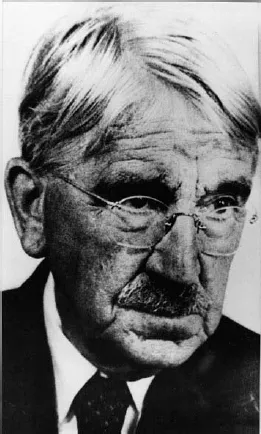
John Dewey
Regina Cortina
1859–1952
This chapter interprets the influence of John Dewey on the field of Comparative Education from the perspective of the declining centrality of the nation-state as a controlling element in social, political and economic changes around the world. One effect of this decline is that public education, which since the 19th century has been associated with expansion of the nation-state and its powers, is being transformed. Social and economic divides in many countries are hindering the access of large numbers of people to the major institutions of society, including and especially education.
The philosopher John Dewey foresaw the possibility of such developments in the early 20th century. In Democracy and Education (1916), he asked, ‘Is it possible for an educational system to be conducted by a national state and yet the full social ends of the educative process not be restricted, constrained, and corrupted?’1 The key issue here is the contradiction he perceived between the ‘full social ends’ of education and the more narrowly constructed agency of the nation-state. In his writings, Dewey argued that a democratic society is not only shaped by how it is governed but by a shared understanding of the interdependent activity of individuals, communities and society as a whole as they work to develop a democratic way of life that can serve them all. From our contemporary perspective, the argument he advanced refers to the construction of citizenship, since citizenship is both linked to the historical process of building a nation-state and to the establishment of democracy as a way of life.
The search for citizenship takes place through initiatives that political scientists refer to as social movements, a form of collective action by people who are marginalized, such as the urban poor and Indigenous groups. Through their mobilization, they engage in a process of learning about democratic forms of participation when confronting the nation-state and demanding equal treatment, access to education and health services, and other objectives involving the rights of citizens. Social movements bring into high relief the sometimes uncomfortable relationship between the nation-state and society when such objectives are not met. Over the years, these movements reflect the struggle of marginalized groups to have their citizenship fully recognized and actualized by the nation-state. This historical process of seeking authentic incorporation as citizens with their own identities and aims points back to what Dewey called the ‘full social ends’ of education in a democratic society. The goal is greater than resolving legal disputes or creating change in the formal organization of the government, but embraces aspirations referring more broadly to the social meaning of citizenship. In this light, social movements represent the demand for a reconceived citizenship extended to those who have been subordinated and excluded by the power of those who control the nation-state.
Dewey at the International Institute, Teachers College, Columbia University
In 1904, John Dewey left the University of Chicago where he had founded the university’s laboratory school, the most important experimental progressive school in the country, to come to Columbia University. His arrival at that university was followed by the creation in 1923 of the International Institute at Columbia’s Teachers College. The International Institute received funds from the Rockefeller Family. A grant of one million dollars started the Institute.2 During those years, thousands of students from many countries around the world came to Teachers College to complete their Master’s degree and participate in intensive summer institutes where they encountered John Dewey and his educational philosophy. Many of them went back to their countries to imagine and develop national education systems. Dewey’s ideas then as well as today were significant in creating new thinking about curriculum, teaching and learning.
To reflect on Dewey’s influence on Comparative Education, it is useful to focus on what was happening in the International Institute at Teachers College, where the field of comparative education as a discipline emerged. Lawrence A. Cremin and his co-authors in their history of Teachers College wrote in 1954 that ‘through the International Institute and the foreign students, the College has had a considerable influence overseas because more than 7,500 students who studied at the College during the life of the Institute frequently were people highly placed in the educational systems of their native countries, rendering their influence far out of proportion to their numbers.’3 All of these students went through the International Institute at Teachers College from 1923 to 1938, where leading scholars such as John Dewey, William Russell, Isaac Kandel (see Chapter 3 by J. Wesley Null in this volume), and Paul Monroe (see Chapter 2 by Liping Bu in this volume) were pioneers in expanding their intellectual curiosity to explore educational systems around the world.
On the occasion of Dewey’s 70th birthday, Isaac Kandel captured the essence of Dewey’s influence on the field of Comparative Education:
It is characteristic of his contributions to the philosophy of Education that Dewey does not insist on the ipsissima verba magistri [the very words of the master] so much as on stimulating thought, on the development of a critical attitude, and on the application of individual effort to the solutions of problems as they are recognized, and it is through this general ferment that his influence is most likely to be enduring, both in this country and abroad.4
John Dewey’s books, particularly The School and Society 5 and Democracy and Education, 6 were translated into many languages. It is through these two books especially that the International Institute played a central role in educational innovation around the world. These books and their translation into many languages exemplify the influence of Dewey on the field of Comparative Education. Most importantly, as Kandel perceived, the books encouraged the readers to apply what they read to the solutions of problems as they saw them in their own countries. After 1917, as Dewey’s biographer Robert Westbrook points out, Dewey’s writings mostly turned to art, esthetics and other subjects.7 Most of the students at Teachers College after 1917 were not exposed directly to Dewey’s presence as a mentor, but they encountered his teachings on schools, cooperative learning and learning by doing. His books remained central to the curriculum for students taking classes at the International Institute.
Dewey’s global influence through his international students
In this chapter, my focus is on the former students of Teachers College and the educational philosophy of John Dewey as his ideas traveled from the classrooms of Teachers College around the world. Analyzing the influence of Dewey on the development of Mexican public education and then looking more broadly to Latin America and to Dewey’s influence on many other countries around the world, this chapter considers the legacy of the Institute from different perspectives. It is important to clarify that the history of Teachers College had two intensive periods of internationalization in the 20th century: first the International Institute that existed from 1923 to 1938, and second the post-World War II period and the support of US federal funding from the International Cooperation Agency – the precursor of the United States Agency for International Development.
In the case of Latin America and Mexico in particular, the quest for equality of social and political rights, including the demand to recognize and honor the identities of marginalized peoples through that quest, has shown that there are two basic aims of social movements in recent times. First, they represent political struggle to gain access to enfranchisement and all that is connected with it in establishing a foothold for greater participation, opportunity and voice in shaping the nation’s future. Second, social movements call for ratification of the multiple identities constituting the citizenry in a diverse society, and they reject notions of citizenship that connect inclusion and participation solely with attributes belonging to social groups already in power. Both the struggle for political enfranchisement and the construction of a citizenry embodying diverse identities are by no means quick turnarounds. They must take place over time, as evidenced by women’s movements, civil rights movements and indigenous movements. All these social movements represent a process of simultaneously challenging the nation-state for greater access and participation while also working to reconstruct a more equitably shared community and social life that respects the multiple identities of society.
Dewey’s philosophy, emphasizing the ‘full social ends’ of education, had a deep and long-lasting influence on the development of public education in Mexico. Moisés Sáenz, a student at Teachers College, Columbia University during the early 1920s, promoted and implemented John Dewey’s ideas in the Secretaría de Educación Pública (Mexican Ministry of Public Education), where he worked upon his return to Mexico after graduate school. Sáenz arrived at Teachers College already a distinguished leader in public education in Mexico, and he was an educator who taught at the Lincoln School. Among other accomplishments, Sáenz was one of the most prominent leaders in the development of rural and secondary schools in Mexico, which were explicitly modeled on principles drawn from the philosophy of Dewey.8 After leaving the Ministry of Education, Sáenz worked in the Mexican Foreign Service and was a leader in the creation of the Inter-American Indian Institute, the first organization that brought together representatives from most countries in the American continent to defend the rights of Indigenous people.9
Just before John Dewey’s trip to Mexico in 1926, in a lecture at the University of Chicago, Moisés Sáenz said:
John Dewey has gone to Mexico. He was first carried there by his pupils at Columbia; he went later in his book — The School and Society is a book well known and loved in Mexico. And now he is going there personally. When John Dewey gets to Mexico, he will find his ideas at work in our schools. Motivation, respect for personality, self-expression, vitalization of school work, the project method, learning by doing, democracy in education — all of Dewey is there. Not, indeed, as an accomplished fact, but certainly as a poignant tendency.10
Sáenz’s enthusiasm must be tempered, however, by the dilemma t...