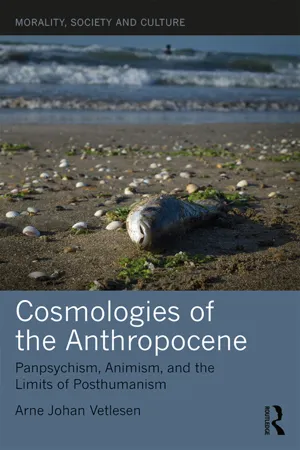
This book engages with the classic philosophical question of mind and matter, seeking to show its altered meaning and acuteness in the era of the Anthropocene. Arguing that matter, and, more broadly, the natural world, has been misconceived since Descartes, it explores the devastating impact that this has had in practice in the West. As such, alternatives are needed, whether philosophical ones such as those offered by figures such as Whitehead and Nagel, or posthumanist ones such as those developed by Barad and Latour. Drawing on recent anthropological work ignored by philosophers and sociologists alike, the author considers a radical alternative cosmology: animism understood as panpsychism in practice. This understanding of mind and matter, of culture and nature, is then turned against present-day posthumanist critiques of what the Anthropocene amounts to, showing them up as philosophically misguided, politically mute, and ethically wanting. A ground-breaking reconceptualization of the natural world and our treatment of it, Cosmologies of the Anthropocene will appeal to scholars of sociology, social theory, philosophy and anthropology with interests in our understanding of and relationship with nature.
eBook - ePub
Cosmologies of the Anthropocene
Panpsychism, Animism, and the Limits of Posthumanism
- 270 pages
- English
- ePUB (mobile friendly)
- Available on iOS & Android
eBook - ePub
Cosmologies of the Anthropocene
Panpsychism, Animism, and the Limits of Posthumanism
About this book
Trusted by 375,005 students
Access to over 1.5 million titles for a fair monthly price.
Study more efficiently using our study tools.
Information
1 Getting it right about mind, nature, and cosmos
This chapter explores the attempt by the philosopher Thomas Nagel to re-engage with the classical questions of philosophy in general, metaphysics in particular. He does so against a predominantly negative background: namely his profound dissatisfaction with the view about reality and about nature – broad labels for big topics, indeed – that he sees as enjoying hegemony within philosophy as well as the natural sciences. As the discussion proceeds, however, it will become evident that Nagel’s attempt to work out a corrective to the present paradigm is far less radical and wide-reaching than he seems to be aware of. As later chapters will demonstrate, that this is so, and the reasons for it, is not peculiar to Nagel’s contribution; it is a feature of several other attempts to break out of a declaredly prison-like human-centered deadlock as well.
I
Nagel tells his readers that the aim of his book Mind and Cosmos is “to argue that the mind-body problem is not just a local problem, having to do with the relation between mind, brain, and behavior in living organisms, but that it invades our understanding of the entire cosmos and its history” (2012: 3). In speaking of “our” understanding, I take Nagel to mean that of Western modernity, including laypersons as well as philosophers. He goes on to observe that intellectual humility requires that we resist the temptation to assume that “even the best developed and most successful forms of contemporary scientific knowledge” are in principle sufficient to understand the universe as a whole (ibid.). Whereas most practicing scientists according to Nagel do not express views about the natural order as a whole, among those who do, joined as they are by philosophers, “reductive materialism is widely assumed to be the only serious possibility” (4). Nagel’s claim is that such materialism, which currently takes the form of psychophysical reductionism, fails in its aim to show “how the physical sciences could in principle provide a theory of everything” (ibid.). The common assumption that everything, including mind, is physical, if only we study it hard enough, must therefore be rejected. Indeed, it “flies in the face of common sense” (5). Alluding to the subtitle of his book, “Why the materialist neo-Darwinian conception of nature is almost certainly false”, Nagel considers it “prima facie highly implausible that life as we know it is the result of a sequence of physical accidents together with the mechanism of natural selection” (6). The resistance of common sense to a fully mechanistic account of the origin and evolution of life, held to depend only on the laws of chemistry and physics, is perfectly legitimate. There is no reason, Nagel asserts, to hold the reductive research program as sacrosanct, although that is precisely what “almost everyone in our secular culture has been browbeaten” into doing (7).
Coming from one of the world’s most renowned analytic philosophers, Nagel’s rhetoric is unusual, and surprisingly strong-worded. In presenting himself as a “layman who reads widely in the literature that explains contemporary science to the nonspecialist” (5), and in siding so explicitly with common sense, Nagel’s project in Mind and Cosmos should be understood as a wide-ranging attack not only on philosophical positions – typically, reductionisms – about which common sense is probably perfectly, and happily, unaware. The book is also meant to challenge the way hegemonic science as well as philosophy have pervaded culture, alienating common sense in its quest for convincing answers to the fundamental questions about the origin of life as well as life’s meaning and value.
Here lies a chief claim of Nagel’s: As humans, we aspire to being able to understand reality in its totality. Nothing less will do. This aspiration is a given for Nagel, indubitable and ineluctable, helping define the human condition. We crave to understand the universe, the natural order, everything that goes into making, and into making possible in the first place, the world of which we are part. It follows that the explanation has to be intelligible: as intelligent beings, creatures endowed with mind, we will not settle for less. Hence, for an explanation of the world to be complete, and to qualify as valid, it has to include at its core an account of ourselves, doing justice to the intelligence that we enact in raising the question about the origin and nature of the world, of everything we take to be real. In enquiring about the world, we also enquire about ourselves; we are epistemic subjects asking questions and demanding coherent answers about epistemic objects.
The reductive materialism that explains the appearance of life from dead matter and that takes evolution to involve nothing but the operation of physical law is not an unassailable doctrine, let alone the one and only scientific theory, says Nagel. Rather it reigns by default. There is something deeply problematic about a theory that seeks to give a complete explanation of the universe and its entities through their unification, by reference to what each and every one of them is taken to have in common. If different entities – some living, others dead, some animate, others inanimate – are said to consist of the same element, how do you account for their difference, for what distinguishes one from the other and marks its specificity? Reductionism, in whatever guise it is conceived, may have the virtue of identifying something common in the manifold of things existing. But it has the vice of losing out on what bestows an entity’s identity as this entity as opposed to that one. In a word, reductionism fails to account for the ontological richness and diversity of the world.
Admittedly, and as anticipated in my Introduction, these are my concerns more than Nagel’s, to be more fully developed later. Nagel’s way of raising the issue of diversity – understood as irreducible such – takes the wholly conventional form of asking how mind (or the mental) can possibly emerge from something purely physical. If you posit the physical as what indubitably exists, and with everything existing as physical (in some minimal sense), how do you explain the existence of mind? More specifically, how do you do so given that – as common sense would insist – mind is something that the “merely” physical is not, that mind can do something, can accomplish things (ask questions, entertain ideas, ponder contra-factuals, etc.) that physical things demonstrably cannot?
“A genuine alternative to the reductionist program”, writes Nagel, “would require an account of how mind and everything that goes with it is inherent in the universe” (15). Perhaps, he goes on to ponder, “the natural order is not exclusively physical” (16).
To suggest that mind is inherent in the universe is certainly to challenge all-out the materialist doctrine. We should, however, note something that Nagel tends not to, namely that his suggestion is not necessarily incompatible with reductionism; on the face of it, it may be a case of replacing one type of reduction with another, that is, a physical one with a mind-oriented one. But then again, to say that mind is inherent in the universe need not imply that everything existing there has mind-character. Rather, it may mean that the existence of mind is to be seen as an ineliminable component of the universe, yet not to be found in every entity but instead in some or in most of them.
However intriguing, Nagel’s suggestion, here as elsewhere, inherits the trait of excessive generality from the doctrine that it seeks to reject. There is simply, on both sides of the disagreement, a lack of a viable way to settle the matter: to show, beyond dispute, whether the universe, or the so-called natural order, in its entirety contains physical, meaning nonmental, properties, or whether it – all of it, as Nagel seems to suggest in his cited formulation – contains mental ones, called mind. As we shall see more fully below, these options by no means exhaust the possibilities; but they are the ones most suited to illuminate Nagel’s suggestion.
A crucial step in Nagel’s argument in Mind and Cosmos is his statement that his “guiding conviction is that mind is not just an afterthought or an accident or an add-on, but a basic aspect of nature” (16). This of course recalls one of the standard arguments against physical reductionism: that it cannot account for mind, and that its attempts to do so amount to a series of ad hoc maneuvers so as to add something (the specific qualities of mind) that is fundamentally alien to it. More important for my purposes is the way Nagel seeks to back up his “conviction”, namely by contending that regarding mind as a basic aspect of nature “is one of the background conditions of science”. And science is “driven by the assumption that the world is intelligible”. Nagel’s idea here is worth quoting in full:
The world in which we find ourselves, and about which experience gives us some information, can be not only described but understood. That assumption is behind every pursuit of knowledge, including pursuits that end in illusion. In the natural sciences as they have developed since the seventeenth century, the assumption of intelligibility has led to extraordinary discoveries, confirmed by prediction and experiment, of a hidden natural order that cannot be observed by human perception alone. Without the assumption of an intelligible underlying order, which long antedates the scientific revolution, those discoveries could not have been made.
(16)
We have already encountered Nagel’s notion that, being intelligent, the understanding of the world – including nonhuman entities – must be such as to seem intelligible to us. The constellation with which Nagel works is that of us as knowers and the world as knowable to us. The world is knowable when it matches up to our faculties of knowledge: reaching out to what we expect to qualify as intelligible, we settle for nothing else.
This notion of Nagel’s may seem sensible enough, even obvious. My worry, however, is that Nagel reduces ontology to epistemology: he reduces the metaphysical question of what is to questions about how we can come to know what is. As we will see in a moment, there is a slide in Nagel’s book from start to end. He begins by asking the big questions about the big picture, meaning our modern conception of nature, understood as the totality of what is. Hence, he aspires to reopen the classical metaphysical inquiry into everything that, in one form or another, makes up reality. The aim of this inquiry is, and remains, totality, an exhaustive theory of what is, doing justice to the richness of everything that exists, yet does so in so many peculiar ways: the many beings that make up Being, to allude to Heidegger.
The slide that I see in the course of Nagel’s discussion is a shrinking, a narrowing of perspective. It is a shift of emphasis from the big picture that is concerned with everything there is, “the natural order” of which humans are just one of many entities, to an increasingly one-sided concentration on the question about how to give the best philosophical or scientific account of what we humans are, especially in terms of consciousness and cognition – i.e., how can we explain that we have come to possess mental capacities of the sort required for asking questions about anything at all? Capacities of such power and sophistication as to seem unique to us among all beings?
It is tempting to respond by saying that the slide is perfectly logical: who would give that exhaustive theory if not the epistemic subject? Isn’t it elementary that in offering a view – any view – about the totality of what is, we need to take into account who it is that offers that view, so as to be able to decide about its truth (validity)?
The problem is that Nagel, in proceeding in said manner, ends up offering his readers a critique of the modern Western notion of the so-called natural order that is both less deep and less far-reaching than it should have been, given the book’s stated aim of re-engaging with totality. It is precisely the obviousness, the “how could it be otherwise?”, of Nagel’s discussion that betrays it, that gives away how conventional it is, how loyal it is to the paradigm he sets out to question, the one inaugurated by Descartes and brought to unprecedented level of “transcendental” sophistication in the epistemology of Kant.
The point I am making against Nagel is reminiscent of the general point Charles Taylor has made on numerous occasions, concerning what Taylor calls the primacy of the epistemological, understood as “the tendency to think out the question of what something is in terms of the question of how it is known” (Taylor 1995: 34). Taylor sees this as “a pervasive feature of modern intellectual culture” (ibid.). Notwithstanding attempts to get rid of it, the Cartesian legacy proves persistent, and I think Nagel is a case in point. Its gist is the insistence that “we can somehow come to grips with the problem of knowledge, and then later proceed to determine what we can legitimately say about other things: about God, or the world, or human life” (Taylor 1995: vii). In other words, we first need to be clear about the nature of knowledge, hence about ourselves, about our capacities as epistemic subjects, and about what it is to make a defensible claim about the world, or some particular entities in it.
Coming at the issue from a different angle than Taylor, namely that peculiar to his version of realism, Roy Bhaskar designates the tendency to “analyse being in terms of knowledge” the “epistemic fallacy”, involving as he sees it “the denial of the possibility of a philosophical ontology”. It is, Bhaskar argues, “a necessary condition for the occurrence of science that the world exists and is of a certain type. Thus the possibility of our knowing is not an essential property, and so cannot be a defining characteristic, of the world”. Accordingly, “knowledge follows existence, in logic and time; and any philosophical position which explicitly or implicitly denies this has got things upside down” (Bhaskar [1975] 2008: 38, 39).
I am not suggesting that Nagel is a case in point for getting the relationship between being and knowledge upside down the way that Bhaskar describes. But Nagel’s project would have gained in clarity had he acknowledged the force of Bhaskar’s (as well as Taylor’s) insight. Short of that, Nagel describes the assumption about the intelligibility of the world, that “rational intelligibility is at the root of the natural order”, as a form of “the principle of sufficient reason – that everything about the world can at some level be understood, and that if many things, even the most universal, initially seem arbitrary, that is because there are further things we do not know, which explains why they are not arbitrary after all” (17). Nagel is in no doubt that the intelligibility of the world – first described as an “assumption” – “is no accident”. On this view, mind is “doubly related to the natural order. Nature is such as to give rise to conscious beings with minds; and it is such as to be comprehensible to such beings. Ultimately, therefore, such beings should be comprehensible to themselves” (17).
This reasoning illustrates the slide that I referred to. The problem is not Nagel’s interest in mind as a something that exists in the natural order. What is problematic is what he immediately proceeds to do with mind: first, connecting it to “conscious beings”, second, postulating that nature is (must be) such as to be comprehensible to those beings, and third, concluding (“therefore”) the comprehensibility to themselves of such beings.
Nagel here actualizes the point made, in somewhat different manner, by Taylor and Bhaskar. In what is meant to strike the reader as a perfectly logical reasoning, and as compelling, Nagel moves from talking about the natural order – the totality, comprising everything, capturing the agenda of classical metaphysics – to concentrating on the issue of comprehensibility. He focuses on comprehensibility not in a universal sense but as it arises for one being in the world of beings, one entity in the myriad of such [entities] within the natural order, namely us humans in our capacity as the ones seeking knowledge and asking about its scope and truth, as brought out in Nagel’s formulation about the things we know and those we (up until now, at least) don’t know.
What I am faulting Nagel for is that he drops the broad concern with “the things”, with totality, in favor of the all-too-familiar, yet restricted concern with knowledge (“comprehensibility”) and the capacities, especially mental capacities, of the sort of beings for whom such knowledge is central.
There is also another restriction involved. Why approach nature, as does Nagel, with a special view to how it gives rise to conscious beings with minds? Why should this be what is most important, and most interesting, about nature? In giving pride of place to mind, does one not risk ignoring other properties, and other forms of existence, in that nature? Why accord such privilege to the former? And last but not least, the million-dollar question: Does mind exist in humans only? If so, how widely and differentiatedly is mind present, or spread out, in the natural order as Nagel understands it?
As I have indicated, there is something question-begging and tendentious about Nagel’s way of going about raising these issues. He tends to pose them in a restricted manner that narrows the scope of his inquiry as compared with the totalizing and exhaustive ambition of metaphysics. This is an ambition that has generally been given up since Descartes and Kant and the “turn inward” (Taylor 1989) that they, in their distinct ways, inaugurated, with the still-lingering consequence that the concerns of epistemology have taken center stage and eclipsed a full philosophical take on the whole of which humans are only a part.
II
Return now to Nagel’s main argument. He dismisses the view that everything that exists can in principle be explained by the laws that govern the physical universe. Physicalism runs up against an insoluble problem: it cannot convincingly account for the existence of mind in the physical universe whose basic elements that it seeks to explain. Indubitable as the existence of mind is (at least to us, and that is what counts on this model), it remains an anomaly in physicalism: something it is forced to acknowledge and so to explain, yet it cannot. Having dismissed materialism, understood as the attempt to explain mind as a consequence of physical law, Nagel goes on to dismiss its traditional chief rival as well, theism taken as the attempt to makes physical law a consequence of mind. None of them succeeds as a comprehensive world view, Nagel maintains, adding that his “interest is in the territory between them” (22). More precisely, his interest is in a secular conception that “acknowledges mind and all that it implies, not as the expression of divine intention but as a fundamental principle of nature along with physical law” (22).
Having at the start of his book rejected the view that mind can be explained by, and can be accounted for as emerging from, something purely physical, it is not surprising that he opts for a theory of reality that allows for both something physical and something mental. Both must be accounted for within the same comprehensive theory. Neutral monism is name of the position he advocates, favoring it over the traditional alternatives of materialism, idealism, and dualism (5). (It is noteworthy that Nagel only mentions idealism in passing, offering no discussion of Hegel and passing over K...
Table of contents
- Cover
- Half Title
- Series
- Title
- Copyright
- Contents
- Preface
- Introduction: from anthropocentrism to the Anthropocene
- 1 Getting it right about mind, nature, and cosmos
- 2 Panpsychism as “inner physics”: Whitehead’s project
- 3 Prospects and pitfalls of agential realism
- 4 Animism – panpsychism in practice
- 5 Agency posthumanist style: proliferation or decimation?
- Bibliography
- Index
Frequently asked questions
Yes, you can cancel anytime from the Subscription tab in your account settings on the Perlego website. Your subscription will stay active until the end of your current billing period. Learn how to cancel your subscription
No, books cannot be downloaded as external files, such as PDFs, for use outside of Perlego. However, you can download books within the Perlego app for offline reading on mobile or tablet. Learn how to download books offline
Perlego offers two plans: Essential and Complete
- Essential is ideal for learners and professionals who enjoy exploring a wide range of subjects. Access the Essential Library with 800,000+ trusted titles and best-sellers across business, personal growth, and the humanities. Includes unlimited reading time and Standard Read Aloud voice.
- Complete: Perfect for advanced learners and researchers needing full, unrestricted access. Unlock 1.5M+ books across hundreds of subjects, including academic and specialized titles. The Complete Plan also includes advanced features like Premium Read Aloud and Research Assistant.
We are an online textbook subscription service, where you can get access to an entire online library for less than the price of a single book per month. With over 1.5 million books across 990+ topics, we’ve got you covered! Learn about our mission
Look out for the read-aloud symbol on your next book to see if you can listen to it. The read-aloud tool reads text aloud for you, highlighting the text as it is being read. You can pause it, speed it up and slow it down. Learn more about Read Aloud
Yes! You can use the Perlego app on both iOS and Android devices to read anytime, anywhere — even offline. Perfect for commutes or when you’re on the go.
Please note we cannot support devices running on iOS 13 and Android 7 or earlier. Learn more about using the app
Please note we cannot support devices running on iOS 13 and Android 7 or earlier. Learn more about using the app
Yes, you can access Cosmologies of the Anthropocene by Arne Johan Vetlesen in PDF and/or ePUB format, as well as other popular books in Social Sciences & Sociology. We have over 1.5 million books available in our catalogue for you to explore.