One prominent function of natural language is to convey information. One peculiarity is that it does not do so randomly, but in a structured way, with information structuring formally recognized to be a component of grammar. Among all information structuring notions, focus is one primitive needed to account for all phenomena.
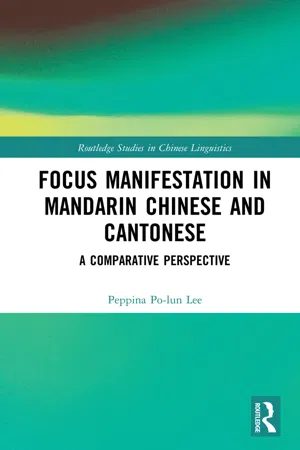
Focus Manifestation in Mandarin Chinese and Cantonese: A Comparative Perspective aims to examine from a semantic perspective how syntactic structures and focus adverbs in Mandarin Chinese and semantic particles in Cantonese conspire to encode focus structures and determine focus manifestation in Chinese. With both as tonal languages, Mandarin Chinese and Cantonese manifest different morpho-syntactic configurations to mark focus. A general principle governing focus marking in Mandarin Chinese and Cantonese is given in the book, which aims to give a better understanding on the underlying principles the two used to mark additive and restrictive meanings, and related focus interpretations. Particular attention is also drawn to the co-occurrence of multiple forms of restrictive and additive particles in Cantonese, including adverbs, verbal suffixes and sentence-final particles. Linearity has shown to be an important parameter to determine how focus is structured in Cantonese.
This book is aimed at advanced graduate students, researchers and scholars working on Chinese linguistics, syntax and semantics, and comparative dialectal grammar.
Trusted by 375,005 students
Access to over 1.5 million titles for a fair monthly price.
One prominent function of natural language is to convey information, and one peculiarity is that it does not do so randomly but in a structured way, with information structuring formally recognized to be a component of grammar. There is general consensus that the linear order of constituents is to a certain extent determined by what is contextually known and what is not, which is what is captured under the concept of givenness and newness proposed as early as in the Prague School in the late 1920s. In the case of Chinese, Liu and Xu (1998) proposed that for every sentence, the sentence-final position in Chinese is by default the position where new information is located, hence the syntactic structural position for informational focus. Apart from linear order and other structural notions, intonation and other tonal events interact with word order to determine the information structure of the sentence. While English employs intonational tonal events as a salient cue, Standard Chinese manifests focal-prominence more in the distinctive realization of lexical tones, since the addition of pitch accents is prohibited (see Chen, Lee, and Pan 2016). Various acoustic cues have been recorded to be involved in focus-marking. For example, lexical words under focus generally having longer duration (see e.g. Jin 1996, Xu 1999, Chen 2006) and higher mean intensity (see e.g. Shih 1988, Chen et al. 2009). The effect of focusing and givenness is not only an issue of accenting and deaccenting.
In a sentence, expressions within the focus domain which are not focused are said to be in the background of the focus domain, with the focus within the focus domain generally to be replaced by some alternatives, which has led to various theories, purely semantic or pragmatic, to account for the relation between the focus and the focus alternatives. This includes association of focus considered under the semantic representation of focus-background partition in line with Partee 1991; Hajićová, Partee, and Sgall 1998; and many others, which assumes that in semantics, the background is mapped onto the restrictor, and the focus onto the nuclear scope of tripartite quantification structures. Pragmatic theories of focus association are represented by Rooth (1985, 1992, 1995) and von Fintel (1994) for focus interpretation. The pragmatic definition of focus may differ from the semantic one in that the complement of the focus, that is, the background part, may not always be presupposed. An example is cited from Erteschik-Shir to illustrate this.
According to Erteschik-Shir, the focus of answer A is “to Mary”, but A does not necessarily presuppose that “I gave it to someone”. Therefore, even though focus may be argued to be syntactically anchored or be semantically interpreted, it is closely related to pragmatic and contextual/discourse factors as well. According to Dik (1997), “the focal information in a linguistic expression is that information which is relatively the most important or salient in the given communicative setting, and considered by [the] S[peaker] to be most essential for [the] A[ddressee] to integrate into his pragmatic information” (cited from Dik 1997, p.326).
The above shows that focus is a phenomenon intertwined with different levels of linguistics and context/discourse. Along the above line of argument, it is widely acknowledged that natural language appeals to four ways to mark focus: (i) syntactic structures, (ii) focus markers, (iii) pitch accents, or (iv) the combination of these devices, with Chinese mainly adopting (i) and (ii). Although much work on focus structure has been conducted, covering a wide range of languages from different linguistic families, an overall picture of how Chinese marks focus is still lacking, despite individual studies on a few isolated phenomena. The current work is based on Mandarin Chinese (henceforth “Mandarin”) and Cantonese, which have been selected for the following reasons. Mandarin appeals to a wide range of syntactic constructions to mark focus, whilst for the use of focus markers, it is restricted to pre-verbal focus adverbs and is not very productive or unattested in post-verbal particles. Cantonese fills in the gap of Mandarin data due to its two unique features: (i) a particularly rich inventory of post-verbal particles, including verbal suffixes and sentence-final particles (SFPs), with the number identified ranging from 30 (see e.g. Kwok 1984; Law S. P. 1990; Luke 1990) to 70 (see Leung 1992/2005), and only around seven in Mandarin (see Hu 1981; Li and Thompson 1981); and (ii) frequent co-occurrence of multiple forms of additive and restrictive adverbs and post-verbal particles, with no redundancy in meaning. The occurrence of multiple forms of focus particles can also be observed in the SFP positions, as Cantonese is relatively free in forming SFP clusters defined as [[IP + SFP1]+SFP2…], possibly consisting of up to seven monosyllabic SFPs, with Mandarin allowing only two, that is, le and ba (see e.g. Leung 1992/2005). Therefore, despite the fact that both Mandarin and Cantonese fall within the Chinese family, they may not be exactly the same in the way they mark focus, at least in terms of their focus markers, which vary in their morpho-syntactic properties.
In this light, this book aims to examine from a semantic perspective how (i) focus adverbs in Mandarin; (ii) focus adverbs, verbal suffixes, and sentence-final particles in Cantonese; and (iii) the co-occurrence of multiple forms of focus adverbs and post-verbal particles conspire to encode focus structures and influence focus manifestation in Chinese. Although I will concentrate more on focus particles, to generalize the overall strategies Mandarin and Cantonese adopted for focus manifestation, syntactic constructions for focus marking will be included. This book also attempts to study focus marking in Mandarin and Cantonese from a comparative perspective, with the ultimate aim to find out how Mandarin and Cantonese differ in representing focus meaning. Association of focus will be considered under the semantic representation of focus-background partition in line with Partee 1992; Hajičová, Partee, and Sgall 1998; and many others, which assumed that in semantics, the background is mapped onto the restrictor, and the focus onto the nuclear scope of tripartite quantification structures. On the other hand, SFPs would be a definable factor in affecting focus interpretation in Cantonese, and taking into consideration their scalar interpretations, various contextual discourse factors, and how speakers’ attitudes affect the semantic meaning of the sentence would be considered under Lasersohn’s (2009) relativist semantic theory.
1.2 Scope of the study and major ideas to be proposed
As mentioned, an important topic of the present study is “focus particles”, which is a category that has never been defined clearly. “Focus particles” are either regarded as a subclass of particles (cf. Helbig 1988, Foolen 1993) or as a subclass of adverbs (cf. König 1991, Hoeksema and Zwarts 1991), which are quite heterogeneous and differently defined in the literature. Gast and van der Auwera (2011) used the general term “operator” for scalar additive particles because “many of the relevant items do not exhibit properties typical of adverbs. Even the term ‘particle’ is too specific, as it entails that the items in question are (uninflected) words, and in many languages, scalar additive operators can be found that are not single independent words, and which therefore cannot be classified as ‘particles’, since they are really ‘particle groups’” (cited from Gast and van der Auwera 2011, p.4). Cantonese involves verbal suffixes and SFPs in such a group of “focus particles”, which are bounded and may not be taken as single independent words. Therefore, without going into the morphological definition of “particles”, the term “particles” in this book is used in a broad sense, which include adverbs, verbal suffixes, and SFPs.
Moreover, it is customary to identify two broad classes of focus particles: additive particles and restrictive particles, and adverbs and particles of these two types are therefore included in the current study. Mandarin has at least four additive adverbs, namely you1 ‘again’, ye ‘also’, hai ‘still’, and zai ‘again’, which vary in the meanings expressed by their stressed and unstressed form, showing that Mandarin to a certain extent relies on prosodic stress to express focus meanings. If this is the case, what role does prosodic stress play in focus interpretation? These four additive adverbs correspond to the Cantonese additive adverbs jau6 ‘again’, dou1 ‘even/also’, zung6 ‘still’, and zoi3 ‘again’, and a comparison will be made between Cantonese and Mandarin additive adverbs to find out whether they are absolute equivalents or not. For example, the Cantonese dou1 ‘all’, which has been assumed to be equivalent to the Mandarin dou ‘all’, does not show a one-to-one mapping to the Mandarin dou, making the two not absolute equivalents. Moreover, Cantonese has the additive adverb gau3 ‘enough’, which needs to be licensed by an assertive SFP. The use of “gau3…SFPassert” requires the predicate to mark a downwards movement of the scale. An immediate question is whether it is due to the semantics of the SFPassert, and previous analyses consider gau3 as an analogy to the Cantonese dou1, which again needs to be further examined. Furthermore, Mandarin hai ‘still/even/also’ is highly polysemous in its uses, conveying the meanings of the English “still”, “even”, and “also”, and if Mandarin rests on one hai to convey all these meanings, will Cantonese be the same or different?
The above picture becomes more complicated if the use of Cantonese verbal suffixes and SFPs is considered. Besides additive adverbs, Cantonese appeals to the additive verbal suffix -maai4 ‘also’ and the additive SFP tim1 ‘too/as well’ to express additivity. If Cantonese already has four additive adverbs corresponding to those of Mandarin and “gau3…SFPassert”, why does Cantonese still rely on -maai4 and tim1? If additive verbal suffixes and SFPs are lacking in Mandarin, in what way does Mandarin express the same meanings? Is a syntactic construction like lian… dou ‘even…also’ a typical way Mandarin uses to express focus meaning?
On the other hand, for restrictive adverbs in Mandarin, there is a list of publications on the restrictive adverbs cai ‘only’ and jiu ‘only’, stressed and unstressed, but many questions have not been fully answered, with a unified and distinct analysis of the two yet to be worked out. I am not in a better position to give a comprehensive and satisfactory account of cai and jiu, and the current focus is more on how the relevant meanings are represented in Cantonese. Moreover, Mandarin also appeals to restrictive adverbs like zhi(-you/-shi) ‘only(-have/be)’ to express restrictive meaning, through the adjunction of the exclusive adverb zhi ‘only’ to shi ‘be’, with exclusiveness conducted by a grammatical mechanism. If this is the case, would it lead to the conclusion that Mandarin relies on focus adverbs with prosodic stress and grammatical mechanisms for restrictive focus structuring? For restrictive adverbs in Cantonese, Cantonese has zing6-hai6 ‘only-be’, zaai1 ‘only’, and sin1 ‘only then’, and the question is how these adverbs are semantically comparable to Mandarin restrictive adverbs.
Aside from this, Cantonese also appeals to the restrictive verbal suffixes -dak1 ‘only’ and the SFPs zaa3 ‘only’ and ze1 ‘only’. If this is the case, what is their role in expressing Cantonese restrictiveness, and in what way does Mandarin convey the same meanings? The picture of SFPs zaa3 and ze1 is complicated in the sense that although both express the basic meaning of “restrictiveness”, they vary in their syntactic positions, with one projected as the head of IP/TP and the other as the head of Attitude P. Under Lasersohn’s relativist semantic theory, the two differ in their speaker stances or the speakers’ attitudes. Therefore, an immediate question is how speakers’ attitudes determine syntactic projection and the semantic meaning of these focus SFPs, and in what way would Mandarin express similar meanings if they lacked SFPs? Moreover, as mentioned, the number of Cantonese SFPs is identified in previous studies ranging from approximately 30 (see e.g. Kwok 1984, Law 1990, Luke 1990) to 95 (see Leung 1992/2005). The great variation in terms of numbers is due to the fact that a change in the tonal property of Cantonese would result in a change in lexical meaning, leaving the question of whether they are the same or distinct SFPs debatable. This to a certain extent does not only apply to a change in tonal property but to a change in vowels as well, leading Fung (2000) to propose the numerous manifestations of SFPs be analysed as evolving from three families, labelled Z-, L-, and G-. In relation to the current study, it seems that not only a variant in tones but also in vowels would give a change in the lexical meaning of the SFPs, which necessarily influence the encoding of focus in Cantonese. This is at least true in the case of restrictive SFPs, which is an issue to be examined. Additionally, while the Z- family is considered to mark the feature [+restrictive] in Cantonese SFPs, Mandarin SFPs do not have focus SFPs, be it the additive or the restrictive type. If this is the case, how does such a morpho-syntactic difference affect focus structuring and marking in Mandarin and Cantonese, and in what way does Mandarin expresses the same meaning as that of Cantonese focus SFPs? All these are issues to be further examined in the remaining parts of the book.
Therefore, through a comparative study between Mandarin and Cantonese additives and restrictives, one objective of the study is to find out the underlying principles the two use to mark additive and restrictive meanings, and related focus interpretations. The issues raised so far seem to suggest that while Mandarin appeals to pre-verbal focus adverbs or grammatical mechanisms to mark additive and restrictive focus, Cantonese appeals more to its particularly rich inventory of verbal suffixes and SFPs, though grammatical mechanisms do play some role in Cantonese focus marking. If grammatical mechanisms play a role in Mandarin or Cantonese in marking focus, does it mean that syntax is crucial in the two? This is particularly the case if one also considers the additive verbal suffix -maai4 ‘add’, of which its interpretation is governed by a Quantification Accessibility Hierarchy (QAH-maai4, see P. Lee 2012) determined according to the distance of the verbal arguments from the verb. Xu (2004, p.277) states that “Chinese is a language which exhibits a reverse relationship between syntactic positioning and phonological prominence of focus, making it different from European languages, while in West Germanic languages, focus has a systematic manifestation via pitch accent”. While Xu’s syntactic positioning is based on his claim that informational focus in Chinese is always located at the final position, and that in languages such as English, focus has a systematic manifestation via pitch accent, regardless of whether the focused element is situated in the syntactically favoured focus position or not. It can be said that Xu is the first one who formally recognized the importance of syntax in determining information structure in Chinese. To further consolidate the role of syntactic constrictions and grammatical mechanisms in marking focus, aside from zhi(-you/-shi) ‘only(-have/be)’ and zing6-hai6 ‘only-be’, the study will also include focus syntactic or grammatical constructions, for example, lian…dou ‘even…also’...
Table of contents
Cover
Half Title
Series Information
Title Page
Copyright Page
Contents
Tables
Acknowledgements
Abbreviations
1 Introduction
2 Theoretical background
3 Additive focus particles
4 Restrictive focus particles
5 Distribution of additives and restrictives in Mandarin Chinese and Cantonese
6 Conclusions: Theoretical consequences and implications
References
Index
Frequently asked questions
Yes, you can cancel anytime from the Subscription tab in your account settings on the Perlego website. Your subscription will stay active until the end of your current billing period. Learn how to cancel your subscription
No, books cannot be downloaded as external files, such as PDFs, for use outside of Perlego. However, you can download books within the Perlego app for offline reading on mobile or tablet. Learn how to download books offline
Perlego offers two plans: Essential and Complete
Essential is ideal for learners and professionals who enjoy exploring a wide range of subjects. Access the Essential Library with 800,000+ trusted titles and best-sellers across business, personal growth, and the humanities. Includes unlimited reading time and Standard Read Aloud voice.
Complete: Perfect for advanced learners and researchers needing full, unrestricted access. Unlock 1.5M+ books across hundreds of subjects, including academic and specialized titles. The Complete Plan also includes advanced features like Premium Read Aloud and Research Assistant.
Both plans are available with monthly, semester, or annual billing cycles.
We are an online textbook subscription service, where you can get access to an entire online library for less than the price of a single book per month. With over 1.5 million books across 990+ topics, we’ve got you covered! Learn about our mission
Look out for the read-aloud symbol on your next book to see if you can listen to it. The read-aloud tool reads text aloud for you, highlighting the text as it is being read. You can pause it, speed it up and slow it down. Learn more about Read Aloud
Yes! You can use the Perlego app on both iOS and Android devices to read anytime, anywhere — even offline. Perfect for commutes or when you’re on the go. Please note we cannot support devices running on iOS 13 and Android 7 or earlier. Learn more about using the app
Yes, you can access Focus Manifestation in Mandarin Chinese and Cantonese by Peppina Po-lun Lee in PDF and/or ePUB format, as well as other popular books in Languages & Linguistics & Languages. We have over 1.5 million books available in our catalogue for you to explore.
-plgo-compressed.webp)