This book examines the role and potential of derivative actions in shareholder protection in public limited companies. Derivative actions have been a focal point of legislators' agendas on shareholder protection, in the past few decades, throughout Europe and beyond. Nevertheless, there remain jurisdictions, such as Greece, which are still devoid of this remedy. Against this backdrop, this book examines whether and how the derivative action may improve shareholder protection, constituting thus a mechanism that justifies legislative attention. It does so in three parts. First, it analyses the desirable role derivative actions assume in protecting shareholder property, monitoring corporate management and mitigating agency costs, alongside their economic implications, introducing the reader to the contemporary international debate on the topic. Having set the desiderata, the second part proceeds with the comparative analysis of Greek, German and UK law – jurisdictions that have recently reformed their provisions on shareholder protection – examining not only the law on derivative actions and their Greek counterpart remedy but also mechanisms of shareholder protection that do, or could, assume functions similar to those of the derivative action. By critically assessing the merits and failures of the respective UK, German and Greek shareholder protection laws, the book then proceeds to offer (in Part III) a model framework of shareholders' derivative litigation for jurisdictions considering reform. Written in an accessible format, it will be an invaluable resource for anyone interested in this important aspect of company law and corporate governance.
eBook - ePub
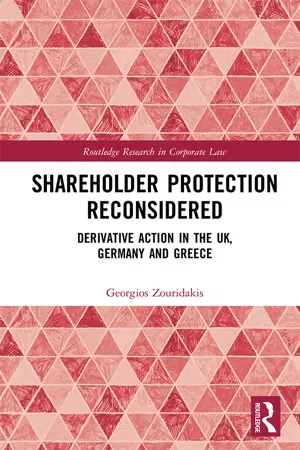
Shareholder Protection Reconsidered
Derivative Action in the UK, Germany and Greece
- 260 pages
- English
- ePUB (mobile friendly)
- Available on iOS & Android
eBook - ePub
Shareholder Protection Reconsidered
Derivative Action in the UK, Germany and Greece
Part I
Derivative actions in abstracto
The theoretical framework of this study
1 Introduction
1.1 The subject and the objectives of this book
It would be an understatement to say that shareholder protection is (and has always been) an integral, yet highly complicated, part of modern company law. Jurisdictions go to great lengths to set intricate systems of checks and balances on the administration of corporate affairs and to devise armouries of rights exercisable in and against the company, elaborate in their construction and application, only to protect the varying interests of shareholders. As suggested by its title, this book focuses on a mechanism of shareholder protection known as the derivative action. It aims to investigate whether Greek shareholder law should be reformed and whether and how this mechanism should be introduced into it. The research purports to evaluate, from the perspective of shareholder protection, the applicable Greek legal framework, identify its shortcomings and inquire how the derivative action may address them, with the view of re-establishing the effectiveness and competitiveness of the national law. To achieve these ends, this book conducts (in Part II) a comparative analysis with two jurisdictions which provide for derivative actions, namely Germany and the UK.1
Derivative actions can be broadly defined as follows: in cases where a wrong is suffered by the company, a (group of minority) shareholder(s) (otherwise barred from litigating directly in their own name and on their own behalf, by virtue of the no reflective loss principle and the principle that only the company may litigate its claims through its competent organs – the ‘proper plaintiff rule’) may be allowed to seek remedy on behalf of the company.2 In practice, a derivative action is useful, if not essential, in cases where those in control of the company (thus able to act – and litigate – on behalf of the company or to instruct those with such capacity) are the ones who wronged the company. The wrong will not be remedied, due to this conflict of interests, to the detriment of all involved in the company – and thus its shareholders – but for the wrongdoers, unless another person derives the right to sue them from the company, acting on behalf and for the benefit of the latter.
1 Capital letters will be used herein when referring to this book’s Parts and Sections, in order to avoid the risk of confusion with other sections or parts of statutes, etc.
2 This is the definition of what is referred herein as ‘genuine’ derivative actions. See also the discussion on the features of derivative actions in Harald Baum and Dan W Puchniak, ‘The Derivative Action: An Economic, Historical and Practice-Oriented Approach’ in Dan W Puchniak, Harald Baum and Michael Ewing-Chow (eds), The Derivative Action in Asia: A Comparative and Functional Approach (CUP 2012) 7. See Georgios Zouridakis, ‘Introducing Derivative Actions in the Greek Law on Public Limited Companies: Issues of Legal Standing and Lessons from the German and UK Experience’ (2015) 26 ICCLR 271, 272 regarding pp. 3–5 in this Section.
Unlike personal shareholders’ claims, derivative actions serve the purposes of reinforcing the accountability of those in control of the company and protecting shareholders cumulatively. They do so by removing the impasse which the ‘proper plaintiff rule’ may create, when necessary.3 The direct beneficiary of a successful derivative claim is the company only, whilst shareholders benefit indirectly or, more precisely, reflectively. However, the shareholders’ right to litigate on behalf of the company evidently constitutes a decisive interference in the ordinary administration of corporate affairs. The law has therefore to facilitate the pursuit of meritorious derivative claims whilst, at the same time, weed out and deter litigation that would disturb the efficient running of the company and run contrary to the company’s and shareholders’ interests. The difficulty in this task resides in that filters against frivolous and vexatious litigation inherently run the risk of disenfranchising shareholders and preventing meritorious claims from being brought, whilst any incentives to shareholders to enforce the corporate claims may be exploited by malicious litigants.
Derivative actions have been considered by many academics as one of the most potent means of (minority) shareholder protection, assuming thus a cardinal role in corporate governance.4 Notwithstanding being a landmark feature of common law,5 they have progressively expanded to civil law jurisdictions.6 The outspread of provisions on derivative actions throughout Europe during the last decade is evidence of voluntary regulatory convergence, on a matter which institutional harmonisation – through the proposal for a fifth company law directive (whose article 16 provided a minimalistic form of a derivative action) – has so far been unsuccessful in the EU.7 The recent history of one of the core continental jurisdictions of this study, Germany, supports this observation.8 Almost a decade ago, the Gesetz zur Unternehmensintegrität und Modernisierung des Anfechtungsrechts (‘Act on Corporate Integrity and Modernisation of Rescission Law’; hereinafter UMAG)9 introduced the new section 14810 to Aktiengesetz (German Stock Corporation Act of 1965) in an attempt to strengthen the protection afforded to minority shareholders.11 The emphasised word alerts the reader of comparative corporate law to the difference from the UK statutory provisions and English common law. Contrary to the continental European approach of conferring the right to sue on behalf of the company only to ex lege minorities, usually determined on the basis of participation in share capital, any shareholder can individually bring a derivative action under English law. This characteristic of derivative actions remained unchanged despite the advent of the new statutory provisions under the Companies Act 2006.12 What also remained largely unaffected, despite various reforms of its national company law statute, is the Greek approach of not providing for a ‘genuine’ derivative action.13
3 Known, under common law, as the rule in Foss v Harbottle (1843) 67 ER 189; (1843) 2 Hare 461.
4 Indicatively: Robert C Clark, Corporate Law (Little, Brown 1986) 639; Arad Reisberg, Derivative Actions and Corporate Governance: Theory and Operation (OUP 2007) 9; see also Cohen v. Beneficial Industrial Corp 337 US 541 (1949), 548, hailing the derivative action as ‘the chief regulator of corporate management’.
5 See GR Sullivan, ‘Restating the Scope of the Derivative Action’ (1985) 44 CLJ 236: ‘Derivative actions have been allowed at least since Atwool v. Merryweather (1867) LR 5 Eq 464n’.
6 For categorisations of jurisdictions into ‘legal families’, see the seminal work of René David and John EC Brierley, Major Legal Systems in the World Today: An Introduction to the Comparative Study of Law (Simon & Schuster 1978). An explanation for the spread of statutory provisions on derivative actions across jurisdictions from the late nineties onwards may be the normative influence of the ‘law and finance’ literature (see Subsection 2.4.3.2). Evidence supporting this explanation can be found in Italy: see Paolo Giudici, ‘Representative Litigation in Italian Capital Markets: Italian Derivative Suits and (if ever) Securities Class Actions’ (2009) 6 ECFR 246.
7 OJ C 7 11.1.1991.
8 Notable civil law jurisdictions having introduced derivative actions to their corporate law statutes during the past three decades include Belgium (since 1991 by virtue of Lois coordonnées sur les sociétés commerciales [Belgian Company Code] art 66bis, of 26 July 1991, Moniteur Belge [MB] [Official Gazette of Belgium]), Italy (since 1998, by virtue of Decreto Legislativo 24 febbraio 1998, n. 58 (It.); Testo Unico in Materia di Intermediazione Finanziaria [TUIF] [Rules and Regulations Concerning Stock Market Trading] art 129, D. Lgs. n. 58); and (People’s Republic of) China (since 2005, by virtue of Standing Comm. Nat’l People’s Cong, 27 October 2005). For a historical overview of this incident of voluntary convergence, see Martin Gelter, ‘Why do Shareholder Derivative Suits Remain Rare in Continental Europe?’ (2011–12) 37 Brook J Int’l L 843; Baum and Puchniak (n 2) 2.
9 BGBl I, 2802. On the replacement of the older provisions, see, indicatively, Nikolaos Paschos and Kay-Uwe Neumann, ‘Die Neuregelungen des UMAG im Bereich der Durchsetzung von Haftungsansprüchen der Aktiengesellschaft gegen Organmitglieder’ (2005) 33 DB 1779; Holger Fleischer, ‘Das Gesetz zur Unternehmensintegrität und Modernisierung des Anfechtungsrechts’ [2005] NJW 3525; see also the decisions in OLG Hamburg, Beschluss vom 19.1.2007 – 11 Wx 33/06, AG 2007 331; Finanzgericht Hamburg Urt. v. 11.09.2009, Az. – 3 K 124/08, DStRE 2010 594, making reference to the UMAG reforms on shareholder-led litigation.
10 Titled: ‘Complaint Admission Proceedings (Derivative Actions)’.
11 UMAG also amended s 147, which constituted the only possibility for shareholder-initiated representative litigation, analogous and functionally equivalent to derivative actions. However, a form of derivative action was provided in the Law on Corporate Groups (Konzernrecht). See AktG ss 310, 317, 318, 323.
12 Now ‘derivative claims’ (as the term applies under CA 2006 Pt 11).
13 (Codified) Law 2190/1920 on (Public) Companies Limited by Shares (Sociétés Anonymes; SAs).
Alas, the Greek law on shareholder litigation on behalf of the company remains somewhat obsolete.14 Despite the fact that members of private limited companies may sue derivatively before Greek courts,15 legislators have continuously refrained from introducing a similar mechanism to the law of public limited companies.16 The provision conceptually and functionally closest to a derivative action under the respective law is the ‘company’s action’ whereby a 5% minority may demand that the board brings the action and, in case the board does not comply with this request, the majority of that minority may petition the court to appoint special representatives to bring the claim.17 The company’s act...
Table of contents
- Cover
- Half Title
- Series Page
- Title Page
- Copyright Page
- Dedication
- Table of Contents
- Acknowledgements
- Abbreviations
- Part I: Derivative actions in abstracto: the theoretical framework of this study
- 1. Introduction
- 2. The importance of an effective shareholder remedy for wrongs against the company
- Part II: Derivative actions de lege lata: a comparative and functional analysis
- 3. Comparison of functionally equivalent rules on shareholders’ enforcement of corporate claims
- 4. The Greek framework for shareholder protection in a comparative context and the (in)existence of alternatives to derivative actions
- Part III: Derivative actions de lege ferenda: suggestions based on comparative considerations
- 5. Proposals for a functioning and truly protective derivative action
- 6. Conclusion
- Bibliography
- Table of cases
- Annex
- Index
Trusted by 375,005 students
Access to over 1.5 million titles for a fair monthly price.
Study more efficiently using our study tools.
Frequently asked questions
Yes, you can cancel anytime from the Subscription tab in your account settings on the Perlego website. Your subscription will stay active until the end of your current billing period. Learn how to cancel your subscription
No, books cannot be downloaded as external files, such as PDFs, for use outside of Perlego. However, you can download books within the Perlego app for offline reading on mobile or tablet. Learn how to download books offline
Perlego offers two plans: Essential and Complete
- Essential is ideal for learners and professionals who enjoy exploring a wide range of subjects. Access the Essential Library with 800,000+ trusted titles and best-sellers across business, personal growth, and the humanities. Includes unlimited reading time and Standard Read Aloud voice.
- Complete: Perfect for advanced learners and researchers needing full, unrestricted access. Unlock 1.5M+ books across hundreds of subjects, including academic and specialized titles. The Complete Plan also includes advanced features like Premium Read Aloud and Research Assistant.
We are an online textbook subscription service, where you can get access to an entire online library for less than the price of a single book per month. With over 1.5 million books across 990+ topics, we’ve got you covered! Learn about our mission
Look out for the read-aloud symbol on your next book to see if you can listen to it. The read-aloud tool reads text aloud for you, highlighting the text as it is being read. You can pause it, speed it up and slow it down. Learn more about Read Aloud
Yes! You can use the Perlego app on both iOS and Android devices to read anytime, anywhere — even offline. Perfect for commutes or when you’re on the go.
Please note we cannot support devices running on iOS 13 and Android 7 or earlier. Learn more about using the app
Please note we cannot support devices running on iOS 13 and Android 7 or earlier. Learn more about using the app
Yes, you can access Shareholder Protection Reconsidered by Georgios Zouridakis in PDF and/or ePUB format, as well as other popular books in Business & Governance d'impresa. We have over 1.5 million books available in our catalogue for you to explore.