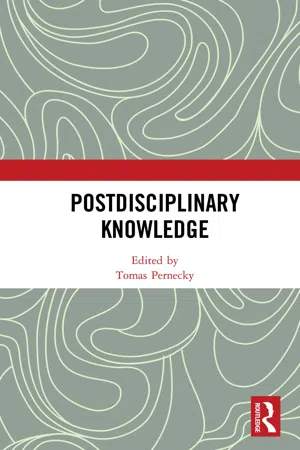
Postdisciplinary Knowledge is the first book to articulate postdisciplinarity in philosophical, theoretical and methodological terms, helping to establish it as an important intellectual movement of the twenty-first century. It formulates what postdisciplinarity is, and how it can be implemented in research practice.
The diverse chapters present a rich collection of highly creative thought-provoking essays and methodological insights. Written by a number of pioneering intellectuals with a range of backgrounds and research foci, these chapters cover a broad spectrum of areas demonstrating alternative ways of producing knowledge. Essays are interspersed with dialogue, encouraging a comprehensive and engaging discussion on this emerging movement.
Not limited to a specific field or discipline, this will be of great interest to upper-level students and researchers in a wide range of subject areas, including: tourism, sociology, education, psychology, physiotherapy, fine arts, architecture and design, as well as those with a general interest in epistemology and methodology.
Trusted by 375,005 students
Access to over 1.5 million titles for a fair monthly price.
Women artists and the legacy of surrealism – the case of Ithell Colquhoun and Camille Billops
Barbara Lekatsas
Artists and the escape from disciplines
What Tom Pernecky (2016) equated with an escape from disciplines ‘marked by flexibility, creative problem solving and intellectual disobedience’ (p. 5) in his definition of postdisciplinarity was first laid out in manifestoes of Romanticism and the avant-garde pertaining to the arts. In fact, it is the artist, in a general sense, who best embodies the qualities of postdisciplinarity. Artists were the first and most persistent to move beyond disciplines, more specifically in their vigorous attack on the strictures of genre, a concept closely related to discipline. Movements in art replaced schools during the romantic era, giving a new breath of life to poetry, in particular, as a spontaneous and superior organiser in any great system of ideas, whether it be science, political philosophy or the arts. In 1883, Oscar Wilde, following the tradition of Charles Baudelaire as artist and critic, wrote in Mr. Whistler’s ‘Ten O’clock’:
There are not many arts but one art merely, poem, picture and Parthenon, sonnet and statue, all are in their essence the same and he who knows one knows all. But the poet is the supreme artist for he is the master of color and of form and the real musician besides and is lord over all life and all arts, and so to the poet beyond all others are these mysteries known.
By the twentieth century, the avant-garde had codified this principle in movements that included all manner of artists who easily crossed genres, yet the movement leaders were poets, none more influential than André Breton, the founder of Surrealism. Michel Foucault (as cited in Faubion, 1999) credited André Breton:
alone [with] the discovery of a space that is not that of philosophy, nor of literature, nor of art, but that of experience … effacing the rubrics in which our culture classified itself, and revealing unforeseeable kinships, proximities, and relations.
In The Encyclopedia of Aesthetics, I described Breton as ‘a French poet, theorist, polemicist, essayist, movement leader, editor and founder of Surrealism … who sought to expand the application of poetic experience to include all forms of expression’ (Lekatsas, 2014, p. 310). In both definitions, there is a recognition of Breton’s expansion of the analogical process of poetry into all domains, including the random walks he and his friends would take through the streets of Paris seeking the hidden poetry of everyday life. In the eloquent first Manifesto of Surrealism of 1924, Breton (1924/2010a) sees poetry as a supreme organiser:
Man proposes and disposes. He and he alone can determine whether he is complete master of himself, that is whether he maintains the body of his desires, daily more formidable in a state of anarchy. Poetry teaches him to. It bears within itself the perfect compensation for the miseries we endure. It can also be an organizer, if ever … we contemplate taking it seriously.
Breton’s dictum to ‘practice poetry’ amounted to a total life style, a poetry of the streets, in the context of a milieu artiste capable of acting as a unit in its ideological prerogatives and political salvos against the establishment. Breton asks in the ‘First Manifesto’, ‘Where does it begin to turn bad and where does the mind’s stability cease? For the mind, is the possibility of erring not rather the contingency of good?’ (p. 5).
In the Dada Manifesto of 1918 (as cited in Lippard, 1971), Tristan Tzara writes, ‘Let us try for once not to be right’ (p. 17). He refuses the conformism that necessarily fuels war, championing disobedience even to Dada:
After the carnage we still retain the hope of a purified mankind. I speak only for myself since I do not wish to convince, I have no right to drag others into my river, I oblige no one to follow me and everybody practices art in his own way.
In fact, Dada came to be known as the anti-art movement. What unified the disparate members was their spirit of defiance and disobedience. In an introduction to Dada for Vanity Fair, Tzara (1922) wrote, ‘It is well known that the Dadaist Movement has 391 presidents and that anyone can become a president without the slightest trouble’ (p. 70).
The Dada Movement was launched in Zurich, February 5, 1916, five months before the Somme Offensive that would drag on between July and November 1916, at the cost of 1.5 million men (fighting on behalf of the British Empire and French Republic against the German Empire), by artists from all over Europe fleeing the First World War to neutral Switzerland. It took the initial form of ‘Cabaret Voltaire’, a café back room in a seedy section of Zurich, named by the German poet, Hugo Ball, after the author of Candide. Voltaire had satirised religion, militarism, monarchy, morals and the bizarre manner in which humans assign inflated value to their forms of intolerance. His irreverent spirit shaped Dada and its offshoot, Surrealism. The name, Dada, chosen at random to conjure the spirit of childhood, poked fun at systems, order, common sense, logic. When the war ended, artists brought some aspect of it home. In Berlin, its disobedience was political, attacking militarism and the bourgeois. Tzara brought it to Paris in 1920, where a group of poets and artists awaited him ‘like the Messiah’ (Lippard, 1971, p. 13) and began the idiosyncratic and antagonistic theatricals that would extend their attack on conformity and expand all forms of expression. Marcel Duchamp launched Dada in New York in 1917 at ‘The Society of Independent Artists’ exhibition with the submission of a porcelain men’s toilet placed at an odd angle (titled ‘Fountain’ and signed ‘R. Mutt’). His ‘Readymades’ and ‘Found Objects’ would revolutionise the concept of art and democratise the use of all types of materials and combinations.
Surrealism grew out of the Dada movement in Paris. Breton attacked centralisation and proclaimed the law of chance in his adaptation of Freud’s free-association method into automatic writing or psychic automatism, expanding the idea into all the arts. From the outset, Dada and Surrealism attracted artists from all fields who deliriously borrowed from each other, mixing genres in the surprising ways reflected in all avant-garde movements. Breton saw chance as integrally bound up in the poetic process, itself an invisible organiser that shapes reality by paradoxically resisting it. Foucault writes, ‘for Breton, a sentence, a word may by themselves constitute the antimatter of the world and counterbalance the whole universe’ (as cited in Faubion, 1999, p. 173). What is evident in Dada and Surrealism is a dialectical rather than a hierarchical approach.
Renato Poggioli (1963/1968) in his Theory of the Avant-Garde identified avant-garde movements ‘as cultures of negation’. He explains, ‘As a minority culture the avant-garde cannot get by without combatting and denying the majority culture it opposes’ (pp. 107–108). Marxists, on the other hand, saw the same avant-garde movements as bourgeois elites (they refused to let the surrealists join their party). Who do we label minorities? Population-wise, women or people of colour can hardly be called a minority, yet the term in such a context identifies a minority as lesser in power rather than number. The term ‘elite’, on the other hand, suggests a group small in number (also a minority) but great in power. What we have here is a relationship that establishes a system of shifting values between the centre and the periphery.
The paradigm of the ‘the periphery and the centre’ was developed by the American philosopher Willard Van Orman Quine in The Web of Belief (Quine & Ullian, 1978). At the centre, he suggested, systems of belief become interlocked into a covenant of reality; at the periphery, however, is where change is possible, where theoretical thought circulates more freely and is fostered by its distance from the centre. Giovanna Borradori writes in The American Philosopher (1994), ‘the ever-mobile frontier becomes a theoretical category in itself, a new center, and is no longer the periphery of western culture’ (p. 2). Postdisciplinarity, even as it suggests a freer play of analogy between the centre and the periphery, implicitly includes a critique of the centre. In her essay ‘Critique, Dissent, Disciplinarity’, Judith Butler (2009) takes on the university itself as a questionable arbiter of disciplines and begins with Kant’s complex delineation of disciplines in The Conflict of the Faculties between censored private domains (domains that should be under government jurisdiction) and free public ones (Kant lobbies for philosophy, subject only to the law of reason). Butler sees the slippery slope of this distinction. She asks, ‘How does the line get drawn – by whom? Through what means? By what right?’ (p. 778). The postdisciplinary critique of the centre is a critique of authority and enforced submission in the name of discipline. Butler quotes Foucault, ‘how not to be governed like that, by that, in the name of those principles, with such and such an objective in mind and by means of such procedures, not like that, not for that, not by them’ (pp. 791–792). She adds,
If these words seem to suggest that critique amounts to a lot of nay-saying, it is important to remember that the no delineates and animates a new set of positions for the subject; it is inventive … every critical question is initially rogue in relation to existing conventions.
In The Law of Genre (Derrida & Ronell, 1980), Jacques Derrida begins with the mocking exhortation that ‘genres are not to be mixed’ (p. 55). He writes, ‘as soon as the word “genre” is …heard, as soon as one attempts to conceive it, a limit is drawn… one must respect a norm… not risk impurity’ (p. 57). Yet as his essay develops he identifies ‘the law of genre’ as ‘a principle of contamination, a law of impurity… a sort of participation without belonging’ (p. 57). The law of genre presupposes ‘a recurrence of a common trait by which one recognizes a membership in a class’ (p. 63). Yet it is framed by what it excludes. Derrida understood the politics of genre and linked the term to its etymological kin in French, gender (p. 56) – the word’s French root, a designation more fixed even than genre in limiting entry to a club. Sad to say, even Surrealism, despite Breton’s defence of its fluid independence, would fall prey to the club syndrome.
Breton’s (1929/2010c) angry ‘Second Manifesto’ (republished in Manifestoes of Surrealism) reiterated his ‘nonconformism’ to an increasingly intolerant Left that attacked his adherence to Surrealism and his non-subordination to the dictates of Communism. Veering his movement away from the examination of ‘the political problem’, he declared that ‘Surrealism would return to its initial concern, which was the problem of human expression in all its forms’ (p. 151). It was first published in 1929 in the final issue of the periodical The Surrealist Revolution (La Révolution surréaliste), the year Joseph Stalin proclaimed as ‘the great turning point’, as he proceeded to implement the policies that would eradicate all opposition and codify Social Realism as the style of Communism. In a manner that suggested his own politically subversive strategy, Breton defended ‘the occultation of Surrealism’ (p. 178) and proposed a hermetic approach and solidarity with the alchemists as a counter-action to the increased censorship of the Left and the Right and the persecution of those holding opposing views. In offering a revolution of the mind in the Second Manifesto, Breton sought to be both utopian and practical in his attack on conformism, by calling out those who had abnegated their right to freedom of thought, yet also attacking the flattening of language. ‘People pretend not to pay attention to the fact that the logical mechanism of the sentence … reveals itself increasingly powerless to provoke the emotive shock in man which really makes his life meaningful’ (p. 152). In the Prolegomena to a Third Manifesto or Not written in the midst of the war in 1942, Breton (1942/2010b) addressed this issue again and advocated ‘a certain return to the study of the philosophy of the Middle Ages as well as the “accursed” sciences … which has been taking place during this war’ (p. 288), attacking those who would make the transformation of the world ‘depend solely on the overturning of world economic conditions’:
Very well system, you have me in your power, I gave myself to you body and soul, but nothing you promised has come ab...
Table of contents
Cover
Half Title
Title Page
Copyright Page
Table of Contents
List of illustrations
Notes on contributors
Acknowledgements
An unintroduction to postdisciplinarity
Part I Being. Thinking. Doing.
Part II Doing. Thinking. Being.
Part III Thinking. Being. Doing.
Index
Frequently asked questions
Yes, you can cancel anytime from the Subscription tab in your account settings on the Perlego website. Your subscription will stay active until the end of your current billing period. Learn how to cancel your subscription
No, books cannot be downloaded as external files, such as PDFs, for use outside of Perlego. However, you can download books within the Perlego app for offline reading on mobile or tablet. Learn how to download books offline
Perlego offers two plans: Essential and Complete
Essential is ideal for learners and professionals who enjoy exploring a wide range of subjects. Access the Essential Library with 800,000+ trusted titles and best-sellers across business, personal growth, and the humanities. Includes unlimited reading time and Standard Read Aloud voice.
Complete: Perfect for advanced learners and researchers needing full, unrestricted access. Unlock 1.5M+ books across hundreds of subjects, including academic and specialized titles. The Complete Plan also includes advanced features like Premium Read Aloud and Research Assistant.
Both plans are available with monthly, semester, or annual billing cycles.
We are an online textbook subscription service, where you can get access to an entire online library for less than the price of a single book per month. With over 1.5 million books across 990+ topics, we’ve got you covered! Learn about our mission
Look out for the read-aloud symbol on your next book to see if you can listen to it. The read-aloud tool reads text aloud for you, highlighting the text as it is being read. You can pause it, speed it up and slow it down. Learn more about Read Aloud
Yes! You can use the Perlego app on both iOS and Android devices to read anytime, anywhere — even offline. Perfect for commutes or when you’re on the go. Please note we cannot support devices running on iOS 13 and Android 7 or earlier. Learn more about using the app
Yes, you can access Postdisciplinary Knowledge by Tomas Pernecky in PDF and/or ePUB format, as well as other popular books in Business & Hospitality, Travel & Tourism Industry. We have over 1.5 million books available in our catalogue for you to explore.