Dissent and Authority in Early Modern Ireland: The English Problem from Bale to Shakespeare examines the problems that beset the Tudor administration of Ireland through a range of selected 16th century English narratives. This book is primarily concerned with the period between 1541 and 1603. This bracket provides a framework that charts early modern Irish history from the constitutional change of the island from lordship to kingdom to the end of the conquest in 1603. The mounting impetus to bring Ireland to a "complete" conquest during these years has, quite naturally, led critics to associate England's reform strategies with Irish Otherness. The preoccupation with this discourse of difference is also perceived as the "Irish Problem," a blanket term broadly used to describe just about every aspect of Irishness incompatible with the English imperialist ideologies. The term stresses everything that is "wrong" with the Irish nation—Ireland was a problem to be resolved. This book takes a different approach towards the "Irish Problem." Instead of rehashing the English government's complaints of the recalcitrant Irish and the long struggle to impose royal authority in Ireland, I posit that the "Irish Problem" was very much shaped and developed by a larger "English Problem," namely English dissent within the English government. The discussions in this book focuse on the ways in which English writers articulated their knowledge and anxieties of the "English Problem" in sixteenth-century literary and historical narratives. This book reappraises the limitations of the "Irish Problem," and argues that the crown's failure to control dissent within its own ranks was as detrimental to the conquest as the "Irish Problem," if not more so, and finally, it attempts to demonstrate how dissent translate into governance and conquest in early modern Ireland.
eBook - ePub
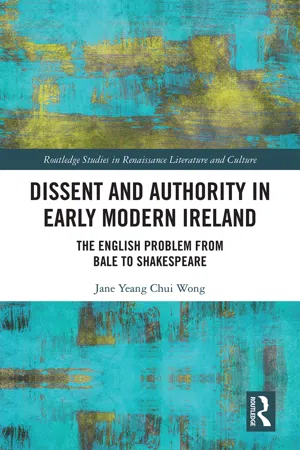
Dissent and Authority in Early Modern Ireland
The English Problem from Bale to Shakespeare
- 218 pages
- English
- ePUB (mobile friendly)
- Available on iOS & Android
eBook - ePub
Dissent and Authority in Early Modern Ireland
The English Problem from Bale to Shakespeare
About this book
Trusted by 375,005 students
Access to over 1.5 million titles for a fair monthly price.
Study more efficiently using our study tools.
Information
1 King Johan (1538), King John, and the Henrician Reformation
The story of the great Kildare rebellion (1534–35) is well known and the sense of alarm on both sides of the Irish Sea is immediately relevant to this chapter. Over his two terms as deputy in the 1520s and 30s, Gerald Fitzgerald’s (ninth earl of Kildare) moves were closely scrutinized in Ireland and England. His disputes with the Dublin Council regarding executive appointments and his hostility toward some of the more prominent members of the Pale community warranted royal summons, though Brendan Bradshaw does not rule out the possibility that Kildare was summoned to discuss plans for the implementation of royal policy in in 1534.1 Kildare’s delay in responding to the summons made him appear even more suspicious. When he finally yielded, he convened a series of meetings with his kin and trusted associates before reporting to the council. At one of these meetings, Kildare formally deputized his heir, the young Thomas Fitzgerald, Lord Offaly and later tenth earl of Kildare, to take his place in his father’s absence. It is assumed that Kildare arrived in England in the spring of 1534 and was sent to the Tower by June.2 Rumors of his death sent panic to Ireland. At a meeting with the council in Dublin on 11 June, Offaly arrived with his military retinue. This event has since been widely sentimentalized: “When [Offaly] had seated himself at the head of the council board… he renounced his allegiance, and declare… ‘I am none of Henry his Deputie; I am his fo. I have more mind to conquer than to governe—to meet him in the field than to serve him in office.’”3 Some of the council members tried to dissuade Offaly, “but the young Lord’s harper, understanding only Irish, and seeing signs of wavering in his bearing, commenced to recite a poem in praise of the deeds of his ancestors, telling him at the same time that he lingered there over long.”4 Offaly, more famously known as “Silken Thomas,” then proclaimed: “[I] will choose rather to die with valiantnesse and libertie, than to live under King Henrie in bondage and villanie.”5
1 Brendan Bradshaw, “Cromwellian Reform and the Origins of the Kildare Rebellion,” Transactions of the Royal Historical Society 27 (1977), 78, 81, 80.
2 Ibid., 81, 86.
3 Alfred Webb, ed., A Compendium of Irish Biography: Comprising Sketches of Distinguished Irishmen, and of Eminent Persons Connected with Ireland by Office or by Their Writings (Dublin: M. H. Gill & Son, 1878), 18.
4 Ibid.
5 Ibid.
The implications that resulted from the development of the rebellion extended beyond Ireland and England with the implementation of the Reformation. News of Kildare’s imprisonment in June 1534 followed closely behind the introduction of the Reformation articles in April and the enforcement of the Oath of Supremacy; Crown authorities were preoccupied with domestic resistance and preparations were being made to fend off potential foreign invasion.6 Ireland had long been perceived to be vulnerable to foreign invasions. While foreign intrigue involving Ireland was not a direct response to the Kildare revolt (Charles V contemplated the possibility of using Ireland as a base to invade England), it certainly contributed to an increased interest in Irish affairs.7 Moreover, the Desmond Fitzgeralds were already in contact with Continental powers in the 1520s in hopes of overthrowing English rule. James Fitzgerald, the tenth earl of Desmond, was known to have proposed an alliance with Francis I in the early 1520s.8 In 1528, the earl courted Charles V for support against Henry VIII, and even though there may have been more Desmond than Kildare agents in the Spanish court, the Kildares also sent their fair share of representatives to Scotland, France, and Rome to lobby Kildare’s cause.9
6 Bradshaw, “Cromwellian Reform,” 84. The chronology of the unfolding events is important: given the dates, Bradshaw emphasizes that plans for the reformation of Ireland was already underway before Kildare was sent to the Tower. Thus, the revolt should not be narrowly interpreted as the Kildares’ response to the encroachment of royal authority in Ireland but that the revolt interrupted the implementation of the reformation program, 86.
7 Micheál Ó. Siochrú, “Foreign Involvement in the Revolt of Silken Thomas, 1534–35,” Proceedings of the Royal Irish Academy: Archaeology, Culture, History, Literature 96 C. 2 (1996), 54.
8 D. B. Quinn, “The Reemergence of English Policy as a Major Factor in Irish Affairs, 1520–34,” in A New History of Ireland: Volume II, Medieval Ireland 1169–1534, edited by Art Cosgrove (Oxford: Oxford University Press, 2008), 673–74.
9 Ibid., 678; Siochrú, “Foreign Involvement,” 57.
10 Siochrú, “Foreign Involvement,” 52.
Charles V’s hostility toward England and “the king’s great matter” very likely elicited his interest in Irish affairs. More notably, Charles was “particularly interested in the relationship between Desmond and Kildare,” and he hoped that “by using the earl’s [Desmond’s] kinsman in Munster as an intermediary he could enlist Kildare’s support against Henry VIII.”10 But Sir John of Desmond (John Fitzgerald, de facto twelfth earl), keen to win Henry’s support and recognition for the contested earldom of Desmond (against James Fitzgerald, de jure twelfth earl) was more cautious.11 Charles V’s understanding of the complex relationships among the different Geraldine branches is less clear. Henry, for instance, enlisted Desmond’s support against the Kildare rebels.12 The king’s letter to Desmond dated 26 April suggests that Desmond probably did not meet Henry’s demands; the king commanded “him either to come to England or send his eldest son James hither to explain his title, and meantime to surrender the earldom, to be held by the Deputy for him who shall appear to have the right.”13
The opposition to the Reformation articles in England, combined with the Kildare revolt and Anglo-Irish intrigue, created a climate of intense anxiety, suspicion, and oppression. Just three days after Desmond was threatened with suspension from his earldom, an unusually detailed description of a conversation in England between two Englishmen, John Hale and Robert Feron, was recorded as evidence of treason and justification for indictment. The men were discussing English politics, when Feron allegedly made remarks about “the King’s evil deeds,” and Hale asserted those comments; he referred to the king as “a robber and pyller of the commonwealth,” and “by his wrongs [we] be oppressed and robbed of our livings as if we were his utter enemies, enemies to Christ, and guilty of his death… [this king] is the most cruellest, capital heretic, defacer, and treader under foot of Christ and of his Church.”14 Given the widespread opposition to the Reformation articles, Hale’s appraisal of Henry VIII would not have been perceived as shocking. What alarmed the authorities was more likely Hale’s observation that Henry’s reformation will incite a rebellion so great it will bring England to her knees:
Until the King and the rulers of this realm be plucked by the pates, and brought, as we say, to the pot, shall we never live merrily in England; which I pray God may chance and now shortly to come to pass. Ireland is set against him, which will never shrink in their quarrel, to die in it. And what think ye of Wales? […] [The Welsh] will join and take part with the Irish, and so invade our realm. If they do so, doubt ye not but they shall have aid and strength enough in England; for this is truth, three parts of England is against the King, as he shall find if he need; for of truth they go about to bring this realm into such miserable condition as is France, which the Commons see and perceive well enough a sufficient cause of rebellion and insurrection in this realm.15
11 Anthony M. McCormack, “Internecine Warfare and the Decline of the House of Desmond, c.1510–c.1541,” Irish Historical Studies 30.120 (1997), 499. On 26 April 1535, the king remained skeptical about Sir John’s claim to the Desmond earldom. L. & P. Hen VIII, Vol. VIII: January–July 1535, no. 594.
12 L. & P. Hen VIII, Vol. VIII: January–July 1535, no. 114.
13 Ibid., no. 594.
14 Ibid., no. 609.
15 Ibid.
Hale’s conviction – “Ireland is set against him [Henry VIII]” – must have been motivated by his awareness of the escalating conflict in Ireland. Another reference to Ireland can be inferred in Hale’s treasonous comments; Hale curses Henry, “[w]hose death I beseech God may be like to the death of the most wicked John, sometime King of this realm, or rather to be called a great tyrant than a King.”16 In the Tudor-protestant tradition, King John is poisoned by a scheming monk; Bale re-enacts this scene in King Johan (1538).17
In the 1520s and 1530s, comparisons of Henry VIII to King John were not uncommon; the two kings stood out among their predecessors and successors as kings who defied papal authority, and both attempted to tighten their grip on the lordship of Ireland with varying success. Carole Levin traces the popularity of the King John narrative to William Tyndale’s The Obedience of a Christian Man (1528), where Tyndale recounts the unjust treatment that John suffers under the tyranny of the pope. Tyndale describes John’s attempt to punish a clerk for counterfeiting money, and in response, the pope punishes John with the Interdict and sanctions French invasion. Consequently, John is forced to surrender England as a papal fiefdom.18 Among other examples that portray John as a hero king, one can be found in Simon Fish’s A Supplicayon for the Beggars (1529), possibly smuggled from the Low Countries...
Table of contents
- Cover
- Half Title
- Series Page
- Title Page
- Copyright Page
- Table of Contents
- List of Illustrations
- Acknowledgments
- Prologue
- 1 King Johan (1538), King John, and the Henrician Reformation
- 2 Englishness and Loyalty in Gerald of Wales’ Expugnatio Hibernica (1189) and Holinshed’s Irish Chronicle (1577)
- 3 Portrait of a Lord Deputy: Sir Henry Sidney in Ireland and on the Page
- 4 Negotiating Violence and Equity in Edmund Spenser’s Faerie Queene, Book V (1596)
- 5 “This present quality of war”: Truth, Trust, and Truce in 2 Henry IV (1597–98)
- Epilogue
- Bibliography
- Index
Frequently asked questions
Yes, you can cancel anytime from the Subscription tab in your account settings on the Perlego website. Your subscription will stay active until the end of your current billing period. Learn how to cancel your subscription
No, books cannot be downloaded as external files, such as PDFs, for use outside of Perlego. However, you can download books within the Perlego app for offline reading on mobile or tablet. Learn how to download books offline
Perlego offers two plans: Essential and Complete
- Essential is ideal for learners and professionals who enjoy exploring a wide range of subjects. Access the Essential Library with 800,000+ trusted titles and best-sellers across business, personal growth, and the humanities. Includes unlimited reading time and Standard Read Aloud voice.
- Complete: Perfect for advanced learners and researchers needing full, unrestricted access. Unlock 1.5M+ books across hundreds of subjects, including academic and specialized titles. The Complete Plan also includes advanced features like Premium Read Aloud and Research Assistant.
We are an online textbook subscription service, where you can get access to an entire online library for less than the price of a single book per month. With over 1.5 million books across 990+ topics, we’ve got you covered! Learn about our mission
Look out for the read-aloud symbol on your next book to see if you can listen to it. The read-aloud tool reads text aloud for you, highlighting the text as it is being read. You can pause it, speed it up and slow it down. Learn more about Read Aloud
Yes! You can use the Perlego app on both iOS and Android devices to read anytime, anywhere — even offline. Perfect for commutes or when you’re on the go.
Please note we cannot support devices running on iOS 13 and Android 7 or earlier. Learn more about using the app
Please note we cannot support devices running on iOS 13 and Android 7 or earlier. Learn more about using the app
Yes, you can access Dissent and Authority in Early Modern Ireland by Jane Wong,Jane Yeang Chui Wong in PDF and/or ePUB format, as well as other popular books in Literature & Literary Criticism. We have over 1.5 million books available in our catalogue for you to explore.