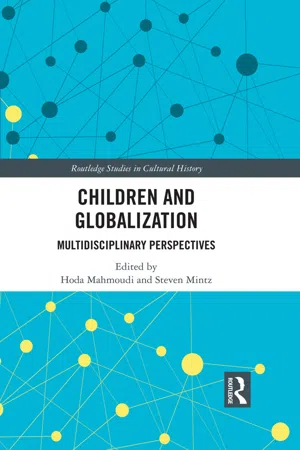
Globalization has carried vast consequences for the lives of children. It has spurred unprecedented waves of immigration, contributed to far-reaching transformations in the organization, structure, and dynamics of family life, and profoundly altered trajectories of growing up. Equally important, globalization has contributed to the world-wide dissemination of a set of international norms about children's welfare and heightened public awareness of disparities in the lives of children around the world. This book's contributors – leading historians, literary scholars, psychologists, social geographers, and others – provide fresh perspectives on the transformations that globalization has produced in children's lives.
eBook - ePub
Children and Globalization
Multidisciplinary Perspectives
- 206 pages
- English
- ePUB (mobile friendly)
- Available on iOS & Android
eBook - ePub
Children and Globalization
Multidisciplinary Perspectives
About this book
Trusted by 375,005 students
Access to over 1.5 million titles for a fair monthly price.
Study more efficiently using our study tools.
Information
Part I
Historicizing Global Childhood
1
“Modern” Childhoods
Adjustment, Variety, and Stress
There are many modern histories of childhood, reflecting crucial differences among regions and particular subperiods within the modern era, plus ongoing divisions by social class, gender, and, in many cases, race or ethnicity. Essays in this volume demonstrate some of the key divisions among children based on exposure to poverty, exploitation, and the effects of war and civil strife, as well as more subtle regional distinctions.
This chapter begins with a different emphasis, as it turns to modern histories of childhood focused on massive change but not, initially, an inquiry into particular regional paths. In attempting to provide a global framework for the experience of children over the past one to two centuries (depending on region), I have emphasized what can be called a modernization model (though I usually avoid the term, because of the connotations that have been associated with oversimplified renderings of the model; Black, 1976). Whether a single word is used or not, my interest lies in four basic and interrelated trends that have described major transformations in childhood in many parts of the world, beginning with the West in the later 18th century and extending through the impacts of communist revolutions or economic and political development projects into our own day. What follows briefly lays out the transformations—which are no great mystery—but then picks up on some of the complexities involved, which I hope help rescue the generalizations from some of the criticisms justly leveled at other versions of the modernization project. There is a common basic pattern to modern childhood history in many different parts of the world that deserves attention, but we can also learn from the fate of modernization models in the past to refine and complicate the presentation after the fundamentals are established.
The result, I hope, will be a clear contribution to the larger theme of childhood in an interconnected world, highlighting both widely shared experiences and comparative complexities that link childhood’s history directly to a number of contemporary debates (Stearns, 2016).
Basic Modern Trends
The most sweeping modern shift has involved the replacement of work with schooling as childhood’s primary focus. The change was—and is—painfully slow; it’s worth remembering that the second half of the 19th century was the peak time, numerically, for child labor in the United States, though the focus had shifted more fully to the mid-teenage years. But the change did occur as part of industrialization, as technology became more complex, educational needs became more clearly identified, and, in some cases, parents developed new concerns about the oversight of their offspring in modern work settings. And, thanks to industrial examples and children’s rights rhetoric, the change might even have been anticipated in some societies as they tried to prepare for industrialization—as in many parts of Latin America by the mid-20th century.
This change obviously revolutionized the economic calculus of childhood, converting children from economic assets to liabilities and ultimately persuading most parents—often along with urban housing constraints—that customary birth-rate levels were unsustainable. This substantial birth-rate reduction proved to be a second major change, altering relationships between parent and individual child, unsettling established patterns of sibling relationships, and, of course, reducing childhood numerically in society as a whole.
Lower birth rates and greater overall prosperity encouraged both families and society more generally to examine traditional levels of child mortality, ultimately generating nothing short of a revolution that, in industrial and industrializing societies, removed children from constituting one of the peak death categories for the first time ever. This demographic transition that lowered birth and infant death rates is one of the most profound shifts in modern history and certainly in the history of childhood and parenting. It protected most families from the challenge of having one or more children die, thereby overturning one of the previously inescapable features of the human experience.
With the rise of schooling and the unfolding of public health measures, the state began to develop a variety of direct contacts with children and childhood, as had not previously been the case before. Some states, particularly under the spur of revolution, began to see their oversight of childhood as a fundamental way to reshape society, using children as alternatives to adult habits; generally, states began to experiment with the boundaries of their oversight, usually after brief but conclusive debates about the limits of parental rights (Cunningham, 1995; Heywood, 2001).
These changes set only a framework for the full modern history of childhood. Their advent and impact vary not only within regions but within social groups. The overturning of traditional demographic relationships—whereby in most agricultural societies poorer families maintained lower birth rates than the better-to-do, in contrast to the normal balance in industrial societies—suggests some of the social complexity involved, as different groups changed at different speeds and to different degrees (Seccombe, 1992; Seccombe, 1993). The order of change can vary significantly as well. Whereas, in the Western experience, birth-rate reduction preceded the most dramatic inroads on child mortality, the relationship has differed in most other cases. Governments quickly see the utility of lower birth rates, but they characteristically hesitate about massive new birth control as they are eager to solidify the population base for military recruitment. Ultimately, however, as in the Soviet Union in the interwar decades, parents themselves take the lead, even against a pro-natalist regime, or as in China after 1978, the state itself shifts gears, joining birth-rate limitation to the attack on mortality levels as a precondition for more effective economic development (Kirschenbaum, 2001).
Many other details warrant attention—including parental reactions to the loss of control represented by the rise of school authority or the vital issue of which gender—mothers or fathers—took the lead in birth rate decisions and why—but the importance of the framework itself deserves emphasis. Indeed, the widespread unfolding of the basic modern pattern offers the most obvious justification for insisting on the pattern itself.
The Japanese reform era after 1868 quickly began to install three of the four measures of modern change: it decreed mass education with the 1872 law (Graff, 1981; Uno, 1999; Platt, 2005; Cross & Smits, 2005). It quickly worked to improve public health and through this maternal and infant mortality, and it inserted the state into various aspects of childrearing—beginning, soon after 1900, to issue pamphlets advising parents who needed guidance to raise children properly. Only the fourth component, birth-rate reduction, was initially missing, but it came into play within a few decades.
Communist regimes form a second and even more sweeping example, as changes in childhood spread beyond the West. It is striking how quickly 20th-century revolutionary governments in both Russia and China began to press for three of the four features of the modern model, despite huge distractions and resource constraints. These governments worked vigorously to lower infant death rates while rapidly expanding schooling and extending state controls over childhood in the process.
Latin America (apart from Cuba, where communism took hold) forms yet another example, with common patterns of change emerging in a more patchwork fashion. Governments began to expand education from the later 19th century onward, ultimately reaching most of the population; government efforts to promote public health and guide childhood in other respects developed as well. These developments were, for example, a key aspect of the Mexican revolution. The capstone change of massive birth-rate reduction came late but very rapidly between the 1960s and the 1990s.
The modern framework for childhood emerged widely (South Asian, Middle Eastern and African examples can be adduced as well), resulting from a combination of imitation and spontaneous need. Once leading Western societies had developed the framework—including school requirements, public health measures, and at least gestures toward outlawing certain forms of child labor—other societies, bent on catching up industrially, easily picked up on the essentials, though with different specifics. Historians such as Harvey Graff have persuasively debated whether education was particularly important in the early industrial labor force in the West, but Japanese observers had no doubt about schools’ centrality. The Japanese moved toward universal education in 1872, far earlier in the industrialization process than the West. By the same token, imitation was not the only factor involved. Birth-rate decisions flowed from the logic of the modern framework itself, including the decline of decent jobs for children and the costs of schooling and urban life—not from any conscious awareness of Western precedents. The provision of education for girls has proved to be a powerful common ingredient in stimulating birth rate change, from the 19th-century West to present-day Iran. Communist ideology, to take another example, spurred the changes associated with modern childhood despite abundant disputes with dominant Western values in other respects. The modernization of childhood was not simple Westernization. And this fact hopefully will help compensate for one of the most common attacks on the model itself—an unduly slavish approach to Western initiatives.
One other point must be stressed. Laying out the “modern pattern” in a few pages risks reducing the essential human element. In fact, the changes involved required, and continue to require, some very difficult choices by various people dealing with children—beginning with the parents—and by children themselves. What competing values had to be debated, for example, in that majority of cases when parents decided on birth-rate reduction? How did children adjust, and how are they adjusting, to the decline in the number of siblings and the buffer that sibling sets could provide between most children and the adult world? How has the dramatic reduction in child mortality intensified the pain felt when, nevertheless, individual children do die? The modern history of childhood is a broad social pattern, but it is also a genuine human drama, with implications that persist easily into the present day.
More is needed, however, and in what follows I want to suggest several complexities in the modern model that add desirable challenge and nuance to the model itself—again, apart from the concomitance of war and exploitation that stand apart from the dominant modern changes. Complexity and the premodern background, variations within the instantiation of modern patterns, and liabilities of modern changes all deserve additional historical attention. These issues, taken together, deliberately address some of the most common failings of modernization claims more generally, while adding analytical richness to the overall modern history of childhood. We can then turn, in closing, to several common changes that more recently add onto the modern model, examining unresolved issues within the modern patterns themselves that will help us set future agendas.
Premodern Backgrounds
One of the legitimate objections to many modernization statements is their tendency to assume a rather homogeneous premodern past. Where childhood is concerned, I would argue that there are two important pre-modern tendencies: the high average birth and child mortality rates and the massive use of child labor. This said, a full exploration of the transition to basic modern trends in childhood must also take into account significant cultural and social variations. Confucian culture, with its strong emphasis on group harmony, set a different basis for modern childhood than did the more individualistic Western approach that began to emerge on the cusp of modernization in the 18th century. While gender differentiation was a common feature of premodern childhoods given the wide prevalence of patriarchal systems, its specifics and intensity could vary greatly.
The preceding statement is admittedly just a placeholder—fuller historical efforts would require more attention to the details of the premodern base in various world regions. But it is important to acknowledge the issue, and we will see crucial manifestations of some of the implications of premodern variety when we turn to the comparative issues within the unfolding of modern childhood itself (Stearns, 2016).
Variations Within the Modern Model
This is a particularly important category, for it directly addresses one of the most common objections to the idea of shared modernization—that it overemphasizes Western characteristics—while also adding vital regional details that reflect distinctive historical precedents and specific modern experiences. Comparative history within the modern framework clearly deserves more attention, and what follows merely scratches the surface. However, we can already see a number of significant opportunities and issues:
- Gender is a key issue. The implications of the modern model suggest a reduction in traditional gender differentiations within childhood. When the birth rate declines it ultimately becomes apparent that thinking of girls mainly in terms of their future as mothers requires some revision. This conclusion may not necessarily emerge quickly, particularly when the state retains pro-natalist aspirations. The decision to offer mass education to girls as well as boys even when curricula remain partially distinct—that is, home economics for girls or, as in Japan, training to be “wise mothers”—is a vital if implicit attack on the kinds of educational and literacy gaps that had sustained patriarchal relationships in agricultural societies. There was, to be sure, some debate over this issue, with conservatives worried that education might overwhelm the “weaker” sex, even damage reproductive capacity, but every society has ultimately decided that the importance of educating girls as potential parents responsible for their own children’s first educational steps and preparing for possible roles in the workforce (including service as teachers) trumped any earlier objections. Hence school attendance requirements, as they gradually developed in the West, included girls as well as boys; Japan, having studied Western patterns and despite a long commitment to patriarchal relationships, unhesitatingly included girls in its sweeping 1872 educational program. The result was a dramatic narrowing of literacy gaps between girls and boys in childhood, which led ultimately to new ...
Table of contents
- Cover
- Half Title
- Series Page
- Title
- Copyright
- Contents
- List of Figures
- Introduction: Children and Globalization
- PART I Historicizing Global Childhood
- PART II Understanding Child Development in Global Contexts
- PART III Recovering Children’s Agency
- Contributors
- Index
Frequently asked questions
Yes, you can cancel anytime from the Subscription tab in your account settings on the Perlego website. Your subscription will stay active until the end of your current billing period. Learn how to cancel your subscription
No, books cannot be downloaded as external files, such as PDFs, for use outside of Perlego. However, you can download books within the Perlego app for offline reading on mobile or tablet. Learn how to download books offline
Perlego offers two plans: Essential and Complete
- Essential is ideal for learners and professionals who enjoy exploring a wide range of subjects. Access the Essential Library with 800,000+ trusted titles and best-sellers across business, personal growth, and the humanities. Includes unlimited reading time and Standard Read Aloud voice.
- Complete: Perfect for advanced learners and researchers needing full, unrestricted access. Unlock 1.5M+ books across hundreds of subjects, including academic and specialized titles. The Complete Plan also includes advanced features like Premium Read Aloud and Research Assistant.
We are an online textbook subscription service, where you can get access to an entire online library for less than the price of a single book per month. With over 1.5 million books across 990+ topics, we’ve got you covered! Learn about our mission
Look out for the read-aloud symbol on your next book to see if you can listen to it. The read-aloud tool reads text aloud for you, highlighting the text as it is being read. You can pause it, speed it up and slow it down. Learn more about Read Aloud
Yes! You can use the Perlego app on both iOS and Android devices to read anytime, anywhere — even offline. Perfect for commutes or when you’re on the go.
Please note we cannot support devices running on iOS 13 and Android 7 or earlier. Learn more about using the app
Please note we cannot support devices running on iOS 13 and Android 7 or earlier. Learn more about using the app
Yes, you can access Children and Globalization by Hoda Mahmoudi, Steven Mintz, Hoda Mahmoudi,Steven Mintz in PDF and/or ePUB format, as well as other popular books in History & Social History. We have over 1.5 million books available in our catalogue for you to explore.