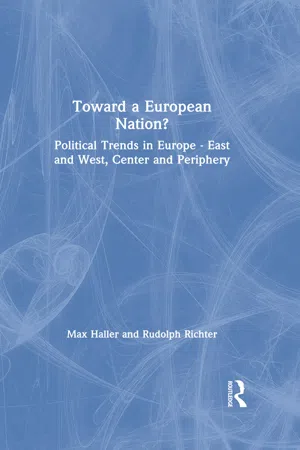
eBook - ePub
Toward a European Nation?
Political Trends in Europe - East and West, Center and Periphery
- 288 pages
- English
- ePUB (mobile friendly)
- Available on iOS & Android
eBook - ePub
Toward a European Nation?
Political Trends in Europe - East and West, Center and Periphery
About this book
This text presents the work of scholars from all over Europe who examine processes of integration and disintegration at the level of nation states, federations, regions and Europe overall.
Trusted by 375,005 students
Access to over 1.5 million titles for a fair monthly price.
Study more efficiently using our study tools.
Information
Part I
Trends, Forces, and Patterns of Integration in Western Europe
The Advent of a European Society
I
Nowadays, more people than ever before speculate about the nature of European society. Europe’s culture, economy, political constitution, unity, diversity, prospects, and destiny are scrutinized and pondered from every conceivable angle. Taken to extremes, the endeavor can be a thankless one. For when people muse endlessly over the possible “essence” of an entity as elusive as a society, we may be fairly confident that something crucial is missing from it. The endemically missing component is usually that which, were it present, would account for the very essence that is being looked for. This is, indeed, a painful paradox, and it arises all too often in the frequent and stubborn search for the nature of European society.1
Europe invites constant speculation because it cannot be taken for granted. It is never obviously or wholly there. It is an essentially problematic entity. Most of us appear to cherish it but are unable to define it properly. For many of its citizens, “European” is the widest possible social identity, beyond occupation, locality, and nation; it is the ultimate frame of social reference in terms of education, taste, ethics, belief, and public and private conduct. Yet its cultural and even physical boundaries are never clear. Until recently, Europe has been only a shared notion, albeit a crucial one, for a set of Western peoples.
The contemporary search for the precise features of European society is at the core of the very plight which now confronts the polities, the cultures, and the economies of Europe’s peoples.2 It is also part and parcel of the current obsession with “identity.” Over the last decades, the search for uniqueness, roots, distinctiveness, difference—in short, for identity—has become one of the chief themes of our age, both in Europe and abroad. As a preoccupation, the search for identity has invaded and colored all our speculations about Europe, including, first and foremost, our often unavowed anxieties about her future at this decisive moment of her history. Sociological enquiry is supposedly detached from such metaphysical concerns, but it has been far from immune to the enticements of that search. Hence the need for us to be aware of the powerful presence of this contemporary inclination. We ought to be aware that, in the end, a relentless search for identity leads nowhere; it is the quintessential Sisyphean task. As sociologists, we ought to know better than to look for the ultimate, at least in this elusive matter: Roots and final identities are best left where they belong, in the realm of mystery, lest they be used and abused by ideologies, whether providentialist, nationalist, or any other ilk. Let then sociology not enter the hallowed realm of the mysterious. Identity is averse to rational analysis, though religion, art, and poetry may sometimes convey it superbly.
The endemic difficulties inherent in any search for the identity of a complex and varied society have been compounded in Europe’s case by two very different things: her own projection upon the rest of the world, and the once prevalent Eurocentric and providentialist conception of history. The world expansion of European culture, variously carried to every comer of the earth—by a handful of seaborn Western European empires, toward the East by the Russians, and then everywhere else by the United States—has, in the end, undermined its own uniqueness and blurred its frontiers. The very worldly success of the “European cultural formula” (the combination of rationalism, political pluralism, individualism, citizenship, and technical growth)3 has meant its contemporary demise as a specifically European phenomenon.
Meanwhile, the philosophies of history that narrated the story of our core traditions and claimed to foretell their triumphant future and destiny have been either disgraced or substantially discredited. There seems to be no way in which comparable Weltgeschichtliche constructs as those of our recent past could be put forward today and receive a wide and serious audience. It looks as though any interpretation of such grandiloquence and ambition that still may dare to appear will be given short shrift by some of us and laughed out of court by the rest. Grand futuristic conceptions (in the past often linked to cosmogonies and philosophies of history) have also been discredited. On a practical level, however, Europeans—like all Westerners as well as all other peoples who have substantially assimilated elements of our culture—continue to be futuristic. With all due caution, it can be said that futurism is our very condition as creatures of modernity: Economists, politicians, industrialists, educators, ecologists, physicists, architects, scientists, sociologists, must all “plan ahead” and forecast. They must, by trade, imagine and wish a future that is different from the present. This is the legacy of the powerful belief in progress that characterized one crucial and easily identifiable trait of our culture from the age of the Enlightenment until yesterday. Such faith in its original shape may have all but disappeared, but it has left us with a need, or compulsion, to plan the time ahead. It has left us with the imperative to be futuristic. It is, nevertheless, a residual futurism. We are now futurists without a grand design.
No particular identity can be established, then, from either the structure and culture of European society or any specific theory of our history and foreseeable future. Yet, looking back on our common history (insofar as it is common) we can at least agree that we have often been united to a considerable extent by what has been termed a Schicksalgemeinschaft. This seems to be true both for our distant and recent past and for our own time, and it includes contemporary trends and the difficult rise, at long last, of a united Europe. Solemn though the expression may sound, it conveys an evident fact: The lives and destinies of the European peoples have been inextricably intertwined for a long time indeed, and no emphasis on internal varieties and variations can ever disguise the fact that the continent has had one single civilization over the centuries. Under Rome, Medieval Christendom, the Renaissance and Reformation, the Enlightenment, and the Democratic and Industrial Revolutions, it is a civilization that has been wholly, though unevenly, shared by nearly all the peoples of the continent. Some of Europe’s former colonies have also shared a substantial part of the experience during the last centuries.
The question that now arises, however, is one of continuity—or, rather, of discontinuity. There is now a distinct possibility that the “shared destiny” that affected Europeans in different but always important senses and degrees may cease to exist over the next decades. Europe may be trying to unite precisely at the moment when its distinctiveness is more problematic than ever. Faced with growing cosmopolitanism, massive immigration from the rest of the world, the relentless spread of the culturally syncretic mass media, telecommunications, global interdependence and the globalization of social relationships, demographic and ecological imbalances, world trade and industry, and transnational social inequalities, specifically European characteristics may become even more blurred than they already are. Europe’s particular traits may become less distinct. This could happen not because our nations will have suffered the inroads of alien cultures, but because they will have had to confront the consequences of their very own projection upon the world—the echo, as it were, of their own voices.
Herein lies the paradox: Europe may lose much of her identity when confronted with the consequences and ramifications of her own historical dynamics as recast, perfected, or transformed by the peoples who once upon a time fell under her spell or were the direct offshoots of her relentless global expansion. The “Europeanization” of the world has weakened the distinctiveness of Europe herself.
Globalization, about which sociologists have had so much to say in recent times,4 was a characteristically European creature during its early stages. Regardless of whether Europeans intended to export modernization (and many colonialists and imperialists clearly did not), capitalism, technology, instrumental reason, the desire for social equality, and the appeal to democracy were innovations that often traveled well. They were easily wrested from Europe’s hands, when they were not preached by the Europeans themselves. They naturally found other homes and soon ceased to be our preserve. European society can no longer be defined only in terms of its traditional civilization, for it now belongs to any people of the earth.
II
General considerations such as these about the nature and present condition of European civilization may turn out to be quite relevant for any rigorous analysis of the possible rise, today, of a single European society. For the advent of Europe as a political, economic, and transnational unit, whose demarcation lines are relatively well clear-cut, and whose nation-states share important traits in their internal structures and dynamics, is taking place precisely when, for the first time in history, her uniqueness as a distinct civilization begins to be questioned. It is likely that both apparently contradictory events are more closely related to each other than they may appear at first sight.
Clearly, the process of economic, political, and cultural unification begun with the 1957 Treaty of Rome was set in motion only after the severe loss of imperial hegemony by several of the European nation-states. Formal steps toward unification also began well after social trends and a diffuse but remarkable political movement, the European Movement, had created the necessary preconditions. The long unification process has not yet been completed, and it is not likely to run its course easily, as the troubled aftermath of the Maastricht agreements of 1991 plainly shows. It was the states’ weaknesses, then, not their strengths, that forced many politicians, economic interest groups, and social movements to move willy-nilly in the direction of unity. Looking back on the last decades, it is obvious that the many undercurrents and social trends that had been leading toward the rise of one single European society for a long time, and are now clearly beginning to come to the fore,5 would not have triggered, by themselves, the incipient moves toward real integration and loss of sovereignty that are under way today. There were also the shared plights of relative national smallness, loss of competitiveness against external powers, military weakness, the Soviet threat in the decades after World War II, and other similarly powerful factors that managed to weaken the seemingly inexhaustible moral and political resources of the defenders of the nation-states. Yet the militant foes of unification stood their ground and made unification a very tough task indeed. They had countless allies among their respective citizenries, for the established nation-states of Europe commanded, and continue to command, enormous emotional resources from their loyal citizens. Even today, hardly any Dane, Italian, German, Frenchman, Scot, Spaniard, or Pole will call Europe his or her motherland, which lends credence to the wrong notion that a strong, federal Europe is inimical to nationhood.
Despite the hard facts of nationalism and national attachments, the diminution of European specificity and independence as a civilization has certainly been a cause of integration. Though not as easily identifiable as other factors, it must be counted alongside the other currents that have broken or undermined well-entrenched resistances against the creation of the single society on this continent. Just as the anxiety over a threat to ethnic identity reinforces nationalism, the loss of European distinctiveness (identity) has given rise to a widespread preoccupation—at least among certain European elites—with its survival. That anxiety has, in turn, spurred the development of “European nationalism,” or “Europeanism,” as a new form of collective identification. Though milder and less demanding than “national” nationalism, “Europeanism” claims—just as any other form of nationalism—its own public pieties, sacred symbols, and loyalties. It also demands its embodiment in political structures.
To these forces, another one must be added. If the globalization and Westernization (that is, “Europeanization”) of the world often require the formation of large markets and political units throughout the globe, they also require, in the end, larger societies. Europe herself is one of them, albeit still in the making. In fact, Europe is the first “larger society” to appear in our times. “State-building” and “nation-building,” those two creatures of modernization, first developed within European civilization. Large-scale “society-building” has also begun within its framework, at least in modern times. America, however, might be the first historical example of the simultaneous development of the three closely related processes of nation-building, state-building, and large-scale society-building. But on European soil, the phenomenon began to develop in the aftermath of World War II, which saw the downfall of the penultimate internal European empire, the Third Reich. The collapse of the last internal European empire, the Russian, between 1988 and 1991, has opened the way to further steps toward societal, not just political, unification. (Empires are often good means to keep a congeries of peoples under one rule and one pax, though they do not always manage to beat them into one single social structure and culture.) The dissolution of Soviet power has indeed left in its wake much disarray and turbulence on its western frontiers, especially in the Balkans, but as intra-European empires go, it looks as though these might be the very last of such turbulences. As a consequence, Europe, East and West, North and South, is now much more ready for peaceful forms of unity among her nations and for greater integration among the diverse interests of her regions, social classes, and groups than it ever was.
The acceleration of a wide variety of European unification processes has been quite recent, however. In fact, trends toward convergence were so slow, and political and violent confrontations between states so acute, that social scientists often were blind to any kind of convergence. Thus the often-heard notion that social scientists notice and react to events only when they have come to fruition or, if they pose some sort of threat, only after it is already too late to do anything about them, rang somewhat true. Yet this familiar harsh judgment is not entirely fair. It is true that, for the most part, European social scientists have preferred to work within the framework of their national societies: They were, in every sense, more easily accessible to them as clearly bound units of observation. There was linguistic unity; and statistical material, already gathered data, and research funds were readily available for territories under one single administration. However, it is no less true that many social scientists have been engaged in work of a truly European scope for a long time. It is a work which, over a number of decades, has scarcely ignored the economic, political, and cultural trends that have been leading toward the rise of this complex but nevertheless single European society that is now only beginning to take shape.6
A “European vision” and a European stand...
Table of contents
- Cover
- Half Title
- Title
- Copyright
- Contents
- About the Editors and Contributors
- Preface
- Introduction
- Part I: Trends, Forces, and Patterns of Integration in Western Europe
- Part II: The Difficult Transition to Democracy, Market, and Civil Society in Eastern Europe
- Part III: Toward a United Europe—Prerequisites, Prospects, and Threats
- Index
Frequently asked questions
Yes, you can cancel anytime from the Subscription tab in your account settings on the Perlego website. Your subscription will stay active until the end of your current billing period. Learn how to cancel your subscription
No, books cannot be downloaded as external files, such as PDFs, for use outside of Perlego. However, you can download books within the Perlego app for offline reading on mobile or tablet. Learn how to download books offline
Perlego offers two plans: Essential and Complete
- Essential is ideal for learners and professionals who enjoy exploring a wide range of subjects. Access the Essential Library with 800,000+ trusted titles and best-sellers across business, personal growth, and the humanities. Includes unlimited reading time and Standard Read Aloud voice.
- Complete: Perfect for advanced learners and researchers needing full, unrestricted access. Unlock 1.5M+ books across hundreds of subjects, including academic and specialized titles. The Complete Plan also includes advanced features like Premium Read Aloud and Research Assistant.
We are an online textbook subscription service, where you can get access to an entire online library for less than the price of a single book per month. With over 1.5 million books across 990+ topics, we’ve got you covered! Learn about our mission
Look out for the read-aloud symbol on your next book to see if you can listen to it. The read-aloud tool reads text aloud for you, highlighting the text as it is being read. You can pause it, speed it up and slow it down. Learn more about Read Aloud
Yes! You can use the Perlego app on both iOS and Android devices to read anytime, anywhere — even offline. Perfect for commutes or when you’re on the go.
Please note we cannot support devices running on iOS 13 and Android 7 or earlier. Learn more about using the app
Please note we cannot support devices running on iOS 13 and Android 7 or earlier. Learn more about using the app
Yes, you can access Toward a European Nation? by Max Haller in PDF and/or ePUB format, as well as other popular books in Politics & International Relations & International Relations. We have over 1.5 million books available in our catalogue for you to explore.