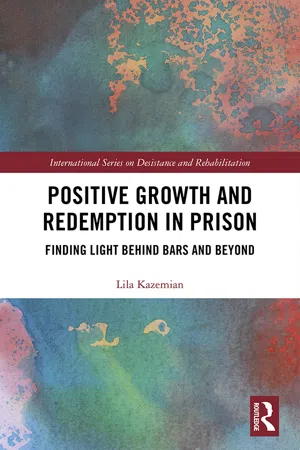
Although the negative consequences of rising incarceration rates have been well-established, criminological research has largely neglected to document psychological, social, and behavioral changes that occur during periods of incarceration. Drawing on an original longitudinal study of long-term French prisoners, this book examines the process of desistance from crime and positive growth in prison. It offers reflections on how personal transformation can be achieved in prison, particularly among individuals serving long prison sentences.
This research investigates the barriers to achieving positive growth in prison, as well as the different ways in which transformation can occur behind bars. It also conceptualizes the process of abandoning crime in prison, and sheds light on the cognitive, social, and structural factors that may trigger, accelerate, or hamper this process. This book explores the circumstances under which individuals can thrive in prison, and identifies key features of the narratives of prisoners who have achieved positive growth. The research presented in this book also examines the intricacies of returning to society after a lengthy period of time in prison.
Written in a clear and accessible style, this book will be invaluable reading for those engaged in studies of criminology and criminal justice, sociology, criminal behavior, prisons, and penology. It is also aimed at a variety of audiences, including academics, practitioners, policy-makers, and prisoners.
Trusted by 375,005 students
Access to over 1.5 million titles for a fair monthly price.
“Why are you here, Lila? Is anyone in your family in prison?” Prisoners have asked me this question countless times over the years, in both American and French prisons. Why would someone willingly choose to spend time in a prison unless they had a personal stake in it? Friends and family who learned of my research interests often asked similar questions: why was I interested in the well-being of individuals who were locked up, presumably because they were too dangerous to be released?
For over 20 years, I have engaged in research with individuals involved in the criminal justice system in Canada, the UK, the United States, and France. With increased interactions with this population, it is easy to realize that any one of us could end up in prison under different life circumstances. Traumatic childhoods. Lack of access to the resources needed to cope with trauma. Exposure to persistent poverty and marginalization. These are only a few of the factors that create an uneven playing field, and that strongly influence who occupies our prisons cells. Regular exposure to prisoners has reminded me, perhaps paradoxically given our treatment of this population, of the fundamental goodness that exists within us all. Prisoners also remind us that if we can look beyond the harmful behaviors in which they/we have engaged and provide opportunities to thrive, there is potential for positive transformations within our prisons. The structure of our current prison systems does not generally promote a path to redemption, and we are not setting up our prisoners to thrive and to build a better life for themselves. Under the conditions as they stand, our prison systems are fundamentally flawed. The lessons drawn from my research aim to offer reflections on reforms and approaches that may make thriving in prison less anomalous, and more widespread. More importantly, this research offers insight for efforts to grow in the face of adversity, in prison as well as in any other challenging setting that is not inherently conducive to positive growth. The prisoners’ experiences in working to reduce (and eventually abandon) criminal behavior has relevance for anyone seeking to give up any other form of harmful behavior, towards oneself and/or others.
These are some of the core assumptions laid out in this book. This is a particularly important topic given the growing reliance on prison as a response to crime, and the increasing number of confined individuals across the world in the last decades. Imprisonment rates have generally been on the rise in most developed countries, though small declines have been noted in recent years (Walmsley, 2018). Although numerous studies have highlighted the negative consequences of rising incarceration rates, we know relatively little about the changes that occur during periods of incarceration. This is particularly true for individuals serving long prison sentences (i.e., ten or more consecutive years). This oversight is a result of the lack of comprehensive data on long-term prisoners. Past research has retrospectively documented various dimensions of prison life, but prospective longitudinal follow-ups of prisoners remain scarce. While we know that prison can be a highly stressful environment (Clemmer, 1958; Hassine, 2004; Johnson & Toch, 1982; National Research Council, 2014; Sykes, 1958), we still have much to learn about how prisoners change, grow or experience setbacks over the course of a prison sentence. Researchers have often assumed that crime stops during periods of incarceration and that it is irrelevant to study the process by which individuals abandon criminal behavior (otherwise known as desistance from crime) among prisoners. The fact remains that individuals undergo many changes in their lives, especially during lengthy periods of confinement, but our understanding of these changes remains limited.
The current research: the French Prison Study
The French Prison Study examines the experiences of long-term prisoners in France, during periods of incarceration and after release. The study was initiated in a prison in the suburbs of Paris in the spring of 2013. I conducted in-depth interviews with 58 long-term male prisoners. Participants were re-interviewed three years later, and interviews are ongoing upon release. Over the course of the follow-up period, some remained in the same facility, others were transferred to a different prison, some were released and remained in the community, and others were released and re-incarcerated.
Figure 1.1 The black box of prison: what changes occur during periods of incarceration?
Criminological research has taught us quite a bit about why individuals eventually abandon criminal behavior, but few studies have focused on studying this process among prisoners. In this book, I examine the individual, social and behavioral changes that unfold over long periods of incarceration in order to better understand the adjustment process and potential barriers to desistance from crime and to a successful eventual return to the community. I offer a conceptualization of desistance in prison, and explore the circumstances that may enable individuals to thrive in prison. Given that most research on desistance draws on samples of individuals in the community, it is unclear whether the body of knowledge on desistance from crime can be extended to prisoners. I also explore the ways in which prison prepares individuals for post-incarceration life, as well as the individual and social factors that may impact reintegration efforts after release from prison. The project ultimately aims to inform about effective practices regarding preparation for release, desistance from crime, and positive growth during periods of incarceration.
France is an interesting site for a prison study, for various reasons. As of early 2019, it had an overall incarceration rate of 104 prisoners per 100,000 population, compared with a rate of 337 per 100,000 population in Brazil, 172 in Australia, 148 in Scotland, 139 in England and Wales, 127 in Spain, 114 in Canada, 77 in Germany and Northern Ireland, 63 in Norway, 61 in the Netherlands, and 59 in Sweden (www.prisonstudies.org). While France does not have one of the highest imprisonment rates in the world, or even in Europe, this figure has been rising over the course of the past decades, like in many other nations (a 13 percent increase between 2005 and 2014; Direction de l’Administration Pénitentiaire, 2014; see also www.prisonstudies.org). France is not up to par with the progressive policies of Scandinavian prisons, which are geared towards rehabilitation and reintegration, but its incarceration rate places it at an approximate midpoint compared with its European counterparts. In addition, France has produced some of the most influential scholars in the fields of criminology and sociology, including Durkheim, Foucault, and Bourdieu, but we know relatively little about contemporary French criminology (Kazemian, 2015). Finally, like many other Western nations, France grapples with the consequences of a history of colonization and oppression, which can be extended to a wide range of developed nations.
Why should the experiences of prisoners in a cultural setting other than our own matter to us? First, the fight for the respect of basic human rights extends far beyond the geographical boundaries of our own country of residence or origin. The treatment of prisoners is a global human rights issue. Second, some comparative research has suggested that while prisoners may have distinctive experiences in different cultural contexts, well-being outcomes tend to be similar across prison settings (Ross et al., 2008). This suggests that the pains of imprisonment converge across different prison environments. The current study illustrates that the commonalities of the prison experience transcend cultural settings. Social norms may vary across cultures, but there are many similarities in the experience of positive growth in the face of hardship. The study of prison experiences, regardless of the cultural context, provides valuable insight for our understanding of human suffering, and the possibility of thriving in adversity.
This book addresses two significant shortcomings of prior research. First, it examines the incarceration experiences of long-term prisoners, a group that has been largely overlooked in past research. The policies and programs targeting prisoners are seldom tailored to those serving long-term prison sentences and we know little about effective interventions, or even how to measure effectiveness, for this population. Second, few studies have documented the process of desistance from crime among prisoners during periods of incarceration. Most research that has examined the prison-desistance link has relied on post-release retrospective data. Given the paucity of prospective longitudinal studies of prisoners, the value of the findings drawn from this research extends far beyond France, or even Europe.
Jamieson and Grounds (2005) discussed some of the limitations of the literature on the effects of imprisonment, which are addressed in the current research. It employs a longitudinal design; part of the sample has been followed up after release from prison; efforts were invested to better capture different forms of distress; and the developmental framework was used to provide better context to broader life circumstances, before, during, and after prison. Importantly, because we know that most prisons across the world, in their current form, do not generally promote positive transformation, this research seeks to better understand the circumstances under which growth is possible in a challenging and repressive prison environment.
Why should we care about long-term prisoners?
In a previous publication (Kazemian & Travis, 2015), we discussed the crucial importance of paying attention to the experiences and needs of long-term prisoners. From a human rights perspective, it is simply the right thing to do. For a variety of reasons, long-term prisoners have been largely left out of conversations about effective strategies for desistance from crime and successful reintegration after prison, resulting in a form of double punishment and limited access to opportunities and incentives for positive growth. From a crime prevention standpoint, evidence suggests that long-term prisoners do not present a higher risk of reoffending (Weekes, 1995; Weisberg et al., 2011; Crayton, 2012). For instance, in a Dutch study, Snodgrass et al. (2011) found that when including relevant control variables, reoffending rates did not differ between matched groups having served short and long sentences. When excluding controls, individuals who served longer sentences were less likely to reoffend. In addition, although limited in scope, available research has suggested that prison misconduct is less prevalent among long-term prisoners (Cunningham & Sorensen, 2006; Flanagan, 1979; Sorensen & Reidy, 2018).
Despite these findings, we continue to espouse the false myth that a violent offense equates a violent person. Being convicted of a violent crime is not necessarily indicative of a high risk of sustained violence (Gottschalk, 2014). Western (2018) reminds us to look beyond the stigma of violence. In the Boston Reentry Study, violence grew in the context of poverty:
Trying to divide the prison population into good people and bad, between violent and nonviolent, fundamentally misunderstands the nature of violence in poor family and neighborhood contexts. The division between the violent and the nonviolent is a moral distortion of a complex social environment in which victims, witnesses, participants, and offenders are often one and the same individuals who suffer harm from each part they play in episodes of violence.
(Western, 2018, p. 81)
This distorted view of violent offending may fuel the misconception that individuals who are convicted of serious crimes are irredeemable, which may explain the limited efforts invested in promoting positive growth among long-term prisoners. Because they will spend many years behind bars, long-term prisoners are important assets to the prison community and can become influential leaders in this environment. Given their prolonged presence in prison, these individuals are ideal candidates for positions of leadership and mentorship in this environment.
Can individuals thrive in prison?
The evidence on the negative and disruptive effects of incarceration is undeniable (Liebling & Maruna, 2005; Haney, 2003; National Research Council, 2014). Incarceration does little to reduce aggregate crime rates or individual-level reoffending, and exerts detrimental effects on mental health and psychological well-being, housing and employment outcomes, family ties, and communities (see Kazemian & Walker, 2019). Some scholars have expressed reservations about the possibility of thriving in prison. Comfort (2012) argued that in the face of extreme social disadvantage, accounts of positive change in prison do not reflect “narratives of thriving,” but rather a “forced choice” in which no viable alternatives are available:
Being in a place with uninterrupted time to think about one’s life and one’s future is a standard practice afforded to youth during their emerging adulthood, some of whom enjoy the liberty of doing this on an island or mountaintop, and many of whom do so in the halls and on the campuses of academe. Were large batches of these high-resourced young people suddenly rerouted to the penitentiary, it is unlikely their ensuing stories would decree the correctional environment well suited to fostering personal development and growth.
(Comfort, 2012, p. 319)
Comfort accurately raises the issue of disparity in exposure to inequality and in acce...
Table of contents
Cover
Half Title
Series Page
Title Page
Copyright Page
Table of Contents
List of illustrations
Series editor introduction
Acknowledgments
1 Introduction
2 The French Prison Study
3 The research participants
4 The desistance paradigm in criminology and its application to long-term incarceration
5 Lotus in the mud: a conceptualization of desistance from crime in prison
6 The barriers to positive growth in prison
7 Achieving positive growth in prison
8 The desistance narrative in prison
9 Life after prison
10 Conclusion
Index
Frequently asked questions
Yes, you can cancel anytime from the Subscription tab in your account settings on the Perlego website. Your subscription will stay active until the end of your current billing period. Learn how to cancel your subscription
No, books cannot be downloaded as external files, such as PDFs, for use outside of Perlego. However, you can download books within the Perlego app for offline reading on mobile or tablet. Learn how to download books offline
Perlego offers two plans: Essential and Complete
Essential is ideal for learners and professionals who enjoy exploring a wide range of subjects. Access the Essential Library with 800,000+ trusted titles and best-sellers across business, personal growth, and the humanities. Includes unlimited reading time and Standard Read Aloud voice.
Complete: Perfect for advanced learners and researchers needing full, unrestricted access. Unlock 1.5M+ books across hundreds of subjects, including academic and specialized titles. The Complete Plan also includes advanced features like Premium Read Aloud and Research Assistant.
Both plans are available with monthly, semester, or annual billing cycles.
We are an online textbook subscription service, where you can get access to an entire online library for less than the price of a single book per month. With over 1.5 million books across 990+ topics, we’ve got you covered! Learn about our mission
Look out for the read-aloud symbol on your next book to see if you can listen to it. The read-aloud tool reads text aloud for you, highlighting the text as it is being read. You can pause it, speed it up and slow it down. Learn more about Read Aloud
Yes! You can use the Perlego app on both iOS and Android devices to read anytime, anywhere — even offline. Perfect for commutes or when you’re on the go. Please note we cannot support devices running on iOS 13 and Android 7 or earlier. Learn more about using the app
Yes, you can access Positive Growth and Redemption in Prison by Lila Kazemian in PDF and/or ePUB format, as well as other popular books in Social Sciences & Criminology. We have over 1.5 million books available in our catalogue for you to explore.