The rise of the Islamic State since 2014 has led to the re-emergence of terrorism as a serious security threat in Asia. Coupled with the ongoing terrorism and insurgency challenges from both radical religious extremists and also ethno-nationalist insurgencies, it is clear that some parts of Asia remain mired in armed rebellion despite decades of nation-building. While the situation in Afghanistan and Pakistan has obviously deteriorated, there is also a growing terrorist challenge, on top of armed insurgencies, in other parts of Asia. A common theme in armed rebellions in the region has been the lack of legitimacy of the state and the presence of fundamental causes stemming from political, economic or social grievances. Addressing rebellion in the region thus requires a comprehensive approach involving transnational co-operation, addressing fundamental grievances, and also the use of more innovative approaches, such as religious rehabilitation and reconciliation programmes.
eBook - ePub
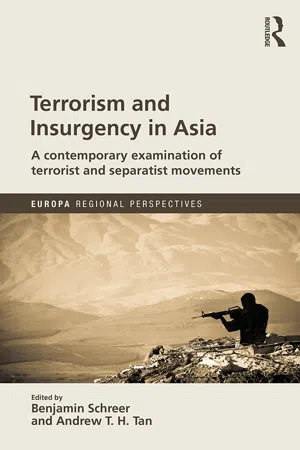
Terrorism and Insurgency in Asia
A contemporary examination of terrorist and separatist movements
- 256 pages
- English
- ePUB (mobile friendly)
- Available on iOS & Android
eBook - ePub
Terrorism and Insurgency in Asia
A contemporary examination of terrorist and separatist movements
About this book
Trusted by 375,005 students
Access to over 1.5 million titles for a fair monthly price.
Study more efficiently using our study tools.
Information
Subtopic
Asian PoliticsPart 1
1 Introduction
Terrorism challenges and the rise of Islamic State
In 2014, the surprising success and rise of Islamic State (IS) in Syria and Iraq attracted worldwide attention. It also galvanised radical Islamist elements throughout the world, attracting thousands of volunteer mujahideen fighters from an estimated 81 countries, including Europe, North America, Africa, Asia and the Middle East, to fight in the Levant, where IS initially succeeded in establishing a caliphate (Tarabay 2014). Even more seriously, the instability in the Levant spilled over to other parts of the world, as demonstrated by a string of IS-inspired terrorist attacks in Europe and Asia.
From around 2015, a string of spectacular IS-inspired terrorist attacks took place in Europe. In January 2015, an attack on the satirical weekly Charlie Hebdo in Paris, killed 12 people. Paris was again the target of coordinated attacks in November 2015, during which 130 people lost their lives. In March 2016, bombings in Brussels claimed the lives of 32 people. In July 2016, a truck drove into crowds celebrating Bastille Day in France, killing 86. In December, a similar truck attack at a Christmas market in Berlin killed 12 people. Another truck attack, this time in Stockholm, in April 2017, killed four people. In May, a major terrorist attack during a music concert in Manchester left 22 people dead. In August, a vehicle attack on pedestrians in Barcelona killed 14 people (Foster 2017).
In South and Southeast Asia, IS also galvanised militants to join the fight in the Middle East. In South Asia, the threat was particularly serious, with senior figures of banned extremist groups in Pakistan such as the Tehrik-e-Taliban (TTP) and the Lashkar-e-Jhangvi pledging allegiance to IS (Jamal 2016; Rana 2015). The Soufan Group also estimated that by January 2016 over 650 Pakistanis had joined IS in the Middle East (Barrett 2017: 13). Furthermore, IS activities added to the growing instability in Pakistan, a nuclear-armed state with serious political, economic and social problems. This was demonstrated by a series of major terrorist attacks within Pakistan, such as the deadly attack on an army school in Peshawar in 2014 that killed 154, including 135 school children (Jamal 2016). Indeed, with an estimated 80,000 casualties in terrorism-related violence between 2005 and 2013, Pakistan has been described as the “Ground Zero” in global terrorism (Gunaratna and Iqbal 2011).
IS has also operated in neighbouring India, though its impact has been more limited compared to Pakistan. By March 2017, around 75 fighters from India had joined IS in the Middle East (Barrett 2017: 12). More seriously, IS emerged in Afghanistan by around mid-2014, where it now has an estimated 3,000 fighters, adding to the growing insurgent threat (VOA News 2017). In early 2016, some Taliban commanders formally pledged allegiance to IS which announced its “Khorasan” theatre in Afghanistan (Comerford 2017).2 After the formal end of the NATO-led International Security Assistance Force (ISAF) at the end of 2014 and the transition to the Resolute Support Mission (RSM) to train and assist Afghan security forces, the Taliban re-emerged and made significant gains against the central government. The Afghan National Army (ANA) proved largely ineffectual, requiring a continuation of the foreign military presence in the country. In view of the deteriorating security situation, the United States sent an additional 3,000 troops to the country in September 2017 to shore up the beleaguered Afghan government (BBC 2017). In June 2018, the RSM totalled about 16,000 troops (NATO 2018).
The situation in Southeast Asia has also remained challenging. While sustained counter-terrorism efforts by regional states since 9-11 have contained the threat from Al Qaeda, various other extremist groups and networks continue to operate across the region. Moreover, since 2014, the rapid rise in the influence of IS has become a major security challenge for some governments. This included the spread of IS ideology, its success in recruiting local extremists, and the threat posed to local governments. Indeed, IS managed to attract hundreds of volunteers from the region to fight in Syria and Iraq.
In July 2016, IS formed a Malay-speaking brigade in Syria, known as Katibah Nusantara, with around 1,000 fighters from Southeast Asia, predominantly from Indonesia and Malaysia (Sholeh 2016: 101). The Soufan Group estimated that by March 2017, 435 Indonesians had been intercepted in Turkey, the transit point for IS volunteers travelling to Syria. Around 384 Indonesians remained with IS, while 50 fighters had returned to Indonesia. By the end of 2016, an estimated 91 Malaysians had also joined IS in the Middle East (Barrett 2017: 12–13). By February 2017, Malaysian authorities had detained 234 people for being alleged IS sympathisers under preventive detention laws (Malay Mail 2017). In the Philippines, an insurgent group that had pledged allegiance to IS shocked the region when it occupied Marawi city in the southern Philippines, in May 2017. The “Marawi siege” lasted five months and drew in US and Australian forces to assist the Philippine army in intense urban combat. Combat operations ceased in October with the defeat of the militants, with over 1,100 people fatalities (ABC News 2017).
On-going insurgencies in Asia
In addition to the growing threat posed by radical Islamist terrorism, a number of Asian nations also continued to experience armed rebellions by various groups, including ethno-nationalist separatist rebellions. While some of the separatist rebellions have taken on religious overtones, they remain focused on secession from the majority-dominated state, to either form independent states or to integrate with another neighbouring state with which the rebels share a similar ethnic and/or religious identity.
Since the end of World War Two, the process of decolonisation has meant the breakup of Western colonial empires and the emergence of many independent states. These newly formed states, however, often lacked legitimacy due to their artificial construction and the forced incorporation of many minorities who refused to accept the rule of the majority ethnic or religious group. The lack of legitimacy of the state often caused armed rebellions which have contested the authority of central governments. Minority groups have also been engaged in separatist rebellions due to political repression, poverty, socio-economic disparities, a sense of relative deprivation, discrimination and prejudice, as well as corruption and mismanagement by central governments. Underlying many of these rebellions has been a sense of alienation from the state, which has translated into a problem of states’ legitimacy. Some states in Asia thus continued to suffer from fragility long after gaining independence from colonial powers and despite decades of efforts at nation-state building (Tan 2007: 14).
Several long-running separatist insurgencies attest to their longevity and persistence. The Moro Muslim separatist rebellion in the southern Philippines began in 1972 and persisted until recently. Although the main rebel movement, the Moro Islamic Liberation Front (MILF), signed a peace agreement with the Philippine government in 2014, violence in the south has continued due to the presence of other militant groups, such as the Abu Sayaff Group and IS. Separately, the Philippines continue to face a Maoist communist insurgency against the central government that is political and ideological in nature. In southern Thailand, the long-running Malay Muslim separatism, which can be traced to the signing of the Anglo-Siamese Treaty in 1909 that led to the former territory of the Pattani sultanate being incorporated into Siam (present-day Thailand), has continued to the present (Pongsudhirak 2007: 267).
In Myanmar, various ethnic minorities have been engaged in secessionist insurgencies against the central government since the country’s independence in 1948. In 2017, despite the emergence of a civilian democratically elected government in Myanmar dominated by Nobel Prize-winning laureate Aung San Suu Kyi, tough counter-insurgency operations carried out by the armed forces against the minority Rohingya Muslims in Arakan State have led to hundreds of thousands fleeing across the border to neighbouring Bangladesh, leading to a major humanitarian crisis (Asrar 2017). The on-going Maoist insurgency in eastern India was described in 2006 by then Prime Minister Manmohan Singh, as the “single biggest internal security threat” to India. From a peak in violence in 2010, the number of casualties has declined but the Maoist insurgents remain a force in India due to enduring fundamental grievances over land rights for indigenous Indians (Roy 2017).
In China, Uighur separatists in Xinjiang province have carried out a number of recent attacks against civilians as well as the security forces. In 2014, several deadly attacks took place. In March, a knife-attack at Kunming’s train station killed 29 people. In May, an attack on a market in Urumqi led to the deaths of 31 people. In July, a police station and government offices were attacked in Yarkant, leaving 96 dead. In September, a car crashed into tourists at Tiananmen Square in Beijing, killing five people (BBC 2014). China has responded with tough, repressive measures, which are certain to fuel the on-going insurgency (The Economist 2018).
Consequently, despite the recent emergence of IS in Asia, the terrorism and insurgency challenges in the region have had a much longer history as well as deeper historical, political, social and economic roots. These challenges are also multi-faceted, as they have involved various disaffected ethnic and religious groups, and have been the product of deep-seated alienation by such groups as a result of the presence of fundamental, long-standing socio-economic and political causes. This means that terrorism and insurgency in Asia have been, and will continue to be major challenges which deserve continued attention as to their causes, implications and counter-strategies.
Objectives of the volume
Given the persistent threat of terrorism and insurgency in Asia, the objective of this volume is to examine the challenges arising from terrorist and insurgent groups in Asia and evaluate the responses to them. In doing so, the volume aims to make a scholarly and policy relevant contribution to our understanding of this serious security problem, one that could help policy makers and scholars alike to understand the nature of the challenge and how to better counter or manage it. This volume is a collaborative endeavour, given the need for expertise spanning the entire Asian region, a vast and diverse continent.
This volume also fills a gap in our contemporary understanding of the terrorist and insurgent problem in Asia, given the current attention to global terrorism, terrorism in Europe and the continuing war on terror in Iraq and Syria. Some of the best cited works on the problem of terrorism and insurgency in Asia, for instance, A Handbook of Terrorism and Insurgency in Southeast Asia (Edward Elgar, 2007), by Andrew Tan, and Terrorism in Southeast Asia (NOVA Science, 2008), by Bruce Vaughn and Emma Chanlett-Avery et. al., are now dated as a result of recent developments, such as the rise and the spread of Islamic State’s radical extremist ideology, the political developments in Myanmar which may have a major impact on its long-running ethnic separatist insurgencies, and the continuing, and worsening situation in both Afghanistan and Pakistan.
This volume focuses on discrete security complexes where there are cross-border linkages (such as the Malay Archipelago states and the theatre consisting of Afghanistan and Pakistan), and those where their non-radical Islamist nature provide a contrast (for instance, separatism in Myanmar, India’s Maoist insurgencies, the communist Maoist insurgency in the Philippines, and also China’s Uighur problem, despite some links with radical Islamism).
This volume is therefore timely and important, and fills a scholarly and policy gap on a long-standing security issue of continuing importance to Asia and the rest of the world.
Organisation of the volume
This volume is organised into four parts and contains a total of 16 chapters. The first part has two chapters which include this introductory chapter. Chapter 2 by Adam Lockyer, which follows this chapter, is entitled “The causes of armed rebellion in Asia”. This chapter provides the conceptual framework for the book, and examines the causes of armed rebellion including terrorism and insurgencies, such as poverty and the linkages between failed states and terrorism. The chapter surveys the literature, sums up key findings that shed light on the fundamental causes of political and religious violence, and assesses how they might throw new light on how terrorism and insurgencies could be countered.
Part 2 of this work examines the key conflict theatres in South and Central Asia, and has six chapters. Chapter 3, by Julian Droogan and Lise Waldek, is entitled “Social media and terrorism in the Asia Pacific”. This chapter examines three violent extremist-related groups operating in the Asia Pacific: one “classic” terrorist, namely, Abu Sayyaf in the Philippines; one a dissident political party, namely, Jemaat-e-Islami in Bangladesh; and one a broad ethno-religious separatist movement, namely, the Uyghurs in China. Each case study explores how the proactive adoption of social media affords opportunities and risks on the ability of the group to maximise its reach, impact, and effect.
Chapter 4, by Lise Waldek, is entitled “The long war: Afghanistan” and provides an overview into the current conflict and endemic violence in Afghanistan. It argues that the current strategic approach that focuses almost exclusively on terrorist organisations, such as Al Qaeda and Islamic State, has pushed Afghanistan into the background where it has become a host, a carrier of the parasite for the unfolding violence and conflict. This approach has delivered primarily military focused solutions that deliver temporary fixes that dissipate almost as quickly as they are won. In her chapter, Waldek proposes a framework of analysis grounded in the historical, socio-cultural and geographical complexities of Afghanistan. Waldek identifies five different yet interconnected sources of instability. These are; power dynamics; identity politics; corruption; the fractured nature of the insurgency; and the broader geo-political context. Each section examines how these issues and relationships shape and generate the instability and violence found across Afghanistan. Waldek argues that developing a more nuanced understanding of the instability generates opportunities to identify and create longer-term solutions to a seemingly intractable violence.
Chapter 5, written by Benjamin Schreer and Tom Waldman, is entitled “Strategy on autopilot: Resolute support and the continuing failure of Western strategy in Afgha...
Table of contents
- Cover
- Half Title
- Series Page
- Title Page
- Copyright Page
- Table of Contents
- List of figures
- Acknowledgements
- The editors and contributors
- PART 1
- PART 2
- PART 3
- PART 4
- Index
Frequently asked questions
Yes, you can cancel anytime from the Subscription tab in your account settings on the Perlego website. Your subscription will stay active until the end of your current billing period. Learn how to cancel your subscription
No, books cannot be downloaded as external files, such as PDFs, for use outside of Perlego. However, you can download books within the Perlego app for offline reading on mobile or tablet. Learn how to download books offline
Perlego offers two plans: Essential and Complete
- Essential is ideal for learners and professionals who enjoy exploring a wide range of subjects. Access the Essential Library with 800,000+ trusted titles and best-sellers across business, personal growth, and the humanities. Includes unlimited reading time and Standard Read Aloud voice.
- Complete: Perfect for advanced learners and researchers needing full, unrestricted access. Unlock 1.5M+ books across hundreds of subjects, including academic and specialized titles. The Complete Plan also includes advanced features like Premium Read Aloud and Research Assistant.
We are an online textbook subscription service, where you can get access to an entire online library for less than the price of a single book per month. With over 1.5 million books across 990+ topics, we’ve got you covered! Learn about our mission
Look out for the read-aloud symbol on your next book to see if you can listen to it. The read-aloud tool reads text aloud for you, highlighting the text as it is being read. You can pause it, speed it up and slow it down. Learn more about Read Aloud
Yes! You can use the Perlego app on both iOS and Android devices to read anytime, anywhere — even offline. Perfect for commutes or when you’re on the go.
Please note we cannot support devices running on iOS 13 and Android 7 or earlier. Learn more about using the app
Please note we cannot support devices running on iOS 13 and Android 7 or earlier. Learn more about using the app
Yes, you can access Terrorism and Insurgency in Asia by Benjamin Schreer, Andrew T. H. Tan, Benjamin Schreer,Andrew T. H. Tan in PDF and/or ePUB format, as well as other popular books in Politics & International Relations & Asian Politics. We have over 1.5 million books available in our catalogue for you to explore.