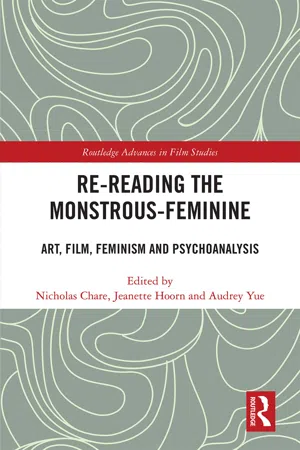
This book provides a critical reappraisal of Barbara Creed's ground-breaking work of feminist psychoanalytic film scholarship, The Monstrous-Feminine, which was first published in 1993. The Monstrous-Feminine married psychoanalytic thinking with film analysis in radically new ways to provide an invaluable corrective to conventional approaches to the study of women in horror films, with their narrow emphasis on woman's victimhood. This volume, which will mark 25 years since the publication of The Monstrous-Feminine, brings together essays by international scholars working across a variety of disciplines who take up Creed's ideas in new ways and fresh contexts or, more broadly, explore possible futures for feminist and/or psychoanalytically informed art history and film theory.
eBook - ePub
Re-reading the Monstrous-Feminine
Art, Film, Feminism and Psychoanalysis
- 268 pages
- English
- ePUB (mobile friendly)
- Available on iOS & Android
eBook - ePub
Re-reading the Monstrous-Feminine
Art, Film, Feminism and Psychoanalysis
About this book
Trusted by 375,005 students
Access to over 1.5 million titles for a fair monthly price.
Study more efficiently using our study tools.
Information
1 Re-reading The Monstrous-Feminine
New Approaches to Psychoanalytic Theory, Affect, Film, and Art
The argument that women’s genitals terrify because they might castrate challenges the Freudian and Lacanian view and its association of the symbolic order with the masculine.
In 2008, the comedy horror film Teeth (Dir. Mitchell Lichtenstein, USA, 2007) was released in cinemas. The film centres upon a high school student, Dawn O’Keefe, who has a vagina with hidden teeth. Early in the narrative, Dawn is forced to have sex by a young man, Tobey, and the teeth emerge cutting of his penis. Researching her condition, Dawn learns about the legend of the vagina dentata or toothed vagina. She seems literally to embody a physical condition previously taken for myth. Teeth is a film that exploits anxieties about female sexuality as a means to shock and amuse its audience. The fear of castration that undergirds the plot resonates with some of the themes that Barbara Creed (1993) examines in her groundbreaking analysis of the horror film genre, The Monstrous-Feminine. Creed devotes an entire chapter to the vagina dentata as it appears in myth and as it relates to Freudian theory. She suggests that the vagina dentata is ‘particularly relevant to the iconography of the horror film, which abounds with images that play on the fear of castration and dismemberment’ (1993, p. 107). Teeth manifests imagery of this kind. Dawn’s actions are akin to those of the femme castratrice, of woman as a castrator (although her vagina practises penectomy). Creed analyses the figure of the femme castratrice in the context of rape revenge films such as I Spit on Your Grave (Dir. Meir Zarchi, USA, 1978). Teeth does not begin as a rape revenge film – in that Dawn’s initial acts of dismembering seem instinctive rather than intended – but she does later consciously exploit her toothed vagina to seek vengeance on those who wrong her or those close to her. In the final scene, she is held hostage by an old man who appears willing to trade her freedom for sexual favours. She looks at him, giving a tight-lipped smile, concealing her teeth. In imprisoning Dawn, the sexual predator is clearly shown to have bitten off more than he can chew.
Teeth was released 14 years after the publication of The Monstrous-Feminine, and demonstrates that the kinds of anxieties regarding genders and sexualities that Creed examines in her book are remarkably enduring in horror films. It is now over 25 years since Creed’s landmark feminist contribution to scholarship on the horror genre. A new, expanded edition of The Monstrous-Feminine is currently in preparation to mark the occasion. As the essays in this volume demonstrate, many of the themes and issues examined in The Monstrous-Feminine continue to manifest in contemporary art and cinema. Creed’s book developed and elaborated upon ideas first considered in her 1986 Screen article ‘Horror and the Monstrous-Feminine’. The Monstrous-Feminine takes representations of ‘woman-as-monster’ as its subject, analysing case studies including Alien (Dir. Ridley Scott, UK, 1979), Carrie (Dir. Brian de Palma, USA, 1976), The Brood (Dir. David Cronenberg, Canada, 1979), The Exorcist (Dir. William Friedkin, USA, 1973), and The Hunger (Dir. Tony Scott, USA, 1983). The examples Creed focusses on mainly derive from American and British cinema yet other scholars such as Brown (2018), Meraj Ahmed Mubarki (2014) and Audrey Yue (2000) have taken up the idea of the monstrous-feminine in relation to different geographical and cinematic contexts. Creed’s approach is psychoanalytic throughout, building on earlier pioneer texts such as Raymond Bellour’s (1979) L’analyse du film, Christian Metz’s (1975) ‘Le signifiant imaginaire’, and Laura Mulvey’s (1975) ‘Visual Pleasure and Narrative Cinema’. Bellour, Metz, and Mulvey are all heavily influenced, in their different ways, by the psychoanalytic theories of Jacques Lacan. Specularity plays an important role in the emergence of subjectivity in Lacanian thought, and as Annette Kuhn (1982, p. 47) has suggested, its pertinence to the study of cinema is therefore easy to comprehend.
Creed critically engages with ideas from both Sigmund Freud and Lacan. Her close readings of Freud’s research, including the case history of ‘Little Hans’, and of excerpts from The Interpretation of Dreams, tease out how the analyst’s own repressions and displacements influence the kinds of interpretations he provides (Harrington 2016, p. 4). Karen Horney (1967) explains in her 1926 essay ‘The Flight from Womanhood’, that psychoanalysis was created by a man and predominantly developed by men such that they evolved ‘more easily a masculine psychology and [understood] more of the development of men than of women’ (p. 54). She goes on to suggest that the psychic development of women as represented within psychoanalysis has ‘been measured by masculine standards’ (p. 57). Creed’s attentive readings of Freud enable the influence of these standards to be recognised and overcome.1 She notes, for instance, that Freud’s justification for identifying the phallus as the primary signifier is not his clinical material but rather social observation (Creed 1993, p. 160). His understanding of sexual difference is influenced by the social norms of Vienna at the time he was writing. Creed repeatedly demonstrates how Freud neglects feminine agency, privileging, for instance, the role of the father as a potential source of castration in his discussion of the Oedipus complex. As Creed (1993, p. 103) observes of both ‘Little Hans’ and ‘The Wolf Man’, ‘[a]t no point in either case study did Freud consider that the child might also fear the mother’s genitals as an agent of castration’.2
In The Monstrous-Feminine, Creed draws not solely on Freud’s ideas but also on those of Lacan, particularly as they have been taken up and developed by Julia Kristeva in her work on abjection, most notably through her 1980 essay, Pouvoirs de l’horreur, published in English translation as Powers of Horror in 1982. Kristeva’s potential importance for the study of film had been remarked since the late 1970s and her work was regularly debated in journals such as m/f, Screen, and Wide Angle. The Monstrous-Feminine, however, provides what is still one of the most sustained and inspiring engagements with Kristeva in the context of film analysis. Other film theorists have made reference to Kristeva’s thinking yet very few have placed her work at the heart of their interpretive framework.3 The centrality of Powers of Horror to The Monstrous-Feminine cannot be underestimated. Kristeva’s exploration of the nascent subject’s establishment of its fragile borders through a rejection of the Mother as psychic figure is coupled with a consideration of how these archaic events continue to influence behaviour in adulthood, particularly through anxieties about the breaching of borders. This makes Kristeva an important thinker of the border as a structuring force in society and culture.4 To best understand the innovativeness of Creed’s uptake of Kristeva’s thinking, a brief overview of Powers of Horror is useful.
Approaching Abjection
In Powers of Horror, Kristeva draws on anthropology and psychoanalysis to examine the role of abjection in subject-formation and subjectivity. Abjection, for Kristeva, describes the process by which an infant is able to forge provisional, transitory boundaries between itself and the figure of the Mother. Once these fragile, tentative boundaries are in place, the infant can progress to the mirror-stage of psychic development. Kristeva (1982, p. 13) notes: ‘Even before being like, “I” am not but do separate, reject, ab-ject’.5 Prior to being capable of recognising its likeness in the mirror, the child must first split from the all-encompassing Mother. These early beginnings of subjectivity, in which the boundary between the nascent subject and the mother are uncertain, are repressed in adulthood but continue to haunt the subject through encounters with abject phenomena. Kristeva (1982, p. 2) lists ‘filth, waste and dung’ as examples of such phenomena, substances that remind the subject of their precarious origins. Bodily excreta, materials the traverse the body from inside to outside, that cross its putative boundaries, call to mind the fragile boundary that came into being between Mother and infant in early psychic life. For Kristeva (1982, p. 4), the corpse, ‘seen without God and outside of science, is the utmost of abjection’.
Kristeva explains that in Jewish and Christian cultures, religion has functioned to protect subjects from encounters with the abject. In an increasingly secular and rationalist society, however, religion no longer performs this task. For Kristeva, this means that art and literature now have an important role to play in policing and processing contemporary encounters with the abject. Her preferred example for unpacking how artistic forms can fulfil the role of religion in modern society, providing controlled encounters with the abject or impure, is the novelist Louis-Ferdinand Céline, whose writings she analyses at length in Powers of Horror.6 In an interview with Charles Penwarden, ‘Of Word and Flesh’, which discusses Kristeva’s (1995) responses to the 1995 Tate Gallery exhibition Rites of Passage, she also views contemporary art as offering catharsis in the face of the abject. Kristeva describes ‘objects that purify abjection in the work of certain artists’ (Kristeva 1995, p. 24). For Kristeva, works by artists such as Louise Bourgeois, Mona Hatoum, and Jana Sterbak embody a language that ‘attempts to come as close as possible, almost to accompany [the] state of abjection, [the] permanent oscillation between subject and object’ (pp. 22–23). This lends the works a cathartic value. Artworks, in Kristeva’s terms, are not passive objects of contemplation. They rouse those who encounter them and act upon them.
Kristeva’s emphasis on avant-garde art and literature as media in which sanctioned transgressions of notions of purity are made possible seems to render catharsis through cultural forms the reserve of a relatively small audience. Creed counters this tendency, providing a compelling demonstration of how Kristeva’s ideas about abjection can also be illuminating in the context of popular culture. In The Monstrous-Feminine, she demonstrates how media such as the horror film also potentially have a therapeutic role.7 For Creed (1986, p. 53), the horror film can operate as ‘a form of modern defilement rite’ that ‘works to separate out the symbolic order from all that threatens its stability, particularly the mother and all that her universe signifies’. She suggests that the central project of the popular horror film is ‘purification of the abject’ (Creed 1993, p. 14). Cinema then provides another means by which to speak and thereby assuage individual malaise (and, by extension, social malaise) regarding psychic identity. Creed’s reading of horror films as modes of encounter with the abject provides a crucial extension of Kristeva’s aesthetics, revealing their pertinence for analyses of popular culture.8
Her Body, Himself
In The Monstrous-Feminine, Creed acknowledges the important work performed by Carol J. Clover (1987) in relation to depictions of women in horror films. Clover’s notion of the Final Girl, the last woman standing who confronts the villain/monster, has become highly influential for the study of slasher films. Creed particularly appreciates Clover’s recognition of the different ways in which the deaths of men and women are treated in the horror genre. Clover (1987, p. 212) suggests that women are permitted a greater emotional range in extreme situations, a range that is fully exploited in horror films: ‘crying, cowering, screaming, fainting, trembling, begging for mercy belong to the female’. This means that ‘[a]bject terror […] is gendered feminine’ (ibid.). Creed’s and Clover’s differing outlooks on horror films, which are both informed by psychoanalysis, have been paired in edited collections such as Fantasy and the Cinema (1989) and The Dread of Difference (1996). Comparing the two approaches is illuminating in terms of significant differences regarding their conception of sex and gender.
Clover provides a complex reading of the processes of identification that potentially occur when viewing slasher films, the horror genre that forms her primary focus. For Clover, identification in the male audience (which she focusses on as forming the main consumers of the slasher genre) shifts from the often male (or seemingly male) villain to the female victim-hero. For Clover (1987, p. 208), these shifting identifications show that ‘gender is less a wall than a permeable membrane’. She does not believe a seamless relation exists between point of view shot (henceforth POV shot) and viewer identification. She does, however, believe it is important that in slasher films, as the narrative unfolds, the POV shot shifts from being predominantly that of the villain to being increasingly that of the Final Girl. There is a complex waxing and waning in operation that ostensibly crosses gender divides (Clover 1987, p. 208). Clover’s nuanced reading of processes of identification, however, is somewhat undercut by the seeming essentialism of her arguments. Clover (1987, p. 215), for example, asks that the Final Girl not be simply viewed as a figurative male yet shortly afterwards in a discussion of uncertainty about gender cultivated by the use of POV shot in slasher films her argument relies heavily on taking the anatomical sex of the protagonist as the yardstick against which perceived gender deviations can be measured. The body is thus rendered the truth of the sex of a person. In Psycho, for example, ‘the dame we glimpse holding the knife […] is later revealed, after additional gender teasing, to be Norman in his mother’s clothes’ (Clover 1987, p. 216). In this reading, Norman masquerades as female (through clothing and voice) but is ultimately shown to be male.
For Clover, sex and gender are categorically distinct. This perceived split between sex and gender enables her to observe of slasher films that ‘[i]t is not that these show us gender and sex in free variation; it is that they fix on the irregular combinations, of which the combination masculine female p...
Table of contents
- Cover
- Half Title
- Series Page
- Title Page
- Copyright Page
- Table of Contents
- Acknowledgements
- 1 Re-reading The Monstrous-Feminine: New Approaches to Psychoanalytic Theory, Affect, Film, and Art
- Part I Introduction: Feminism and Psychoanalysis
- Part II Introduction: Expanding the Monstrous-Feminine
- Part III Introduction: Reproductive and Post-Reproductive Bodies and the Monstrous-Feminine
- Part IV Introduction: Rethinking the Monstrous-Feminine through a Transnational Frame
- List of Contributors
- Index
Frequently asked questions
Yes, you can cancel anytime from the Subscription tab in your account settings on the Perlego website. Your subscription will stay active until the end of your current billing period. Learn how to cancel your subscription
No, books cannot be downloaded as external files, such as PDFs, for use outside of Perlego. However, you can download books within the Perlego app for offline reading on mobile or tablet. Learn how to download books offline
Perlego offers two plans: Essential and Complete
- Essential is ideal for learners and professionals who enjoy exploring a wide range of subjects. Access the Essential Library with 800,000+ trusted titles and best-sellers across business, personal growth, and the humanities. Includes unlimited reading time and Standard Read Aloud voice.
- Complete: Perfect for advanced learners and researchers needing full, unrestricted access. Unlock 1.5M+ books across hundreds of subjects, including academic and specialized titles. The Complete Plan also includes advanced features like Premium Read Aloud and Research Assistant.
We are an online textbook subscription service, where you can get access to an entire online library for less than the price of a single book per month. With over 1.5 million books across 990+ topics, we’ve got you covered! Learn about our mission
Look out for the read-aloud symbol on your next book to see if you can listen to it. The read-aloud tool reads text aloud for you, highlighting the text as it is being read. You can pause it, speed it up and slow it down. Learn more about Read Aloud
Yes! You can use the Perlego app on both iOS and Android devices to read anytime, anywhere — even offline. Perfect for commutes or when you’re on the go.
Please note we cannot support devices running on iOS 13 and Android 7 or earlier. Learn more about using the app
Please note we cannot support devices running on iOS 13 and Android 7 or earlier. Learn more about using the app
Yes, you can access Re-reading the Monstrous-Feminine by Nicholas Chare, Jeanette Hoorn, Audrey Yue, Nicholas Chare,Jeanette Hoorn,Audrey Yue in PDF and/or ePUB format, as well as other popular books in Media & Performing Arts & Film History & Criticism. We have over 1.5 million books available in our catalogue for you to explore.